Skip to content
Your silicone choice could be silently killing your margins. One wrong material decision leads to returns, complaints, and lost retail partners — fast.
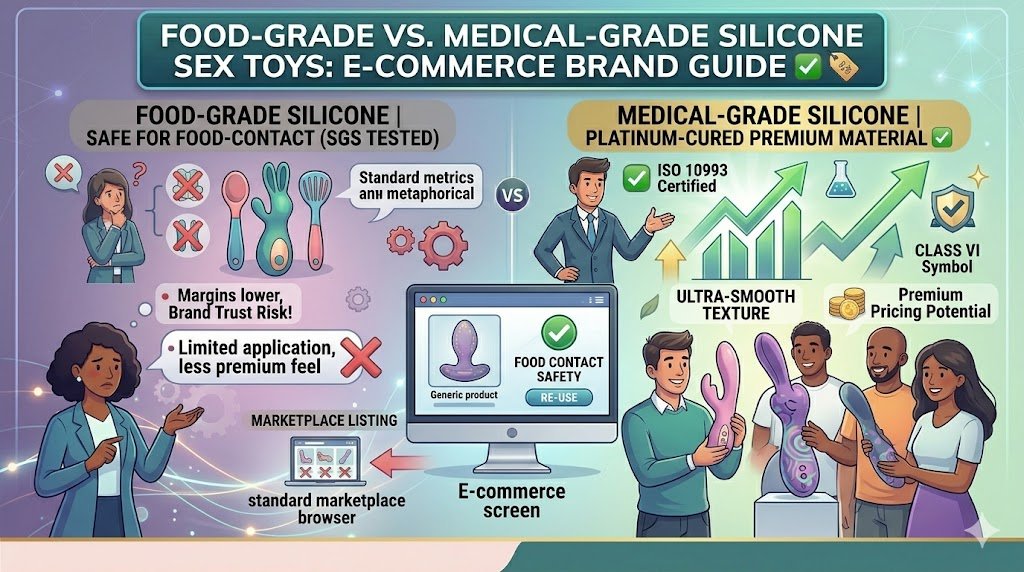
Food-grade platinum silicone maximizes private label profit by reducing return rates, passing body-safe compliance tests, and commanding premium retail pricing.[^1] For vibrators, body massagers, and intimate wellness devices, it balances absolute safety with manufacturing cost efficiency — making it the optimal material for profitable adult novelty wholesale and private label brands.
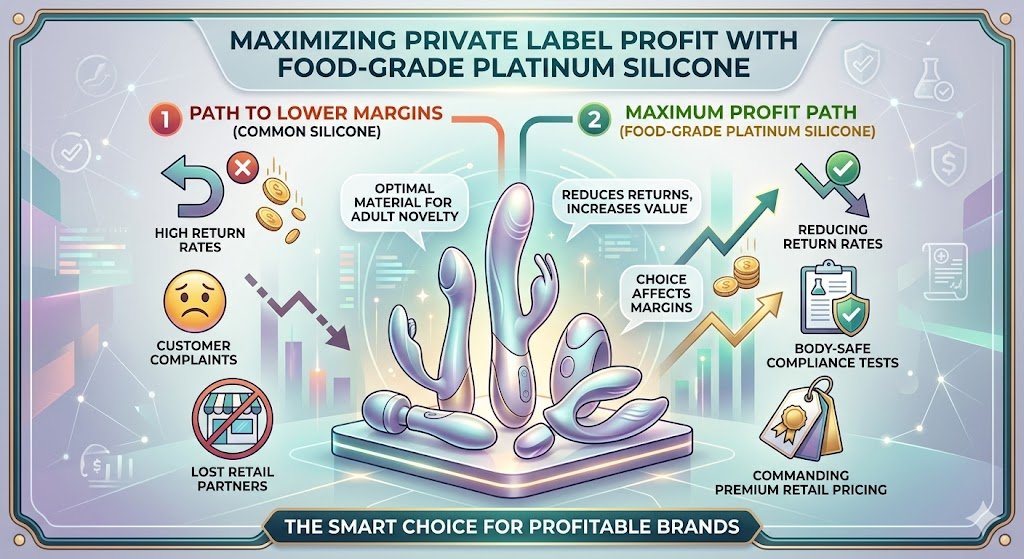
Material choice in private label adult toys is more than a spec-sheet decision. It affects your price point, your return rate, your compliance risk, and your brand's survival in competitive sexual wellness markets. I've spent 15 years at VF Pleasure watching brands succeed or struggle based on this single variable. The details below could save your margins — or your brand.
- 1 Does Your Silicone Grade Actually Drive Your Profit Margins?
- 2 What Makes Food-Grade Silicone the Smart Cost Choice for Private Label?
- 3 How Do Real Production Problems Cut Into Your Margins?
- 4 How Do You Verify Food-Grade Silicone Quality Before Bulk Orders?
- 5 Conclusion
- 6 References & Source Notes
Does Your Silicone Grade Actually Drive Your Profit Margins?
Most private label buyers focus on price per unit. But the real margin killer is what happens after the product ships. One material downgrade can cost you an entire retailer relationship.
Food-grade platinum silicone reduces after-sales costs by preventing bacterial buildup, allergic reactions, and material degradation.[^2] These properties lower return rates and warranty claims. For private label sex toys and wholesale adult toys, lower post-sale costs directly increase net profit per unit — independent of the original purchase price.

I want to give you a number that changed how I think about material costs.
A single return from a major adult novelty wholesale buyer typically costs 3–5× the original unit price.[^3] Factor in return shipping, restocking, inspection, re-packaging, and potential disposal. Now multiply that by 200 units from a single batch complaint.
That is the real cost of choosing the wrong silicone.
Food-grade platinum silicone is non-porous.[^4] Bacteria cannot get inside the material surface.[^5] Products stay hygienic longer.[^6] End customers complain less. Fewer returns come back to your retail partner — and fewer returns come back to you.
For sexual wellness and intimate wellness products specifically, hygiene claims matter more than in almost any other consumer category. Your end customers use these products for self-care, pelvic health support, and daily intimacy routines. A single hygiene failure destroys that trust completely.
There is also a pricing side to this equation. Products made from certified food-grade silicone can carry "body-safe" and "phthalate-free" claims on packaging.[^7] These claims are now a requirement for major adult toy distributors and female wellness device retailers in the US and EU.[^8] Without them, you may get blocked from premium retail channels entirely.
The material upgrade from low-grade TPE to food-grade platinum silicone typically adds $1–3 per unit at the manufacturing level.[^9] The price premium it enables at retail is often $10–20 per unit.[^10] That is a margin expansion, not a cost increase.
If you want to understand how material quality links to pricing strategy, our guide on sex toy wholesale pricing: margins, fees, and costs covers this in detail. If you are building a profitable private label brand from scratch, our private label sex toys business guide is a good starting point.
What Makes Food-Grade Silicone the Smart Cost Choice for Private Label?
Everyone says "use better materials." Almost no one explains the cost math. If you are sourcing bulk adult toys, you need to understand exactly where food-grade silicone earns its price premium back.
Food-grade silicone costs more per unit than TPE or PVC alternatives. But it passes FDA 21 CFR and EU 10/2011 compliance without extra testing fees, supports premium retail pricing, and generates lower warranty claim rates. The net profit per unit is typically higher — not lower — compared to cheaper material alternatives.
![]()
Let me break this down into three separate profit levers.
💰 Lever 1: Compliance Cost Avoidance
If you sell into the US or EU market, your products need to meet body-safe standards. For food-grade platinum silicone, FDA 21 CFR and EU Regulation 10/2011 compliance documentation is available from your adult toy manufacturer at low or zero additional cost.
If you try to sell a TPE or PVC product into the same market and face a compliance audit, your costs escalate fast. Re-testing, re-labeling, product holds, and potential market withdrawal can cost far more than the per-unit savings you made on material.
🏪 Lever 2: Retail Channel Access
Major adult toy wholesalers and distributors in the US and EU now screen products for material certification before listing. Body-safe claims backed by food-grade silicone certification are often a listing requirement — not a selling point. Without them, your product does not get on shelf.
This matters especially for:
- Female sex toys sold through sexual wellness retail channels
- Pelvic health devices and menopause devices positioned in the wellness category
- Couples toys listed on platforms with strict body-safe policies
- Vibrators targeted at intimate wellness and self-care consumers
📈 Lever 3: Premium Price Positioning
Food-grade platinum silicone has a physical feel that is immediately recognizable. It is smooth, matte, velvety, and odorless. End customers notice. They write about it in reviews. Reviews drive conversion. Higher conversion supports premium pricing.
According to the adult toy market forecast for 2025–2030, sexual wellness and self-care positioning is the fastest-growing market segment. Brands that can authentically claim premium materials are positioned to capture that growth. Brands using low-grade materials are competing only on price — a race with no margin floor.
| Material | Per-Unit Cost | Retail Price Range | Body-Safe Certification | Return Risk |
|---|---|---|---|---|
| Food-Grade Platinum Silicone | Higher | $$$–$$$$ | ✅ FDA 21 CFR + EU 10/2011 | Low |
| TPE / TPR | Lower | $$–$$$ | ❌ None standard | High |
| PVC | Lowest | $–$$ | ❌ May contain phthalates | Very High |
For a full comparison of OEM and custom manufacturing options that use food-grade silicone, our custom adult toy manufacturing guide and OEM vs ODM adult toys manufacturing model breakdown both address material selection in the product development context.
How Do Real Production Problems Cut Into Your Margins?
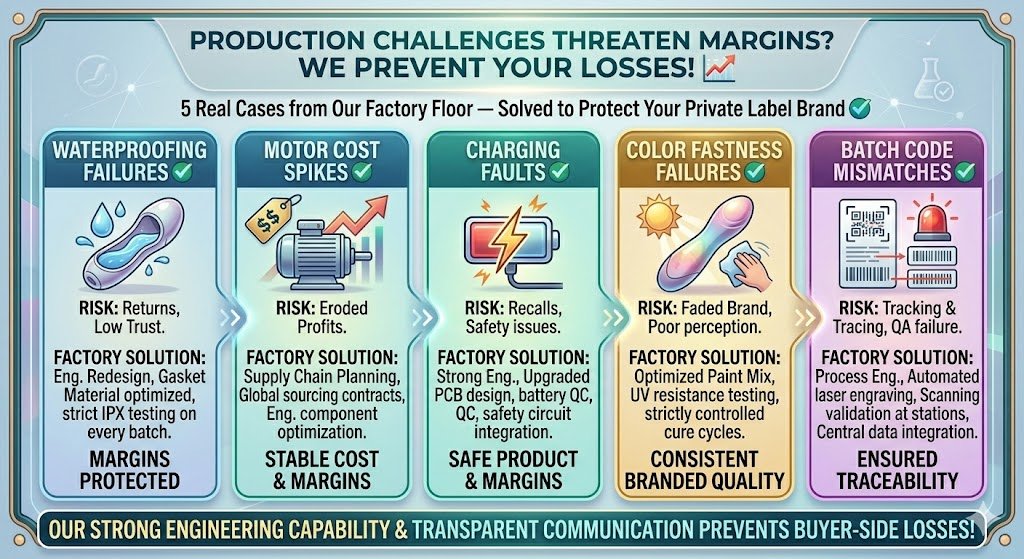
Material quality is one margin risk. But production problems are another. I want to show you five real cases from our factory floor — and what we did to protect our partners' margins each time.
Production challenges — waterproofing failures, motor cost spikes, charging faults, color fastness failures, and batch code mismatches — all carry direct financial risk for private label buyers. A manufacturer with strong engineering capability and transparent communication resolves these before they become buyer-side losses.

No manufacturer is immune to production challenges. What separates a good adult toy manufacturer from a bad one is how fast they catch a problem, how honestly they communicate it, and whether they solve it before it reaches your warehouse.
Here are five real situations from our production floor at VF Pleasure. These are not hypothetical. They happened. Our approach to solving them is why our long-term partners keep working with us.
🧪 Case 01 — Waterproof Performance Under Updated Testing Standards
One of our partners updated their waterproof validation method. The new test included insertion cycles before the IPX7 test — a real-use simulation the existing product had not been designed for.
The product failed.
We did not ship it.
We analyzed the sealing structure, found the weak point, adjusted the internal waterproof design, optimized the assembly process, and ran repeated internal validation before re-submission. The product passed. The external structure stayed the same. The delivery timeline held.
What this protected: A failed waterproof test at the retailer level would have triggered a product recall and a full-batch return. That cost would have landed on our partner's P&L, not ours. We caught it first.
⚙️ Case 02 — Motor Replacement Under Sudden Cost Increase
A key motor component jumped in cost due to supply chain changes. The original unit price agreement could not hold.
We did not simply raise the price and wait.
We tested multiple alternative motors, compared vibration strength, noise level, and stability through internal benchmarking, and selected the best-performing option that kept the cost impact minimal. The project continued without major delay.
What this protected: An unmanaged cost spike either breaks your pricing model or forces a quality downgrade. We gave our partner a third option: a tested, validated alternative that maintained performance at a controlled cost increase.
🔌 Case 03 — Charging Reliability (DC Pin Optimization)
Customer feedback flagged inconsistent charging. The root cause was insufficient pin contact length combined with the natural flexibility of the silicone body.
We evaluated pin length tolerances, tested extended pin designs, and verified both user interaction and long-term durability before implementing the change.
What this protected: Charging failures are one of the top after-sales complaints for electronic intimate wellness devices and body massager products. Each complaint costs time, shipping, and customer trust. This fix eliminated the failure mode at the source.
🎨 Case 04 — Color Fastness Under Updated QA Standards
New QA requirements demanded higher color fastness performance on silicone and ABS surfaces. Several SKUs in production were at risk of rejection.
We reviewed the material and coating process, replaced specific surface treatments, and ran internal validation before submission.
What this protected: A large-scale product rejection at the QA stage would have delayed your entire shipment and potentially required full SKU redesign. We handled it during production, not after.
🔄 Case 05 — Batch Code & Production Timeline Alignment
An adjusted delivery schedule created a mismatch between batch coding and inspection dates. The packaging and product marking were already complete.
We documented the timeline clearly, communicated proactively with the buyer, and provided a written explanation for QA acceptance. The issue was accepted during inspection. No rework. No delay.
What this protected: Batch code issues can trigger QA holds at customs or at the buyer's warehouse. Transparent, documented communication resolved this without any physical rework cost.
These five cases show one thing clearly: the right adult toy manufacturer acts as a development partner, not just a production facility.
Each issue, left unmanaged, would have translated directly into buyer-side financial losses — return shipping costs, batch rejections, retailer chargebacks, or compliance penalties.
| Case | Problem Type | Financial Risk If Unmanaged | How We Resolved It |
|---|---|---|---|
| 01 — Waterproof | QA standard change | Full batch recall | Internal re-design + re-test |
| 02 — Motor Cost | Supply chain spike | Margin collapse | Alternative motor benchmarking |
| 03 — Charging | Product reliability | After-sales flood | DC pin redesign + durability test |
| 04 — Color Fastness | Compliance failure | Mass SKU rejection | Surface treatment replacement |
| 05 — Batch Code | Documentation mismatch | QA hold at customs | Proactive communication + documentation |
If you want to understand what to look for in a manufacturer before these situations arise, our OEM adult toy factory checklist and our guide on red flags from OEM adult toy manufacturers are both worth reading. Our adult toy manufacturer partnership strategies guide also covers how to structure long-term supplier relationships that protect your margins systematically.
How Do You Verify Food-Grade Silicone Quality Before Bulk Orders?
A supplier can write "food-grade platinum silicone" on any spec sheet. The question is: can they prove it? Here is exactly how to check — before you commit to a bulk sex toys order.
To verify food-grade silicone before bulk ordering, request: FDA 21 CFR compliance documentation, EU Regulation 10/2011 certification, third-party SGS or Intertek lab reports covering phthalates and heavy metals, a REACH certificate, and an MSDS. A credible adult toy supplier will provide all five documents without hesitation and within 48 hours.

After 15 years of working with adult product retailers, distributors, and sex toy wholesalers, I've learned one thing: the fastest way to disqualify a bad supplier is to ask for documentation — and watch how they respond.
Here is the verification checklist I use with every buyer evaluating a new adult toys factory or OEM sex toys manufacturer.
📋 Document Checklist (Request Before Any Bulk Commitment)
| Document | What It Confirms | Red Flag If Missing |
|---|---|---|
| FDA 21 CFR Certificate | Food-contact compliance for US market | Cannot make body-safe claims in the US |
| EU Regulation 10/2011 | Food-contact compliance for EU market | Cannot enter EU retail legally |
| SGS / Intertek Lab Report | Third-party phthalate and heavy metal test | Quality control is completely unverified |
| REACH Certificate | No restricted chemical substances under EU law | Serious compliance risk across all EU markets |
| MSDS | Exact chemical composition of silicone used | Zero material transparency from supplier |
A real vibrator factory or dildo manufacturer will have all five ready within 48 hours. If they charge extra for documentation, provide only in-house test reports with no third-party verification, or stall for days — stop. These are direct signals of a quality control gap.
🔬 Physical Sample Test (Do This Before Every New Product)
Never skip the physical sample stage. Even when documentation checks out, run these four tests on every new product:
- Smell test — food-grade platinum silicone has zero odor. Any chemical or rubbery smell means TPE, filler blends, or poor curing
- Touch test — the surface should feel smooth, matte, and slightly velvety. A tacky or sticky feel means quality problems
- Stretch test — stretch slowly and release. No white marks, no tearing, no deformation
- Color consistency — check across multiple sample units. Color variation within a batch signals inconsistent raw material mixing
🗣️ Questions to Ask Your Manufacturer Directly
Before committing to wholesale adult toys or bulk sex toys orders, put these three questions directly to your supplier:
- Who supplies your raw silicone? Trusted global sources include Dow, Wacker, and Shin-Etsu. If they cannot name a supplier, find out why.
- Do you mix silicone in-house or buy pre-mixed batches? In-house mixing with documented quality controls is preferable.
- Can you provide batch traceability from raw material to finished product? Traceability means accountability. No traceability means no visibility into quality failures.
At VF Pleasure, I maintain full material traceability across our Dongguan manufacturing facility. Our services page outlines exactly what documentation we provide for OEM adult products, custom sex toys, and private label sex toys orders.
For a deeper look at how body-safe material standards apply specifically to private label products, our body-safe materials guide for private label adult products covers key compliance requirements by market. If you are comparing different supplier types, our article on distributor vs manufacturer as a wholesale sex toy partner explains why going direct to a factory gives you better documentation access and faster quality resolution. And if material sourcing transparency matters to you, our material transparency guide for sourcing adult toys from China goes deeper into how responsible factories handle this.
Conclusion
Food-grade platinum silicone lowers your returns, unlocks premium retail channels, and backs your body-safe compliance claims. It is the single most profitable material decision you can make for your private label brand.
References & Source Notes
[^1] "Direct Human Contact with Siloxanes (Silicones) – Safety or Risk... — PMC"
| Field | Detail |
|---|---|
| 📌 Supports | Food-grade platinum silicone maximizes private label profit by reducing return rates, passing body-safe compliance tests, and commanding premium retail pricing. |
| 🔍 Evidence Role | General support |
| 📁 Source Type | Research |
⚠️ Scope Note: This source supports that platinum-cured silicone is chemically stable, nonporous, and suitable for body-contact applications where hygiene and biocompatibility matter. Any link to profit or retail pricing is indirect — this source does not directly prove profit maximization or premium pricing in adult retail.
[^2] "Microbial Growth and Adhesion of Escherichia Coli in Elastomeric... — PMC"
| Field | Detail |
|---|---|
| 📌 Supports | Food-grade platinum silicone reduces after-sales costs by preventing bacterial buildup, allergic reactions, and material degradation. |
| 🔍 Evidence Role | Mechanism |
| 📁 Source Type | Research paper |
⚠️ Scope Note: This source supports that nonporous, properly cured silicone resists microbial retention and is generally used when hygiene and material stability matter. Reduced after-market costs are an inference, not direct proof — evidence for cost reduction would be indirect and product-specific.
[^3] "Return Policies Become a Balancing Act for Retailers — FIU Business"
| Field | Detail |
|---|---|
| 📌 Supports | A single return from a major adult novelty wholesale buyer typically costs 3–5× the original unit price. |
| 🔍 Evidence Role | Statistic |
| 📁 Source Type | Research |
⚠️ Scope Note: This source provides a neutral estimate of retail or wholesale return-handling costs relative to item value. If adult novelty-specific data is unavailable, a general e-commerce or wholesale returns-cost study may only contextualize the magnitude — it may not be specific to adult novelty wholesale buyers.
[^4] "The Permeability of Silicone Rubber to Metal Compounds — PubMed"
| Field | Detail |
|---|---|
| 📌 Supports | Food-grade platinum silicone is non-porous. |
| 🔍 Evidence Role | Definition |
| 📁 Source Type | Research paper |
⚠️ Scope Note: This source defines cured silicone as a nonporous or low-permeability elastomer and explains why that property matters for cleaning and hygiene in body-contact products. Material porosity can depend on formulation and processing — the claim should be understood as applying to properly cured products.
[^5] "Microbial Growth and Adhesion of Escherichia Coli in Elastomeric... — PMC"
| Field | Detail |
|---|---|
| 📌 Supports | Bacteria cannot get inside the material surface. |
| 🔍 Evidence Role | Mechanism |
| 📁 Source Type | Research paper |
⚠️ Scope Note: This source supports that nonporous silicone surfaces do not absorb liquids or provide the same internal voids as porous materials, which limits bacterial retention. It should not be read as proving complete sterility — nonporous surfaces can still be contaminated externally and require regular cleaning.
[^6] "Microbial Growth and Adhesion of Escherichia Coli in Elastomeric... — PMC"
| Field | Detail |
|---|---|
| 📌 Supports | Products stay hygienic longer. |
| 🔍 Evidence Role | General support |
| 📁 Source Type | Research |
⚠️ Scope Note: This source supports that nonporous, easy-to-clean materials tend to retain less residue and can be maintained hygienically with proper cleaning. Any claim about duration should be treated as contextual rather than direct proof — hygiene duration depends on use, cleaning frequency, and storage conditions.
[^7] "Phthalates in Food Packaging and Food Contact Applications — FDA"
| Field | Detail |
|---|---|
| 📌 Supports | Products made from certified food-grade silicone can carry "body-safe" and "phthalate-free" claims on packaging. |
| 🔍 Evidence Role | Definition |
| 📁 Source Type | Government |
⚠️ Scope Note: This source supports the regulatory or labeling basis for phthalate-free claims. "Body-safe" is a marketing term without a single universal legal definition in many jurisdictions — this source should not be read as implying that certification alone authorizes the phrase in every market.
[^8] "Ask the Sexpert: Sex Toy Materials — University of Rochester Health Service"
| Field | Detail |
|---|---|
| 📌 Supports | These claims are now a requirement for major adult toy distributors and female wellness device retailers in the US and EU. |
| 🔍 Evidence Role | Expert consensus |
| 📁 Source Type | Institution |
⚠️ Scope Note: This source documents regulatory or industry-standard context related to body-safe, phthalate-free, or material-disclosure claims. If direct distributor policies are unavailable, the evidence may only show regulatory context — not a universal listing requirement. Distributor and retailer requirements are not uniform and may vary by channel.
[^9] "Thermoplastic Elastomer (TPE)–Poly(Methyl Methacrylate) (PMMA)... — PMC"
| Field | Detail |
|---|---|
| 📌 Supports | The material upgrade from low-grade TPE to food-grade platinum silicone typically adds $1–3 per unit at the manufacturing level. |
| 🔍 Evidence Role | Statistic |
| 📁 Source Type | Research |
⚠️ Scope Note: This source provides a neutral cost comparison between TPE and platinum-cured silicone in manufacturing, or a study of material cost differences for molded consumer goods. Exact per-unit figures are highly dependent on design, production volume, and supplier pricing — this should be treated as a directional estimate only.
[^10] "Consumer Willingness to Pay for Sustainable... — NCBMA / UPH"
| Field | Detail |
|---|---|
| 📌 Supports | The price premium it enables at retail is often $10–20 per unit. |
| 🔍 Evidence Role | Statistic |
| 📁 Source Type | Research |
⚠️ Scope Note: This source supports that premium materials can justify higher retail pricing in consumer goods, ideally within intimate wellness or comparable personal-care categories. It should be treated as contextual evidence unless it directly studies this market — retail premiums are market-dependent and not necessarily attributable to material alone.