Skip to content
You keep seeing "medical-grade silicone" on every supplier spec sheet. Is it real — or a label to close your order? After 15 years in adult toy manufacturing, I know the difference.
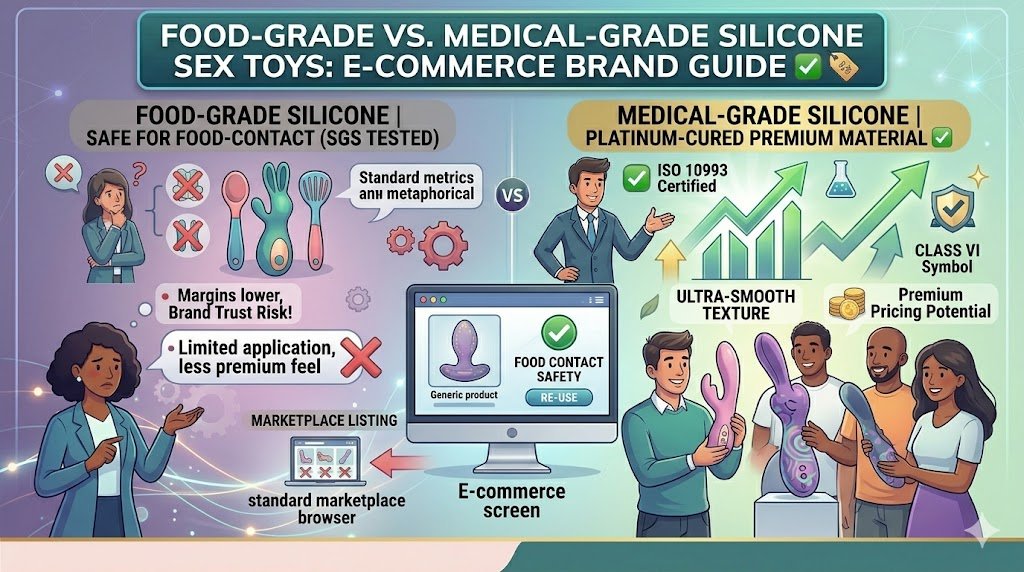
Most adult toys don't need medical-grade silicone.[^1] They need food-grade silicone.[^2] Food-grade silicone is FDA-certified, non-toxic, odorless, phthalate-free, and non-porous.[^3] For vibrators, body massagers, and intimate wellness devices used on body surfaces, it meets the highest EU and US safety standards — at a commercially viable cost.[^4]

I've walked through factories where the spec sheet says "medical-grade" but the production line tells a completely different story. This gap between claim and reality is one of the biggest risks for e-commerce brands sourcing wholesale adult toys today. If you're building a brand around sexual wellness, self-care, or intimate wellness — your material choice is your first brand promise. Let me break down what each term actually means, which one belongs in your products, and how to verify it before you place a single bulk order.
Is "Medical-Grade Silicone" in Adult Toys Just a Marketing Claim?
Your supplier writes "medical-grade" on every quote. Most buyers I meet have never asked for proof. That single oversight might be your biggest brand risk.
True medical-grade silicone must pass ISO 10993 biocompatibility testing — the same standard used for surgical implants.[^5] This certification costs thousands per product.[^6] Most sex toy factories cannot justify that cost.[^7] When a supplier claims "medical-grade," ask for the ISO 10993 certificate. Most cannot provide it.

What "Medical-Grade Silicone" Actually Means — And Why It Rarely Applies to Sex Toys
Here is a fact that most people in adult novelty wholesale don't know: "medical-grade" is not a single, universally enforced label. It refers to a specific performance standard, and it is extremely demanding.
True medical-grade silicone must pass:
- ISO 10993 — a 17-part biocompatibility testing series covering cytotoxicity, sensitization, and genotoxicity
- USP Class VI — systemic toxicity and implant-level safety testing
- FDA 510(k) clearance — required for any implantable device sold in the US
These tests exist for one reason: devices like pacemakers, catheters, and joint replacements go inside the human body for extended periods. The cost to run this testing per product can reach $5,000–$20,000.[^8] And that cost repeats with every product variation.
| Silicone Grade | Certification Standard | Designed For | Cost Premium |
|---|---|---|---|
| Medical-Grade | ISO 10993 + USP Class VI | Surgical implants, catheters | 3–5× higher |
| Food-Grade | FDA 21 CFR + EU 10/2011 | Cookware, baby products, adult toys | Standard |
| Industrial-Grade | None | Non-body-contact items | Lower |
A vibrator or body massager used on the skin surface does not meet the clinical definition of an implantable device. So requiring ISO 10993 certification for it is like requiring airplane-grade titanium for a kitchen knife. The standard doesn't match the use case.
Most adult toy manufacturers in China — even reputable ones — cannot justify implant-level testing costs for body-surface products. So when a sex toys factory says "medical-grade," what they often mean is "body-safe" or "food-grade." These are not the same legal claim.
⚠️ Brand risk alert: If a regulator or consumer challenges your "medical-grade" claim and you cannot produce an ISO 10993 certificate, your brand is exposed. "Body-safe" and "medical-grade" are not the same thing in a legal context.
I've seen this exact issue derail brands at the worst possible moment — right after a product launch. If you want to know how to vet supplier claims before that happens, our OEM adult toy factory checklist is a good place to start. For a full look at compliance standards across key markets, our body-safe adult toys manufacturing standards guide goes deeper.
Why Food-Grade Silicone Is the Real Safety Standard for Sexual Wellness Products?
After 15 years of manufacturing, I've learned that food-grade platinum silicone is the honest answer for sexual wellness products. It is not a compromise. It is the right material for the job.
Food-grade silicone meets FDA 21 CFR and EU Regulation 10/2011 standards.[^9] It is non-toxic, odorless, phthalate-free, latex-free, and non-porous.[^10] For sexual wellness products, female wellness devices, and pelvic health devices, these properties meet all major market requirements — without the cost of implant-grade certification.

The Real Safety Profile of Food-Grade Platinum Silicone — And Why It Beats the Alternatives
Not all food-grade silicone is equal. The single most important variable is the curing agent used during production. At VF Pleasure, we use platinum-cured food-grade silicone across every product line. Here is exactly why that matters.
Platinum-Cured vs. Peroxide-Cured vs. TPE: A Direct Comparison
| Property | Platinum-Cured Silicone | Peroxide-Cured Silicone | TPE / TPR (not silicone) |
|---|---|---|---|
| Body-safe | ✅ Yes | ⚠️ Sometimes | ❌ Often not |
| Odor-free | ✅ Zero odor | ⚠️ May have residual smell | ❌ Often has chemical odor |
| Non-porous | ✅ Yes | ✅ Yes | ❌ No — harbors bacteria |
| Phthalate-free | ✅ Yes | ✅ Yes | ❌ May contain phthalates |
| Sterilizable | ✅ Boil or bleach | ✅ Yes | ❌ No |
| Latex-free | ✅ Yes | ✅ Yes | ✅ Yes |
Platinum-cured food-grade silicone delivers:
- Zero phthalates — no endocrine-disrupting chemicals that could affect hormonal health or pelvic health
- Non-porous surface — bacteria, mold, and yeast physically cannot penetrate the material, which matters deeply for intimacy and personal hygiene
- Hypoallergenic — safe for latex-sensitive users, a growing segment in the female wellness devices and menopause devices market
- Fully sterilizable — can be boiled or wiped with a 10% bleach solution, making it a genuine self-care product
- FDA-approved for direct food contact — meaning it is already cleared for surfaces that touch the inside of mouths, which is a higher bar than most people realize
These properties have a direct commercial impact. Products made from high-quality food-grade platinum silicone earn better reviews, generate fewer returns, and build stronger brand loyalty. For e-commerce brands launching private label sex toys or custom adult toys, your material choice is your first public brand statement.
Customers shopping for female sex toys with a focus on pelvic health and intimate wellness increasingly read product ingredient lists the same way they read food labels. They will notice. And so will their reviews.
💡 My take: The FDA approves food-grade silicone for direct, sustained food contact. For a body massager or vibrator used externally on skin, this level of safety certification is more than sufficient — and far more honest than a "medical-grade" claim you cannot back up.
From a cost-to-safety ratio, food-grade platinum silicone is the optimal solution. It gives you absolute body safety and commercial profitability at the same time. That is why it has become the default material for adult toy suppliers, sex toy wholesalers, and dildo manufacturers serious about their brand's long-term reputation.
For more on where sexual wellness and product design are heading together, our article on the wellness and sex toy convergence is worth reading. And if you want a full guide to choosing a supplier based on material quality, check out our silicone sex toy manufacturer guide.
How Do You Verify Silicone Quality Before Placing a Bulk Order?
I work with procurement professionals every week. The smart ones ask one question first: "Can you prove what this material is?" Most suppliers cannot answer that well.
To verify silicone grade before ordering bulk adult toys, request: an FDA 21 CFR compliance letter, third-party SGS or Intertek lab reports for phthalates and heavy metals, a material safety data sheet (MSDS), and a physical sample. Any credible adult toy supplier will provide all four without hesitation.

Step-by-Step Material Verification for Adult Toy Buyers
I built this checklist after 15 years of working with buyers from the US, EU, and Australia. Use it every time you evaluate a new sex toy manufacturer, dildo manufacturer, or OEM sex toys partner — before you discuss price or MOQ.
Step 1: Request These Five Documents Upfront
Ask for all five before anything else:
- ✅ FDA 21 CFR compliance certificate — confirms food-grade status for the US market
- ✅ EU Regulation 10/2011 certificate — required for EU market entry
- ✅ SGS or Intertek third-party lab report — must cover phthalates, PAHs, heavy metals, and BPA
- ✅ REACH compliance certificate — confirms no restricted chemical substances under EU law
- ✅ MSDS (Material Safety Data Sheet) — shows the exact chemical composition of the silicone
A real adult toys factory will have all five ready within 48 hours. If a supplier stalls, charges extra for documentation, or provides only in-house test reports — those are clear red flags.
Step 2: Test the Physical Sample Yourself
No document replaces a hands-on check. Request a sample and do this:
- Smell test — platinum-cured food-grade silicone has zero odor. Any chemical or rubbery smell means it is likely TPE, peroxide-cured, or a blend with fillers
- Touch test — food-grade silicone feels smooth, matte, and slightly velvety. A tacky or sticky surface suggests poor curing or added fillers
- Stretch test — it should stretch evenly without tearing or leaving a white residue behind
- Burn test (for advanced buyers only) — genuine silicone burns to a fine white ash. TPE or PVC burns black and releases dark, acrid smoke
Step 3: Ask About the Raw Material Supply Chain
Put these three questions directly to your adult toy manufacturer:
- Who makes your raw silicone? (Dow, Wacker, and Shin-Etsu are the globally trusted names)
- Does your factory mix silicone in-house or buy pre-mixed batches?
- Can you provide batch traceability from raw material all the way to the finished product?
A transparent sex toy factory with nothing to hide answers these clearly and quickly. Vague answers here usually mean weak quality controls further up the chain.
Step 4: Confirm Factory-Level Certifications
| Certification | What It Confirms | Why It Matters |
|---|---|---|
| ISO 9001 | Quality management system | Consistent, repeatable production standards |
| ISO 13485 | Medical device quality management | Bonus credibility for silicone handling processes |
| CE Marking | European conformity | Required for selling electronic toys in the EU |
| RoHS | Restriction of hazardous substances | Essential for any product with electrical components |
At VF Pleasure, we maintain full material traceability at our Dongguan manufacturing facility and welcome buyer audits. Our services page outlines all documentation we provide for OEM adult products, custom sex toys, and wholesale sex toys orders.
📋 Quick fact: Third-party lab testing costs roughly $150–$400 per panel. Any adult toy supplier who asks you to pay for their own certification upfront — or who refuses entirely — is not a supplier worth your business.
If you're building a wholesale adult novelty catalog, launching bulk sex toys under your own brand, or entering a new market with private label sex toys, material verification is your first line of defense. One bad product batch can remove you from Amazon, Shopify, or any major EU distributor platform overnight.
For a deeper look at sourcing responsibly, check our guide on eco-friendly adult novelty products and materials, our full breakdown of material transparency when sourcing adult toys from China, and our practical guide on verifying adult toy quality from Chinese suppliers.
Conclusion
Food-grade platinum silicone is the real safety standard for adult toys. Don't let "medical-grade" marketing claims mislead your sourcing. Verify everything, protect your brand — your customers will notice.
References & Source Notes
[^1] "Most Important Biomedical and Pharmaceutical Applications... — PMC"
| Field | Detail |
|---|---|
| 📌 Supports | Most adult toys don't need medical-grade silicone. |
| 🔍 Evidence Role | General support |
| 📁 Source Type | Government |
⚠️ Scope Note: Contextual support only. Product-specific requirements can vary by jurisdiction and intended use. Sources on body-contact consumer products and biocompatibility support the narrower point that external-use adult toys are not typically regulated as implantable medical devices; this does not prove that medical-grade silicone is unnecessary in every case.
[^2] "Progress in Research on the Safety of Silicone Rubber Products... — PubMed"
| Field | Detail |
|---|---|
| 📌 Supports | They need food-grade silicone. |
| 🔍 Evidence Role | General support |
| 📁 Source Type | Research |
⚠️ Scope Note: This is an application claim, not a formal regulatory determination for sexual wellness products. Standards and technical references can show that food-contact silicone is used for direct-contact consumer goods and may be suitable for some body-contact applications; the source should not be read as proving universal adequacy for all adult toys.
[^3] "Phthalates in Food Packaging and Food Contact Applications — FDA"
| Field | Detail |
|---|---|
| 📌 Supports | Food-grade silicone is FDA-certified, non-toxic, odorless, phthalate-free, and non-porous. |
| 🔍 Evidence Role | Definition |
| 📁 Source Type | Government |
⚠️ Scope Note: The FDA generally clears or regulates materials for specific uses rather than certifying all silicone as a category. "FDA-certified" is a stronger claim than many sources will support and should be checked against the exact product and resin formulation.
[^4] "How Are Medical Devices Regulated in the European Union? — PMC"
| Field | Detail |
|---|---|
| 📌 Supports | For vibrators, body massagers, and intimate wellness devices used on body surfaces, it meets the highest EU and US safety standards — at a commercially viable cost. |
| 🔍 Evidence Role | General support |
| 📁 Source Type | Government |
⚠️ Scope Note: The phrase "highest EU and US safety standards" is comparative and may not be directly defined in a single source. Regulatory and standards sources support that external-use devices are evaluated differently from implantable devices; they do not by themselves establish "the highest" standard for every product type.
[^5] "Biocompatibility Testing for Implants: A Novel Tool for Selection and... — PMC"
| Field | Detail |
|---|---|
| 📌 Supports | True medical-grade silicone must pass ISO 10993 biocompatibility testing — the same standard used for surgical implants. |
| 🔍 Evidence Role | Definition |
| 📁 Source Type | Research paper |
⚠️ Scope Note: The term "medical-grade" is not universally standardized and may be used inconsistently in commerce. This source provides contextual support; it should not be read as proof that every item marketed as "medical-grade" must pass the full ISO 10993 series.
[^6] "Implantable Medical Devices — Lab on a Chip (USC BioMEMS)"
| Field | Detail |
|---|---|
| 📌 Supports | This certification costs thousands per product. |
| 🔍 Evidence Role | Statistic |
| 📁 Source Type | Research |
⚠️ Scope Note: The exact per-product cost is variable and should be treated as an estimate unless independently documented. Cost depends on test scope, laboratory, device class, and how much prior data can be reused.
[^7] "The Challenges for Manufacturers of the Increased Clinical... — PMC"
| Field | Detail |
|---|---|
| 📌 Supports | Most sex toy factories cannot justify that cost. |
| 🔍 Evidence Role | General support |
| 📁 Source Type | Research |
⚠️ Scope Note: The claim is probabilistic and would need market-wide data to confirm "most." Manufacturing and market studies may support that small and medium factories face substantial certification burdens; this is an inference about industry economics, not direct proof about most factories.
[^8] "A Crisis-Responsive Framework for Medical Device Development — HMS / CCSP"
| Field | Detail |
|---|---|
| 📌 Supports | The cost to run this testing per product can reach $5,000–$20,000. |
| 🔍 Evidence Role | Statistic |
| 📁 Source Type | Research |
⚠️ Scope Note: A precise dollar range is highly variable and not universal across products or laboratories. The exact range should be verified against an independent source because it depends on device class and test scope.
[^9] "Packaging & Food Contact Substances (FCS) — FDA"
| Field | Detail |
|---|---|
| 📌 Supports | Food-grade silicone meets FDA 21 CFR and EU Regulation 10/2011 standards. |
| 🔍 Evidence Role | Definition |
| 📁 Source Type | Government |
⚠️ Scope Note: Compliance is formulation- and use-specific, not automatic for all silicone products. The citation should clarify whether the material, additive system, or finished article is being regulated.
[^10] "Release Paper: Can Phosphate Esters Be an Alternative to Silicone? — BioResources"
| Field | Detail |
|---|---|
| 📌 Supports | It is non-toxic, odorless, phthalate-free, latex-free, and non-porous. |
| 🔍 Evidence Role | General support |
| 📁 Source Type | Research |
⚠️ Scope Note: These are material properties that vary by formulation and processing. Odorlessness and toxicity depend on manufacturing controls, so this source should be read as contextual support rather than universal proof.