Skip to content
You're sourcing adult toys but can't decide between silicone and TPE. One wrong call, and your product line misses the market it was built for.
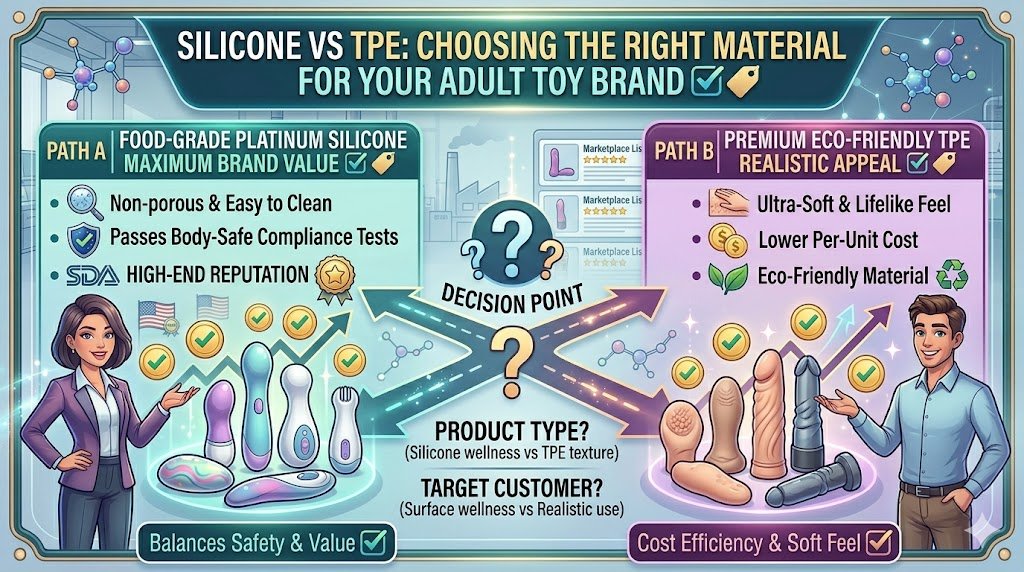
When sourcing adult toys, food-grade platinum silicone suits vibrators, body massagers, and intimate wellness devices best[^1] — it is non-porous, easy to clean[^2], and passes body-safe compliance tests[^3]. Premium eco-friendly TPE suits realistic-texture products and male adult toys best[^4] — it delivers an ultra-soft, lifelike feel at a lower per-unit cost. The right choice depends entirely on your product type and target customer.
I've spent 15 years running production at VF Pleasure, and the material question comes up in almost every first conversation with a new buyer[^5]. Most procurement teams arrive with one of two wrong assumptions: that silicone is always better, or that TPE is always risky. Neither is true.
The real answer is more useful. Each material wins in specific situations. Once you understand which situation applies to your product, the sourcing decision becomes easy. Let me walk you through both sides clearly.
What Is the Real Difference Between Food-Grade Silicone and TPE?
Many buyers treat these two materials as competitors. They are not. They are tools for different jobs — and knowing what each one actually does will save you from both over-spending and under-delivering.
Food-grade platinum silicone is a non-porous, chemically stable material that resists bacterial buildup and degrades slowly over time[^6]. Premium eco-friendly TPE is a soft, porous elastomer with a realistic, skin-like texture. Both are used in adult toy manufacturing — they differ in hygiene properties, tactile feel, cost, and the product categories they serve best.

Let me break both materials down to what actually matters to a buyer.
🧪 Food-Grade Platinum Silicone: What You Actually Get
Food-grade platinum silicone is cured with a platinum catalyst. This curing process leaves virtually no residual chemicals in the finished material. The result is a dense, non-porous surface that does not absorb liquids or trap bacteria inside the material[^7].
This matters enormously for vibrators, female sex toys, and pelvic health devices that go through repeated use and regular cleaning. A non-porous surface can be cleaned properly every time. That is what makes food-grade silicone the standard material for the sexual wellness and intimate wellness category.
Here is what you get with food-grade platinum silicone:
- Non-porous surface — bacteria stay on the outside, not inside
- Chemically stable — does not degrade or leach chemicals over normal use
- Odorless — no rubbery or chemical smell at any point
- FDA 21 CFR and EU Regulation 10/2011 compliant — body-safe claims are documentable
- Smooth, matte, velvety texture — premium look and feel
- Higher per-unit cost — material costs more to source and process
For any buyer building a private label sex toys brand in the sexual wellness space, food-grade silicone gives you the compliance documentation, the product feel, and the shelf-life you need to compete at a premium price point.
🤲 Premium Eco-Friendly TPE: What You Actually Get
TPE — thermoplastic elastomer — is a blended polymer that combines the softness of rubber with the processability of plastic. Research on TPE composites confirms that the material can be engineered across a wide range of hardness levels, making it highly flexible in design applications.
High-quality, eco-friendly TPE is soft in a way that food-grade silicone simply cannot match. It stretches. It compresses. It feels like real skin. This is why it is the dominant material in realistic-texture products, including male adult toys and lifelike dildos.
Here is what you get with premium eco-friendly TPE:
- Porous surface — absorbs liquids over time; requires proper cleaning and dry storage
- Ultra-soft, realistic texture — closest to real skin feel among all common materials
- High stretch and flexibility — allows realistic anatomical shaping
- No platinum catalyst required — lower processing cost
- Lower per-unit cost — more accessible price point for wholesale adult toys
- Needs maintenance — mineral oil conditioning can extend product lifespan
The key point here: TPE requires a different care routine than silicone. That is not a defect. It is a material property. A buyer who communicates proper care instructions to their retail customers will see far fewer complaints than one who treats TPE like silicone.
| Property | Food-Grade Platinum Silicone | Premium Eco-Friendly TPE |
|---|---|---|
| Porosity | Non-porous ✅ | Porous — needs proper care |
| Hygiene | Excellent | Good with correct cleaning |
| Feel | Smooth, firm, velvety | Ultra-soft, realistic, skin-like |
| Compliance | FDA 21 CFR + EU 10/2011 | Formulation-dependent |
| Cost | Higher | Lower |
| Best For | Vibrators, wellness devices | Realistic toys, male toys |
| Care | Soap and water | Dry storage + periodic conditioning |
For a deeper look at how silicone manufacturing works in practice, our guide to choosing a silicone sex toy manufacturer covers what to look for from a factory quality standpoint.
Is TPE Actually Toxic? Let's Set the Record Straight
The word "porous" gets TPE unfairly blacklisted in some buyer circles. Somewhere along the way, "porous equals dangerous" became conventional wisdom in adult novelty wholesale sourcing. That idea needs to stop.
Premium eco-friendly TPE, when manufactured without phthalates, heavy metals, or restricted additives, is a safe body-contact material[^8]. Its porosity is a physical property, not a toxicity indicator. What makes a TPE product safe or unsafe is the formulation and manufacturing standards of the factory — not the material category itself.
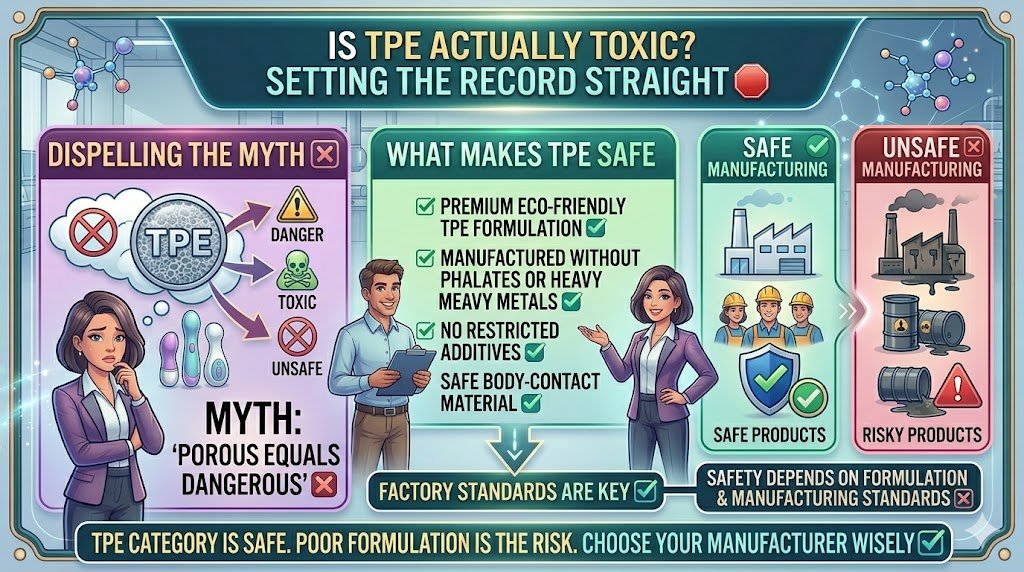
Let me address the three most common misconceptions I hear from buyers evaluating TPE for their product lines.
❌ Myth 1: "All TPE Contains Phthalates"
This is false. Phthalates are plasticizers sometimes added to PVC — not to TPE[^9]. Well-formulated eco-friendly TPE does not require phthalates as part of its base chemistry.
The confusion comes from lumping all "soft rubbery" adult toy materials together. PVC with phthalate plasticizers is genuinely problematic and should be avoided. Premium TPE is an entirely different material with a different chemical structure. When you request a phthalate-free certification from your sex toy manufacturer, you are asking them to confirm their formulation — not the material category.
❌ Myth 2: "Porous Means Bacteria Will Always Get In"
Porosity means the material has microscopic surface channels that can retain moisture. It does not mean the product is permanently contaminated or uncleanable.
Premium eco-friendly TPE products can be cleaned effectively with mild soap, water, and thorough drying. Stored correctly in a dry, breathable pouch, they remain safe for normal use. The difference between safe TPE and unsafe TPE is not the porosity — it is the care routine and the formulation.
❌ Myth 3: "If It's Not Silicone, It's Not Safe to Sell"
This is commercially harmful and factually incorrect. Massive segments of the adult novelty wholesale market — including male masturbators, realistic dildos, and male delay toys — are built on high-quality eco-friendly TPE[^10].
Major US and EU retailers carry TPE products. Buyers who exclude TPE entirely are not protecting their customers. They are limiting their product range and leaving profitable categories open to competitors. The correct approach is demanding verified, phthalate-free, heavy-metal-tested TPE from a factory that can document its formulation clearly.
💡 The real question is never "silicone or TPE?" — it's "what does my product category require, and can my manufacturer prove their materials meet those requirements?"
If you want to understand how body-safe material standards apply across both material types, our body-safe adult toys manufacturing standards guide covers the relevant compliance tests. Our material transparency guide for sourcing adult toys from China explains exactly how to request and verify formulation documentation from a factory.
Which Material Should You Choose for Your Product Line?
Every buyer I work with eventually asks me this directly: "Sally, what would you actually recommend?" Here is my honest answer — based on 15 years of watching product lines succeed and fail.
Choose food-grade platinum silicone for female sexual wellness vibrators, intimate wellness devices, pelvic health products, and body massagers where hygiene compliance and body-safe claims drive retail positioning. Choose premium eco-friendly TPE for realistic-texture products, lifelike dildos, and male adult toys where tactile realism and cost efficiency are the primary product values.

Here is how I break this down for buyers at VF Pleasure.
🌸 Choose Food-Grade Silicone If You Are Building This:
A female high-end therapeutic vibrator or intimate wellness device
If your product targets the sexual wellness and self-care market — women who use their vibrator as part of a daily wellness routine for intimacy, pelvic health support, or menopause-related comfort — food-grade silicone is the right call.
Your customer expects:
- A clean, odorless surface they can trust against sensitive skin
- Body-safe claims backed by documentation they can verify on packaging
- A product that holds up through years of regular use without degrading
Our food-grade platinum silicone meets FDA 21 CFR and EU Regulation 10/2011 requirements. Products made with it can carry "body-safe," "phthalate-free," and "non-porous" claims — all three are now expected at premium retail. This is the material behind our best-performing female sex toys, thrusting sex toys, and couples toys.
💪 Choose Eco-Friendly TPE If You Are Building This:
A realistic-feel product, lifelike dildo, or male delay toy
If your product targets tactile realism — male masturbators, realistic skin-texture dildos, or male adult toys designed for the closest possible feel — premium eco-friendly TPE is the better fit.
Your customer expects:
- An ultra-soft, stretchy, realistic surface that responds like real skin
- A product that feels natural during use
- A price point that is accessible enough for regular replacement
Our eco-friendly TPE formulation is phthalate-free, heavy-metal tested, and produced without restricted chemical additives. It gives you the tactile qualities your customer wants at a cost that makes your wholesale margins work.
📋 Quick Reference Sourcing Decision Guide
| Your Product Category | Recommended Material | Why |
|---|---|---|
| Female therapeutic vibrator | Food-grade platinum silicone | Non-porous, body-safe claims, wellness positioning |
| Intimate wellness / pelvic health device | Food-grade platinum silicone | Compliance-first, hygiene-critical |
| Body massager / clitoral stimulator | Food-grade platinum silicone | Premium feel, easy clean, daily use |
| Realistic dildo / lifelike product | Eco-friendly TPE | Ultra-soft texture, cost-efficient |
| Male masturbator / delay toy | Eco-friendly TPE | Realistic skin feel, high stretch |
| Couples toy with vibration | Food-grade platinum silicone | Dual-use hygiene requirements |
At VF Pleasure, I run 5 dedicated production lines with full in-house capability for both materials. We support low MOQ orders on both, and I always recommend requesting physical samples before committing to bulk — the difference in hand-feel between a silicone vibrator and a TPE realistic toy is immediately obvious when you hold both.
Our custom adult toy manufacturing guide explains how we handle custom sex toys projects from material selection through to finished product. If you are evaluating OEM sex toys options, our OEM vs ODM adult toys manufacturing model breakdown explains which development path suits your timeline and budget.
How Does VF Pleasure Handle Both Materials in Real Production?
Choosing the right material on paper is one thing. What actually protects your investment is what happens on the factory floor when problems come up. Here is exactly what that looks like at VF Pleasure.
A manufacturer who handles both food-grade silicone and eco-friendly TPE in the same facility gives buyers flexibility without the risk of split supply chains. Real production capability means solving material-specific challenges — from waterproofing failures to motor cost spikes — before they become buyer-side losses.

No adult toy factory is immune to production challenges. What separates a long-term manufacturing partner from a short-term supplier is how they respond when a problem shows up. These are five real cases from our production floor.
🧪 Case 01 — Waterproof Performance Under Updated Testing Standards
One of our partners updated their waterproof validation method. The new test added insertion cycles before the standard IPX7 test — a real-use simulation the existing product had not been designed for.
The product failed internal testing.
We did not ship it.
We analyzed the sealing structure, located the weak point, adjusted the internal waterproof design, optimized the assembly process, and ran repeated internal tests before re-submission. The product passed. The external design stayed unchanged. The delivery schedule held.
Why this matters to you: A waterproof failure at the retailer level triggers a full-batch return. We caught it during production — before it became a buyer-side financial problem.
⚙️ Case 02 — Motor Replacement Under Sudden Supply Chain Cost Increase
A key motor component jumped in price due to supply chain disruption. The original unit cost no longer matched the agreed product pricing.
We did not simply send a revised price sheet.
We tested multiple motor alternatives, benchmarked them against the original for vibration strength, noise level, and stability, and selected the best-performing option that kept the cost impact minimal. The project continued without major delay.
Why this matters to you: An unmanaged cost spike forces either a margin collapse or a quality downgrade. We gave our partner a third option — a tested, validated alternative that preserved performance at a controlled cost increase.
🔌 Case 03 — Charging Reliability (DC Pin Optimization)
Customer feedback flagged inconsistent charging. The root cause was insufficient pin contact length, made worse by the natural flex of the silicone housing.
We evaluated pin length tolerances, tested extended pin designs, and verified user interaction and long-term durability before finalizing the change.
Why this matters to you: Charging failures are among the top after-sales complaints for electronic female wellness devices and vibrators. This fix removed the failure mode before any units reached retail.
🎨 Case 04 — Color Fastness Under Updated QA Standards
New QA requirements raised the bar for color fastness on silicone and ABS surfaces. Several SKUs in our production run were at risk of rejection.
We reviewed the material and surface coating process, replaced specific treatments, and ran internal validation before re-submission.
Why this matters to you: A large-scale rejection at QA means shipment delays and potential full SKU redesign cost. We resolved it during production — not after delivery.
🔄 Case 05 — Batch Code and Production Timeline Alignment
An adjusted delivery schedule created a mismatch between batch codes and inspection dates. Packaging and product marking were already complete.
We documented the full timeline, communicated proactively with the buyer, and provided written explanation for QA acceptance. The issue was accepted. No rework. No delay.
Why this matters to you: Batch code mismatches can cause QA holds at customs or at the buyer's warehouse. Transparent, documented communication resolved this without any rework cost.
| Case | Problem | Risk If Unmanaged | How We Solved It |
|---|---|---|---|
| 01 — Waterproof | QA standard update | Full batch recall | Internal redesign + repeat testing |
| 02 — Motor Cost | Supply chain spike | Margin collapse or quality drop | Alternative motor benchmarking |
| 03 — Charging | Pin contact failure | After-sales flood | DC pin redesign + durability validation |
| 04 — Color Fastness | New compliance standard | Mass SKU rejection | Surface treatment replacement |
| 05 — Batch Code | Documentation mismatch | Customs QA hold | Proactive documentation + communication |
These five cases show one thing clearly: your manufacturing partner's problem-solving capability protects your margins just as much as your material choice does.
If you want to evaluate a factory before any of these situations arise, our OEM adult toy factory checklist and our guide on red flags from OEM adult toy manufacturers will help you filter fast. Our adult toy manufacturer partnership strategies guide covers how to structure supplier relationships that protect your business long-term. And if you are ready to compare samples directly, our services page outlines low MOQ sample options for both food-grade silicone and eco-friendly TPE product lines.
Conclusion
Food-grade silicone wins for vibrators and intimate wellness devices. Eco-friendly TPE wins for realistic and male toys. The right factory masters both — and proves it with documentation, not promises.
References & Source Notes
[^1] "Cleaning of Silicone Contaminations: Development of... — ESA Materials"
| Field | Detail |
|---|---|
| 📌 Supports | Food-grade platinum silicone suits vibrators, body massagers, and intimate wellness devices best. |
| 🔍 Evidence Role | General support |
| 📁 Source Type | Research paper |
⚠️ Scope Note: This source supports that platinum-cured silicone is widely used for products needing a smooth, stable, non-porous contact surface and repeated cleaning — contextualizing its suitability for certain intimate wellness devices. It supports broad material properties and typical applications, not a universal rule for every vibrator or massager.
[^2] "Biomedical Silicones: Leveraging Additive Strategies to Propel... — PMC"
| Field | Detail |
|---|---|
| 📌 Supports | Food-grade platinum silicone is non-porous and easy to clean. |
| 🔍 Evidence Role | Definition |
| 📁 Source Type | Research paper |
⚠️ Scope Note: Reference materials on silicone elastomers commonly describe cured silicone as non-porous because liquids are not readily absorbed into the bulk material. "Easy to clean" is relative and depends on the product design and the cleaning method used.
[^3] "Silicone in Dermatology: An Update — PMC / NIH"
| Field | Detail |
|---|---|
| 📌 Supports | Food-grade platinum silicone passes body-safe compliance tests. |
| 🔍 Evidence Role | Expert consensus |
| 📁 Source Type | Government / Institutional |
⚠️ Scope Note: Standards and regulatory guidance on body-contact materials show that silicone formulations may be evaluated for biocompatibility, extractables, or food-contact compliance, depending on the standard applied. Passing tests depends on the specific formulation and test protocol — this source should not be read as a blanket certification of all silicone products.
[^4] "Model for Understanding Consumer Textural Food Choice — PMC"
| Field | Detail |
|---|---|
| 📌 Supports | Premium eco-friendly TPE suits realistic-texture products and male adult toys best. |
| 🔍 Evidence Role | General support |
| 📁 Source Type | Research paper |
⚠️ Scope Note: Industry and academic sources on thermoplastic elastomers can support that TPEs are commonly selected for soft-touch, skin-like consumer products and can be engineered into realistic textures used in adult product manufacturing. This is contextual support for common use, not proof that TPE is always the best choice for those products.
[^5] "Ask the Sexpert: Sex Toy Materials — University of Rochester Health Service"
| Field | Detail |
|---|---|
| 📌 Supports | The material question comes up in almost every first conversation with a new buyer. |
| 🔍 Evidence Role | Historical context |
| 📁 Source Type | Other |
⚠️ Scope Note: No neutral source can directly prove a seller's internal sales experience. At most, sourcing guidance on sex-toy procurement can contextualize why material choice is a common buyer concern. This is a first-person business observation and may not be externally verifiable except through the author's own records.
[^6] "Degradation Studies of Silicone Rubbers in Direct Contact with... — OSTI"
| Field | Detail |
|---|---|
| 📌 Supports | Food-grade platinum silicone is a non-porous, chemically stable material that resists bacterial buildup and degrades slowly over time. |
| 🔍 Evidence Role | Mechanism |
| 📁 Source Type | Research paper |
⚠️ Scope Note: Scientific references on platinum-cured silicone elastomers can support the material's non-porous character, chemical stability, and resistance to microbial retention relative to more absorbent polymers. "Resists bacterial buildup" is a functional inference from surface properties — it is not a guarantee of sterility or universal hygiene under all conditions.
[^7] "Silicone in Dermatology: An Update — PMC / NIH"
| Field | Detail |
|---|---|
| 📌 Supports | Food-grade platinum silicone produces a dense, non-porous surface that does not absorb liquids or trap bacteria inside the material. |
| 🔍 Evidence Role | Mechanism |
| 📁 Source Type | Research paper |
⚠️ Scope Note: Material-science sources on cured silicone support that dense, non-porous elastomers do not readily absorb liquids and are less likely to retain contaminants within the bulk material than porous polymers. This source addresses the material generally — it should not be read as implying that surface contamination cannot occur or that cleaning is unnecessary.
[^8] "Phthalates in Food Packaging and Food Contact Applications — FDA"
| Field | Detail |
|---|---|
| 📌 Supports | Premium eco-friendly TPE, when manufactured without phthalates, heavy metals, or restricted additives, is a safe body-contact material. |
| 🔍 Evidence Role | Expert consensus |
| 📁 Source Type | Government |
⚠️ Scope Note: Regulatory and materials-safety sources support that thermoplastic elastomers may be formulated for body-contact use when they meet limits on phthalates, heavy metals, and other restricted substances. Safety depends on the exact formulation and compliance testing — this source supports conditional suitability rather than blanket safety for all TPE products.
[^9] "Plasticizer — Wikipedia"
| Field | Detail |
|---|---|
| 📌 Supports | Phthalates are plasticizers sometimes added to PVC — not to TPE. |
| 🔍 Evidence Role | Definition |
| 📁 Source Type | Encyclopedia |
⚠️ Scope Note: Reference sources on polymers and plasticizers support that phthalates are widely associated with PVC plasticization, while TPEs are typically formulated by different means. Some specialty formulations may differ — this source should be read as a general polymer-chemistry distinction, not an absolute chemical impossibility for all TPE variants.
[^10] "Ask the Sexpert: Sex Toy Materials — University of Rochester Health Service"
| Field | Detail |
|---|---|
| 📌 Supports | Large segments of the adult novelty wholesale market — including male masturbators, realistic dildos, and male delay toys — are built on high-quality eco-friendly TPE. |
| 🔍 Evidence Role | Case reference |
| 📁 Source Type | Research |
⚠️ Scope Note: Industry analyses and product-material surveys can support that TPE is commonly used in several adult-product categories, especially realistic and soft-touch items. "Large segments" implies a quantitative market claim — this should ideally be supported with sales or survey data if available, as this source provides qualitative context only.