Skip to content
Production delays are the nightmare of cross-border e-commerce. One late shipment can wipe out a holiday season, burn your ad spend, and destroy customer trust you spent years building. And in the adult toy factory space, the gap between a factory's quoted lead time and its actual delivery record can be enormous.
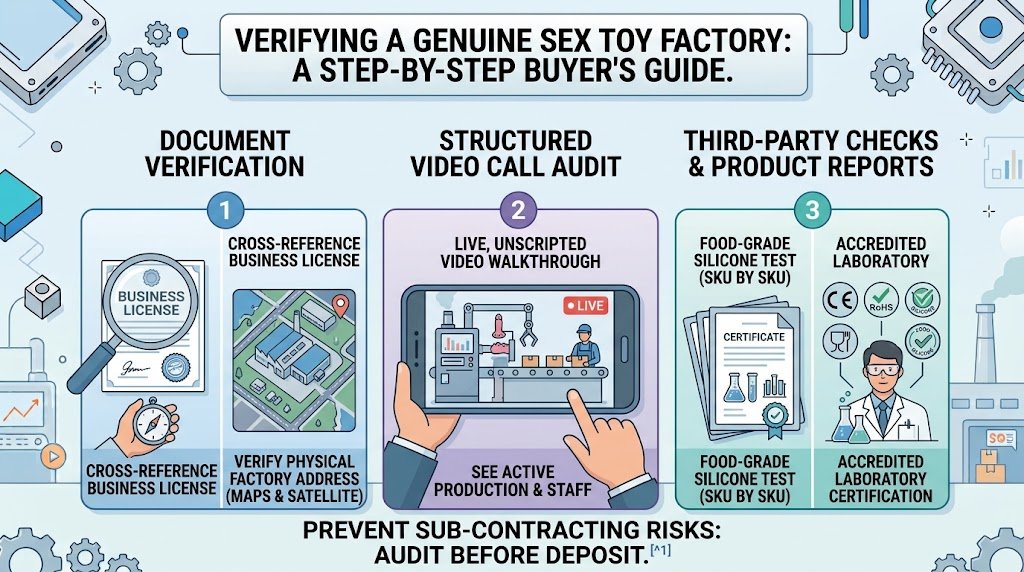
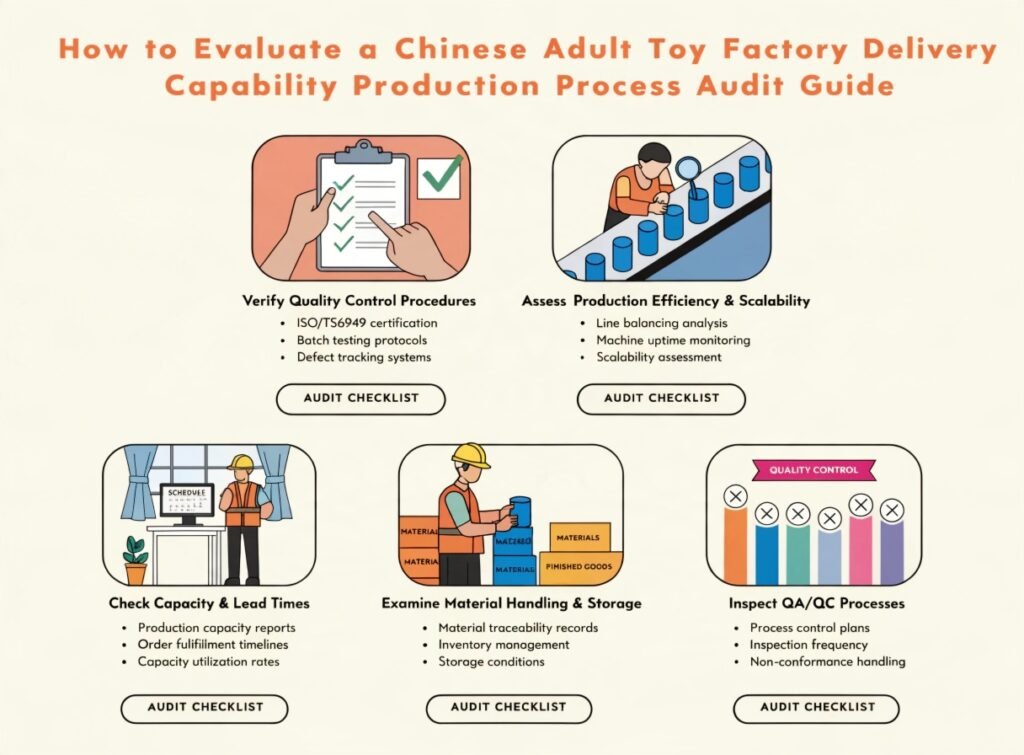
You evaluate a Chinese adult toy factory's delivery capability by auditing five things before you place any order: their documented production process, monthly output capacity, quality control checkpoints, component sourcing structure, and their track record of solving production problems under pressure. A factory that cannot show you evidence of all five is a delay risk — regardless of what their sales team tells you on a video call.1
I'm Sally. I run VF Pleasure — a direct adult toys factory in Dongguan, China, with over 15 years of manufacturing experience and 5 to 10 active production lines running at any given time. Our monthly output sits at 50,000 units. We run a documented 12-step production process. And we have solved real, documented production problems for partners who had every reason to walk away and chose to stay — because we fixed the issue before it reached their customer.
I'm not writing this article to sell you on VF Pleasure. I'm writing it because I've watched too many buyers — procurement heads at adult novelty wholesale retailers, brand founders in the sexual wellness space, cross-border e-commerce operators — get burned by factories that over-promised and under-delivered. This guide gives you the exact audit framework I would use if I were in your seat, evaluating a factory I'd never worked with before.
- 1 Why Do Chinese Adult Toy Factories Miss Delivery Deadlines?
- 2 What Does a Real Adult Toy Factory's Production Process Look Like?
- 3 How Do You Audit a Factory's Delivery Capability Before You Order?
- 4 What Do Real Production Problems Tell You About a Factory's Reliability?
- 5 How Do You Build a Supply Chain That Avoids Delays Long-Term?
- 6 Conclusion
- 7 References & Source Notes
Why Do Chinese Adult Toy Factories Miss Delivery Deadlines?
You sent the purchase order. The factory confirmed the lead time. Four weeks later, production is "almost done." Two more weeks and the goods are "waiting for packaging." Another week and there is a vague update about a component shortage. Sound familiar? This is not bad luck. It is a structural problem in how most adult toy suppliers communicate and manage their production flow.
Chinese adult toy factories miss delivery deadlines most often because of four structural problems: component dependency on sub-suppliers with no backup options, insufficient production capacity spread across too many concurrent orders, weak internal QC that pushes rework into the final production stage, and poor communication systems that hide problems until they become crises. Each of these is visible before you place an order — if you know what questions to ask.1
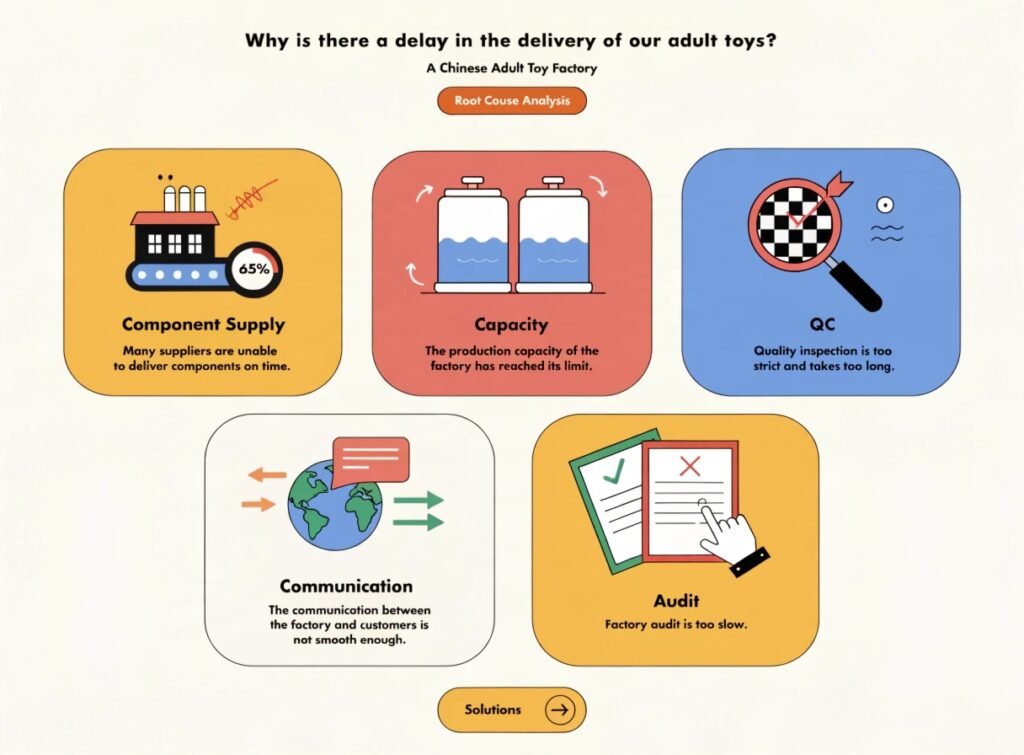
Delays are not random. They follow patterns. And every pattern points to a specific weakness you can verify before you send a deposit.
🔴 Root Cause 1 — Single-Source Component Dependency
The vibrator motor. The silicone body compound. The USB-C charging module. Every adult toy has three to seven critical components sourced from sub-suppliers. A factory that relies on a single sub-supplier for any critical component is one supply chain disruption away from a two-to-four-week delay — with no alternative path.
I've seen this happen with motors specifically. When a key component cost spiked due to supply chain disruption, factories that had no alternative sourcing strategy either passed the full cost increase to their client or delayed while they scrambled to find an alternative. The factories that had pre-tested alternative components moved faster and kept their timelines. Ask any factory you evaluate: "For each critical component, how many qualified sub-suppliers do you have? Have you tested alternatives?" If the answer is vague, the delay risk is real. Our adult toy manufacturing challenges and solutions guide documents a real case of this exact problem — and how a proactive engineering solution protected the delivery timeline.
🔴 Root Cause 2 — Capacity Overcommitment
A factory with 3 production lines and 15 active OEM clients has a math problem. You will not know which order gets deprioritised when a premium client's urgent reorder comes through. It will be yours.
Ask for a factory's monthly production capacity — in units, not a vague claim like "large capacity." Ask how many active clients they serve simultaneously and how they allocate production slots. A factory with genuine monthly capacity of 50,000 units across 5–10 production lines has the headroom to absorb unexpected demand spikes without pushing your order to the back. A factory without this transparency is hiding a capacity constraint.
🔴 Root Cause 3 — QC Failures That Surface at the Finish Line
The most expensive delay in any production run is the one that happens on day 28 of a 30-day lead time. That is when a waterproof test failure, a silicone surface defect, or a packaging print error surfaces — and the factory has to choose between shipping defective goods or delaying for rework.
A factory with strong inline quality control — QC checkpoints built into each production stage, not just a final inspection — catches these problems at day 5 or day 10, not day 28. That is what makes the difference between a two-day correction and a two-week delay. Our verify adult toy quality from Chinese suppliers guide explains how to assess a factory's QC architecture before you order.
🔴 Root Cause 4 — Communication That Hides Problems
This is the one that most buyers don't expect to audit. A factory that delays sharing bad news until the last possible moment — because they are hoping to fix it without telling you — puts you in the worst possible position. You have no time to adjust your logistics, warn your retail buyer, or arrange alternatives.
Ask factories directly: "Show me an example of a production problem you communicated to a client proactively — before the delivery date was affected." A factory that can answer this with a specific case has a communication culture that protects you. A factory that cannot answer it probably has the opposite culture.
📊 Delay Risk Indicator Summary
| Risk Factor | Low Risk Signal | High Risk Signal |
|---|---|---|
| Component sourcing | Multiple qualified sub-suppliers, alternatives pre-tested | Single-source, no documented alternatives |
| Production capacity | Named monthly unit output, 5–10 production lines | Vague claims, no verifiable capacity data |
| QC structure | Inline checkpoints per production stage | Final inspection only |
| Communication culture | Documented proactive problem communication | No examples of early issue reporting |
| Lead time history | Client references confirm on-time delivery | No reference contacts, only testimonial text |
What Does a Real Adult Toy Factory's Production Process Look Like?
Most factories describe their production process in broad strokes — "we design, manufacture, and ship." That tells you nothing useful about delivery reliability. A factory with a genuinely documented, stage-gated production process can show you exactly where your order is at any point in the cycle — and exactly where delays, if any, will emerge.
A real adult toy factory's production process runs through a minimum of 10–12 documented stages: from initial product design and material sourcing through mold development, silicone and component production, assembly, inline QC checks, waterproof testing, functional testing, packaging, final QC inspection, and pre-shipment verification. Each stage has defined inputs, outputs, and pass/fail criteria — and the factory should be able to show you documentary evidence for every one.2
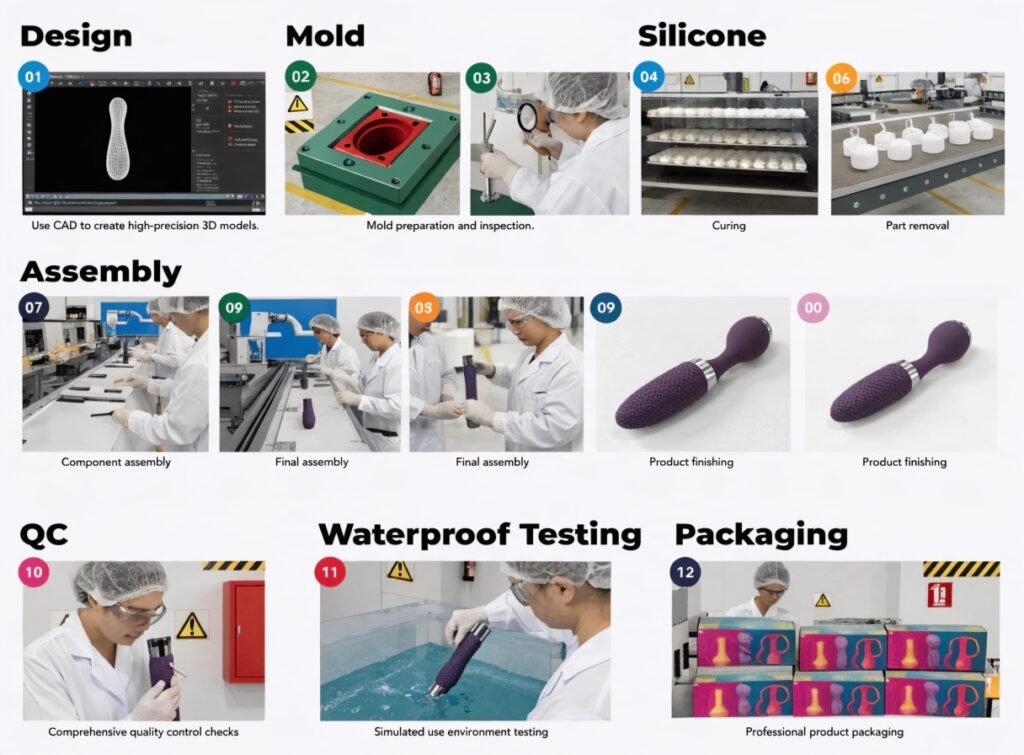
Here is how VF Pleasure's 12-step production process works — and what each stage tells you about delivery reliability at every adult toys factory running a serious program.
🏭 The VF Pleasure 12-Step Production Process
At VF Pleasure, our production process is documented and transparent. Every order runs through the same sequence — no shortcuts, no stage skipping regardless of timeline pressure.
| Step | Stage | What Happens | Delivery Reliability Signal |
|---|---|---|---|
| 01 | Product design & brief review | Engineering team reviews client specs against manufacturing feasibility | Early flag of any specification that cannot be built to timeline |
| 02 | Material sourcing | Food-grade platinum silicone, ABS plastic, electronic components confirmed from qualified sub-suppliers | Component readiness confirmed before production start |
| 03 | Mold development (if custom) | Tooling created for custom OEM designs; ODM uses existing validated molds | Custom orders add 2–4 weeks — flagged at stage 01 |
| 04 | Silicone body production | Platinum-cured food-grade silicone molded to spec | Visual and dimensional QC check at completion |
| 05 | ABS component production | Hard-shell components molded and surface-treated | Color fastness and dimension check |
| 06 | Electronic component assembly | Motor, PCB, charging module, and control components assembled | Functional test: vibration modes, charging circuit |
| 07 | Body assembly & sealing | Silicone and ABS components joined; waterproof sealing applied | Inline sealing integrity check before waterproof test |
| 08 | Waterproof testing | IPX7 submersion validation under real-use simulation conditions | Pass/fail recorded per batch — not just per product line |
| 09 | Functional performance testing | All vibration modes, charging cycles, and user interaction tested | Performance baseline confirmed against spec |
| 10 | Packaging | Brand packaging assembled, documentation inserted, QC sticker applied | Packaging accuracy check against approved artwork |
| 11 | Final QC inspection | Full batch sampling against AQL standard; written QC report generated | QC report sent to client before shipment dispatch |
| 12 | Pre-shipment verification | Shipping documentation, compliance declarations, and customs paperwork confirmed | No shipment without complete documentation package |
💡 Why this matters for your delivery timeline: A factory that cannot walk you through its production process stage by stage — with specific QC checkpoints named — is either making it up as they go or hiding a step where quality frequently fails. Both outcomes produce delays.
📏 Monthly Capacity as a Delivery Reliability Signal
A factory's stated monthly capacity is one of the most useful pieces of data in any delivery audit. At VF Pleasure, our 5–10 production lines run at a combined monthly output of 50,000 units. That number means something specific:
- We can absorb a sudden reorder request without bumping another client's scheduled production
- We have redundant production line capacity — if one line has a maintenance issue, others continue
- We can run multiple SKUs simultaneously for clients with multi-product orders
- Our component procurement scale gives us priority access with sub-suppliers during supply chain pressure periods
When you evaluate any sex toy factory, ask: "What is your verified monthly output in units — across which product categories — and how many simultaneous active client orders are currently running?" A factory that cannot answer this specifically has not measured it — and a factory that has not measured its capacity cannot manage it.
How Do You Audit a Factory's Delivery Capability Before You Order?
You have a factory in front of you. They have a professional website, a clean showroom, and a sales representative who answers every question confidently. But confidence in a video call is not evidence of delivery capability. Here is the audit framework I recommend to every buyer evaluating a new adult toy manufacturer for the first time.
You audit an adult toy factory's delivery capability with a five-part framework: production documentation review, capacity verification, QC checkpoint mapping, component sourcing structure assessment, and reference checks from active clients. Each part takes less than 30 minutes to complete — and the data it gives you is worth more than any factory tour.3
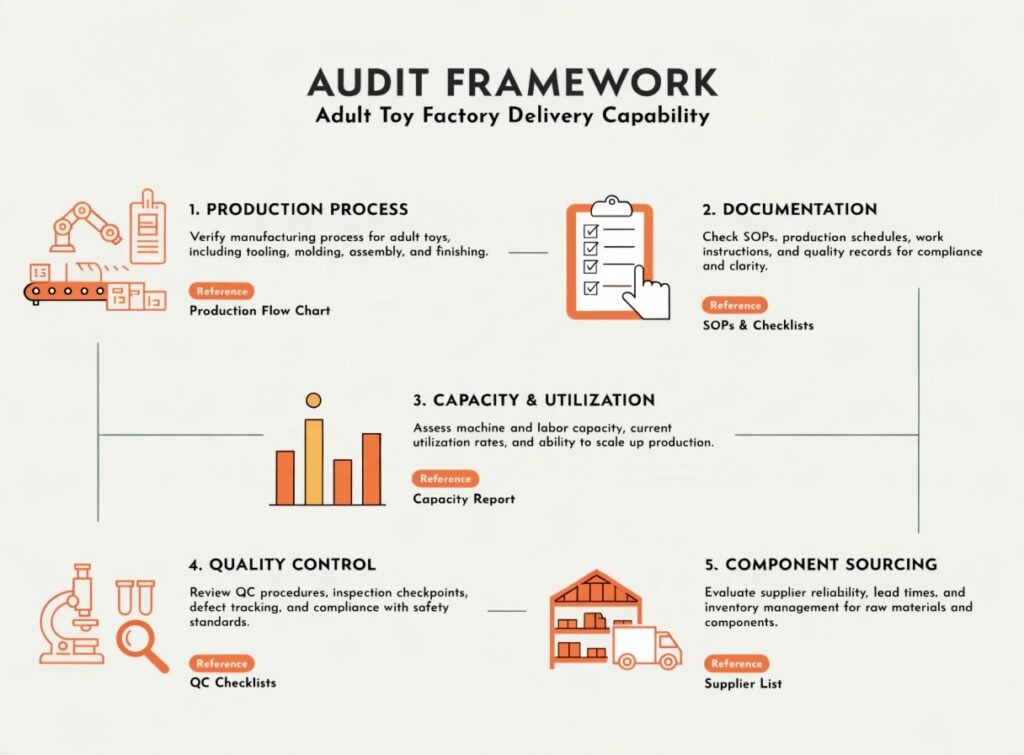
Here is each part of the framework — with the exact questions to ask and the answers that tell you whether to proceed or walk away.
📋 Part 1 — Production Documentation Review
Ask the factory to send you the following before any further discussion:
- ✅ A written production process overview with named stages and QC checkpoints
- ✅ A sample production schedule or Gantt chart from a recent completed order (anonymised is fine)
- ✅ A sample QC inspection report from a recent batch
- ✅ Their current lead time by product category — ODM vs OEM vs custom
A factory with these documents ready is a factory that runs its production systematically. A factory that cannot produce any of these documents is running on informal processes — which means delays will be informal too: unexpected, unexplained, and hard to resolve.
Our choose reliable OEM adult toy factory China checklist and sex toy manufacturing process guide both include the document verification checklist in full.
📏 Part 2 — Capacity Verification
Request the following:
- Named monthly unit output across all product lines
- Number of active production lines and their current utilisation rate
- How the factory handles capacity conflicts between existing clients and new orders
- Whether they run overtime or additional shifts during peak demand periods
💡 The benchmark to use: At VF Pleasure, our 50,000-unit monthly capacity across 5–10 production lines means we have a defined, manageable workload. Ask your candidate factory to match this level of specificity. Vague answers like "we have large capacity" or "we can handle any order volume" are not capacity statements — they are sales statements.
🔍 Part 3 — QC Checkpoint Mapping
Ask the factory to describe their quality control process in sequence — which checks happen at which production stages, what documentation each check generates, and who on their team is responsible for pass/fail decisions. Then ask:
- "If a product fails waterproof testing at stage 8 of your process, what happens next — and how does it affect the delivery timeline?"
- "Can you show me a real QC report from a recent completed order?"
A factory that solves QC failures at stage 8 with rework and a two-day delay is very different from one that discovers failures at stage 11 with a two-week delay. The difference is not luck — it is QC architecture. Our adult toy quality compliance guide and body-safe adult toys manufacturing standards guide explain how to read QC architecture from a factory's documentation.
🧩 Part 4 — Component Sourcing Structure Assessment
Ask the factory for the following:
- How many qualified sub-suppliers do they use for critical components (motors, silicone compound, PCB, charging modules)?
- Have they tested and qualified alternative sub-suppliers for any critical component?
- In the last 12 months, has any component shortage or price increase affected a client's delivery timeline — and how was it resolved?
This question sequence specifically surfaces the single-source dependency risk I described in the previous section. A factory that has pre-tested alternative components is a factory that will not call you in week three to say their motor supplier raised prices and they need to delay. Our material transparency sourcing guide explains how to map a factory's component dependency structure.
🤝 Part 5 — Reference Checks
Ask for two or three reference contacts from current active clients — not testimonials on the website, but real people you can contact directly. Ask those references:
- "Has this factory ever missed a delivery deadline with you? If yes, how did they handle it?"
- "Has the factory ever identified and communicated a production problem before it became a delivery delay?"
- "Would you recommend them for a first-time order of [your target volume]?"
A factory that cannot provide reference contacts, or whose references cannot speak to delivery performance specifically, has not earned the trust they are asking you to extend.
📊 Factory Audit Scorecard
| Audit Area | Pass Threshold | Fail Signal |
|---|---|---|
| Production documentation | Written process with named QC checkpoints available | Cannot produce documentation |
| Capacity verification | Named monthly unit output confirmed | Vague "large capacity" claims |
| QC checkpoint mapping | Inline checks per production stage, sample QC report available | Final inspection only, no sample report |
| Component sourcing | Multiple qualified sub-suppliers for critical parts | Single-source, no tested alternatives |
| Reference checks | 2+ references confirm on-time delivery and proactive communication | No reference contacts provided |
What Do Real Production Problems Tell You About a Factory's Reliability?
Here is what separates the factories worth working with from the ones that will cost you sleep and missed launches: not whether they have ever had a production problem — every factory has — but whether they solved it before it reached your customer. A factory's track record of problem resolution is the most reliable predictor of delivery reliability you can find. And you can ask for it directly.
A factory's real production problem record tells you three things about its delivery reliability: whether it has the engineering discipline to identify problems before they become delays, whether it communicates proactively or defensively when problems arise, and whether its solutions are structural fixes or short-term patches that resurface in the next production run.4
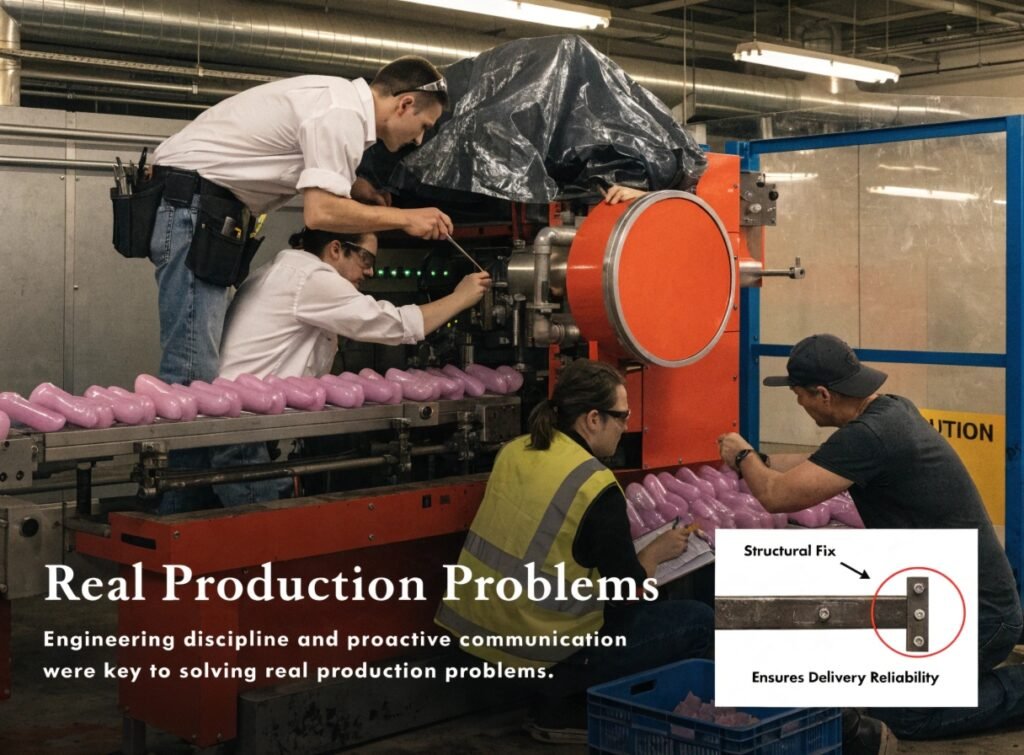
At VF Pleasure, we document the engineering challenges we solve for our partners. These five cases are from our production floor — the evidence standard I recommend you ask every factory to match before you sign any purchase order.
🧪 Case 01 — Waterproof Seal Failure Under Updated Testing Conditions
One of our partners updated their IPX7 testing protocol to include pre-use simulation — insertion cycles before the submersion test. This mirrors real customer use conditions more accurately than static submersion. The product failed the updated standard.
Fixing this could have meant redesigning the external product shape, triggering a CE re-declaration, and delaying the order by weeks. Instead, we analyzed the sealing architecture at the internal structural level, identified specific assembly sequence weaknesses, rebuilt the internal waterproof design, and ran repeated internal validation before the formal retest.
The product passed the updated IPX7 standard. No external redesign. No shipping delay. No brand impact.4
💡 What this case shows about delivery reliability: We identified the failure mode internally. We solved it internally. We retested internally before resubmitting. The client's timeline was protected by engineering discipline — not by luck or a last-minute rush.
⚙️ Case 02 — Motor Substitution Under Sudden Supply Chain Cost Increase
A key motor component cost spiked significantly due to supply chain disruption. The original product could no longer be built at the agreed price point without either absorbing a loss or passing the full increase to the client.
Rather than making a silent substitution — the approach that produces "this version feels weaker" customer reviews — we benchmarked multiple alternative motor options against the original's vibration strength, noise level under load, and long-term operational stability. We ran internal performance testing across all candidates and selected the one that maintained performance consistency within the client's premium sexual wellness brand positioning.
The product arrived at retail with no detectable performance change. The client's pricing power was protected.4
💡 What this case shows about delivery reliability: A component crisis that might have forced a two-to-three-week delay was absorbed at the engineering sourcing level. The delivery timeline held. The client was informed and involved — not surprised at shipment.
🔌 Case 03 — Charging Reliability Failure from a DC Pin Contact Design Flaw
Post-production customer feedback flagged intermittent charging failures across a product batch. We traced the root cause to DC pin contact geometry — specifically, how pin length interacted with the natural flex of the silicone body under repeated use conditions.
We evaluated pin length and structural tolerance, tested extended pin design variants under simulated use cycles, and confirmed long-term durability under accelerated testing conditions. The resolution was a structural engineering fix — not a warranty replacement program.4
💡 What this case shows: We traced the problem to its root cause rather than treating the symptom. A warranty program would have created ongoing after-sales cost. The structural fix eliminated the failure mode at the source.
🎨 Case 04 — Color Fastness Compliance Failure After a QA Standard Update
Updated QA standards required higher color fastness performance on silicone and ABS surfaces. Several SKUs in a client's range failed the new criteria. Rather than shipping under the previous standard and hoping no one tested the updated requirement, we reviewed the full material and surface treatment process, identified the specific treatments causing failure, replaced them with compliant alternatives, and conducted internal validation before re-submission.4
Every SKU passed the updated standard. No large-scale production rejection. No retail delisting. No customs hold.
🔄 Case 05 — Batch Code and Inspection Timeline Misalignment
An adjusted delivery schedule created a mismatch between batch codes and inspection dates. Packaging and product marking were already printed. The batch code did not align with the formal inspection timing — a documentation gap that could have triggered QA inspection failure and a full shipment hold.
Rather than leaving this as an unresolved problem for the client to manage at customs, we documented the full production and inspection timeline with complete traceability, communicated with the client proactively before the inspection, and provided a written QA explanation for the inspector. The documentation was accepted without rework. Delivery was maintained on schedule.4
🧠 Five Cases, One Standard: What to Ask Every Factory
| Engineering Problem | Risk if Unresolved | How We Resolved It | Time Impact |
|---|---|---|---|
| IPX7 seal failure under real-use test | Shipment delay, CE re-declaration | Internal structural redesign | Zero delay |
| Motor cost spike, performance risk | Price increase or silent performance drop | Component benchmarking and validation | Minimal delay |
| Charging contact design flaw | After-sales cost, repeat returns | DC pin structural engineering | Resolved pre-shipment |
| Color fastness non-compliance | Customs hold, platform rejection | Proactive surface treatment replacement | No delay |
| Batch code documentation gap | QA failure, full shipment hold | Timeline documentation and inspector briefing | No delay |
Use this table as a benchmark framework. Ask every factory candidate: "Show me five documented production problems you resolved for a client — with the problem, the solution, and the outcome for the delivery timeline." A factory that can show you this data has a problem-resolution culture. A factory that cannot has a hope-it-works culture. Our red flags OEM adult toy manufacturer guide and crafting high-quality adult toys guide document the specific signals that separate these two factory types.
How Do You Build a Supply Chain That Avoids Delays Long-Term?
You've audited the factory. You've reviewed the production documentation. You've checked the references and reviewed their problem-resolution cases. Now the question is: how do you build a supply chain structure that keeps delays from becoming a chronic issue as your order volumes grow?
You build a delay-resistant adult toy supply chain by establishing three structural anchors with your manufacturing partner: a documented production schedule with client-specific timeline milestones, a proactive communication protocol that requires the factory to report problems at the stage they occur — not at the deadline — and a scaling roadmap that grows your order volume in line with the factory's verified capacity rather than faster.5
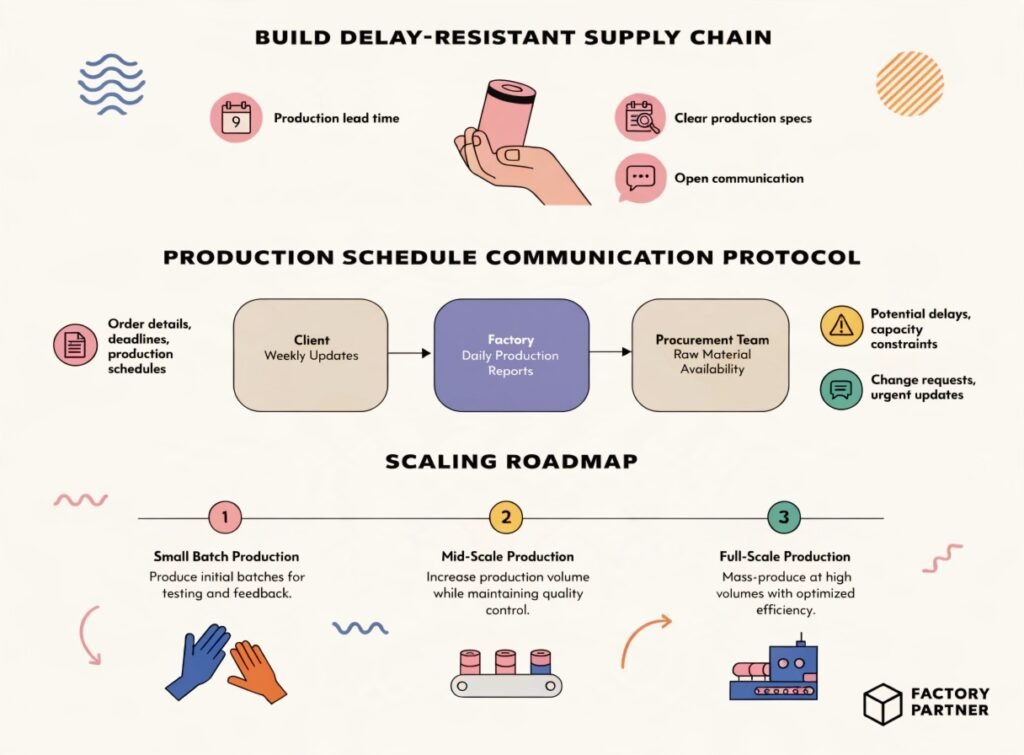
Long-term supply chain reliability is not a factory characteristic — it is a relationship characteristic. The factories that deliver consistently over years do so because their clients have built communication structures that surface problems early. Here is how to build that structure from your first order.
📅 Anchor 1 — A Documented Production Schedule with Client-Specific Milestones
Your purchase order should include a production milestone schedule — not just a delivery date. That schedule should name:
- ✅ Material readiness date — when all components are confirmed at the factory
- ✅ Production start date — when the first unit enters the line
- ✅ Inline QC checkpoint date — when the first QC review occurs mid-production
- ✅ Waterproof and functional test completion date — when all testing is finished
- ✅ Final QC inspection date — when the QC report is generated
- ✅ Pre-shipment verification date — when documentation is confirmed complete
- ✅ Dispatch date — when the shipment leaves the factory
A factory that agrees to this milestone structure — and reports against it proactively — will almost never surprise you with a last-day delay. A factory that resists this level of milestone transparency is telling you something important about how they prefer to manage client expectations.
📡 Anchor 2 — A Proactive Problem Communication Protocol
Before your first order begins, agree on a simple rule: if any production stage takes longer than planned, the factory contacts you within 24 hours of identifying the delay — not when the delivery date arrives.
This one rule changes everything. It gives you time to adjust your logistics, update your retail buyer, or modify your marketing timeline. It turns a supply chain crisis into a manageable schedule change. And it is the most revealing test of a factory's communication culture you can run.
Our how to negotiate with Chinese adult toy factories guide explains how to establish this communication protocol at the negotiation stage — before you sign a purchase order — so it becomes a contractual expectation rather than an informal request.
📈 Anchor 3 — A Scaling Roadmap Tied to Verified Capacity
The most common supply chain mistake growing wholesale adult sex toy buyers make is scaling their order volumes faster than their factory can absorb them. You go from 500 units to 5,000 units in one order cycle — and the factory, unwilling to lose the business, accepts the order without the capacity to deliver it.
Match your scaling speed to the factory's documented capacity. If their verified monthly output is 50,000 units across 5–10 lines, a 5,000-unit order is a manageable increment. A 50,000-unit first order from a new client is a risk — for both parties.
Plan your scaling roadmap with your factory as a shared document. Ask them to confirm at each order increment: "Is this volume within your current confirmed production capacity for my delivery window?" A factory that answers yes with capacity data behind it is a factory you can scale with. Our adult toy manufacturer partnership strategies guide and sex toy wholesale pricing breakdown guide both explain how to structure a scaling roadmap that protects your supply chain as your business grows.
🔁 The Long-Term Relationship Framework
The best supply chain relationships I've seen in 15 years of running a custom sex toys factory share one common structure:
| Relationship Stage | What the Buyer Does | What the Factory Does |
|---|---|---|
| First order | Small test volume, full audit, milestone schedule agreed | Produces to spec, reports on every milestone, delivers QC report pre-shipment |
| Second order | Moderate increase, requests component sourcing update | Confirms capacity, flags any sub-supplier changes, maintains proactive communication |
| Third order onward | Scales with confidence, begins custom OEM planning | Offers capacity forecasting, proactive product improvement suggestions |
| Ongoing partnership | Multi-SKU catalog expansion, seasonal volume planning | Dedicated production capacity allocation, priority slot management |
💡 Sally's 15-year production floor observation: The buyers who never have supply chain delay problems are not lucky. They built a relationship with a factory that treats them as a priority client — because they invested the time to audit properly, communicate clearly, and scale sensibly. That investment happens in the first order, not the fifth. Our distributor vs manufacturer wholesale sex toy partner guide and find reliable adult toy manufacturer wholesale guide explain how to identify factories that are structured for this kind of long-term reliability from the start.
Conclusion
Production delays in cross-border adult toy e-commerce are not inevitable — they are predictable, and they are preventable if you audit the right things before you place your first order: documented process, verified capacity, inline QC, component sourcing depth, and a communication culture that treats early bad news as a client service, not a weakness.
🚀 Ready to Audit VF Pleasure's Delivery Capability — and See Our 12-Step Process in Action?
At VF Pleasure, transparency is not a sales pitch — it is how we run production. Our Dongguan factory operates 5–10 active production lines with a monthly output of 50,000 units. Our 12-step production process is documented, stage-gated, and available for review before you place any order.
We offer every serious buyer:
- ✅ Full production process documentation — 12 stages with named QC checkpoints, available on request
- ✅ Verified monthly capacity of 50,000 units — across vibrators, female sex toys, couples toys, thrusting sex toys, and male adult toys
- ✅ Production milestone scheduling per order — confirmed dates for every stage from material readiness to shipment dispatch
- ✅ QC report with every shipment — generated before dispatch, sent to you before goods leave the factory
- ✅ Documented engineering problem-resolution cases — five real examples available for review, as shown in this article
- ✅ OEM and ODM programs — custom sex toys with food-grade platinum silicone, CE, and RoHS compliance documentation per SKU
📬 Start Your Factory Audit — Tell Me Three Things:
1. What product category are you sourcing?
(e.g., custom vibrators / bulk adult toys for wholesale / private label sexual wellness / OEM adult novelty line)2. What order volume are you planning — and what is your target delivery window?
(e.g., 500 units with a 6-week lead time / 5,000 units for a Q4 wholesale reorder)3. Have you been burned by a factory delay before — and what specifically went wrong?
(This helps me show you exactly which part of our process addresses that specific risk)
References & Source Notes
-
Choose Reliable OEM Adult Toy Factory China Checklist — VF Pleasure
| Field | Detail |
|---|---|
| 📌 Supports | You evaluate a Chinese adult toy factory's delivery capability by auditing five things: documented production process, monthly output capacity, QC checkpoints, component sourcing structure, and problem-resolution track record. Each of the four root causes of delay — component dependency, capacity overcommitment, late-stage QC failures, and poor communication — is visible before you place an order. |
| 🔍 Evidence Role | Definition + General Support |
| 📁 Source Type | Industry Guide |
⚠️ Scope Note: Root cause analysis of factory delays reflects VF Pleasure's 15+ years of manufacturing and B2B partnership experience. Delay patterns and their root causes vary by factory type, product category, and order volume. Buyers should use this framework as a starting point for due diligence — not as a guaranteed predictor of any specific factory's behaviour. Independent third-party factory audits are recommended for all high-volume supplier relationships.
-
Sex Toy Manufacturing Process Guide — VF Pleasure
| Field | Detail |
|---|---|
| 📌 Supports | A real adult toy factory's production process runs through 10–12 documented stages with defined QC checkpoints at each stage. VF Pleasure's 12-step process and 50,000-unit monthly capacity provide a benchmark for evaluating any factory's delivery capability claims. |
| 🔍 Evidence Role | Definition + Mechanism |
| 📁 Source Type | Industry Guide |
⚠️ Scope Note: The 12-step process and 50,000-unit monthly capacity figure reflect VF Pleasure's current production capability and workflow documentation. Actual stage names, QC checkpoint locations, and capacity figures vary between factories. Buyers should request factory-specific documentation — not rely on general industry descriptions — when evaluating any specific manufacturing partner's production system.
-
Verify Adult Toy Quality from Chinese Suppliers — VF Pleasure
| Field | Detail |
|---|---|
| 📌 Supports | A five-part pre-order audit framework — production documentation review, capacity verification, QC checkpoint mapping, component sourcing structure assessment, and reference checks — gives buyers the data needed to assess any adult toy factory's delivery reliability before placing a deposit. |
| 🔍 Evidence Role | Mechanism |
| 📁 Source Type | Industry Guide |
⚠️ Scope Note: The five-part audit framework reflects VF Pleasure's advisory experience with B2B buyers evaluating Chinese adult toy manufacturers. Individual factory documentation quality, reference availability, and communication willingness vary significantly. Buyers should supplement this framework with in-person or third-party factory audits for any significant sourcing commitment.
-
Adult Toy Manufacturing Challenges and Solutions — VF Pleasure
| Field | Detail |
|---|---|
| 📌 Supports | A factory's real production problem record reveals its engineering discipline, communication culture, and whether its fixes are structural or superficial — all of which are stronger predictors of delivery reliability than any stated lead time. Five documented cases from VF Pleasure show the standard buyers should expect. |
| 🔍 Evidence Role | Case Reference |
| 📁 Source Type | Industry Guide |
⚠️ Scope Note: All five case studies are drawn from real anonymised production projects at VF Pleasure. They illustrate the factory's engineering problem-solving discipline and communication approach — not a guarantee that equivalent outcomes will result in all production situations. Engineering outcomes depend on the specific failure mode, product construction, QA standard, and project timeline. Buyers should use documented cases as one evidence input in a broader factory evaluation, not as a sole basis for sourcing decisions.
-
Adult Toy Manufacturer Partnership Strategies — VF Pleasure
| Field | Detail |
|---|---|
| 📌 Supports | A delay-resistant supply chain is built on three structural anchors: a documented production milestone schedule, a proactive problem communication protocol agreed before the first order, and a scaling roadmap tied to the factory's verified monthly capacity rather than the buyer's growth ambition alone. |
| 🔍 Evidence Role | Mechanism + General Support |
| 📁 Source Type | Industry Guide |
⚠️ Scope Note: The long-term supply chain framework reflects VF Pleasure's 15+ years of B2B manufacturing partnership experience. Actual outcomes in any specific buyer-factory relationship depend on the quality of communication established, the clarity of purchase order documentation, and the individual factory's capacity management discipline. Buyers should formalise all milestone schedules and communication protocols in writing as part of their purchase order or supplier agreement documentation.