Skip to content
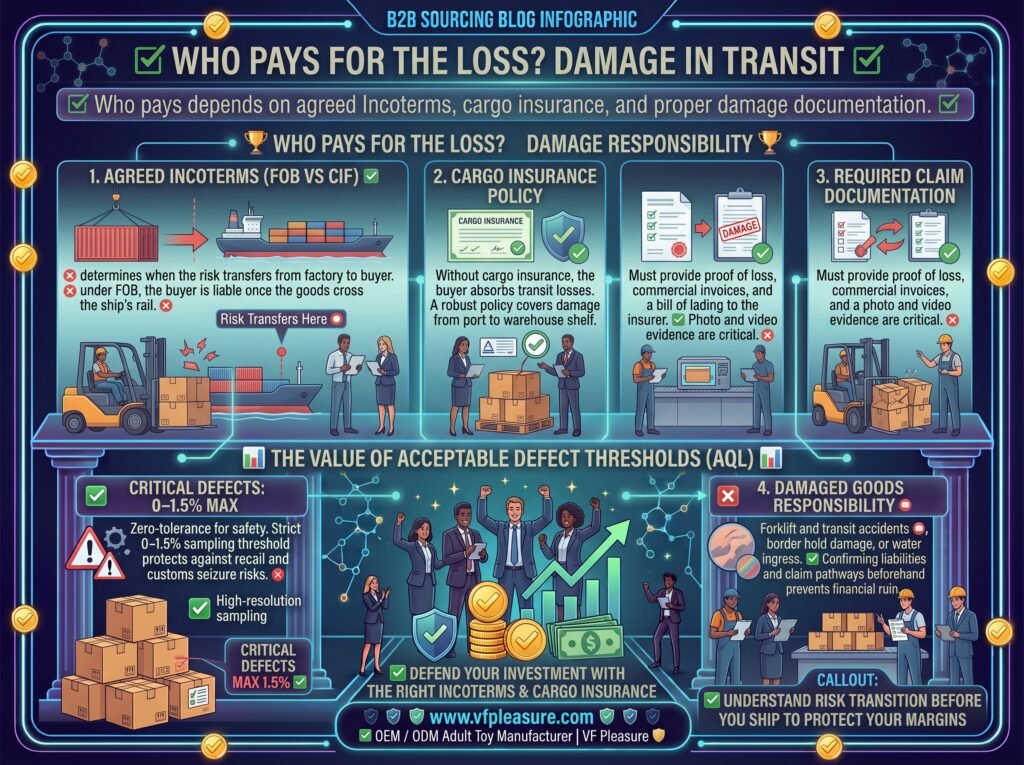
You paid the factory. You paid the freight forwarder. You paid customs duties. Your container lands — and a forklift accident at the port has crushed two cartons. Inside: 200 units of your private label food-grade silicone vibrators, branded packaging you spent three weeks designing, and compliance documentation that names your brand as the EU responsible person. Who pays for the loss? The answer depends entirely on a decision you made before the shipment left Dongguan — and most buyers make it without understanding its consequences.
When an adult toy shipment is damaged, who pays depends on three things: the Incoterm agreed in your purchase order (which determines at what point the risk transfers from factory to buyer), whether you purchased cargo insurance and what type, and whether you can provide the documentation an insurer requires to process a claim. Most buyers operating under FOB terms are financially exposed from the moment goods cross the ship's rail — and most discover this only after damage has occurred.1
I'm Sally. I run VF Pleasure — a direct adult toys factory in Dongguan, China, with 15+ years of B2B manufacturing experience. We provide full documentation to ensure smooth importation and compliance across our clients' target markets. Our packaging passes 3-metre drop testing and 50kg stress testing before any shipment leaves our facility — because packaging integrity is the first line of cargo protection. But once the shipment leaves our dock, the commercial risk framework shifts — and understanding it is the buyer's responsibility, not ours.
This guide covers every layer of the cargo damage question: which Incoterm controls your risk, what insurance types cover adult toy shipments, what the industry-specific gaps are, and how to file a claim that actually succeeds.
⚠️ Important note: Cargo insurance terms, carrier liability limits, and Incoterm interpretations vary by jurisdiction, carrier, and individual policy. This article provides general commercial guidance — not legal or insurance advice. Confirm all coverage details with a licensed freight insurance provider before your next shipment.
- 1 Why Do Adult Toy Importers Need Cargo Insurance Specifically?
- 2 What Incoterm Determines Who Is Responsible for Cargo Damage?
- 3 What Types of Cargo Insurance Should Adult Toy Importers Know?
- 4 What Adult Toy Specific Risks Does Standard Cargo Insurance Miss?
- 5 How Do You File a Successful Cargo Insurance Claim for Adult Toys?
- 6 How Does Strong Packaging Reduce Your Insurance Risk from the Factory?
- 7 Conclusion
- 8 References & Source Notes
Why Do Adult Toy Importers Need Cargo Insurance Specifically?
Generic cargo damage guidance treats all goods the same way. Adult toy importers face a specific combination of risk factors that makes cargo insurance more important — and more complex — than for most other consumer goods categories.
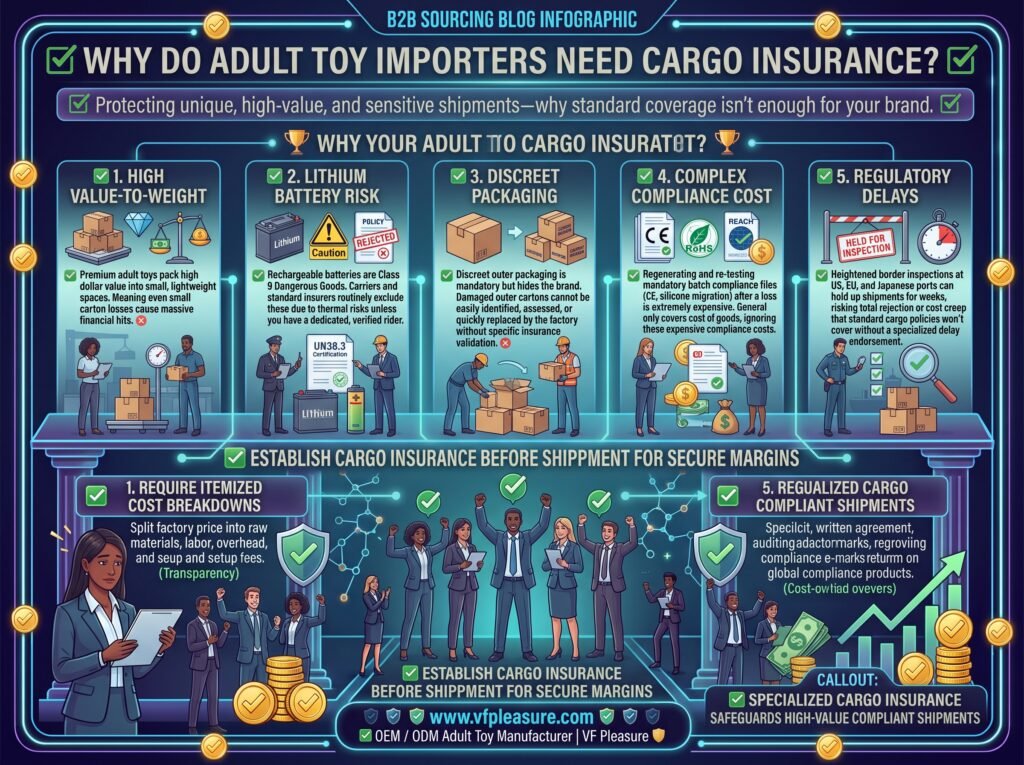
Adult toy importers need cargo insurance specifically because their shipments combine four compounding risk factors: high value-to-weight ratio that makes partial damage losses disproportionately expensive, lithium battery components that create carrier liability exclusions in standard policies, discreet packaging requirements that complicate damage assessment and replacement logistics, and multi-jurisdiction compliance documentation that must be regenerated at cost if goods are lost or destroyed.1
![]()
Here is each risk factor — and why it affects how you need to structure your coverage.
💎 Risk Factor 1 — High Value-to-Weight Ratio
A carton of 50 food-grade silicone vibrators weighs roughly 15–20kg and has a commercial value of $500–$1,500 depending on specification. The declared customs value per kilogram is often higher than standard bulk consumer goods — which means a single damaged carton creates a disproportionately large loss relative to its physical size.
Standard carrier liability under the Hague-Visby Rules (sea freight) and the Warsaw/Montreal Convention (air freight) limits compensation to approximately $2.50–$5.00 per kilogram of actual gross weight. For a 15kg carton with a commercial value of $800, the carrier's maximum liability is roughly $37.50–$75. The gap between carrier liability and actual product value is the loss that cargo insurance exists to cover.
🔋 Risk Factor 2 — Lithium Battery Exclusions
Almost every rechargeable adult toy contains a lithium-ion battery — and lithium batteries carry specific carrier handling requirements under UN38.3 certification and IATA/IMDG dangerous goods regulations. Standard carrier insurance policies often contain explicit exclusions or reduced coverage for shipments containing lithium batteries, particularly for air freight.
This exclusion is frequently not disclosed at booking. You discover it when you file a claim.
📦 Risk Factor 3 — Discreet Packaging Complicates Damage Assessment
Most adult toy importers ship in plain outer cartons with no product description on the exterior — for obvious reasons. This means that when a damaged shipment arrives, the claims assessment process requires opening boxes to confirm contents, which creates chain-of-custody complications and may require the importer to be physically present or provide detailed product manifests.
It also means that partial damage — one crushed carton from a pallet of 10 — requires documentation of what was in that specific carton rather than a uniform manifest entry.
📋 Risk Factor 4 — Compliance Documentation Regeneration Cost
If a shipment containing your private label food-grade silicone products is lost or destroyed, the product replacement cost is not your only loss. You also lose your CE documentation, your food-grade silicone migration test reports, and your RoHS certificates — all of which are tied to that specific production batch. Regenerating these documents for a replacement batch adds cost and timeline. This is not a cost that standard cargo insurance covers, but it is a real loss that sophisticated buyers factor into their insurance valuation.
At VF Pleasure, all products comply with CE, RoHS, REACH, and CA65 standards, with full documentation per batch. We keep copies of all compliance certificates and can reissue batch documentation for insurance purposes — but the buyer still needs to have accounted for the documentation regeneration cost in their claim preparation.
What Incoterm Determines Who Is Responsible for Cargo Damage?
The Incoterm in your purchase order is the document that determines whether a cargo damage event is your problem or your factory's problem — and where the transition point is between the two. Most buyers accept the factory's default Incoterm without understanding what it transfers to them.
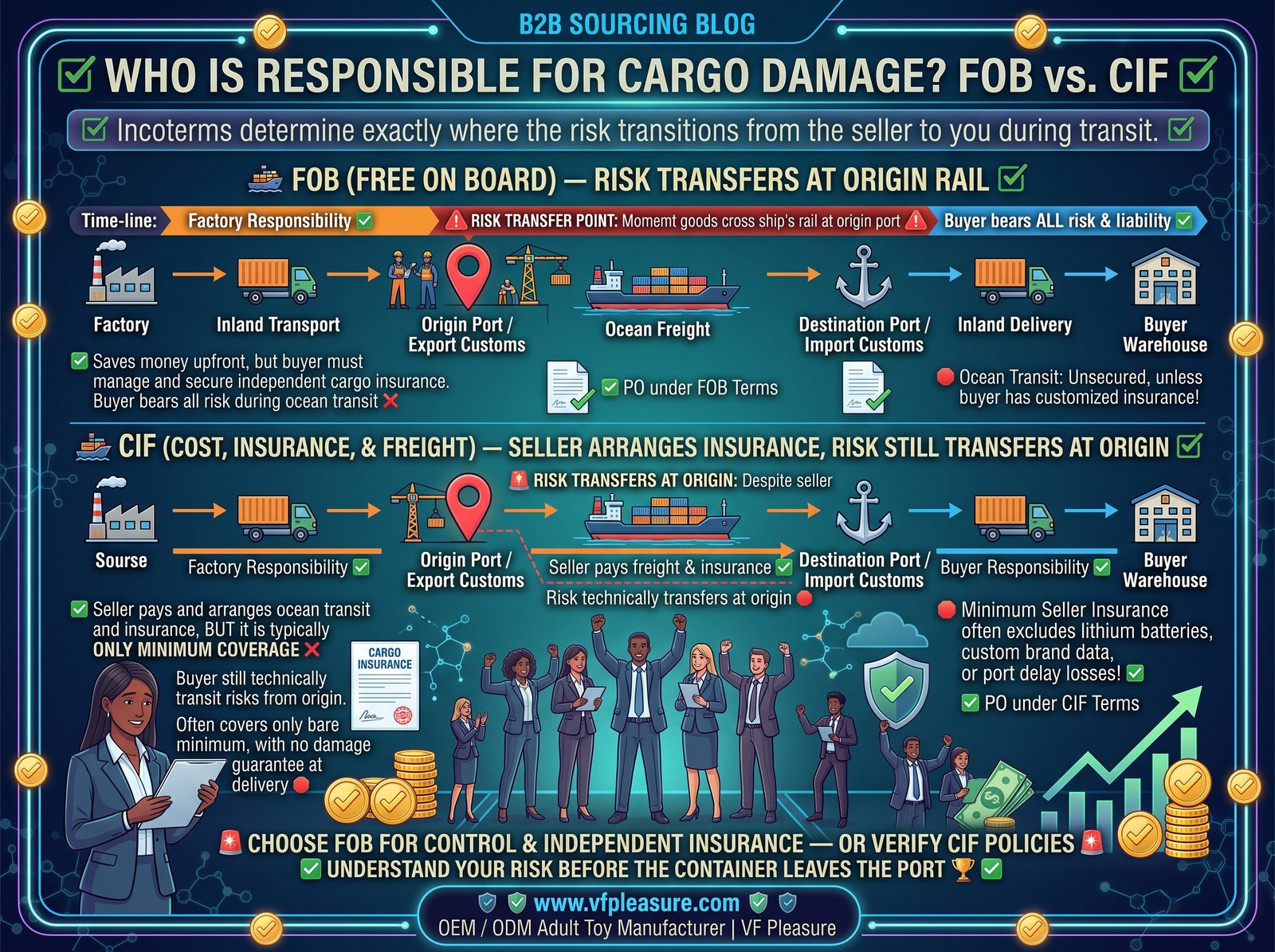
The Incoterm that determines risk responsibility for cargo damage in adult toy imports is almost always either FOB (Free On Board) or CIF (Cost, Insurance, and Freight). Under FOB, risk transfers to the buyer the moment goods cross the ship's rail at the port of origin — the buyer bears all risk during ocean transit and is responsible for arranging their own cargo insurance. Under CIF, the seller arranges and pays for insurance to the port of destination — but the insurance often provides only minimum coverage and the risk still technically transfers to the buyer at origin.2
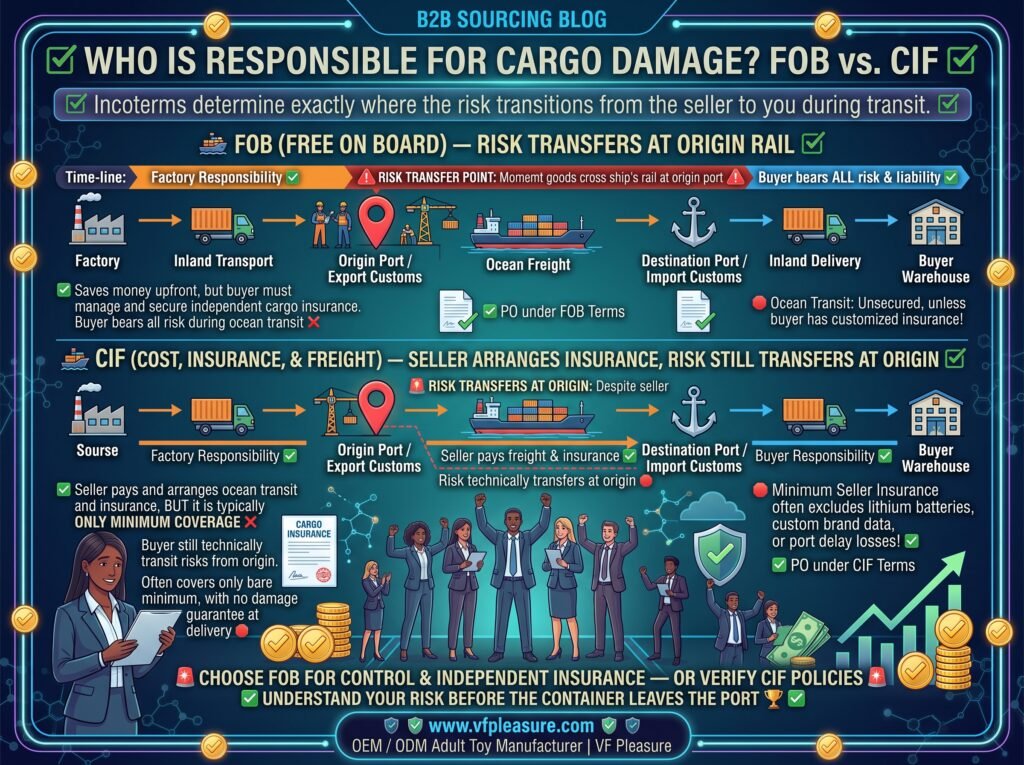
Here is the full Incoterm risk transfer map — with the specific implication for adult toy importers at each stage.
📊 Incoterm Risk Transfer Map for Adult Toy Importers
| Incoterm | Risk Transfers To Buyer | Who Arranges Insurance | Practical Implication |
|---|---|---|---|
| EXW (Ex Works) | Factory loading dock | Buyer | Buyer bears all risk from factory gate. Maximum buyer risk exposure. |
| FOB (Free On Board) | Ship's rail at origin port | Buyer | Most common for China exports. Buyer responsible once loaded on vessel. |
| CFR (Cost & Freight) | Ship's rail at origin port | Buyer | Seller pays freight but buyer still bears transit risk — must arrange own insurance. |
| CIF (Cost, Insurance, Freight) | Ship's rail at origin port | Seller (minimum coverage) | Seller provides insurance but typically at Institute Cargo Clause C — minimum cover. |
| DAP (Delivered At Place) | Named destination | Seller | Seller bears risk to named destination. Buyer only bears unloading and customs costs. |
| DDP (Delivered Duty Paid) | Named destination | Seller | Maximum seller risk. Seller bears all risk including customs, duties, and delivery. |
🎯 The FOB Reality for Most Adult Toy Importers
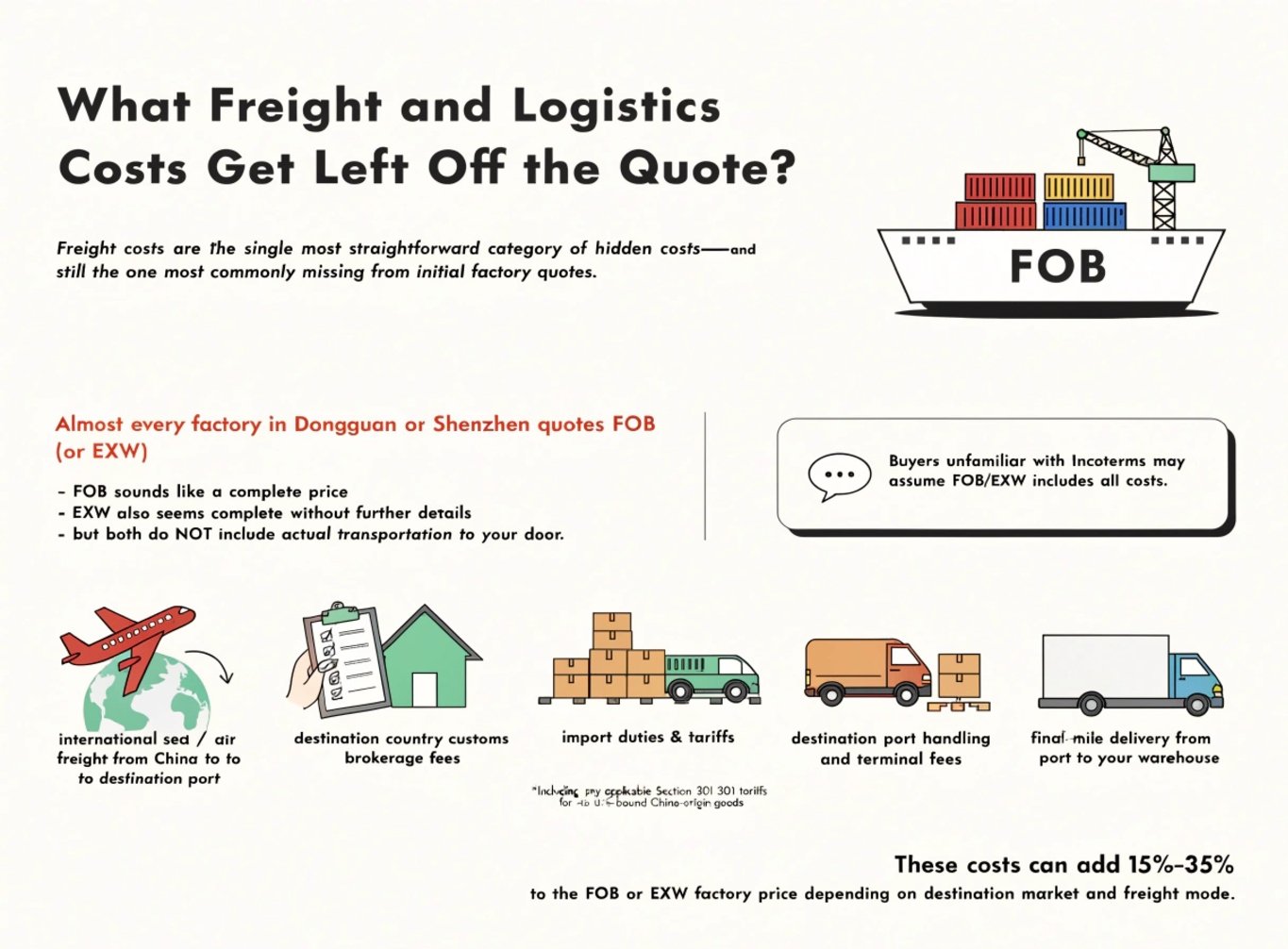
The majority of Chinese adult toy exports operate under FOB terms — because FOB is the standard export quotation structure for most Chinese manufacturers, including the quote format most buyers receive from factories. This means most adult toy buyers are fully exposed to cargo damage risk during ocean transit without having made a conscious decision to self-insure. Many simply assume the freight forwarder's fee includes insurance coverage. It almost never does.
At VF Pleasure, our standard mass order lead time is 25–35 days with expedited options available. Our goods travel from Dongguan to Guangzhou Nansha port or Shenzhen Yantian port before ocean transit — a journey where goods are handled multiple times before they even reach the vessel. Under FOB terms, your risk begins at the port, not at our factory gate.
🚢 The CIF Misunderstanding
CIF sounds safer for buyers — the seller arranges and pays for insurance. But two details undermine this apparent protection:
-
Risk still transfers at origin: Despite the seller arranging insurance, the buyer holds the risk from the moment goods pass the ship's rail. If there is a dispute about whether damage occurred before or after loading, the buyer — not the seller — bears the claim burden.
-
CIF insurance is typically minimum cover: Sellers arranging CIF insurance have no incentive to purchase premium coverage — they are not bearing the risk. Most CIF insurance is at Institute Cargo Clause C (the minimum standard), which covers only major perils and excludes most partial damage scenarios.
The practical advice: regardless of your Incoterm, arrange your own marine cargo insurance through a broker who understands your cargo and your markets.
What Types of Cargo Insurance Should Adult Toy Importers Know?
Cargo insurance is not one product. It is a spectrum of coverage levels with very different claims outcomes. Understanding which type you have — and which type you need — is the difference between a claim that recovers your loss and a claim that gets denied.
The three core cargo insurance types that adult toy importers need to understand are: Institute Cargo Clause A (all-risk coverage that covers virtually any physical loss or damage unless specifically excluded), Institute Cargo Clause B (named perils coverage covering major events like fire, sinking, and collision but excluding most handling damage), and Institute Cargo Clause C (minimum named perils coverage that excludes almost all standard warehouse and transit damage scenarios). Adult toy importers should operate on Clause A — any lesser coverage is functionally inadequate given the high value-to-weight ratio and handling complexity.3
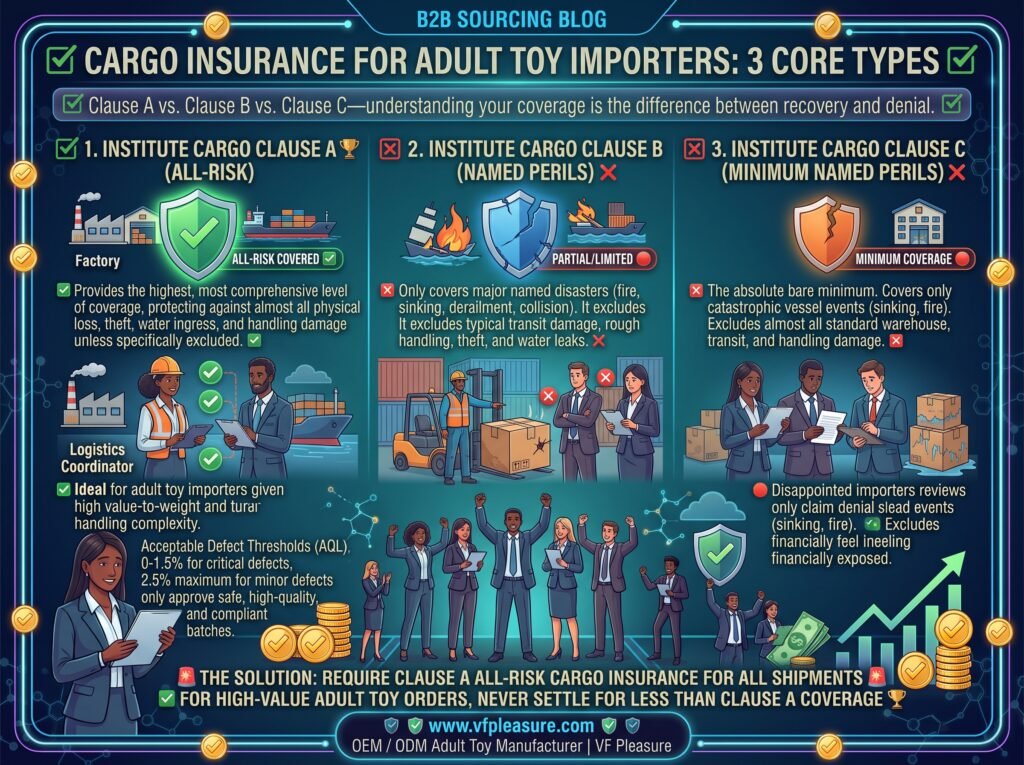
Here is what each coverage level actually covers — and the scenarios where each one fails you.
🛡️ Institute Cargo Clause A — What Adult Toy Importers Need
Clause A is all-risk coverage. It covers any physical loss or damage to the insured goods during the insured transit unless the loss falls within a specific exclusion category. Standard exclusions include:
- Inherent vice — damage the goods would have suffered regardless of how they were handled (e.g., silicone degradation due to a pre-existing material defect)
- Delay — losses attributable to delayed delivery rather than physical damage
- Inadequate packaging — damage caused by packaging insufficient for the transit method
- War and strikes — typically covered by separate war and strikes clauses
For adult toy importers, Clause A is the minimum practical standard. Handling damage at port facilities — the crushed carton scenario from the opening — is covered under Clause A and excluded under B and C.
⚠️ Institute Cargo Clause B — Why It Is Insufficient
Clause B covers fire, explosion, vessel stranding, sinking, overturning, collision, discharge at port of distress, earthquake and lightning, and water entry. It does not cover: general handling damage, accidental dropping, moisture damage, theft of individual items from containers, and most partial damage scenarios that are not attributable to a named major event.
The majority of adult toy cargo damage claims involve handling damage — crushed cartons, dropped pallets, moisture infiltration through damaged outer packaging. Clause B does not cover any of these.
🚫 Institute Cargo Clause C — Minimum Coverage, Maximum Exposure
Clause C is the coverage most commonly provided under CIF terms. It covers only total loss or major damage from fire, explosion, vessel loss, or discharge at a port of distress. It provides essentially no protection for any routine cargo handling event.
If your factory is quoting you CIF and providing Clause C coverage, you are commercially uninsured for the vast majority of realistic damage scenarios.
📋 Coverage Comparison by Risk Event
| Risk Event | ICC A | ICC B | ICC C |
|---|---|---|---|
| Fire or explosion on vessel | ✅ | ✅ | ✅ |
| Vessel sinking or stranding | ✅ | ✅ | ✅ |
| Forklift accident at port | ✅ | ❌ | ❌ |
| Container drop during loading | ✅ | ❌ | ❌ |
| Water entry through damaged packaging | ✅ | ✅ | ❌ |
| Theft from container | ✅ (with separate clause) | ❌ | ❌ |
| Moisture damage | ✅ | ❌ | ❌ |
| Partial carton damage from handling | ✅ | ❌ | ❌ |
💡 Sally's practical note: In 15 years of manufacturing experience, I have seen clients lose cargo from almost every scenario in that table. Fire and vessel sinking are rare. Forklift accidents, dropped containers, and partial carton damage are common. Clause A is not a luxury — it is the only coverage that protects against the scenarios that actually happen.
What Adult Toy Specific Risks Does Standard Cargo Insurance Miss?
Even with Clause A coverage, adult toy importers face two categories of risk that standard marine cargo policies either exclude explicitly or handle inadequately: lithium battery component claims and customs seizure scenarios.
Standard cargo insurance policies may exclude or reduce coverage for adult toy shipments containing lithium-ion batteries unless the batteries are declared at booking, UN38.3 certification documentation is presented, and the policy is specifically endorsed to cover lithium-containing goods. A policy that does not name lithium battery goods may deny claims on the basis that the shipper failed to disclose dangerous goods material in the manifest.4
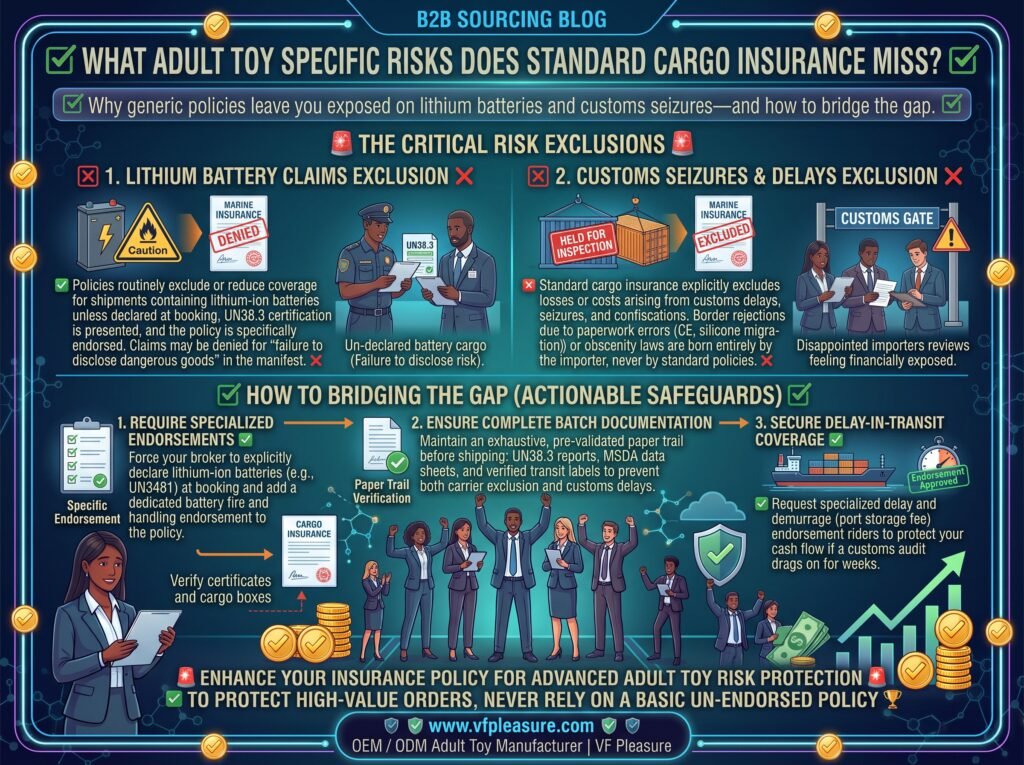
Here is each adult toy specific insurance risk — with what to do about each one before your next shipment.
🔋 Risk 1 — Lithium Battery Disclosure and Coverage
Every rechargeable adult toy contains a lithium-ion cell — typically a small 3.7V LiPo battery in a bullet vibrator or a larger pack in a rechargeable wand or couples toy. Lithium batteries are classified as dangerous goods under IATA regulations (air freight) and IMDG regulations (sea freight) and must be declared in your shipping manifest.
Standard cargo insurance policies often contain language such as "goods containing dangerous goods as defined by IATA/IMDG are excluded unless declared at time of booking." If you did not declare lithium-containing goods at booking, you may have coverage on the box but not on its contents.
What to do:
- Confirm with your freight forwarder that your shipment is manifested as containing lithium batteries (UN 3481 for batteries in equipment)
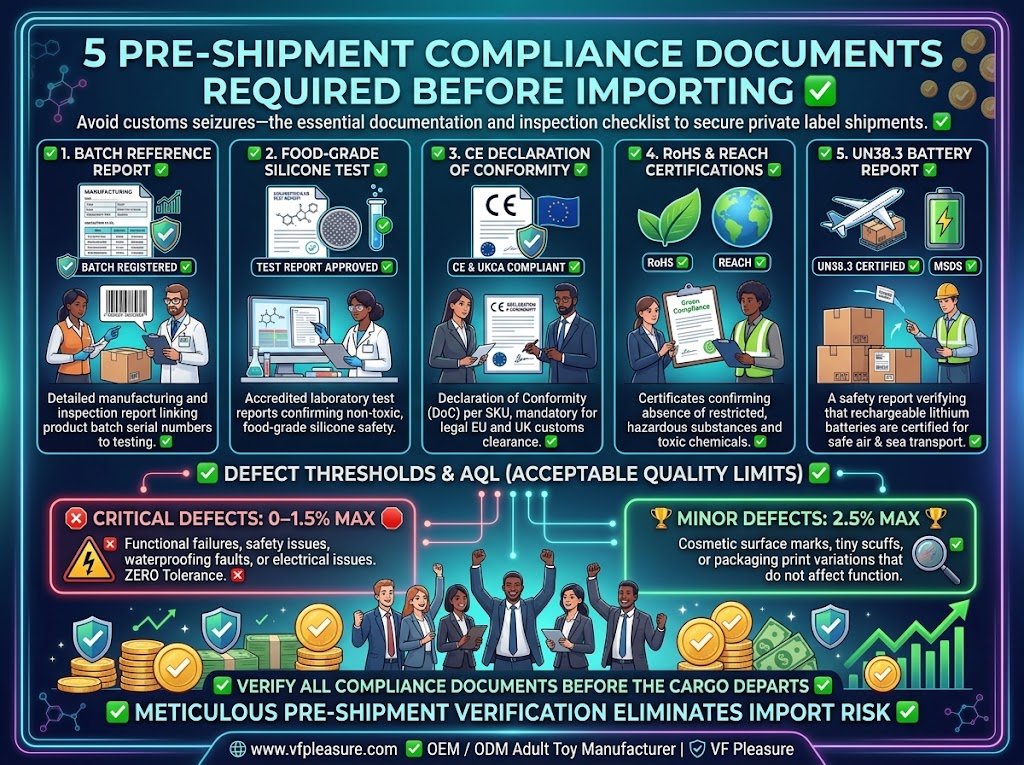
- Provide UN38.3 certification documentation to your insurer at booking — not after a claim
- Ask your cargo insurance broker specifically: "Does this policy cover goods containing lithium-ion batteries shipped under Section II of IATA PI 967/970?"
At VF Pleasure, we provide compliance certificates for every batch, including UN38.3 battery documentation for rechargeable products. Having this documentation ready before shipment is part of our standard documentation package.
🚫 Risk 2 — Customs Seizure and Confiscation
In some markets and some shipping lanes, adult product shipments face heightened customs inspection risk. If a shipment is seized or confiscated at customs — even for a documentation issue rather than a legality issue — standard cargo insurance does not cover the loss.
Cargo insurance covers physical loss or damage from physical perils. Customs seizure is an administrative action, not a physical peril. The loss is real and total — but it is uninsured by any standard marine cargo policy.
What protects you against this risk is documentation quality, not insurance. CE compliance documentation per SKU, food-grade silicone certification per batch, correct HS classification, accurate commercial invoice values, and clean UN38.3 battery certification are the documents that prevent customs holds from becoming confiscations. At VF Pleasure, we provide full documentation to ensure smooth importation and compliance across all target markets — because documentation is both a compliance tool and a customs clearance risk reduction tool.
🌡️ Risk 3 — Temperature and Humidity Damage
Food-grade platinum silicone is stable across a wide temperature range — non-porous and hypoallergenic, ensuring products are safe, durable, and easy to clean. But extreme temperature or humidity during transit can affect ABS plastic components, printed packaging materials, and electronic components.
Most standard Clause A policies do not cover temperature or humidity damage unless it is caused by a covered peril (e.g., water entry from a vessel damage event). Damage from a container stored in a heat-exposed location or subjected to temperature cycles during transit is typically excluded.
What to do: Specify inner packaging requirements to your factory that include moisture barriers, silica gel desiccant packs in each carton, and inner plastic wrapping around products. At VF Pleasure, our packaging development includes carton-level moisture protection specifications that reduce this risk at the packing stage.
How Do You File a Successful Cargo Insurance Claim for Adult Toys?
Filing a cargo insurance claim without the right documentation is almost always unsuccessful — not because the insurer is acting in bad faith, but because the documentation requirements for a successful claim are specific, sequential, and time-sensitive. Missing any single requirement can result in claim denial even when the physical damage is undeniable.
A successful cargo insurance claim for an adult toy shipment requires five documentation elements: a claused bill of lading or air waybill notation showing the damage was identified at point of delivery, a commercial invoice showing the declared value matching the insured value, photographic evidence of the damage taken before any goods are moved or disposed of, a cargo survey report from an approved surveyor, and the original cargo insurance certificate covering the shipment.5
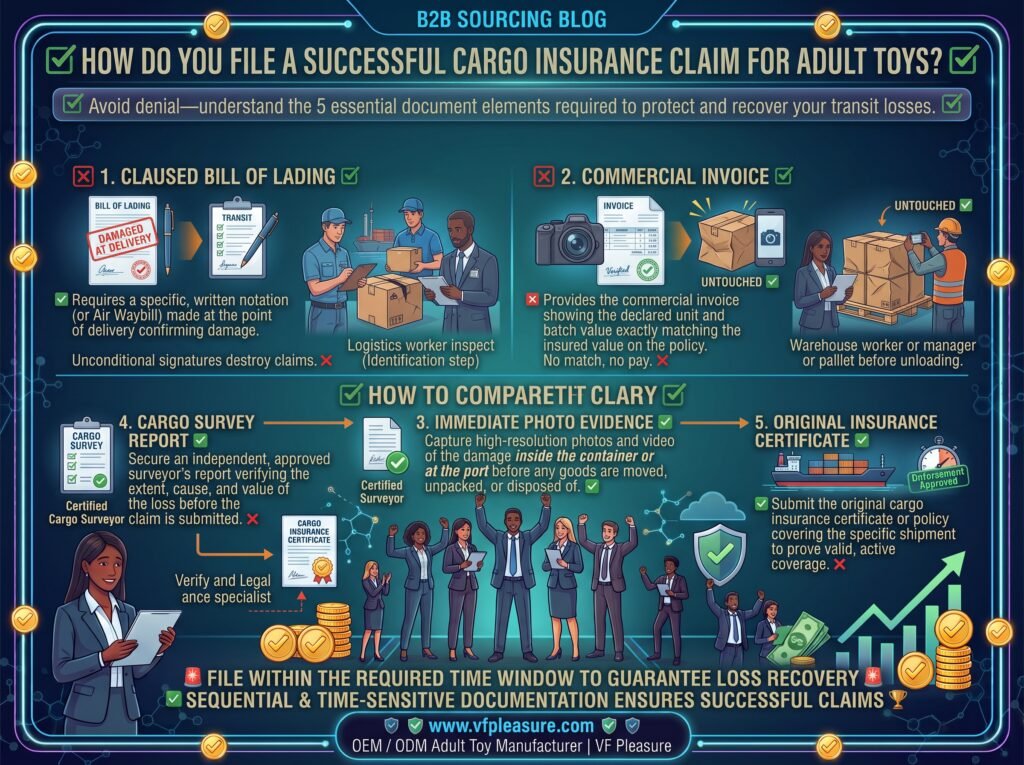
Here is the exact claims process — in the order it must be executed to protect your entitlement.
📝 Step 1 — Note the Damage on the Delivery Receipt (Immediate)
The single most important action in a cargo insurance claim sequence is noting the damage on the delivery receipt — the document you sign when the goods are handed over at destination. This document is called the Bill of Lading (B/L) receipt notation for sea freight or the airway bill receipt notation for air freight.
If you sign the delivery receipt as "received in good order" without noting visible damage, you have created a document that contradicts your damage claim. Always inspect visually before signing. If any carton is damaged, write specifically on the receipt: "received with [X] cartons showing [description of damage]." If you cannot inspect at delivery, write "received — subject to inspection."
This notation is not a complaint. It is a legal record that damage was present at delivery — which is required to establish that damage occurred during transit rather than after.
📸 Step 2 — Photograph Everything Before Moving Anything
Before any goods are moved, unpacked, or reorganised, photograph:
- The outer packaging showing damage
- The damage to individual cartons showing the point of impact or compression
- The inner products if visible through damaged packaging
- The delivery location and any handling equipment visible
- Any marks or stickers on the damaged cartons referencing carrier identity
These photographs are your evidence that the damage was present in the condition received — not something that happened after unloading.
📋 Step 3 — Notify Your Insurer Within the Policy Window
Most cargo insurance policies require notification of a claim within a specific window — typically 7–30 days of delivery. Check your policy for the exact requirement. Late notification is one of the most common grounds for claim denial.
Your notification should include: the policy number, the shipment details (vessel name or flight number, origin port, destination port), the date of delivery, and a brief description of the damage discovered. This notification starts the claim clock — the detailed documentation comes later.
🔍 Step 4 — Commission a Cargo Survey Report
A cargo survey report from an approved independent marine surveyor is typically required by insurers before processing a significant claim. The surveyor assesses: the physical damage, the probable cause, the extent of loss, the salvage value of damaged goods, and the replacement cost.
For adult toy shipments, the survey also needs to address:
- Whether food-grade silicone products are salvageable (surface damage may make them commercially unsaleable even if technically intact)
- Whether lithium battery components are safe for transport after impact damage
- The replacement cost including compliance documentation regeneration
Authorise the surveyor quickly — most policies require the survey to be commissioned within a specific window and completed before damaged goods are disposed of or moved.
📦 Step 5 — Compile Your Claims Documentation Package
A complete claims package for an adult toy shipment includes:
| Document | Purpose | Source |
|---|---|---|
| Cargo insurance certificate | Proves coverage was in place | Your insurer |
| Commercial invoice | Establishes declared value | Your factory |
| Packing list | Confirms contents per carton | Your factory |
| Bill of lading or AWB | Confirms shipment and clausing notation | Freight forwarder |
| Delivery receipt with damage notation | Establishes damage at delivery | Your record |
| Photographs of damage | Visual evidence | Your team |
| Cargo survey report | Independent damage assessment | Marine surveyor |
| Replacement cost quotation | Quantifies the claim | Factory (replacement quote) |
| Compliance documentation costs | For private label documentation regeneration | Compliance consultant |
💡 Sally's note on claim preparation: At VF Pleasure, we maintain copies of all compliance documentation — CE, RoHS, food-grade silicone migration test reports, batch records — and can provide replacement documentation for insurance purposes. When a shipment is damaged and replacement is needed, we can expedite the production of a replacement batch and provide new batch-specific documentation. This accelerates the claim process because the replacement cost quotation can be prepared quickly. Keep your factory informed as soon as you identify a damage event — their responsiveness directly affects your claim timeline.
How Does Strong Packaging Reduce Your Insurance Risk from the Factory?
Cargo insurance is the financial backstop when goods are damaged. Strong packaging from your factory is the physical backstop that prevents damage from occurring at all — and it has a direct relationship with your insurance claim entitlement, because insurers can deny claims where damage is attributable to inadequate packaging.
Strong factory packaging reduces adult toy cargo insurance risk through two mechanisms: physical protection that prevents damage during the handling events most likely to occur in transit, and documentation of packaging standards that protects your claim entitlement against the inadequate packaging exclusion that insurers use to deny coverage when cargo is damaged.6
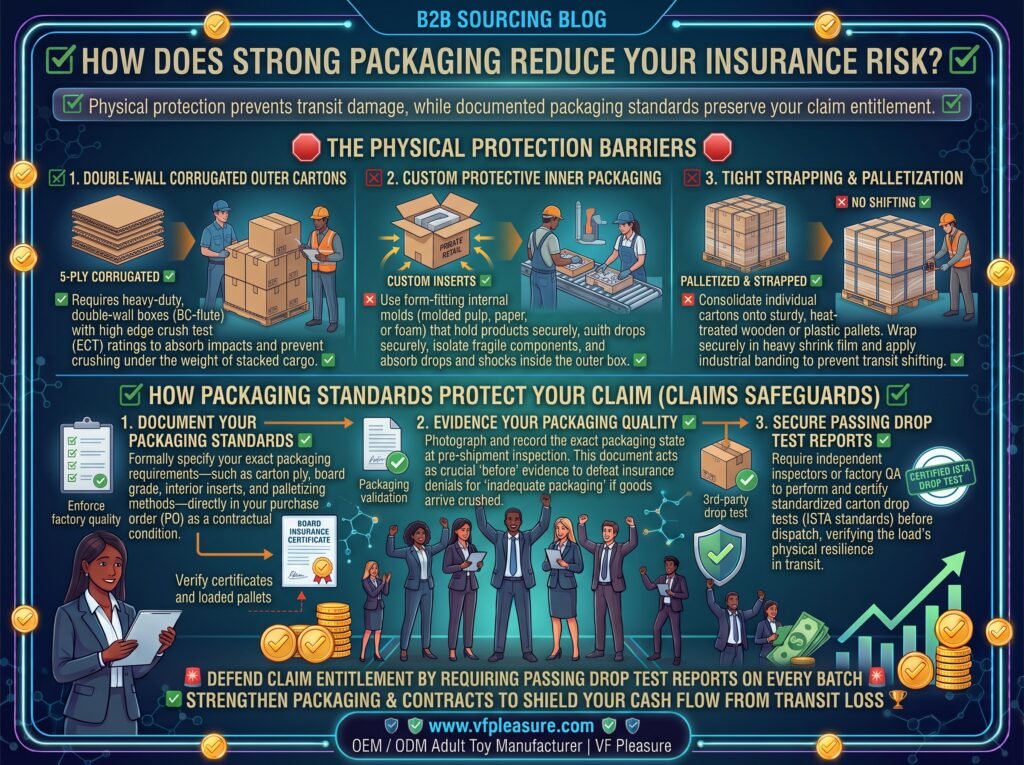
Here is how packaging quality at the factory level interacts with your insurance coverage.
📦 How VF Pleasure's Packaging Testing Protects Your Cargo
At VF Pleasure, our packaging passes drop testing using a 3-metre height simulator and stress testing using 50kg pressure rigs before any order is dispatched. These tests are not for show — they validate that the carton structure, inner padding, and product positioning will survive the handling events that occur in real transit: dropped by a forklift, compressed under other pallets, handled by mechanical equipment at port.
Food-grade silicone is prioritised for its non-porous, hypoallergenic properties — and a properly packaged food-grade silicone vibrator can survive the physical stresses of international transit without product damage even when outer packaging is compromised. The product material itself is part of the cargo protection system.
⚠️ The Inadequate Packaging Exclusion
Most cargo insurance policies contain a clause that denies coverage where damage is attributable to "insufficient or unsuitable packing of the goods." If an insurer's surveyor determines that your packaging was not appropriate for the transit method — and that the damage resulted from the packaging failure rather than a covered peril — your claim may be denied in whole or in part.
The defences against this exclusion are:
- Factory documentation confirming the packaging passed drop and compression testing consistent with the transit method
- Evidence that the packaging met the standards required by the freight carrier for that shipping lane
- A cargo survey report that confirms the damage was caused by a covered peril (impact, water entry) rather than inherent packaging inadequacy
Our packaging development includes carton-level specifications verified by our QC system — documentation we provide to clients who request it for cargo insurance purposes.
📋 Cargo Protection Checklist: Before Your Shipment Leaves the Factory
| Protection Layer | What to Confirm | Who Provides It |
|---|---|---|
| Inner product packaging | Individual product sealed in PE bag or blister with silica gel | Factory |
| Inner box padding | Foam or paper padding around each product unit | Factory |
| Carton compression rating | Edge Crush Test (ECT) rating stated on carton | Factory |
| Moisture barrier | Poly liner inside each carton | Factory |
| Carton seal | All carton seams taped on both sides | Factory |
| Drop test documentation | Written record of packaging drop test result | Factory |
| Stress test documentation | Written record of compression test result | Factory |
| Pallet stability | Shrink-wrap over pallet confirmed before loading | Freight forwarder |
Request confirmation of each of these items before authorising shipment release from the factory. A factory that cannot confirm its packaging has been tested to the freight standards applicable to your shipping lane is a factory whose packaging may contribute to a denied insurance claim.
Conclusion
When your adult toy shipment is damaged, who pays comes down to three decisions you made before the goods left the factory: your Incoterm, your insurance type, and whether your documentation was complete. Clause A insurance, FOB terms with buyer-arranged coverage, lithium battery declaration, and factory packaging documentation do not prevent damage — but they determine whether you recover from it.
🚀 Source Adult Toys from a Factory Built for Transit-Ready Shipments
At VF Pleasure, every shipment leaves our Dongguan facility with packaging tested to 3-metre drop standards, compliance documentation ready for customs and insurance claims, and full CE, RoHS, REACH, and CA65 certification per batch. Our food-grade platinum silicone products are built for the physical stresses of international transit as well as the compliance demands of regulated markets.
We support every shipment with:
- ✅ Transit-ready packaging — drop-tested to 3m, compression-tested to 50kg, moisture-protected per carton
- ✅ Complete compliance documentation per batch — CE, RoHS, REACH, CA65, and food-grade silicone migration test reports
- ✅ UN38.3 battery certification — for all rechargeable products, required for manifest declaration and insurance coverage of lithium-containing goods
- ✅ Third-party lab verification — SGS or Bureau Veritas for private label sex toys orders
- ✅ Full product range — vibrators, female sex toys, couples toys, thrusting sex toys, and male adult toys
📬 Start Your Shipping-Ready Sourcing Conversation:
1. Which market are you importing into — and what is your freight method?
(US / EU / UK / Australia — sea freight or air freight — determines which insurance standards apply and which compliance documents you need at customs)2. What product category and order volume are you planning?
(Volume and product type affect packaging specifications, UN38.3 requirements, and insurance valuation)3. Are you currently operating under FOB or CIF terms — and do you have Clause A cargo insurance in place?
(This tells me whether I need to flag any specific shipping risk exposure in your current setup)👉 Request Compliance Documentation Package + Free Product Samples from VF Pleasure →
References & Source Notes
-
VF Pleasure — Adult Toy Customs CE & RoHS Compliance Guide 2026
| Field | Detail |
|---|---|
| 📌 Supports | When adult toy cargo is damaged, liability depends on the Incoterm (which determines risk transfer point), the cargo insurance type purchased, and the documentation available for claims. Most FOB shipments transfer risk to the buyer at origin. VF Pleasure provides full documentation for smooth importation and compliance across all target markets, including CE, RoHS, REACH, CA65, and food-grade silicone certification per batch. |
| 🔍 Evidence Role | Definition + General Support |
| 📁 Source Type | Industry Guide |
⚠️ Scope Note: Incoterm risk transfer descriptions and carrier liability limits cited reflect general industry standards at time of writing. Actual carrier liability limits, Incoterm interpretations, and insurance coverage requirements vary by carrier, insurance provider, jurisdiction, and specific contract terms. All cargo insurance arrangements should be confirmed with a licensed marine insurance provider before shipment.
-
VF Pleasure — Evaluate Chinese Adult Toy Factory Delivery Capability
| Field | Detail |
|---|---|
| 📌 Supports | FOB and CIF are the dominant Incoterms for Chinese adult toy exports. Under FOB, the buyer bears transit risk from the ship's rail at origin. Under CIF, the seller arranges insurance but typically provides minimum Clause C coverage, and risk still transfers to the buyer at origin. VF Pleasure's standard mass order lead time is 25–35 days with expedited options, supporting buyer insurance planning timelines. |
| 🔍 Evidence Role | General Support |
| 📁 Source Type | Industry Guide |
⚠️ Scope Note: Incoterm descriptions follow the ICC Incoterms 2020 standard. Incoterm application may vary by individual contract and carrier. Buyers should confirm the specific Incoterm in their purchase order and its implications with their freight forwarder and a licensed insurance professional.
-
VF Pleasure — Adult Toy Quality Compliance Guide
| Field | Detail |
|---|---|
| 📌 Supports | Institute Cargo Clause A (all-risk) provides the only practically adequate cargo insurance for adult toy importers. Clause B and C exclude most handling damage scenarios — forklift accidents, dropped containers, partial carton damage — that represent the most common real-world cargo damage events. Adult toy high value-to-weight ratios make Clause A essential. |
| 🔍 Evidence Role | Mechanism |
| 📁 Source Type | Industry Guide |
⚠️ Scope Note: Institute Cargo Clause descriptions reflect the standard ICC marine insurance framework. Specific policy terms vary between insurers, and exclusions within any policy should be reviewed directly with the issuing insurance provider. The coverage comparison table reflects the general scope of each clause — individual policy endorsements may modify coverage in either direction.
-
VF Pleasure — Adult Toy Customs CE & RoHS Compliance Guide 2026
| Field | Detail |
|---|---|
| 📌 Supports | Adult toy specific cargo insurance risks include lithium battery exclusions requiring UN38.3 documentation at booking, customs seizure risks not covered by any standard cargo policy (documentation quality is the protection), and temperature/humidity damage scenarios excluded from most standard policies. VF Pleasure provides UN38.3 certification for all rechargeable products and compliance documentation to prevent customs holds. |
| 🔍 Evidence Role | General Support |
| 📁 Source Type | Industry Guide |
⚠️ Scope Note: Lithium battery exclusion provisions vary by insurance provider and specific policy. Customs seizure risk and temperature damage exclusions reflect general standard cargo insurance policy terms. All specific coverage questions should be confirmed with the issuing insurer before relying on coverage assumptions for any specific shipment.
-
VF Pleasure — Adult Toy Manufacturing Challenges and Solutions
| Field | Detail |
|---|---|
| 📌 Supports | A successful cargo insurance claim requires five documentation elements: claused delivery receipt, commercial invoice matching insured value, photographs of damage before movement, cargo survey report, and insurance certificate. VF Pleasure maintains copies of all compliance documentation and can provide replacement batch documentation and expedited re-production for insurance replacement claims. |
| 🔍 Evidence Role | Mechanism |
| 📁 Source Type | Industry Guide |
⚠️ Scope Note: Cargo claim documentation requirements described are general industry best practice. Specific requirements vary by insurer, policy terms, and the nature of the loss. Notification windows and survey requirements should be confirmed in the specific policy before a claim event occurs. This article does not constitute insurance advice — consult a licensed marine insurance professional for claim-specific guidance.
-
VF Pleasure — Crafting High-Quality Adult Toys
| Field | Detail |
|---|---|
| 📌 Supports | Strong factory packaging reduces cargo insurance risk through physical damage prevention and by protecting claim entitlement against the inadequate packaging exclusion. VF Pleasure's packaging passes 3m drop testing and 50kg compression testing, and food-grade platinum silicone provides inherent product resilience during transit. Inadequate packaging is a documented basis for cargo insurance claim denial. |
| 🔍 Evidence Role | General Support |
| 📁 Source Type | Industry Guide |
⚠️ Scope Note: Packaging test specifications (3m drop, 50kg compression) reflect VF Pleasure's internal packaging validation standards. Specific carrier and insurance packaging requirements vary by freight method, route, and policy terms. The inadequate packaging exclusion is a standard provision in marine cargo policies — its application depends on the specific facts of each damage scenario and the insurer's assessment. Buyers should request factory packaging test documentation and confirm it meets carrier requirements with their freight forwarder.