Skip to content

Your product is done. The samples passed. The food-grade silicone is confirmed. The compliance documentation is ready. Now your factory needs one more thing before they can pack and ship: your complete packaging specification — the barcodes, SKU labels, inner box details, master carton markings, and quantity-per-case information that tells the packing team exactly what to apply, where to apply it, and how to build every shipping unit.
This is the step most private label brands get wrong — not because it is complicated, but because nobody tells them what the factory actually needs. The result is a shipment that arrives at your warehouse, 3PL, or Amazon FBA centre labelled incorrectly, packed in the wrong quantities, or missing the data your receiving team needs to confirm the shipment against your purchase order.
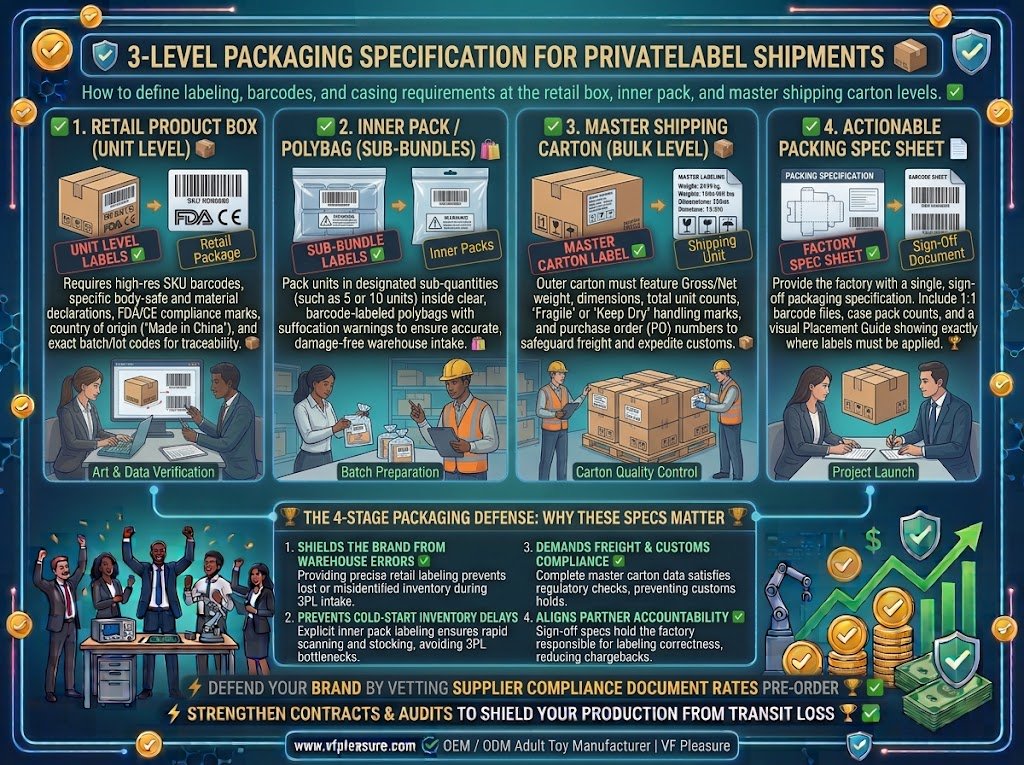
A private label sex toy packaging specification covers information at three distinct physical levels: the retail product box (what your customer holds), the inner pack or polybag label (what your warehouse scans on intake), and the master shipping carton (what your freight forwarder and receiving dock use to verify and process the shipment). Each level has different data requirements, different parties responsible for providing the information, and different consequences when something is missing.1
I'm Sally. I run VF Pleasure — a direct adult toys factory in Dongguan, China, with 15+ years of B2B manufacturing experience. VF Pleasure provides private label services with custom packaging, logos, and colours to create unique products — and part of that service is managing the packaging specification process so that shipments arrive at clients' fulfilment destinations correctly labelled and documented.
This guide gives you the complete packaging specification checklist, sorted by packaging level and responsibility owner. At the end, you will find a downloadable handover table you can complete and send to your factory before packaging production begins.
- 1 Why Does Packaging Label Accuracy Matter More Than Most Brands Expect?
- 2 Level 1: The Retail Product Box — What Goes on the Box Your Customer Opens?
- 3 Level 2: The Inner Pack or Polybag — What Goes on the Unit-Level Label?
- 4 Level 3: The Master Shipping Carton — What Goes on the Outside of Every Carton?
- 5 Who Is Responsible for What — Brand vs Factory Responsibility Matrix
- 6 The Physical Scan Verification: What to Check Before You Approve Shipment
- 7 The Packaging Handover Table: What to Send Your Factory
- 8 Conclusion
- 9 References & Source Notes
Why Does Packaging Label Accuracy Matter More Than Most Brands Expect?
The brand presentation side of packaging — matte box, embossed logo, satin insert — is what most private label guides cover. This guide covers the operational side: the information that makes your shipment scannable, receivable, and correctly processable at every stage of the supply chain between your factory and your customer.
Packaging label accuracy matters because every physical handover point in your supply chain — factory to freight forwarder, customs clearance, 3PL warehouse intake, Amazon FBA check-in, retail buyer receiving dock — requires specific information in a specific location to function without manual intervention. A missing barcode at Amazon FBA means the shipment is rejected. A wrong unit count on a master carton means your receiving team's count does not match the packing list. A missing country of origin on the retail box means a customs query you cannot resolve from 12,000 kilometres away.1
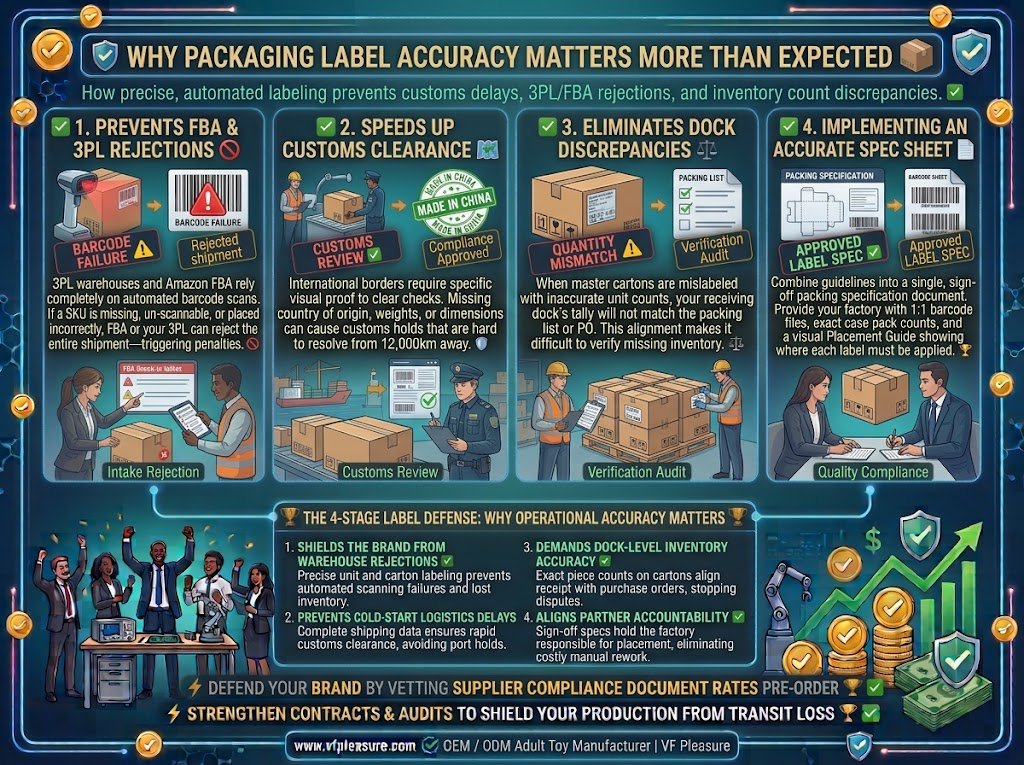
Here is the consequence map — what a missing or incorrect element at each packaging level creates downstream.
⚠️ Missing Information Consequence Map
| Missing Element | Level | Downstream Consequence |
|---|---|---|
| UPC / EAN barcode | Retail box | Amazon FBA rejection; retail buyer cannot scan to receive |
| Country of origin | Retail box | Customs query or hold at destination |
| FNSKU (Amazon FBA) | Retail box or polybag | Amazon will not admit inventory |
| SKU / item number | Retail box or inner label | Warehouse cannot match to PO; receiving error |
| Units per inner pack | Inner carton label | Warehouse counts are wrong from intake |
| Units per master carton | Outer carton label | Freight and receiving counts do not match packing list |
| Gross/net weight | Outer carton label | Freight quote based on wrong weight; customs may query |
| Dimensions | Outer carton label | Freight booking is wrong; pallet plan fails |
| Batch/lot code | Retail box or outer carton | QC traceability breaks; compliance documentation gap |
| Destination address | Outer carton label | Shipment goes to wrong location |
Our private label sex toys category covers the brand presentation side of packaging. This guide covers the operational data side — the two work together, and neither is complete without the other.
Level 1: The Retail Product Box — What Goes on the Box Your Customer Opens?
The retail product box is the only packaging level your customer ever sees. It carries your brand story, your visual identity, and your positioning. But alongside all of that, it must also carry a set of operational data elements that are non-negotiable for the channel you are selling through — and that must be confirmed with your factory before printing begins.
The retail product box for a private label adult toy must carry eight operational data elements regardless of your brand design: a scannable barcode in UPC (US), EAN (EU/UK), or equivalent format; your brand name; the product name and model number or SKU; country of origin; material claim (food-grade silicone for body-contact surfaces); any required regulatory marks (CE logo, RoHS symbol, recycling symbol); compliance language (Prop 65 warning if shipping to California/US); and the importer's name and address for EU and UK market products.2
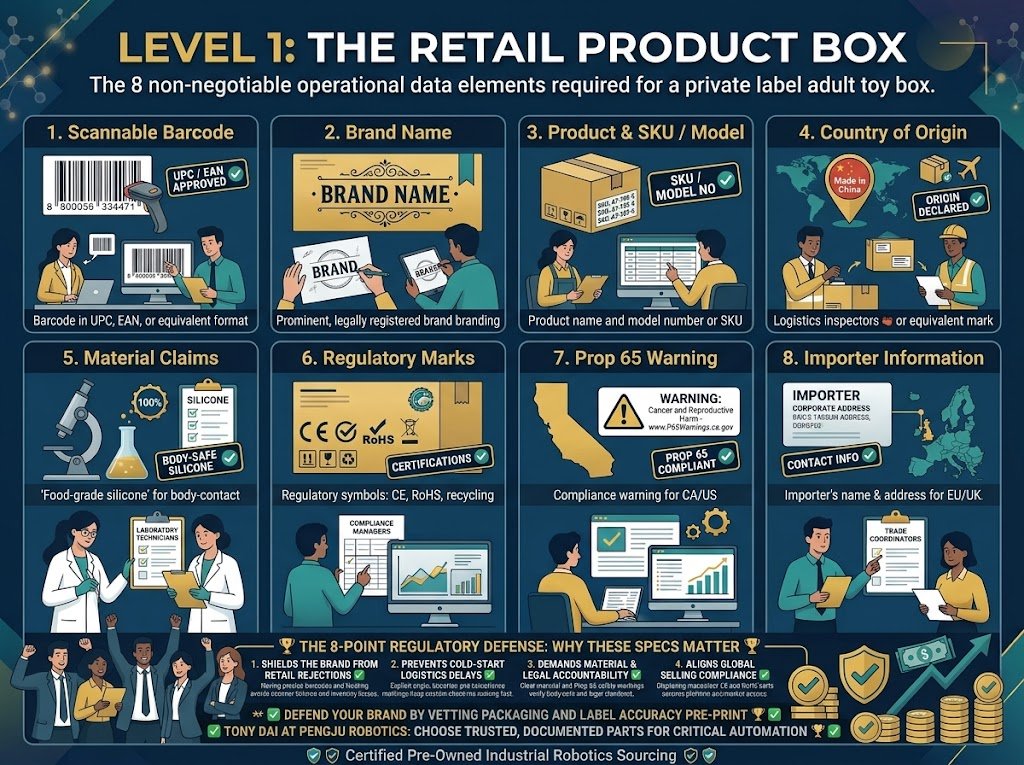
Here is each element — who is responsible for providing it, what format it needs to be in, and which distribution channels require it.
📦 Retail Box Element 1 — Barcode (UPC / EAN / FNSKU)
Who provides it: The brand owner — not the factory. Your factory cannot generate your barcode; they print what you provide.
Format requirements:
- US market: UPC-A barcode (12 digits). Requires a GS1 company prefix. Register at GS1 US (gs1.org/get-barcodes) if you do not already have one.
- EU/UK market: EAN-13 barcode (13 digits). GS1 prefix registration at your national GS1 organisation.
- Amazon FBA: FNSKU barcode (Amazon-assigned). Generated in Seller Central when you create the product listing. This is different from UPC/EAN and must be added as a separate label if you are selling through FBA.
What to provide to your factory: A vector or high-resolution EPS/PDF file of the printed barcode including the human-readable number beneath it. Do not provide a barcode image as a low-resolution PNG from a website — the scan rate will be poor.
Common mistake: Using the same UPC for multiple product variations (different colours, different sizes). Each variation needs its own unique barcode.
📦 Retail Box Element 2 — Material Claim: Food-Grade Silicone
Who provides it: The brand owner provides the copy; the factory confirms the material specification.
What it must say: "Food-grade silicone" for all body-contact surfaces. Never "medical-grade silicone" — adult toys are not medical devices and this claim creates regulatory exposure.
At VF Pleasure, all body-contact surfaces use food-grade platinum silicone — non-porous, hypoallergenic, and verified by third-party laboratory testing per production batch. All VF Pleasure products use food-grade silicone, ABS plastic, and other non-toxic body-safe materials. Your packaging copy must accurately reflect the specific material standard your factory uses — and VF Pleasure's standard is food-grade, not medical-grade.
📦 Retail Box Element 3 — Country of Origin
Who provides it: The factory — this is a manufacturing fact, not a brand decision.
What it must say: "Made in China" (or the actual country of manufacture). Required for US customs (19 CFR 134), EU market consumer protection requirements, and UK import labelling.
Where it appears: Typically on the bottom or back of the retail box, often in small print near other regulatory information.
Important note: Country of origin on the retail box must match the country of origin on the commercial invoice and shipping documentation. A mismatch creates a customs query.
📦 Retail Box Element 4 — Required Regulatory Marks
| Mark | Required For | Minimum Size |
|---|---|---|
| CE mark | Electronic products in EU and UK markets | 5mm height minimum |
| UKCA mark | Electronic products in UK market | 5mm height minimum |
| RoHS compliance symbol | Electronic products in EU/UK | Bin with X symbol |
| Battery recycling symbol | Products with batteries in EU/UK | Standard recycling symbol |
| Recycling symbol (materials) | Most EU market products | Standard triangle symbols |
These marks appear on the packaging artwork and must be sized correctly — an undersized CE mark can trigger a compliance flag. Your factory's compliance documentation covers the underlying standards; the marks on the box confirm compliance to customers and regulators.
📦 Retail Box Element 5 — EU Importer / UK Responsible Person Address
From December 2024 under the EU General Product Safety Regulation (GPSR), electronic products sold in the EU must carry the name and address of the EU responsible person on the product or packaging. For UK market sales, a UK-based responsible person address is required.
If you are importing into the EU or UK under your own brand name, your company name and address must appear on the box. If you are selling through a distributor who is the importer of record, their address appears instead.
Who provides it: The brand owner provides their business address for EU/UK market products.
Level 2: The Inner Pack or Polybag — What Goes on the Unit-Level Label?
Not every private label adult toy ships in a retail box. Some products — particularly those going through wholesale, 3PL, or Amazon prep services — need a unit-level label on the inner polybag or on the product box itself that carries operational data for warehouse scanning, not retail presentation.
The inner pack or polybag label for warehouse operations must carry three scannable or readable data elements: your SKU (your internal stock-keeping unit code), the FNSKU barcode if the product is going to Amazon FBA, and the product name in a form that matches your purchase order and warehouse management system. It may also carry the batch code for QC traceability, particularly important for food-grade silicone products where batch-level material documentation is your compliance chain.3
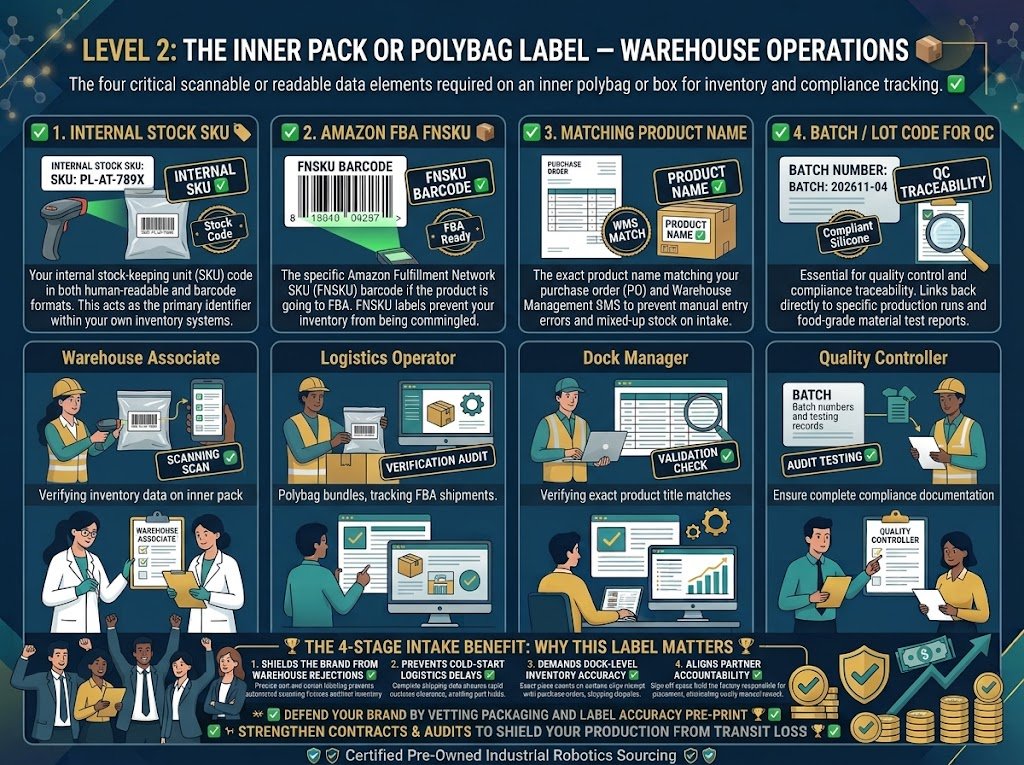
Here is each element — and the specific channel requirements that determine which ones you need.
🏷️ Inner Label Element 1 — Your SKU
Your SKU is your internal product identifier — it should match the product code in your inventory management system, your purchase orders with the factory, your warehouse receiving documents, and (for Amazon sellers) your Merchant SKU in Seller Central.
Format: Typically alphanumeric, 8–16 characters. Keep it consistent across all documents.
Who creates it: The brand owner. Set your SKU before you place the purchase order and include it on every document that references this product.
Why it matters at warehouse intake: When your 3PL or warehouse receives your shipment, they scan or manually enter the SKU from each unit to verify against your packing list. If the SKU on the box does not match what is in their system, receiving stops until the discrepancy is resolved.
🏷️ Inner Label Element 2 — FNSKU (Amazon FBA)
If any units are going to Amazon FBA, each unit that Amazon will receive needs an FNSKU label. This is Amazon's internal product identifier — it is different from your UPC/EAN, it is specific to your Amazon seller account, and it is generated in Seller Central when you convert the product to FBA.
Application options:
- Applied by factory in China: You send the FNSKU barcode file to your factory, they print and apply the labels during packing — this is the most cost-effective option if your FBA quantity is significant
- Applied by Amazon prep service: Goods arrive at a prep centre unlabelled; the prep service applies FNSKU labels — costs approximately $0.15–0.30 per unit
- Applied by FBA warehouse (Amazon service): Amazon can label units for a per-unit fee, but this is the most expensive option
What to provide to your factory: A PDF file of the FNSKU label at the correct print size (2.625" × 1" for standard US FBA labels). Your factory needs this file before packaging production is finalised.
🏷️ Inner Label Element 3 — Batch / Lot Code
For private label adult toys with food-grade silicone body-contact surfaces, the batch or lot code links the physical unit to its compliance documentation — the food-grade silicone migration test report that covers that production run.
Who provides it: The factory assigns the batch code. You record it from the packing list and QC documentation.
Where it appears: On the bottom of the retail box or on the inner polybag label, in small print. A 6–8 digit alphanumeric code format is standard.
Why it matters: If Amazon, a customs authority, or a retailer asks for compliance documentation for a specific product, you need to be able to connect the unit on your shelf to a specific batch code, and that batch code to the food-grade silicone test report that covers it. A product without a traceable batch code breaks this chain.
Level 3: The Master Shipping Carton — What Goes on the Outside of Every Carton?
The master carton is the unit your freight forwarder counts, your customs declaration is built around, and your receiving dock verifies when the truck arrives. Every carton label error at this level creates a discrepancy between physical goods and paperwork — which can trigger customs queries, receiving delays, or freight invoice disputes.
The master carton label for a private label adult toy shipment must carry ten elements that serve logistics, customs, and warehouse receipt simultaneously: brand name, product name and SKU, carton number (e.g., 1 of 20), quantity per carton (units), gross weight in kg, net weight in kg, carton dimensions (L × W × H in cm), country of origin, purchase order number, and destination address or warehouse code.4
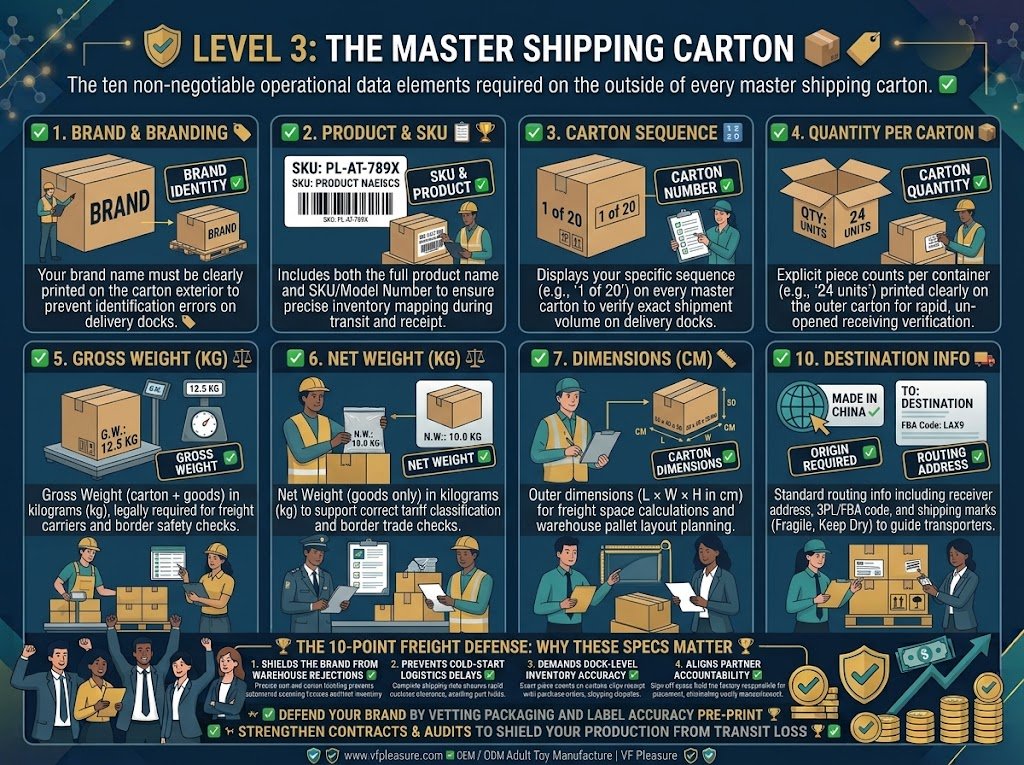
Here is each element — with the specific format your factory needs and who provides it.
📦 Master Carton Element by Element
Brand name: Your brand name, printed clearly on at least two sides of the carton. Not the factory's name.
Product name and SKU: The product name as it appears on your purchase order, plus your SKU. This links the physical carton to your inventory and purchase order documentation.
Carton number: Numbered sequentially (e.g., "Carton 1/20", "1 of 20"). This is critical for freight transit — it allows your freight forwarder to confirm all cartons shipped have arrived at destination. Missing carton numbers mean you cannot tell if the shipment is complete.
Quantity per carton: The number of individual retail units in this carton. This number must match your packing list exactly. A packing list error here causes receiving count discrepancies that can take days to resolve.
Gross weight: The weight of the sealed carton including all contents and packaging. In kilograms.
Net weight: The weight of the products inside the carton, excluding packaging materials. In kilograms.
Carton dimensions: Length × Width × Height in centimetres, measured on the sealed carton. This is used for freight booking and pallet planning.
Country of origin: "Made in China" or the actual manufacturing country. Must match all shipping documentation.
Purchase order number: Your PO number as issued to the factory. This is the link between physical goods and your financial documents.
Destination address or warehouse code: The delivery address (for direct delivery to your warehouse or 3PL) or the warehouse code (for Amazon FBA, this is the shipment ID from your shipment plan).
📏 Quantity Configuration: Deciding Units per Carton
Before your factory begins packing, you need to confirm the quantity configuration — how many retail units go into one master carton. This decision affects:
- Freight cost: Fewer, heavier cartons are usually cheaper than many light cartons for sea freight; the reverse may apply for air freight
- 3PL/FBA intake efficiency: Very small quantities per carton (e.g., 2 units) slow down receiving; very large quantities (e.g., 100 units) can make receiving difficult
- Amazon FBA: Amazon FBA has no fixed carton quantity requirement, but very heavy cartons (over 23kg) require a "heavy package" warning label
Standard quantity configurations for adult toy private label shipments:
| Product Type | Typical Retail Box Size | Common Units per Master Carton |
|---|---|---|
| Bullet vibrator / small toy | Small (approx 100 × 60 × 60mm) | 24–48 units |
| Standard vibrator | Medium (approx 200 × 100 × 80mm) | 12–24 units |
| Wand massager | Large (approx 300 × 150 × 100mm) | 6–12 units |
| Couples toy | Medium-large | 12–20 units |
These are starting points — confirm with your freight forwarder that the resulting carton dimensions and weights align with your freight mode and destination warehouse requirements.
Who Is Responsible for What — Brand vs Factory Responsibility Matrix
The most common cause of packaging specification errors is unclear responsibility — the brand assumes the factory will handle something, the factory assumes the brand has provided it, and neither party checks until the shipment is packed and the error is discovered during pre-shipment inspection.
Packaging specification responsibilities are divided between the brand owner and the factory by the nature of each data element: the brand provides all information unique to their business identity (barcodes they register, their SKU system, their business address, their purchase order numbers), and the factory provides all information that describes the physical manufacturing reality (dimensions, weights, country of origin, batch codes). Both parties must confirm every element before printing or packing begins.5
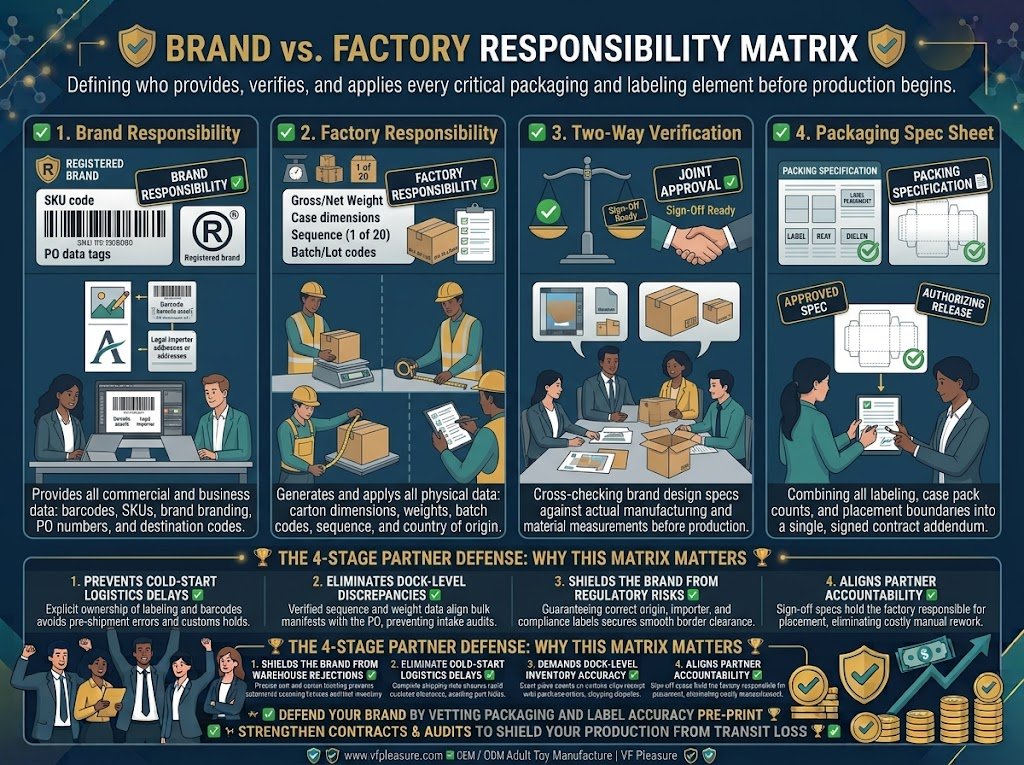
Here is the complete responsibility matrix.
📋 The Packaging Responsibility Matrix
| Data Element | Brand Responsible | Factory Responsible | Confirmed By |
|---|---|---|---|
| UPC/EAN barcode | ✅ Brand generates and provides | ❌ | Brand confirms print accuracy on proof |
| FNSKU (Amazon) | ✅ Brand generates and provides | ❌ | Brand confirms label file and placement |
| Brand name and logo | ✅ Brand provides artwork | ❌ | Brand approves proof |
| Product name | ✅ Brand provides copy | ❌ | Brand approves proof |
| Your SKU | ✅ Brand creates and provides | ❌ | Brand confirms on packing list |
| Importer / responsible person address | ✅ Brand provides | ❌ | Brand approves copy |
| Material claim (food-grade silicone) | ✅ Brand writes the copy | ✅ Factory confirms material | Factory signs off on material specification |
| Country of origin | ❌ | ✅ Factory provides | Confirmed on commercial invoice |
| Regulatory marks (CE, RoHS) | ✅ Brand includes in design | ✅ Factory confirms compliance | Compliance documentation confirms |
| Batch / lot code | ❌ | ✅ Factory assigns | Factory provides on packing list and QC report |
| Gross / net weight | ❌ | ✅ Factory measures and provides | Factory provides on packing list |
| Carton dimensions | ❌ | ✅ Factory measures and provides | Confirmed with freight forwarder |
| Units per carton | ✅ Brand specifies preference | ✅ Factory confirms feasibility | Both confirm on packing specification sheet |
| Purchase order number | ✅ Brand provides | ❌ | Brand confirms on all documents |
| Destination address | ✅ Brand provides | ❌ | Brand confirms in shipping instructions |
At VF Pleasure, our private label program covers custom packaging with logos and colours tailored to your brand — and we manage the packaging specification process with a structured handover document that covers all of the elements above. We encourage clients to complete and return the packaging specification form before any print or label production begins, so every element is confirmed in writing by both parties before production locks in.
The Physical Scan Verification: What to Check Before You Approve Shipment
Even after all specifications have been confirmed and all proofs approved, the pre-shipment stage must include a physical scan verification — an actual scan of the printed barcode on the production packaging using a barcode scanner or a smartphone barcode scanning app. Proof approval does not confirm scan quality.
Before authorising shipment release, verify four physical barcode and label elements on production packaging samples: scan each barcode type (UPC/EAN and FNSKU if applicable) with a real scanner to confirm the number decoded matches the number printed, scan the FNSKU label in the Amazon mobile app to confirm it resolves to the correct ASIN, verify the master carton label dimensions match the actual sealed carton measurements, and confirm the packing list's quantity-per-carton figure by physically counting a sample carton.6
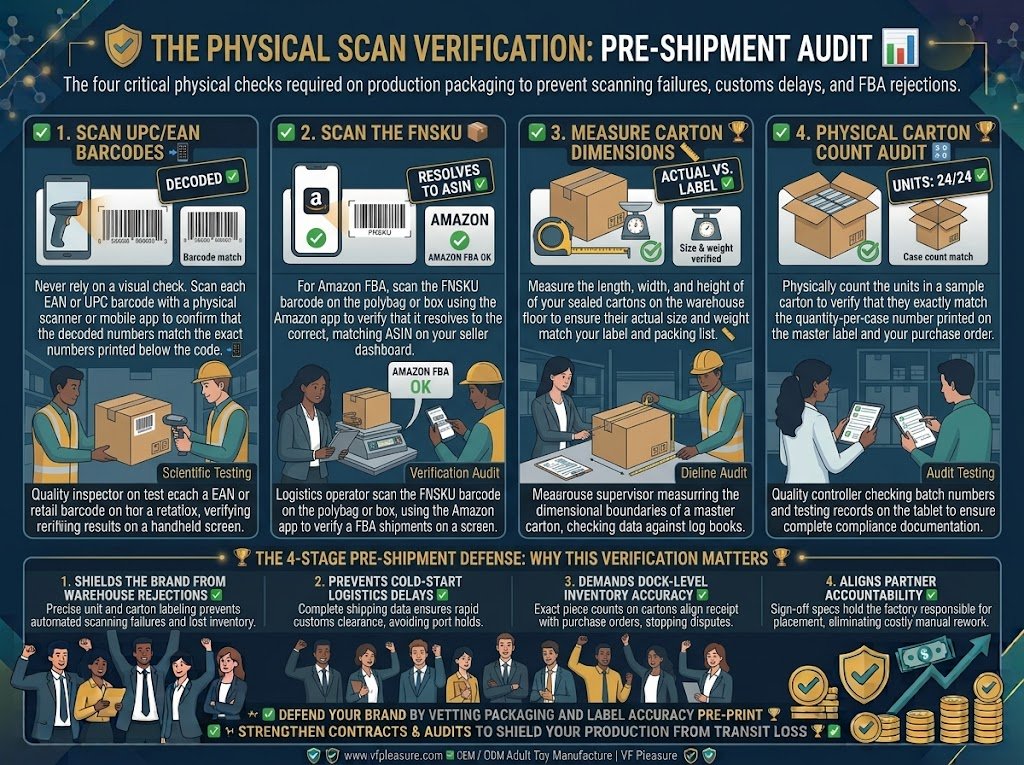
Here is the specific scan verification procedure for each element.
📱 Scan Verification Step 1 — UPC/EAN Barcode
Use a barcode scanner app on your smartphone (iOS/Android — free apps are available) or a dedicated scanner. Hold the scanner approximately 10–20cm from the barcode and confirm:
- The decoded number matches the human-readable digits printed beneath the barcode
- The scan is clean — no repeat scans required, no errors
- Scan from multiple angles to confirm the barcode reads correctly in the range of orientations a warehouse scanner might encounter
If the barcode is printed too small, too lightly, or on a surface with a sheen that causes glare, the scan rate will be poor. Reject the proof and request corrective print adjustments before production.
📱 Scan Verification Step 2 — FNSKU (Amazon FBA)
Install the Amazon Seller app on your smartphone. Use the scanner function to scan the FNSKU label. It should resolve to your product's ASIN and confirm the correct product name.
This is the only reliable way to confirm that the FNSKU file you provided to the factory was printed correctly and will function at the FBA check-in scan. Do not skip this step — an incorrectly printed FNSKU results in FBA admission failure for the entire shipment.
📐 Scan Verification Step 3 — Carton Dimensions
Measure a sealed production carton with a tape measure. Confirm:
- Length × Width × Height match the dimensions on the carton label
- Gross weight (weigh the sealed carton) matches the carton label figure
These measurements become part of your shipping documentation and freight invoice. Incorrect dimensions affect your freight quote and dimensional weight calculation.
🔢 Scan Verification Step 4 — Physical Unit Count
Open one master carton and count the units inside. Confirm the count matches:
- The "quantity per carton" figure on the carton label
- The "quantity per carton" figure on the packing list
A count discrepancy here means the packing list is wrong — which means your entire shipment's documentation overstates or understates the quantity shipped. Catching this before the carton is sealed costs seconds. Catching it at your receiving dock costs hours.
💡 Sally's note from 15 years of managing shipment handovers: The most expensive packaging errors are the ones nobody catches at the factory — because nobody checked physically. A proof approval is not a physical check. The scan verification steps above take 15 minutes on a sample of production units before the shipment is loaded. Those 15 minutes have saved multiple clients from FBA admission failures, incorrect customs declarations, and receiving dock count disputes. Make them non-negotiable in your pre-shipment process.
The Packaging Handover Table: What to Send Your Factory
Everything in this guide ultimately flows into one document: your packaging specification and handover table. This is the document you complete and send to your factory before any packaging production begins. It confirms every required element, assigns responsibility for each, and serves as the reference document for both the factory's packaging team and your own pre-shipment verification.
Here is the fillable handover table template — customise and send to your factory alongside your packaging artwork files and purchase order.
📋 Packaging and Carton Handover Specification Table
Part A — Product and Brand Information (Brand to complete)
| Field | Brand Input |
|---|---|
| Brand name | |
| Product name | |
| Your SKU code | |
| UPC barcode number | |
| EAN barcode number (if EU/UK) | |
| FNSKU (if Amazon FBA — attach label file) | |
| Importer / EU responsible person name | |
| Importer address | |
| Purchase order number | |
| Destination (warehouse address or FBA shipment ID) |
Part B — Material and Compliance (Factory to confirm)
| Field | Factory Confirmation |
|---|---|
| Body-contact material | Food-grade silicone (confirm grade) |
| Country of origin | |
| CE compliance applies? (Y/N + document reference) | |
| Batch/lot code format for this production run |
Part C — Carton Specification (Factory to complete, Brand to approve)
| Field | Factory Input |
|---|---|
| Units per retail inner box | |
| Units per inner pack (if applicable) | |
| Units per master carton | |
| Master carton dimensions (L × W × H in cm) | |
| Master carton gross weight (kg) | |
| Master carton net weight (kg) | |
| Total master cartons in this shipment | |
| Total units in this shipment |
Part D — Label Application Confirmation (Both parties)
| Label | Location | Applied by | Confirmed (✅/❌) |
|---|---|---|---|
| UPC/EAN barcode | Retail box (back or bottom) | Factory (from brand file) | |
| FNSKU label | Retail box or polybag | Factory or prep service | |
| Batch/lot code | Retail box bottom or inner label | Factory | |
| Master carton label | Two sides and one end of carton | Factory | |
| Country of origin | Retail box | Factory (in artwork) | |
| CE mark (if applicable) | Retail box | Factory (in artwork) |
Our private label sex toys program, private label adult products development process guide, and wholesale private label adult products guide 2025 cover the brand presentation and compliance sides of private label packaging in detail. This guide and its handover table complete the picture by covering the operational data layer that makes your shipment function correctly at every handover point.
Conclusion
Private label packaging for adult toys requires two parallel tracks: the brand presentation layer your customer experiences, and the operational data layer your supply chain runs on. Every barcode, SKU, weight, dimension, and carton count on the handover table above exists to make your shipment scannable, receivable, and traceable from factory floor to customer delivery — and all of it needs to be confirmed in writing before your factory begins packing.
🚀 Source from a Factory That Manages the Full Packaging Specification Process
At VF Pleasure, our private label service covers custom packaging, logos, and colours — and our account management team handles packaging specification with a structured handover document that confirms every operational data element before production begins.
Our private label packaging support includes:
- ✅ Custom packaging production — retail box, inner pack, master carton with your specifications
- ✅ FBA-ready labelling — FNSKU label application at factory, reducing prep service costs
- ✅ Batch/lot code system — per-production-run codes that link physical units to food-grade silicone compliance documentation
- ✅ Food-grade platinum silicone — the correct, verifiable material claim for all body-contact surfaces
- ✅ CE, RoHS, REACH, CA65 documentation — per batch, provided alongside packing list
- ✅ Drop testing to 3m — packaging validated for standard transit conditions before shipment
- ✅ Full product range — vibrators, female sex toys, couples toys, thrusting toys, and male adult toys
📬 Send Us Your Packaging Specification Conversation Starter:
1. What channel are you shipping to?
(Amazon FBA / your own 3PL / retail distributor — each has different label and carton requirements that affect the handover table)2. Do you have your UPC/EAN barcodes registered yet?
(If not, we can advise on GS1 registration before packaging production begins)3. What is your target units-per-carton configuration?
(Share your product dimensions and we will confirm the configuration that optimises freight cost for your shipping mode)👉 Request a Packaging Specification Consultation + Free Product Samples →
References & Source Notes
-
VF Pleasure — Private Label Adult Products Development Process
| Field | Detail |
|---|---|
| 📌 Supports | Private label packaging operates at three distinct levels — retail box, inner pack label, and master carton — each with different data requirements for different supply chain handover points. VF Pleasure provides private label services with custom packaging, logos, and colours including FBA-ready labelling and batch code application as part of the private label program. |
| 🔍 Evidence Role | Definition + General Support |
| 📁 Source Type | Industry Guide |
⚠️ Scope Note: Packaging and labelling requirements described reflect common requirements for major distribution channels (Amazon FBA, wholesale, DTC). Specific requirements vary by fulfilment partner, retailer, and destination market. Buyers should confirm current channel-specific requirements with their specific 3PL, retailer buyer, or Amazon marketplace requirements documentation before finalising packaging specifications.
-
VF Pleasure — Body-Safe Adult Toys Manufacturing Standards Guide
| Field | Detail |
|---|---|
| 📌 Supports | Retail product boxes must carry barcodes, brand name, SKU, country of origin, food-grade silicone material claim, regulatory marks (CE, RoHS), compliance language (Prop 65), and EU responsible person address. VF Pleasure uses food-grade silicone — not medical-grade — for all body-contact surfaces, and all products are CE and RoHS certified. The food-grade silicone claim on packaging must accurately reflect the material standard used in production. |
| 🔍 Evidence Role | Definition |
| 📁 Source Type | Industry Guide |
⚠️ Scope Note: Retail box requirements described reflect common requirements for major markets (US, EU, UK). Specific requirements vary by market and distribution channel. EU GPSR responsible person requirements are based on the regulation effective December 2024. Buyers should confirm current regulatory requirements for their specific markets with a qualified compliance advisor.
-
VF Pleasure — Adult Toy Quality Compliance Guide
| Field | Detail |
|---|---|
| 📌 Supports | Inner pack or polybag labels must carry SKU, FNSKU (for Amazon FBA), and batch/lot code for traceability to food-grade silicone compliance documentation. Batch codes link physical units to the specific production run covered by per-batch compliance certificates. VF Pleasure provides compliance certificates for every batch that can be linked to batch codes appearing on product packaging. |
| 🔍 Evidence Role | Mechanism |
| 📁 Source Type | Industry Guide |
⚠️ Scope Note: Amazon FNSKU requirements described are based on Amazon FBA programme requirements as generally understood at time of writing. Amazon's FBA requirements are updated periodically. Sellers should confirm current FNSKU, label size, and placement requirements in Amazon Seller Central before finalising label specifications with their factory.
-
VF Pleasure — Evaluate Chinese Adult Toy Factory Delivery Capability
| Field | Detail |
|---|---|
| 📌 Supports | Master shipping cartons must carry brand name, product name and SKU, carton number, quantity per carton, gross/net weight, dimensions, country of origin, PO number, and destination address. Accurate carton labelling is essential for freight documentation, customs clearance, and warehouse receiving — all of which create handover points where missing data generates operational delays. |
| 🔍 Evidence Role | Mechanism |
| 📁 Source Type | Industry Guide |
⚠️ Scope Note: Master carton label requirements described reflect standard international shipping and warehouse receiving practice. Specific requirements vary by freight carrier, destination country customs regulations, and individual warehouse receiving procedures. Buyers should confirm carton label requirements with their freight forwarder and receiving warehouse before finalising specifications with the factory.
-
VF Pleasure — Private Label Sex Toys Business Guide
| Field | Detail |
|---|---|
| 📌 Supports | Brand owners are responsible for all business-identity data (barcodes, SKU, address, PO numbers) while the factory is responsible for all manufacturing-reality data (dimensions, weights, country of origin, batch codes). Both parties must confirm every element before print or pack production begins. VF Pleasure manages packaging specification with structured handover documentation as part of the private label service. |
| 🔍 Evidence Role | Mechanism |
| 📁 Source Type | Industry Guide |
⚠️ Scope Note: Responsibility matrix describes a general division of responsibilities appropriate for most private label manufacturing relationships. Individual factory agreements may vary in what the factory includes as a standard service. Buyers should confirm which elements are included in their specific factory's private label program and which require separate brand-side input.
-
VF Pleasure — Verify Adult Toy Quality Chinese Suppliers Guide
| Field | Detail |
|---|---|
| 📌 Supports | Physical scan verification before shipment release should confirm: UPC/EAN scans correctly, FNSKU resolves to the correct ASIN in the Amazon Seller app, carton label dimensions match actual sealed carton measurements, and physical unit count matches the packing list quantity-per-carton figure. Physical verification catches errors that proof approvals cannot. |
| 🔍 Evidence Role | Mechanism |
| 📁 Source Type | Industry Guide |
⚠️ Scope Note: Scan verification procedures described are practical field verification methods appropriate for pre-shipment inspection. Definitive barcode quality verification uses ISO standard grading equipment. For high-volume shipments or channel partners with strict label requirements, engaging a third-party inspection service for barcode grading alongside the standard pre-shipment inspection is recommended.