Skip to content

A customer contacts your support team. Their vibrator stopped charging. You ask them to return the cable — and realise you have no record of which cable type ships with that specific model. Your factory sends seven different connector types across thirty active SKUs, and you have been storing spare cables in a single unlabelled box since the first reorder. Three weeks later, you ship the wrong cable, your customer still cannot charge their product, and you have now generated two contacts, one unnecessary replacement unit, and a one-star review about customer service.
This scenario is not rare. It is the default outcome for any wholesale adult toy retailer who does not build a cable-to-model matching system before their product catalogue grows beyond five SKUs.
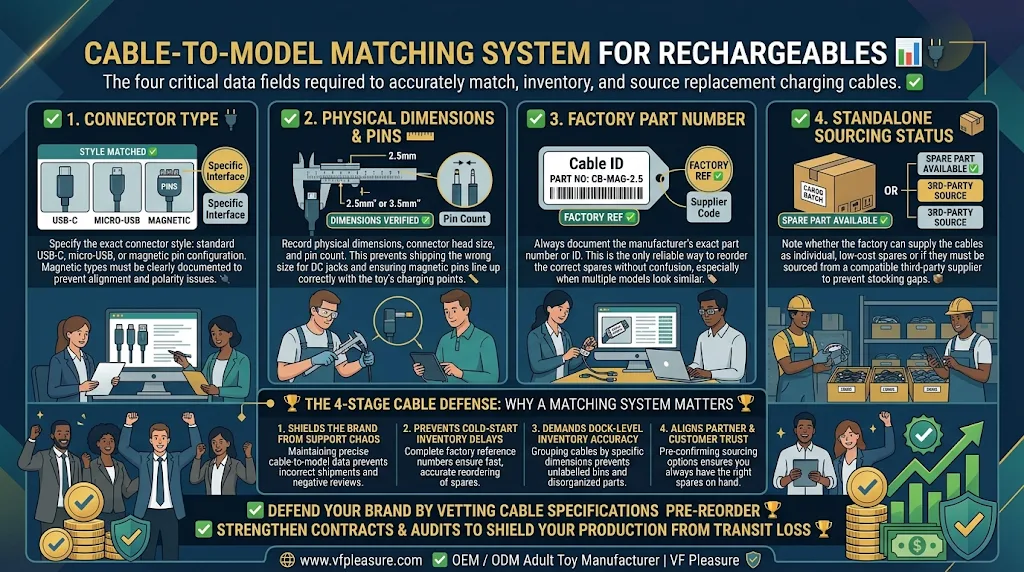
Matching replacement charging cables to wholesale sex toy models requires a model-level cable specification record that captures four data fields for every rechargeable SKU in your catalogue: connector type (USB-C, USB-A micro, magnetic pin configuration, or proprietary), cable physical dimensions (connector head size and pin count where applicable), the factory's internal cable reference or part number, and whether the cable can be sourced as a standalone spare part from your factory or must be sourced from a compatible third-party supplier.1
I'm Sally. I run VF Pleasure — a direct adult toys factory in Dongguan, China, with 15+ years of B2B manufacturing experience. Adult toy charging cable compatibility is one of the most frequently mishandled after-sales issues in the wholesale channel — not because the problem is complicated, but because retailers never build the reference system at the time it costs nothing to build: before the first support contact arrives.
This guide gives you the complete cable matching framework, the connector type identification system, the model-to-cable documentation approach, and the spare parts procurement strategy that converts a recurring customer service problem into a handled process.
- 1 Why Is Charging Cable Matching More Complex for Adult Toys Than for Consumer Electronics?
- 2 The Five Connector Types: How to Identify Each One
- 3 How to Build Your Model-to-Cable Reference System
- 4 Can You Order Replacement Cables as Standalone Parts?
- 5 How to Identify Cable Type from Packaging and Product Markings
- 6 How to Structure Your Spare Parts Procurement Strategy
- 7 What Information Should Your Customer Service Team Have?
- 8 Conclusion
- 9 References & Source Notes
Why Is Charging Cable Matching More Complex for Adult Toys Than for Consumer Electronics?
For mainstream consumer electronics — smartphones, headphones, tablets — USB-C standardisation has largely solved the cable compatibility problem. For adult toys, it has not — for reasons specific to this product category's design constraints and manufacturing economics.
Charging cable matching is more complex for adult toys than for mainstream consumer electronics because adult toys prioritise waterproofing over universal connector standards. A USB-C port creates a structural opening in the product casing that requires complex waterproofing engineering. Magnetic pin charging eliminates this opening entirely, achieving IPX7 waterproofing without any port. The result is that rechargeable adult toys use at least five distinct charging connection systems — and none of the magnetic systems are cross-compatible between manufacturers.1
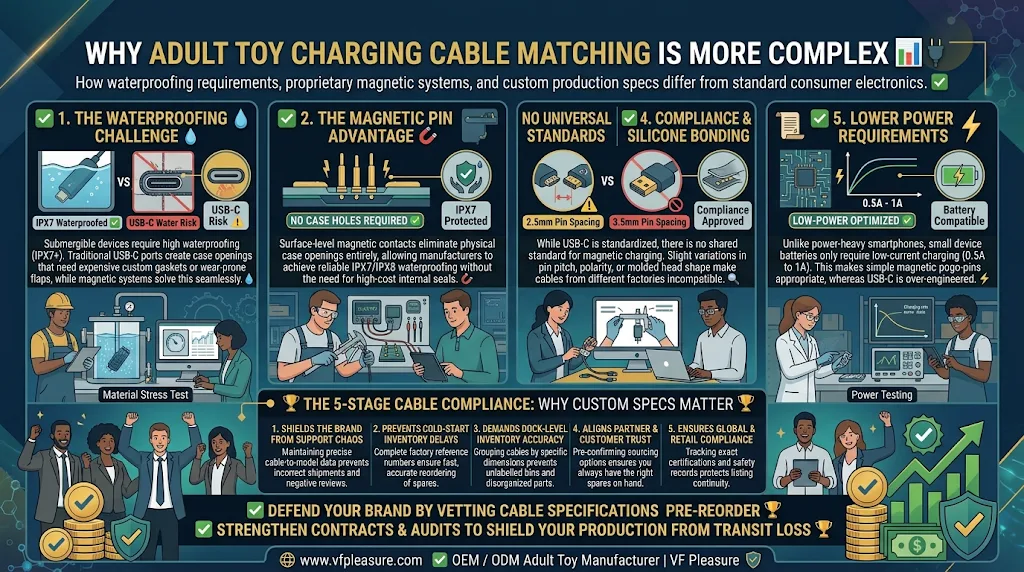
Here is the complete connector type landscape for rechargeable adult toys — with the waterproofing implication of each system.
📊 Adult Toy Charging Connector Type Reference
| Connector Type | Waterproof Achievable? | Cross-Compatible? | Identifiable By |
|---|---|---|---|
| USB-C | Yes — with sealed port + plug cap | Yes — universal standard | Oval symmetrical port, 2.4mm tall |
| USB-A (micro-USB) | Limited — older design | Yes — micro-USB standard | Trapezoidal port, 1.8mm |
| Magnetic 2-pin | Yes — no port, surface contact | No — dimension-specific | 2 circular contact points, various spacing |
| Magnetic 4-pin | Yes — no port, surface contact | No — dimension-specific | 4 contact points in line or square pattern |
| Proprietary pogo pin | Yes — recessed contact points | No — brand/factory-specific | Custom pin array, unique to specific factory |
| Inductive/wireless charging | Yes — fully sealed | Qi standard compatible | No visible contact points |
The key implication: USB-C and micro-USB cables are commodity items any retailer can source. Every magnetic system is factory-specific and in most cases model-specific. A retailer who sources five SKUs with magnetic charging from five different factories may need five different replacement cables that are physically indistinguishable from each other until they fail to connect.
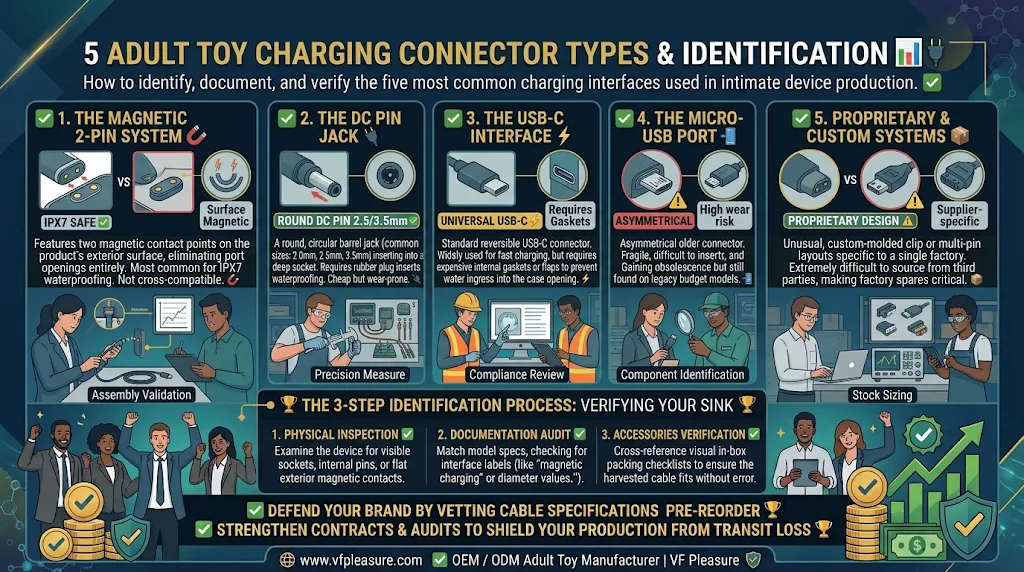
The Five Connector Types: How to Identify Each One
Before you can match replacement cables to models, you need to identify which connector type each model uses — from the physical product and from the factory's documentation. Here is the identification guide for each type.
You identify an adult toy's charging connector type through three methods: physical inspection of the product for visible port openings or surface contact points, the product specification sheet where the charging interface should be explicitly stated, and the cable physical description from the in-box accessories list. When all three methods are available, cross-referencing them confirms the specification. When only one is available, treat the information as provisional until the other two can confirm it.2
🔍 Connector Identification Guide
Type 1 — USB-C
Physical appearance: An oval symmetrical port, typically on the base or underside of the product. The connector head is symmetrical — it inserts either way. Port opening is approximately 8.7mm wide × 2.4mm tall. Usually accompanied by a silicone plug cap to maintain waterproofing when not charging.
Specification sheet description: Should read "USB-C" — confirm with factory if description reads "Type-C" (synonymous) or simply "USB" (ambiguous — request clarification).
Cable availability: Universal — any USB-C to USB-A or USB-C to USB-C cable of appropriate quality will function, provided the factory has not implemented proprietary firmware handshaking (rare in adult toys but worth confirming with the factory).
Type 2 — Micro-USB (USB-A)
Physical appearance: A trapezoidal port with a slightly wider top than bottom. Port opening approximately 7.5mm × 1.8mm. Found primarily in older product designs — fewer new products use micro-USB as USB-C has become the standard for new development.
Specification sheet description: "Micro-USB" or "USB-A charging"
Cable availability: Universal — micro-USB cables are widely available.
Type 3 — Magnetic 2-Pin
Physical appearance: No visible port opening. Instead, the product has two circular metallic contact points on the base, side, or underside — typically spaced 5–15mm apart. The charging cable has a corresponding magnetic end that aligns to these contact points.
Specification sheet description: "Magnetic charging" — this description alone is insufficient for replacement sourcing. You also need: pin count (2), pin spacing in millimetres, pin diameter, and polarity orientation.
Cable availability: Not universal. You must source from your factory or from the original cable supplier. A 2-pin magnetic cable from one factory will physically attach to a 2-pin product from another factory if the pin spacing matches — but polarity orientation may be reversed, causing either no charging or potential electronic damage.
Type 4 — Magnetic 4-Pin
Physical appearance: Four metallic contact points, arranged either in a line (2+2 configuration) or in a 2×2 square. The increased pin count allows for higher charging current or combined data/charging functionality.
Specification sheet description: "Magnetic charging (4-pin)" — also need pin spacing, contact point diameter, and the specific current the cable delivers.
Cable availability: Not universal. Factory-specific. Even 4-pin magnetic cables between different factories may not cross-function.
Type 5 — Proprietary Pogo Pin
Physical appearance: A custom-designed charging dock or cable that connects to a specific recessed contact point array unique to that factory's product line. Common in higher-end wand massagers and premium vibrators where the product casing design drives a custom charging solution.
Specification sheet description: May be described as "magnetic charging" or "custom charging dock" — request the factory's specific cable reference number for this type.
Cable availability: Factory-exclusive. No third-party alternative is available. You must source replacements from your factory.
How to Build Your Model-to-Cable Reference System
The model-to-cable reference system is a simple lookup table that tells anyone in your organisation — your customer service team, your warehouse, your purchasing manager — which cable ships with which product and where to get a replacement. It takes one day to build and saves dozens of hours in mismatched spare-part failures over the lifetime of your product catalogue.
A model-to-cable reference system should be structured as a product-level record containing six fields for every rechargeable SKU: factory model number, buyer SKU, connector type, connector-specific dimensions (pin spacing and pin count for magnetic types), factory cable part number or reference, and cable sourcing path (factory direct / compatible universal / third-party supplier with part number). Every new rechargeable SKU should be added to this table before the first customer support contact occurs.3
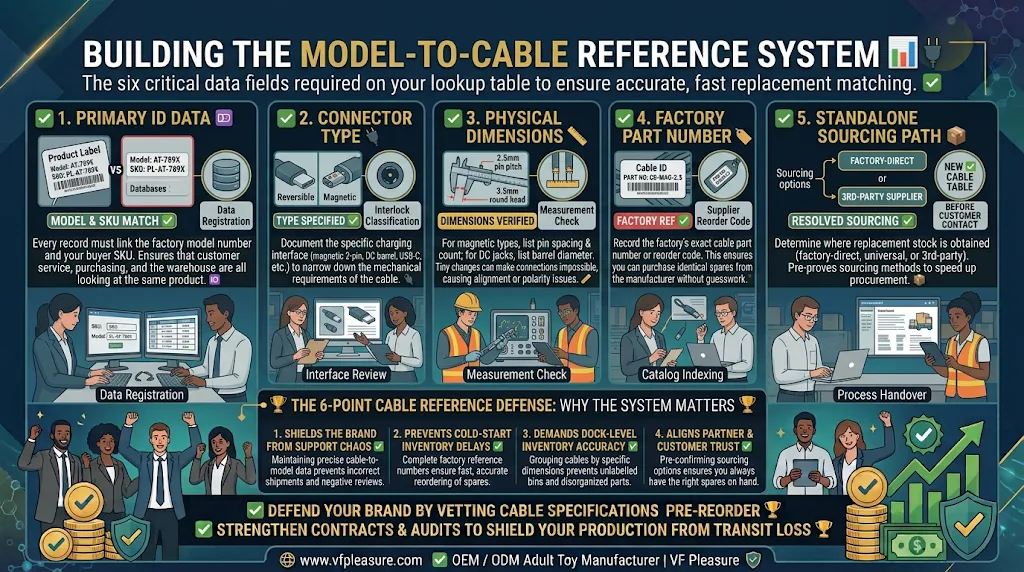
📋 The Model-to-Cable Reference Table Template
| Field | Description | Example |
|---|---|---|
| Factory Model No. | Factory's internal product code | HB2310 |
| Buyer SKU | Your internal SKU | BR-VIB-001 |
| Product Name | Your brand's product name | Silken Wand Pro |
| Connector Type | From the five types above | Magnetic 2-pin |
| Pin Spacing (mm) | For magnetic types only | 8mm |
| Pin Diameter (mm) | For magnetic types only | 2mm |
| Cable Current (mA) | As specified by factory | 500mA |
| Factory Cable Part No. | Factory's internal cable reference | CBL-MAG-2P-8M |
| Cable Length (cm) | Physical cable length | 80cm |
| Sourcing Path | How to procure replacements | Factory direct |
| Third-Party Alternative | If available | N/A |
| Notes | Polarity, special instructions | Red wire = positive |
🗂️ Building the Table: The Four-Question Request to Your Factory
For every rechargeable product in your catalogue, send your factory this four-question request:
"For factory model [model number], we need the following cable specification data for our after-sales reference system:
1. Connector type — USB-C, micro-USB, or magnetic (specify pin count)?
2. If magnetic: pin spacing in mm, pin diameter in mm, and polarity orientation (which pin is positive)?
3. Your internal cable part number or reference for this product's charging cable?
4. Is the replacement cable available to order as a standalone item from your factory? If yes, what is the minimum order quantity and unit price?"
This request costs your factory five minutes to answer per model. The data it produces protects your after-sales operation for the lifetime of that product.
Can You Order Replacement Cables as Standalone Parts?
This is the practical question most retailers reach first — and the answer varies by factory, connector type, and order volume. Understanding the three scenarios that determine cable availability helps you plan your after-sales spare parts strategy before you have a customer urgently waiting.
Replacement charging cables for wholesale adult toys can be sourced through three paths: factory-direct order for proprietary or magnetic cables that cannot be sourced elsewhere, universal USB-C or micro-USB cables from any electronics supplier, or a third-party cable supplier if the factory can provide the cable's specific technical drawing. The factory-direct path is the only reliable option for magnetic and proprietary cables — but it typically requires a minimum order quantity and may carry a longer lead time than a universal cable purchase.4
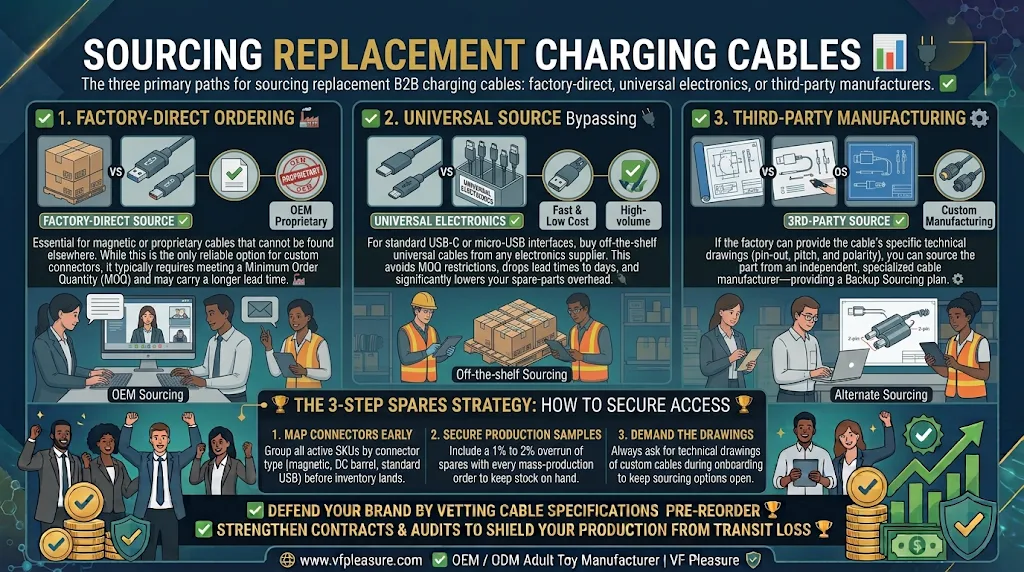
Here is each sourcing path — with the conditions where it works and where it fails.
🔋 Path 1 — Factory-Direct Order for Proprietary or Magnetic Cables
When it works: The cable is magnetic or proprietary — no universal alternative exists. Your factory is responsive and maintains cable stock as a spare parts item.
What to ask your factory:
"Do you stock [cable reference CBL-MAG-2P-8M] as a spare part? What is your minimum order quantity for standalone cable orders? What is your lead time for cable-only orders?"
Most factories that produce at scale maintain some cable stock, particularly for their most active product lines. At VF Pleasure, our 12-step production process and per-batch QC documentation means production records are maintained per model — which also supports after-sales accessory requests referenced to specific factory model numbers.
What to plan for:
- Minimum order quantities for spare cables are often 50–200 pieces per model — factor this into your spare parts budget
- Lead time for cable-only orders from China is typically 7–15 days for small quantities that can ship by express freight
- Consider ordering spare cables with each production order rather than reactively — the incremental cost is minimal against the cost of a mishandled customer support case
🔋 Path 2 — Universal USB-C or Micro-USB Cables
When it works: Your product uses a genuine USB-C or micro-USB port with no proprietary firmware handshaking. The factory has confirmed that any standard USB cable will function.
What to confirm with your factory:
"Does your USB-C charging port accept any standard USB-C cable, or does it require a cable with a specific current rating or firmware handshake? Is there any reason a standard USB-A to USB-C cable would not work as a replacement?"
If the factory confirms that any standard USB-C cable functions, you can procure replacement cables from any electronics supplier, at commodity pricing, with immediate availability. No minimum order from your factory required.
Important: Confirm the current rating the product's charging circuit accepts. Most adult toy USB-C charging circuits operate at 5V/500mA–1A. A cable capable of these specifications is standard. Do not assume a high-wattage fast-charging cable is always better — confirm the product's rated input with the factory.
🔋 Path 3 — Third-Party Supplier Using Factory Technical Drawing
When it works: Your factory cannot supply replacement cables affordably (too small a minimum order, too long a lead time), but they can provide a technical drawing of the magnetic cable connector — pin spacing, pin diameter, polarity, current rating.
With a technical drawing, a third-party cable supplier can manufacture a compatible cable. This path requires:
- Factory provision of a connector technical drawing (not all factories will provide this — confirm willingness before relying on this path)
- A cable manufacturer relationship — typically available through Alibaba, Made-in-China, or a specialist cable supplier
- Testing of the third-party cable against the actual product before committing to a large spare parts order
This path carries more risk than factory-direct sourcing because even small dimensional variations in the magnetic connector can affect connection reliability. If you pursue this path, test with at least 10 units before ordering bulk spare parts.
How to Identify Cable Type from Packaging and Product Markings
Your after-sales team cannot open a factory reference spreadsheet every time a customer support ticket arrives. They need a fast-lookup method using information already on the customer's product or packaging. Here is how to extract cable type information from the three most accessible sources.
The fastest method for identifying an adult toy's cable type during a customer support interaction is the product packaging barcode — by looking up the buyer SKU or UPC against your model-to-cable reference table. The second fastest is the product specification label on the retail box, which should state the charging interface type. The third method is the factory model number printed on the product base or the product specification card inside the box, cross-referenced against your factory model-to-cable table.5
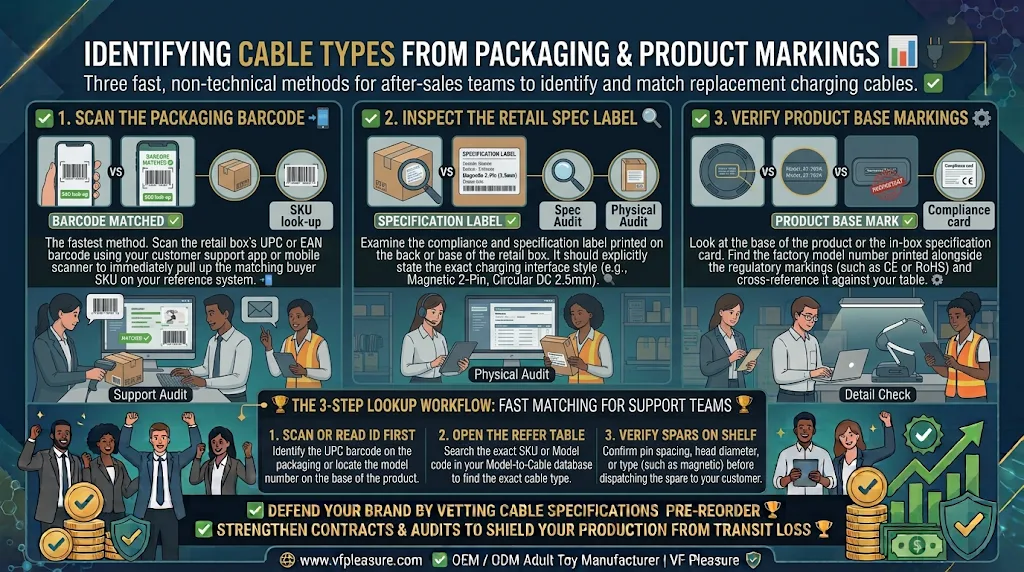
🏷️ Fast-Lookup Method 1 — Buyer SKU from Packaging Barcode
When a customer provides their order information, your order management system should show you which buyer SKU they purchased. That SKU links directly to your model-to-cable reference table — giving you the cable type in seconds.
Requirement: Your model-to-cable reference table must be integrated into or linked from your order management or CRM system, not sitting in a separate spreadsheet that nobody looks at.
🏷️ Fast-Lookup Method 2 — Product Specification Label
The retail product box should carry a charging specification in either the specification panel or the regulatory marks area. Common specifications appear as:
- "USB-C charging" — USB-C connector; universal cable
- "Magnetic charging" — magnetic connector; need to cross-reference model number
- "DC 5V — 500mA input" — confirms current specification; helps identify cable even if connector type is labelled generically
If your retail box does not carry a charging specification, add one to your packaging artwork before the next production run. It costs nothing and eliminates the most common first question in charging-related support tickets.
🏷️ Fast-Lookup Method 3 — Factory Model Number from Product Base
The factory model number is frequently printed on the product base, typically as a small engraved or printed alphanumeric code. Your customer service team can ask the customer to read this code, and you cross-reference it against your model-to-cable table for the exact cable specification.
Requirement: Your model-to-cable table must be indexed by factory model number, not just by buyer SKU — because customers often do not know their order SKU but can read a number off the bottom of the product.
How to Structure Your Spare Parts Procurement Strategy
A reactive spare parts strategy — ordering replacement cables only when customers start complaining — always results in a service gap. By the time you contact the factory, place the order, wait for production or stock confirmation, and receive the cables by express freight, three to four weeks have passed. A proactive strategy eliminates this gap at negligible cost.
A proactive replacement cable procurement strategy for wholesale adult toy retailers follows three principles: order a small quantity of replacement cables with every production order (not separately), maintain a cable inventory level equal to the expected return rate for rechargeable products in your catalogue (typically 1–3% of units sold), and update your cable inventory record whenever a new rechargeable SKU is added to your catalogue.6
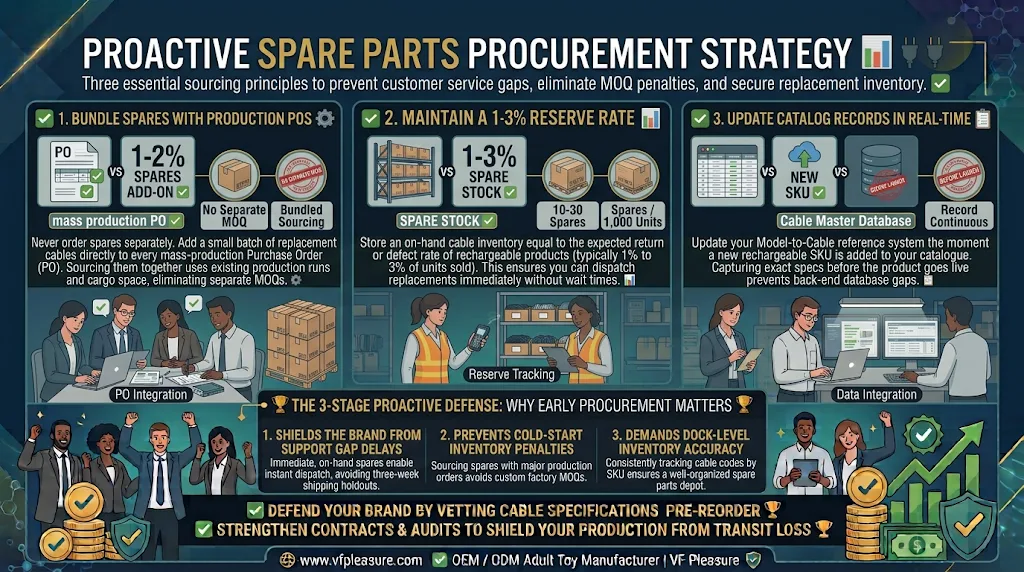
Here is the three-principle strategy — with the specific actions for each.
📦 Principle 1 — Order Replacement Cables with Every Production Order
When you place a production order for a rechargeable product, include a cable spare parts line in the same purchase order. Calculate based on your expected support rate for that product type.
Calculation guide:
- Typical charging-related support rate: 0.5–2% of units sold within the first 90 days
- For a 500-unit production order: order 5–10 spare cables
- For a 1,000-unit production order: order 10–20 spare cables
The factory absorbs the cable into the same production logistics as the main order — so no additional freight is required. The incremental cost of 10–20 spare cables is usually $10–40. The cost of a single mishandled customer support case with shipping and reprocessing is typically $15–50. The math is straightforward.
📦 Principle 2 — Maintain Target Cable Inventory Level
Set a minimum cable inventory level for each magnetic or proprietary cable type — reorder when stock falls below this level, not when it reaches zero.
Minimum inventory formula:
- Minimum stock = (monthly unit sales of that product type × expected support rate × 3 months)
Example: You sell 200 units per month of a magnetic-charging vibrator. Your support rate for charging issues is 1%. Your minimum stock is: 200 × 0.01 × 3 = 6 cables. When stock falls to 6 cables, place a reorder.
📦 Principle 3 — Update Cable Inventory Records at New SKU Launch
Every time you add a new rechargeable SKU to your catalogue, add a row to your model-to-cable table on the same day. Do not wait until a support ticket arrives. The data is available from your factory at the time of product onboarding — use it then.
What Information Should Your Customer Service Team Have?
A customer service team that cannot quickly identify which cable a product uses will either ship the wrong cable or tell the customer to wait while they find out — neither outcome is acceptable for a support interaction about a product that a customer cannot currently use.
Your customer service team needs four resources to handle charging cable replacement requests without escalation: a printed or digital model-to-cable quick reference table sorted by product name (not factory model number), a physical stock of the three most common proprietary cable types in your catalogue, a clear policy on whether replacement cables are provided free of charge or charged at cost, and a contact path to your factory account manager for models not covered by the quick reference table.7
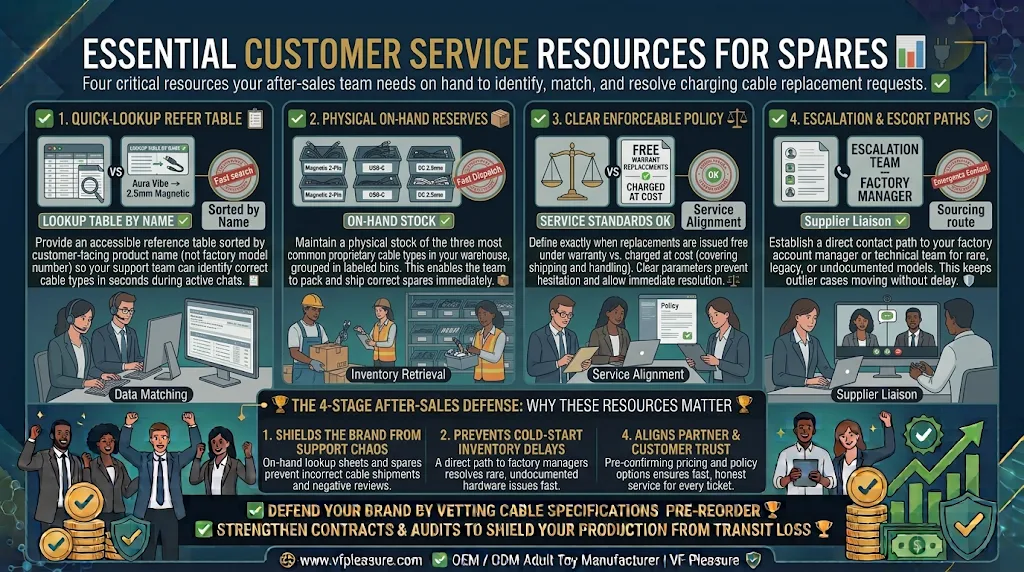
Here is what each resource should look like.
👥 Resource 1 — Quick Reference Table (Customer-Facing Sort Order)
Your model-to-cable table as built above is indexed for procurement purposes — by factory model number. Your customer service team needs the same data sorted by your brand's product name — the name the customer uses when contacting support.
Create a second tab or a second document sorted by:
- Your brand's product name (alphabetical)
- Cable type (one of five connector types)
- Sourcing path: "Standard USB-C" / "Spare — contact warehouse" / "Order from factory (3–5 day lead time)"
This lookup table should be accessible on the customer service team's screen within two clicks of any support ticket.
👥 Resource 2 — Physical Stock of Common Cable Types
Identify the three most common cable types across your catalogue and maintain physical stock of at least 10 cables of each type at your returns/customer service location.
These do not need to be branded cables — they need to physically connect to the product and deliver the correct charging current. A replacement cable sent to a customer as a goodwill gesture does not need to match the factory's original cable aesthetically; it needs to function.
👥 Resource 3 — Clear Replacement Cable Policy
Define your replacement cable policy before the first support ticket arrives:
- Under warranty period (typically first 90 days): replacement cable at no cost, shipped free
- Out of warranty: replacement cable at cost price, customer pays shipping
- Lost or damaged by customer (confirmed non-defect): replacement cable at cost price
Having this policy documented and accessible means your customer service team can give a definitive answer on the first contact rather than escalating to a manager.
👥 Resource 4 — Factory Account Manager Contact for Edge Cases
For unusual cable requests — a product model not in your standard catalogue, a cable compatibility question you cannot answer from the reference table, a request for a bulk spare parts order — your customer service team needs a direct contact path to your factory account manager.
At VF Pleasure, our account management team responds within minutes during work hours and maintains detailed product records that can answer cable-specific questions with precision. Having that contact accessible to your customer service team as an escalation path for edge cases is part of the after-sales support infrastructure that separates a professionally managed product catalogue from a reactive one.
Our private label sex toys category, adult toy manufacturer partnership strategies guide, and adult toy manufacturing challenges and solutions guide all address the factory support relationship that makes after-sales processes like this one function reliably.
Conclusion
Matching replacement charging cables to wholesale adult toy models is a data management problem, not a technical one. Build the model-to-cable reference table when the product is onboarded, confirm cable specifications with your factory before the first support ticket, maintain a small spare parts stock for proprietary and magnetic cables, and give your customer service team the lookup tools they need to resolve charging queries on first contact.
🚀 VF Pleasure: Full Cable Specifications Available for Every SKU
At VF Pleasure, every rechargeable product in our catalogue comes with documented cable specifications — connector type, pin configuration for magnetic systems, and factory cable part reference — available on request alongside our standard product data package.
We support after-sales operations with:
- ✅ Per-model cable specification confirmation — connector type, pin data, and current rating for every rechargeable SKU
- ✅ Replacement cable ordering — available as standalone parts alongside production orders for magnetic and proprietary cable types
- ✅ Full product range — vibrators, female sex toys, couples toys, thrusting sex toys, and male adult toys
- ✅ High-resolution product images and marketing assets — supporting accurate retail listing including charging specification callouts
- ✅ Food-grade platinum silicone products — CE, RoHS, REACH, CA65 certified per batch with full documentation
📬 Start Your Cable Matching Conversation:
1. Which specific models in your current catalogue use magnetic or proprietary charging?
(These are the SKUs where building the reference table is most urgent — I can confirm exact specifications for any VF Pleasure model number)2. What is your approximate monthly sales volume for rechargeable products?
(This determines the minimum spare parts stock quantity that makes sense for your catalogue)3. Do you currently include replacement cables as a line item in your production orders?
(If not, I can show you how to structure this as part of your next purchase order with minimal additional cost)👉 Request Cable Specifications + Free Product Samples from VF Pleasure →
References & Source Notes
-
VF Pleasure — Adult Toy Manufacturing Challenges and Solutions
| Field | Detail |
|---|---|
| 📌 Supports | Matching replacement charging cables to wholesale adult toy models requires a model-level cable specification record. Adult toys use at least five distinct charging connection systems including USB-C, micro-USB, magnetic 2-pin, magnetic 4-pin, and proprietary pogo pin — none of the magnetic or proprietary types are cross-compatible between manufacturers. Waterproofing requirements (IPX7) drive the use of magnetic charging systems in premium products. |
| 🔍 Evidence Role | Definition + General Support |
| 📁 Source Type | Industry Guide |
⚠️ Scope Note: Charging connector type descriptions and compatibility guidance reflect general adult toy industry practice at time of writing. Individual factory designs vary. Always confirm specific cable specifications for each model directly with your factory before building a replacement cable procurement programme. Never assume cross-compatibility between magnetic cables from different factories without physical testing.
-
VF Pleasure — Sex Toy Manufacturing Process Guide
| Field | Detail |
|---|---|
| 📌 Supports | Connector type identification uses three methods: physical inspection of the product, product specification sheet, and in-box accessories list. Cross-referencing all three methods confirms specification. VF Pleasure's production process includes per-model specification documentation accessible to account managers for after-sales reference queries. |
| 🔍 Evidence Role | Mechanism |
| 📁 Source Type | Industry Guide |
⚠️ Scope Note: Physical connector identification dimensions described (USB-C: 8.7mm × 2.4mm; micro-USB: 7.5mm × 1.8mm) are standard connector specifications. Magnetic pin dimensions vary by factory and product design — always measure from the actual product or confirm with the factory's technical specification.
-
VF Pleasure — Private Label Sex Toys Business Guide
| Field | Detail |
|---|---|
| 📌 Supports | A model-to-cable reference system requires six fields per SKU: factory model number, buyer SKU, connector type, connector-specific dimensions, factory cable part number, and sourcing path. Every new rechargeable SKU should be added before the first customer support contact. VF Pleasure maintains per-model production records that support factory-level cable part reference queries. |
| 🔍 Evidence Role | Mechanism |
| 📁 Source Type | Industry Guide |
⚠️ Scope Note: The model-to-cable reference table template provided is a general framework. Field requirements may vary based on individual retail system and CRM structures. Adapt the template to your specific systems before deployment.
-
VF Pleasure — Adult Toy Manufacturer Partnership Strategies
| Field | Detail |
|---|---|
| 📌 Supports | Replacement cable sourcing follows three paths: factory-direct for magnetic and proprietary cables, universal USB-C/micro-USB for standard connectors, and third-party supplier with technical drawing for cases where factory sourcing is impractical. Factory-direct is the only reliable path for magnetic cables. VF Pleasure supports standalone cable orders alongside production orders for active models. |
| 🔍 Evidence Role | Mechanism |
| 📁 Source Type | Industry Guide |
⚠️ Scope Note: Availability of replacement cables as standalone factory orders varies by factory and model. Minimum order quantities for spare cable orders typically range from 50–200 pieces. Lead times for small cable-only orders from China are typically 7–15 days by express freight. Confirm specific availability, MOQ, and lead time with your factory for each model before relying on this sourcing path.
-
VF Pleasure — Private Label Sex Toy Packaging Checklist
| Field | Detail |
|---|---|
| 📌 Supports | The fastest cable identification methods for customer support are buyer SKU lookup via order system (linking to model-to-cable table), product specification label on retail box, and factory model number from product base cross-referenced against the cable table. Adding a charging specification to retail packaging (USB-C, magnetic charging, etc.) eliminates the most common first question in charging support tickets. |
| 🔍 Evidence Role | Mechanism |
| 📁 Source Type | Industry Guide |
⚠️ Scope Note: Fast-lookup methods described assume a maintained and accessible model-to-cable reference table. The effectiveness of these methods depends entirely on the completeness and currency of that reference table. Update the table whenever a new rechargeable SKU is added or when factory cable specifications change between production runs.
-
VF Pleasure — Adult Toy Quality Compliance Guide
| Field | Detail |
|---|---|
| 📌 Supports | A proactive replacement cable procurement strategy orders spare cables with every production order (not reactively), maintains inventory equal to expected return rate (typically 1–3% of units), and updates cable inventory records at new SKU launch. QC failures are a documented cause of shipment delays — proactive spare parts management extends the same preventive principle to after-sales operations. |
| 🔍 Evidence Role | General Support |
| 📁 Source Type | Industry Guide |
⚠️ Scope Note: Replacement cable order quantities (5–10 cables per 500 units) and support rate estimates (0.5–2%) are general reference ranges. Actual support rates vary by product type, charging system, and customer base. Track your actual charging-related support rate per SKU and adjust spare parts orders accordingly.
-
VF Pleasure — Adult Toy Manufacturing Challenges and Solutions
| Field | Detail |
|---|---|
| 📌 Supports | Customer service teams need four resources for cable replacement handling: a product-name-sorted quick reference table, physical stock of common cable types, a documented replacement policy, and a factory account manager contact for edge cases. VF Pleasure account management responds within minutes during business hours and maintains detailed product records accessible for after-sales queries. |
| 🔍 Evidence Role | General Support |
| 📁 Source Type | Industry Guide |
⚠️ Scope Note: Customer service resource recommendations reflect general best practice for wholesale adult toy after-sales operations. Actual resource requirements vary by catalogue size, support volume, and organisational structure. The replacement cable policy described (free within warranty, at-cost outside warranty) is one common framework — individual businesses should set their own policies based on margin, customer expectations, and competitive positioning.