Skip to content

You placed three orders with your factory. Products arrived. Customers are buying. Everything seems to be working — but you are managing by feel rather than data. You have no documented record of what percentage of orders arrived on time, what your actual defect rate was across those batches, how long it took to get answers to urgent questions, or whether the compliance documentation your factory provided met the standard you would need to defend if a platform or customs review arrived tomorrow. Without KPIs, you cannot tell whether your supplier relationship is performing well or just performing acceptably.
Supplier KPIs for adult toy manufacturers in year one cover five measurable dimensions: on-time delivery rate, critical defect rate, compliance documentation completeness, communication response time, and food-grade silicone material consistency across batches. "Good" in year one is not perfection — it is a documented baseline that either confirms your supplier is reliable or gives you the specific evidence needed to negotiate improvement or switch suppliers with confidence.1
I'm Sally. I run VF Pleasure — a direct adult toys factory in Dongguan, China, with 15+ years of B2B manufacturing experience and a monthly production capacity of 50,000 units. We provide compliance certificates for every batch and welcome client KPI frameworks — because a factory that performs well against measurable standards has nothing to fear from being measured.
This guide gives you every KPI, the specific measurement method, the year-one benchmark that defines "good" for each, and the escalation trigger that tells you when to have a serious conversation with your factory before problems compound into a business crisis.
- 1 Why Do Adult Toy Buyers Need Supplier KPIs More Than Most?
- 2 KPI 1: On-Time Delivery Rate — What to Measure and What "Good" Looks Like
- 3 KPI 2: Critical Defect Rate — What to Measure and What "Good" Looks Like
- 4 KPI 3: Compliance Documentation Completeness Rate — What to Measure and What "Good" Looks Like
- 5 KPI 4: Communication Response Time and Proactivity — What to Measure and What "Good" Looks Like
- 6 KPI 5: Food-Grade Silicone Material Consistency Rate — What to Measure and What "Good" Looks Like
- 7 How Do You Build a Year-One Supplier Scorecard?
- 8 What Are the Escalation Triggers That Require Formal Action?
- 9 Conclusion
- 10 References & Source Notes
Why Do Adult Toy Buyers Need Supplier KPIs More Than Most?
Supplier KPI frameworks exist in every sourcing category. They are more important in adult toy sourcing than in most others — for three reasons that are specific to this category's combination of regulatory exposure, brand dependency, and platform sensitivity.
Adult toy buyers need supplier KPIs more than most categories because three compounding risks make unmonitored supplier performance dangerous: the body-contact nature of the product makes food-grade silicone material consistency a safety issue, not just a quality issue; the platform operating environment (Amazon, Shopify, retail buyers) makes compliance documentation gaps account-threatening rather than just operationally inconvenient; and the intimate nature of the product means quality failures generate the most damaging review patterns in e-commerce — customer trust damage that does not recover quickly.1
Here is how each compounding risk maps to the KPI framework this guide covers.
📊 Risk-to-KPI Mapping
| Compounding Risk | KPI That Monitors It | Consequence If Unmonitored |
|---|---|---|
| Food-grade silicone consistency | Material consistency rate (KPI 5) | Body-safe claim becomes unverifiable; platform or customs exposure |
| Compliance documentation gaps | Documentation completeness rate (KPI 3) | Amazon flag, customs hold, retail buyer rejection |
| Quality failures in body-contact product | Critical defect rate (KPI 2) | Returns wave, review damage, chargeback spike |
| Delivery misses affecting launch windows | On-time delivery rate (KPI 1) | Lost campaign spend, missed retail windows, subscriber cancellations |
| Communication failures hiding problems | Response time and proactivity (KPI 4) | Delayed problem discovery = more expensive resolution |
Each KPI in this guide addresses one of these five risks directly. Used together, they give you a complete picture of your supplier's performance that you can share with the factory, negotiate improvements against, or use as documented evidence when evaluating a supplier switch.
KPI 1: On-Time Delivery Rate — What to Measure and What "Good" Looks Like
On-time delivery rate is the most commonly tracked supplier KPI and the most commonly mis-measured one. The error is in how "on-time" is defined — and in particular, whether the metric measures dispatch date or arrival date, and how it handles delays that were communicated in advance versus ones that surfaced at the delivery date itself.
On-time delivery rate for an adult toy supplier should be measured as the percentage of orders that arrive within the agreed delivery window — where "agreed delivery window" is the specific date range stated in the purchase order, not an informal estimate given in a message. "Good" in year one is 90% or higher on-time delivery with proactive advance notice on all delays. A factory at 100% on-time rate with no advance notices on the occasional delay is actually performing worse on relationship quality than one at 95% with consistent 10-day advance notification.2
Here is exactly how to measure it — and what the data tells you.
📅 How to Measure On-Time Delivery Rate
Step 1: Record the agreed delivery date from the purchase order — not from a message, not from a verbal conversation, but from the formal purchase order or proforma invoice confirmation.
Step 2: Record the actual delivery date — when goods were received at your warehouse or confirmed at destination port, not when they left the factory.
Step 3: Calculate: (number of orders delivered within the agreed window ÷ total orders placed) × 100
Step 4: Record separately: the number of orders where the factory provided advance notice of a delay (minimum 10 business days before the delivery date) versus the number where delays were communicated after the delivery date had already been missed.
📊 Year-One Delivery Rate Benchmarks
| Rate | Assessment | What It Tells You |
|---|---|---|
| 95–100% on time | Strong | Factory has reliable production scheduling and capacity management |
| 90–94% on time | Acceptable | Some scheduling pressure; monitor for trend |
| 80–89% on time | Concerning | Systemic capacity or planning issue; raise in formal review |
| Below 80% on time | Requires action | Fundamental reliability problem; begin supplier diversification |
The advance notice rate matters as much as the raw on-time rate. VF Pleasure's standard mass order lead time is 25–35 days with expedited options available for urgent orders. Within this timeline, any anticipated deviation should surface at the 15-day remaining mark — not at the delivery date.
💡 Measurement tip: For your first three orders, you may not have a purchase order with a formal delivery date. Retroactively agree delivery dates in writing before your next order — even for orders already in production — by sending a written confirmation email: "Per our agreement, delivery is targeted for [date]. Please confirm." A reply confirmation creates the documented benchmark you need.
KPI 2: Critical Defect Rate — What to Measure and What "Good" Looks Like
Critical defect rate is the KPI most directly tied to customer returns, platform listing health, and brand reputation damage. It is also the KPI most commonly misunderstood — because factories report "overall defect rate" or "QC pass rate" that bundles critical and minor defects together, obscuring the specific failures that actually damage your business.
Critical defect rate should be measured as the percentage of units in a delivered batch that have functional failures, food-grade silicone material non-compliance, charging failures, or waterproofing failures — not the overall defect rate including minor cosmetic issues. "Good" in year one is a critical defect rate at or below 1% per batch. Any batch exceeding 2% critical defects requires a root cause report from the factory within 5 business days of discovery.3
🔬 How to Measure Critical Defect Rate
Step 1: Define your critical defect categories in writing before your first order. For adult toys, these typically include:
- Functional failure — no power, vibration mode not functioning, motor not activating
- Charging failure — product does not charge or loses charge faster than specified
- Waterproofing failure — product fails waterproof test after IPX-rated claim
- Food-grade silicone non-compliance — surface texture, hardness, or colour inconsistent with approved sample in a way that suggests material substitution
- Safety failure — any damage to product structure that creates a use safety concern
Step 2: Conduct AQL sampling on each received batch — not just visual inspection. Test units for function, charging, and waterproofing. Compare silicone surface against your retained approved sample.
Step 3: Calculate: (number of units with any critical defect ÷ total units in AQL sample) × 100
Step 4: Record the defect category for each critical failure found — this data identifies patterns that indicate specific engineering or process issues.
📊 Year-One Critical Defect Rate Benchmarks
| Rate | Assessment | Required Response |
|---|---|---|
| 0–1% | Strong | Document and maintain |
| 1.1–2% | Acceptable — watch | Request QC batch report; confirm inline checks are functioning |
| 2.1–4% | Concerning | Require root cause report; consider independent pre-shipment inspection |
| Above 4% | Requires immediate action | Do not accept future shipments without pre-shipment inspection approval |
QC failures cause a significant share of shipment delays across the industry. VF Pleasure's 12-point inspection system conducts four checkpoints: raw material intake, pre-assembly, finished product, and batch testing — using gas chromatography for phthalate screening, IPX7 chambers for waterproof testing, 50kg pressure rigs for stress testing, and 3-metre drop simulation for packaging. This multi-stage system catches critical defects before shipment rather than after receipt. When evaluating any factory's critical defect rate, ask which of these test categories their QC system actually covers.
KPI 3: Compliance Documentation Completeness Rate — What to Measure and What "Good" Looks Like
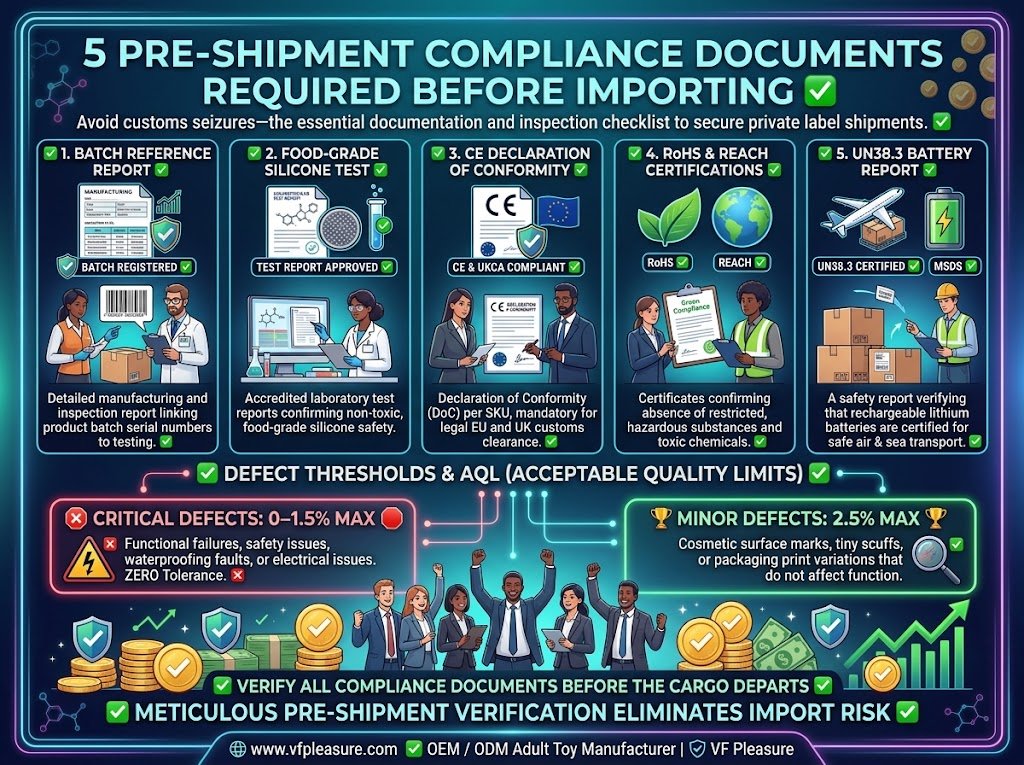
Compliance documentation completeness is the KPI that protects your market access. A batch delivered without a food-grade silicone test report means you cannot respond to an Amazon compliance request, cannot list on a retail buyer's platform, and cannot defend a body-safe material claim if a customer or regulator asks. Missing documentation discovered after delivery is far more expensive than documentation requested before it.
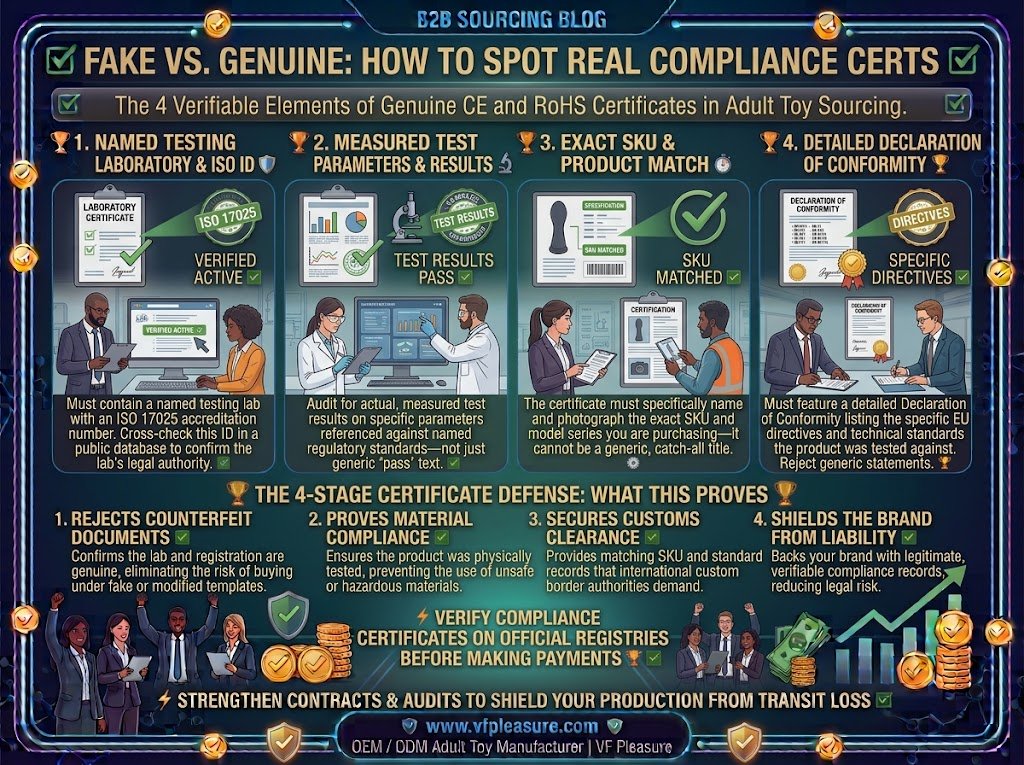
Compliance documentation completeness rate measures the percentage of delivered batches accompanied by the complete required document set — food-grade silicone migration test report from a named accredited laboratory, CE Declaration of Conformity, RoHS certificate, and CA65 where applicable — before or concurrent with shipment, not requested after. "Good" in year one is 100% documentation completeness on every batch. Any batch where documentation is missing at delivery is a KPI failure regardless of product quality.4
📋 How to Measure Documentation Completeness Rate
Step 1: Define your required documentation set for each product type:
| Product Type | Required Documents |
|---|---|
| Rechargeable electronic adult toy | CE Declaration, RoHS certificate, food-grade silicone migration report, UN38.3 battery certification |
| Non-electronic body-contact toy | Food-grade silicone migration report, REACH/CA65 where applicable |
| App-controlled or wireless toy | All of the above + FCC documentation (US) |
Step 2: Record on each delivery: (a) whether the full document set was received, (b) whether documents were received before or after delivery, (c) whether any document was missing entirely.
Step 3: Calculate: (number of batches with complete documentation received at or before delivery ÷ total batches delivered) × 100
Step 4: Track separately: documents received late (after delivery) versus documents not provided at all. Late documents affect your platform account operations. Missing documents are a compliance failure.
📊 Year-One Documentation Completeness Benchmarks
| Rate | Assessment | What It Tells You |
|---|---|---|
| 100% | Strong | Factory has systematic documentation process tied to production |
| 90–99% | Acceptable first order; unacceptable pattern | Document gap trigger; require pre-shipment documentation confirmation |
| Below 90% | Requires immediate attention | Factory lacks systematic documentation; escalate formally |
⚠️ Food-grade silicone documentation note: VF Pleasure manufactures exclusively to food-grade silicone standards — never medical-grade. All VF Pleasure products comply with CE, RoHS, REACH, and CA65 standards, with full documentation provided to ensure smooth importation. Each batch receives its own food-grade silicone compliance certificate tied to that specific production run. This per-batch structure is what the documentation completeness KPI is designed to verify across your supplier base.
KPI 4: Communication Response Time and Proactivity — What to Measure and What "Good" Looks Like
Communication is the invisible KPI — the one that most buyers track informally by feel rather than in a spreadsheet. This is a mistake. Communication patterns are highly predictive of how a supplier will perform under production pressure, and the data is available if you measure it.
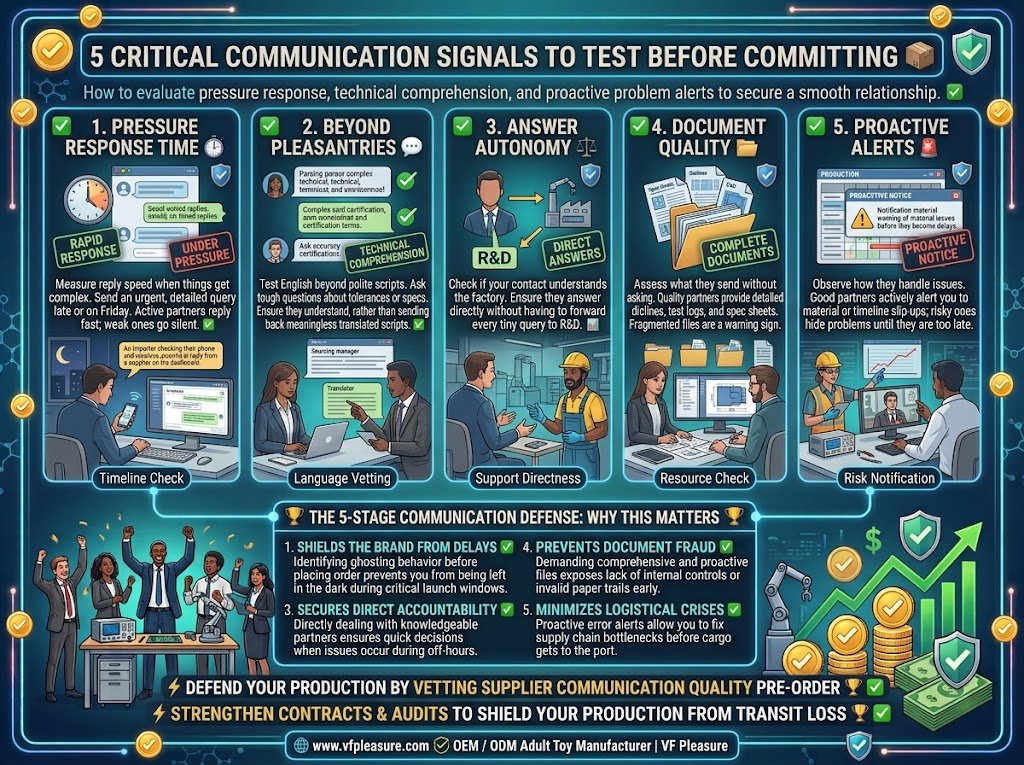
Supplier communication KPIs cover two dimensions: response time (how long it takes to receive a substantive answer to a business question) and proactivity (how often the supplier communicates important information before the buyer asks). "Good" in year one is a response time under 24 hours for routine questions and under 4 hours for urgent ones, combined with at least one unprompted proactive update per active production order.5
📡 How to Measure Communication Performance
Step 1 — Response Time Tracking
For each business-relevant message you send (not social pleasantries), record:
- Time sent
- Time of first substantive response (a reply that addresses the question, not "I'll check")
- Whether the response fully answered the question or required a follow-up
Calculate average response time over rolling 30 days.
Step 2 — Proactivity Tracking
For each active production order, record:
- Number of unprompted status updates received from the factory
- Number of times a potential problem was communicated proactively before the buyer asked
- Number of times a problem was discovered by the buyer rather than disclosed by the factory
Calculate a proactivity ratio: unprompted communications ÷ total order duration in weeks.
Step 3 — Quality of Information
Record separately whether each factory communication contained specific, actionable information (dates, quantities, measurements) or vague reassurances ("going well," "almost ready," "on track").
📊 Year-One Communication Benchmarks
| Dimension | Strong | Acceptable | Concerning |
|---|---|---|---|
| Routine response time | Under 12 hours | 12–24 hours | Over 24 hours |
| Urgent response time | Under 2 hours | 2–4 hours | Over 4 hours |
| Proactive updates per order | 3+ unprompted | 1–2 unprompted | 0 — all buyer-initiated |
| Information quality | Specific dates and quantities | Mix of specific and vague | Predominantly vague reassurance |
The communication KPI is the leading indicator for all other KPIs. A factory that communicates proactively about production progress will also communicate proactively about quality issues and delivery risks. A factory that only responds when pressed will also wait until the last moment to disclose a delivery delay or a component shortage. Measuring communication performance in year one tells you which category your factory falls into before you discover it through a business crisis.
KPI 5: Food-Grade Silicone Material Consistency Rate — What to Measure and What "Good" Looks Like
This is the KPI unique to adult toy sourcing — and the one most commonly absent from standard supplier KPI frameworks borrowed from other categories. Material consistency across batches is not just a quality concern. It is the basis of your body-safe claim. If your food-grade silicone test report covers batch 1 but your customer is receiving batch 4 — which may have been produced from a different material lot with different pigmentation or hardness — your claim may be technically unverifiable for the goods actually in the market.
Food-grade silicone material consistency rate measures whether each delivered batch matches the approved sample's food-grade silicone characteristics — hardness, surface texture, colour, and compliance documentation currency. "Good" in year one is 100% material specification consistency across all batches, with a per-batch test report from an accredited laboratory for each production run. Any material variation that is not pre-notified and pre-approved is a KPI failure.6
🧬 How to Measure Material Consistency
Step 1: Retain physical reference samples from your approved production batch — three to five units — as your material baseline. Store them in your compliance file alongside the food-grade silicone test report for that batch.
Step 2: On receipt of each subsequent batch, compare a sample of received units against your retained reference samples:
- Silicone hardness: compare compression feel against reference unit
- Surface texture: visual and tactile comparison under standardised lighting
- Colour: comparison against your Pantone reference or retained colour swatch
- Surface finish: check for any increased seam visibility or surface marks versus reference
Step 3: Confirm the batch-specific food-grade silicone test report is present and references the production batch just received.
Step 4: Calculate: (number of batches with confirmed material consistency matching reference samples and current per-batch test report ÷ total batches received) × 100
📊 Why Per-Batch Test Reports Are Required — Not Annual Reports
Food-grade platinum silicone remains the gold standard for adult toy body-contact surfaces — non-porous and hypoallergenic, ensuring products are safe, durable, and easy to clean. VF Pleasure provides compliance certificates for every batch, with third-party lab verification through SGS or Bureau Veritas available for private label orders.
The reason this matters for your KPI framework: a food-grade silicone annual report covers the material used in one tested batch. If your supplier substitutes a different silicone lot in a subsequent batch — whether due to supply chain pressure, cost optimisation, or oversight — the annual report no longer covers the goods you are selling. Per-batch reporting is the only mechanism that maintains continuous verification of your body-safe material claim.
How Do You Build a Year-One Supplier Scorecard?
The five KPIs above give you the measurement dimensions. A scorecard structures them into a single review instrument that you can share with your factory quarterly, use as the basis for a mid-year performance conversation, and reference at the annual renewal decision point.
A year-one adult toy supplier scorecard should record each KPI on a quarterly basis, with a simple traffic-light rating (green/amber/red) for each dimension, a trend indicator showing whether performance is improving or declining, and a named corrective action for any KPI in amber or red status. The scorecard is shared with the factory at each quarterly review — because a supplier who sees their performance data is a supplier who can respond to it.7
Here is the scorecard template — ready to use from your first quarterly review.
📊 Year-One Supplier KPI Scorecard Template
| KPI | Q1 Result | Q1 Rating | Q2 Result | Q2 Rating | Trend | Corrective Action |
|---|---|---|---|---|---|---|
| On-time delivery rate | — | 🟢/🟡/🔴 | — | — | ↑↓→ | — |
| Critical defect rate | — | 🟢/🟡/🔴 | — | — | ↑↓→ | — |
| Documentation completeness | — | 🟢/🟡/🔴 | — | — | ↑↓→ | — |
| Communication response time | — | 🟢/🟡/🔴 | — | — | ↑↓→ | — |
| Material consistency rate | — | 🟢/🟡/🔴 | — | — | ↑↓→ | — |
Traffic light criteria:
- 🟢 Green: Meeting or exceeding benchmark
- 🟡 Amber: Within 10% of benchmark; monitoring required
- 🔴 Red: More than 10% below benchmark; corrective action required
📅 The Year-One Review Calendar
| Quarter | KPI Review Focus | Factory Discussion Agenda |
|---|---|---|
| Q1 (Orders 1–3) | Establish baselines; no benchmarks yet | Share the scorecard framework; get factory buy-in |
| Q2 (Orders 4–6) | First formal benchmark comparison | Review Q1 data; identify any amber/red patterns |
| Q3 (Orders 7–9) | Trend analysis begins | Discuss improvement plans for any amber KPIs |
| Q4 (Orders 10–12) | Full-year assessment | Annual renewal decision; KPI targets for year two |
💡 Sally's 15-year factory-side perspective: I welcome clients who bring KPI scorecards to their quarterly reviews. It tells me two things: they understand their supply chain well enough to measure it, and they are building a long-term relationship rather than managing by feel. A factory that resists being measured by a reasonable KPI framework is a factory that either lacks confidence in its own performance or is not oriented toward the kind of partnership that produces consistent results over time. "We were impressed by their fast production and delivery times. VF Pleasure has been instrumental in our growth." — James Carter, CEO. That kind of feedback reflects a relationship where both sides know what "good" looks like.
What Are the Escalation Triggers That Require Formal Action?
A supplier scorecard is a monitoring tool. Escalation triggers are the specific threshold events that convert monitoring into action — because not every KPI miss requires the same response, and knowing the difference between an amber watch situation and a red action trigger protects you from both over-reacting to isolated events and under-reacting to patterns.
The five escalation triggers that require formal supplier action in year one are: two consecutive orders below the benchmark on any single KPI, one batch with a critical defect rate above 4%, one batch with any missing compliance documentation, one instance of a delivery delay discovered at or after the delivery date without prior notification, and one confirmed case of a material substitution without prior written approval. Each of these triggers a different response — from formal written notice to supplier diversification.8
Here is each trigger and the appropriate response.
🚨 Escalation Trigger Response Map
| Trigger | Formal Response | Timeline |
|---|---|---|
| Two consecutive orders below delivery benchmark | Written performance notice requesting root cause and improvement plan | Within 5 business days of second miss |
| Critical defect rate above 4% in any batch | Hold payment; require pre-shipment inspection on all subsequent orders | Immediate |
| Missing compliance documentation | Withhold balance payment until documentation provided; formal notice | Same delivery date |
| Delay discovered at delivery date without advance notice | Formal communication breach notice; review penalty clause applicability | Within 24 hours |
| Material substitution without written approval | Full batch rejection or negotiated concession; written record required | Immediate on discovery |
The most important escalation rule: every formal response must be in writing and must reference the specific KPI and the specific order it applies to. A verbal complaint changes nothing. A written performance notice with data creates a documented record that either produces improvement or provides the evidence base for a supplier transition decision.
Our adult toy manufacturer partnership strategies guide, adult toy manufacturing challenges and solutions guide, and red flags OEM adult toy manufacturer guide all address the supplier performance evaluation framework from different angles — collectively covering the full picture from relationship structure through performance management through transition planning.
Conclusion
Supplier KPIs in year one are not about holding a factory to impossible standards. They are about establishing what "good" means in concrete, measurable terms — so that you and your factory share the same definition of acceptable performance and so that any deviation from it is visible, documented, and actionable before it becomes a business crisis.
🚀 Partner with a Factory That Welcomes Being Measured
At VF Pleasure, we operate under the same standards this guide describes. Our monthly production capacity of 50,000 units across 5–10 production lines, our 12-point inspection system with four documented QC checkpoints, our per-batch food-grade silicone compliance certificates, and our proactive production milestone communication are all measurable against the KPI framework above.
We provide every client with:
- ✅ Measurable delivery performance — production milestone confirmations at material intake, mid-production QC, finished product QC, and pre-shipment dispatch
- ✅ Per-batch food-grade silicone documentation — from named accredited laboratories, tied to the specific production batch your customer receives
- ✅ Critical defect rate verified by 4-checkpoint QC — gas chromatograph, IPX7 chambers, 50kg pressure rigs, 3m drop simulator
- ✅ Documentation completeness per batch — CE, RoHS, REACH, CA65 documentation before or concurrent with shipment
- ✅ Third-party verification through SGS or Bureau Veritas — for private label sex toys on request
👉 Request a Quarterly Scorecard Template + Free Samples from VF Pleasure →
References & Source Notes
-
VF Pleasure — Adult Toy Quality Compliance Guide
| Field | Detail |
|---|---|
| 📌 Supports | Supplier KPIs for adult toy manufacturers cover five dimensions: on-time delivery rate, critical defect rate, documentation completeness, communication response time, and material consistency. Adult toys require more rigorous KPI tracking than most categories because body-contact safety, platform compliance, and brand trust damage compound the consequences of unmonitored supplier performance. |
| 🔍 Evidence Role | Definition + General Support |
| 📁 Source Type | Industry Guide |
⚠️ Scope Note: KPI frameworks and benchmarks described are general best-practice guidelines based on VF Pleasure's 15+ years of manufacturing experience. Actual acceptable performance levels vary by business model, product type, and market. Buyers should calibrate benchmarks to their specific context — including platform requirements, order frequency, and market sensitivity — rather than applying these figures rigidly to all supplier situations.
-
VF Pleasure — Evaluate Chinese Adult Toy Factory Delivery Capability
| Field | Detail |
|---|---|
| 📌 Supports | On-time delivery rate should be measured against purchase order agreed dates, distinguishing on-time arrivals from late deliveries with and without advance notice. Year-one benchmark of 90%+ on-time delivery is appropriate, with advance notification of delays considered part of performance quality. VF Pleasure's standard mass order lead time is 25–35 days with expedited options available. |
| 🔍 Evidence Role | Mechanism |
| 📁 Source Type | Industry Guide |
⚠️ Scope Note: Delivery rate benchmarks (90%+ as "good") reflect general industry performance expectations for Chinese adult toy manufacturers. Individual business needs may require higher standards — for subscription box operators with fixed monthly fulfillment dates or retail buyers with strict delivery windows, 95%+ may be the appropriate minimum threshold.
-
VF Pleasure — Sex Toy Manufacturing Process Guide
| Field | Detail |
|---|---|
| 📌 Supports | Critical defect rate should measure functional failures, food-grade silicone non-compliance, charging failures, and waterproofing failures at AQL batch level. Year-one benchmark of 1% or below for critical defects. QC failures cause a significant share of shipment delays in the industry. VF Pleasure's 12-point inspection system with 4 checkpoints (raw material, pre-assembly, finished product, batch testing) using gas chromatograph, IPX7 chambers, 50kg rigs, and 3m drop simulation. |
| 🔍 Evidence Role | Mechanism + Benchmark |
| 📁 Source Type | Industry Guide |
⚠️ Scope Note: The 1% critical defect rate benchmark reflects AQL standards for premium consumer goods with body-contact safety implications. This is stricter than general consumer goods AQL 2.5 standards — justified by the body-contact nature of adult toys and the platform compliance risk of recurring defect patterns. Measurement methodology should be confirmed with any third-party inspection firm used for AQL sampling.
-
VF Pleasure — Body-Safe Adult Toys Manufacturing Standards Guide
| Field | Detail |
|---|---|
| 📌 Supports | Documentation completeness rate should target 100% — every batch accompanied by complete required documentation before or concurrent with delivery. VF Pleasure provides CE, RoHS, REACH, CA65, and food-grade silicone documentation as standard, with all documentation pre-shipment. Food-grade silicone — not medical-grade — is the correct material claim for adult toy body-contact surfaces. |
| 🔍 Evidence Role | Mechanism + Benchmark |
| 📁 Source Type | Industry Guide |
⚠️ Scope Note: Required documentation set described reflects common requirements for major markets (EU, US, UK). Specific requirements vary by destination market and product type. Buyers should confirm the documentation set applicable to their specific market combination with a compliance advisor before finalising their documentation completeness KPI criteria.
-
VF Pleasure — Adult Toy Manufacturer Partnership Strategies
| Field | Detail |
|---|---|
| 📌 Supports | Communication KPIs cover response time (under 24 hours routine, under 4 hours urgent) and proactivity (unprompted updates per active order). Communication quality is a leading indicator of overall supplier performance. VF Pleasure typically replies within minutes during work hours and provides proactive production milestone updates as standard. |
| 🔍 Evidence Role | Mechanism |
| 📁 Source Type | Industry Guide |
⚠️ Scope Note: Communication response time benchmarks reflect reasonable expectations for international B2B manufacturing relationships accounting for time zone differences. VF Pleasure's stated response time ("within minutes") applies during stated work hours (Mon–Fri, 9am–5pm CST). All communication KPI expectations should be established in writing with the factory before measurement begins.
-
VF Pleasure — Material Transparency Sourcing Adult Toys China Guide
| Field | Detail |
|---|---|
| 📌 Supports | Food-grade silicone material consistency rate targets 100%, with per-batch test reports from accredited laboratories for each production run. Food-grade platinum silicone is the gold standard for adult toy body-contact surfaces — non-porous and hypoallergenic. VF Pleasure provides per-batch compliance certificates with third-party SGS or Bureau Veritas verification available for private label orders. |
| 🔍 Evidence Role | Mechanism + Benchmark |
| 📁 Source Type | Industry Guide |
⚠️ Scope Note: Material consistency assessment described (hardness, texture, colour comparison against retained reference samples) provides a practical field verification method. Definitive material verification requires laboratory-based migration testing. The KPI framework described combines practical batch comparison with documentation verification — both are necessary for comprehensive material consistency management.
-
VF Pleasure — Adult Toy Manufacturing Challenges and Solutions
| Field | Detail |
|---|---|
| 📌 Supports | Year-one supplier scorecard should record KPIs quarterly with traffic-light ratings, trend indicators, and named corrective actions — shared with the factory at each review. The scorecard converts informal performance monitoring into documented evidence that supports either improvement conversations or supplier transition decisions. |
| 🔍 Evidence Role | General Support |
| 📁 Source Type | Industry Guide |
⚠️ Scope Note: Scorecard template and review calendar are planning frameworks based on general supplier management best practice. Individual buyers should adapt the review frequency and KPI weighting to their specific order frequency, business model, and relationship maturity. New suppliers may benefit from more frequent review (monthly for the first two orders) before transitioning to quarterly cadence.
-
VF Pleasure — Red Flags OEM Adult Toy Manufacturer Guide
| Field | Detail |
|---|---|
| 📌 Supports | Five escalation triggers require formal action: two consecutive KPI misses, critical defect rate above 4%, missing compliance documentation, undisclosed delivery delay, and unapproved material substitution. Each trigger has a specific formal response with timeline. Written documentation of all escalation responses is essential for both improvement tracking and supplier transition evidence. |
| 🔍 Evidence Role | Case Reference + Mechanism |
| 📁 Source Type | Industry Guide |
⚠️ Scope Note: Escalation triggers and formal responses are general frameworks. Specific contractual remedies depend on the purchase order and manufacturing agreement terms in place. Buyers should confirm that their purchase agreements include the specific performance clauses (penalty clause, batch rejection right, payment withholding right) that give the formal responses legal standing.