Skip to content
Your private label order is complete. The factory says it passed QC. Your deposit is spent, your campaign is planned, and your retail buyer is waiting. This is the moment most brands skip the pre-shipment inspection — because everything feels done, and checking feels like a delay. It is not a delay. It is the last moment your brand has to catch a problem before your customer does.
A pre-shipment inspection for private label sex toy orders covers six areas: physical product functionality testing, food-grade silicone material and surface verification, compliance documentation completeness, waterproofing and charging reliability checks, private label packaging accuracy against approved artwork, and AQL batch sampling to confirm the inspection applies to a statistically valid sample — not just the units the factory placed on top.1
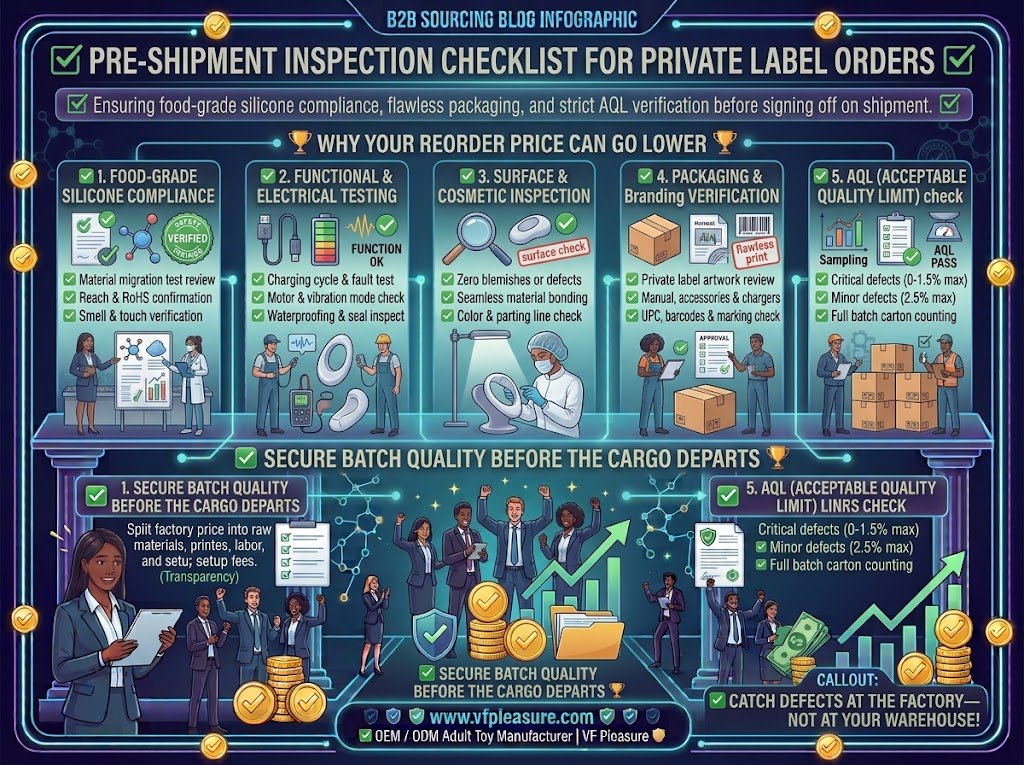
I'm Sally. I run VF Pleasure — a direct adult toys factory in Dongguan, China, with 15+ years of B2B manufacturing experience. Our 12-point inspection system runs four quality checkpoints from raw material intake through pre-shipment batch testing — and QC failures are responsible for a significant share of shipment delays across the industry. The brands that avoid those delays are the ones that treat pre-shipment inspection as a non-negotiable step, not an optional confidence check.
This guide gives you the complete pre-shipment inspection checklist — organised by category, with the specific pass/fail criteria for each check. It covers what a factory's own QC should have already verified, what an independent inspector needs to re-verify on your behalf, and what to do when the inspection finds something wrong.
- 1 Why Is Pre-Shipment Inspection Critical for Private Label Sex Toy Orders Specifically?
- 2 What Physical Product Tests Must Every Pre-Shipment Inspection Include?
- 3 What Material and Compliance Documents Must Be Present Before Shipment?
- 4 How Do You Inspect Private Label Packaging and Brand Accuracy?
- 5 Should You Use a Third-Party Inspector or Rely on the Factory's QC Report?
- 6 What Happens If Your Pre-Shipment Inspection Finds Problems?
- 7 Conclusion
- 8 References & Source Notes
Why Is Pre-Shipment Inspection Critical for Private Label Sex Toy Orders Specifically?
Generic manufacturing orders carry quality risk. Private label orders carry brand quality risk — which is different, and higher. When a generic wholesale product fails, a buyer gets a refund. When a private label product fails, a brand gets a review.
Pre-shipment inspection is critical for private label sex toy orders because the brand name on the packaging makes the buyer responsible for every quality, safety, and compliance claim the product carries — including food-grade silicone material standards, CE compliance, waterproof ratings, and vibration performance. A factory's internal QC report confirms the factory's assessment. A pre-shipment inspection confirms that the factory's assessment is accurate for the units you are actually receiving.1
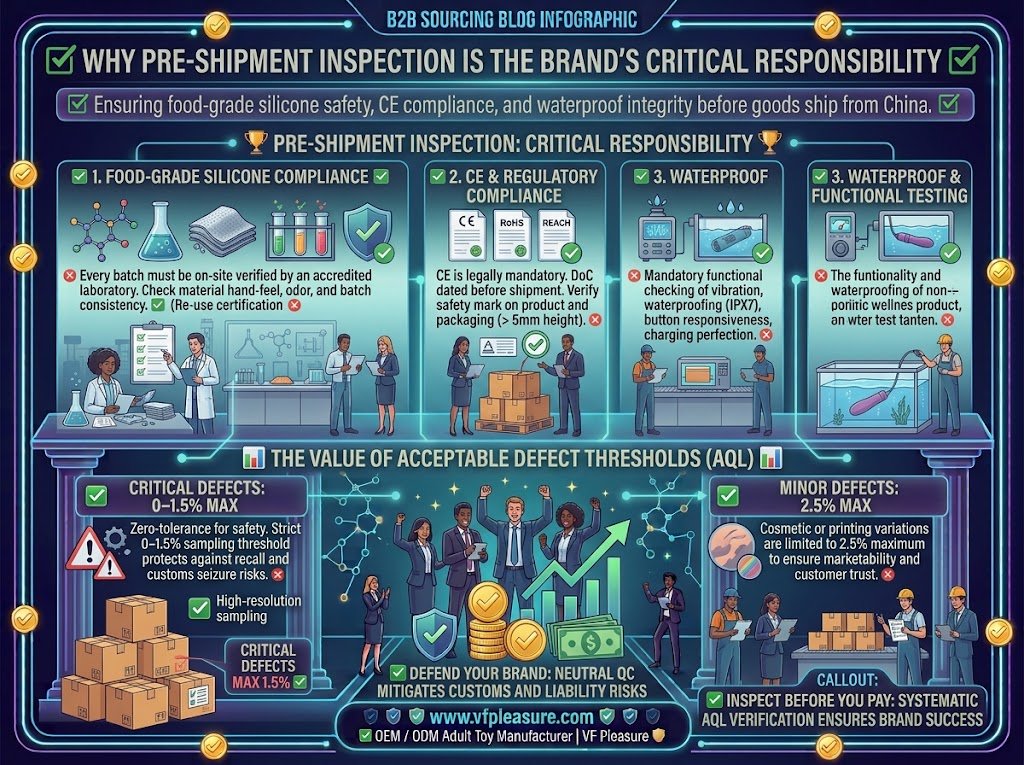
Here is what makes the private label inspection requirement different from a standard wholesale quality check.
🏷️ The Three Private Label Amplifiers of Quality Risk
Amplifier 1 — Brand name = brand liability
Your brand is on the packaging. Your brand name appears on the CE Declaration of Conformity. Your brand name is what your customer associates with every experience — positive or negative — they have with the product. A charging failure in a generic wholesale product is a product return. The same failure in a private label product is a one-star review with your brand name attached.
Amplifier 2 — Compliance documentation names you
For products entering the EU market, the CE Declaration of Conformity names your brand as the responsible person. If customs or a market surveillance authority finds a non-compliant product in your shipment, they are looking at your brand, not the factory. The factory's QC report is not your defence. Your independently verified pre-shipment inspection report is.
Amplifier 3 — Your customer cannot tell the factory apart from you
When your customer evaluates your private label vibrator, they have no visibility into where it was manufactured, what QC system was used, or whether the food-grade silicone claim was independently verified. They see your brand. Every product quality and safety decision you made during sourcing — including the decision about whether to conduct a pre-shipment inspection — is invisible to them but present in every unit they receive.
Our adult toy quality compliance guide and body-safe adult toys manufacturing standards guide explain the compliance accountability chain that makes this inspection a brand protection investment, not just a sourcing procedural step.
What Physical Product Tests Must Every Pre-Shipment Inspection Include?
Product functionality testing is the inspection layer that catches the defects most likely to generate returns, chargebacks, and negative reviews. It is also the layer most commonly executed at insufficient sample size — with inspectors testing three to five units from a 500-unit batch and calling it validated. The right sample size, the right test methodology, and the right pass/fail threshold turn a functionality check into actual protection.
Every pre-shipment inspection for a private label sex toy order must include five physical product tests: all vibration modes confirmed across a statistically valid AQL sample, charging cycle testing with simulated-use insertion/removal cycles, waterproofing validation using IPX7 submersion including pre-use simulation, surface and silicone finish comparison against the approved sample, and structural integrity testing under simulated transport stress conditions.2
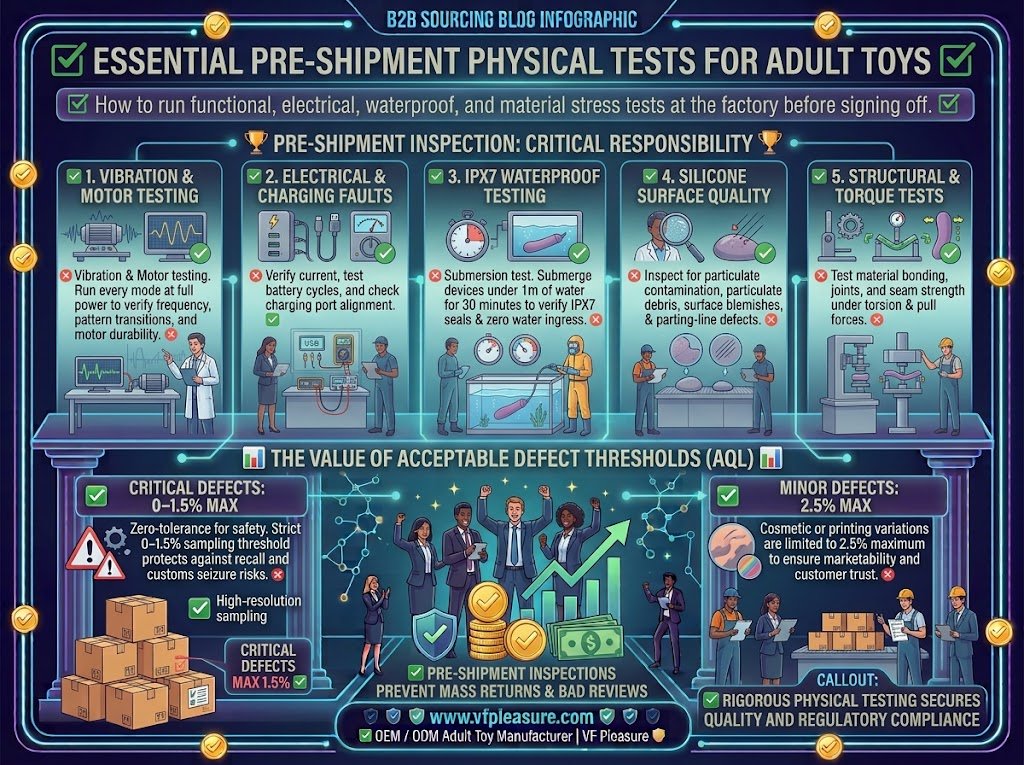
Here is each test — with the specific methodology and pass/fail criteria.
🔬 Physical Test 1 — Vibration Mode Confirmation
What to test: Every vibration pattern and intensity level named in the product specification.
Methodology: Each sampled unit is powered on and cycled through every mode. Mode transitions are timed where specified. Maximum vibration intensity is assessed against the approved sample.
Pass criteria: All modes activate on first attempt. Mode cycling is consistent and matches the approved sample sequence. Maximum intensity is subjectively comparable to the approved sample (or measurably within specification if vibration amplitude has been documented).
Fail signals: Any mode that fails to activate. Any mode that requires multiple button presses to activate. Any perceptible reduction in maximum intensity compared to the approved sample.
🔌 Physical Test 2 — Charging Cycle Testing
What to test: The charging connection geometry, full charge cycle completion, and charge retention.
Methodology: Each sampled unit is connected to the charging cable. Connection should make on the first attempt without requiring precise alignment beyond normal user adjustment. Units are charged to full and battery indicator tested where present. Charging is repeated after three insertion/removal cycles.
Pass criteria: Charging connection makes cleanly on first attempt. Full charge completes within the specified charge time. Charging remains stable after repeated insertion/removal cycles.
Fail signals: Connection requires unusually precise positioning. Charging drops out during a cycle. Full charge time significantly exceeds specification.
When intermittent charging failures surfaced across a batch for one of our clients, root cause analysis traced the issue to DC pin contact geometry — specifically how pin length interacted with the silicone body's natural flex under repeated use. The fix was a structural engineering change at the pin level. A pre-shipment charging cycle test conducted with use-simulation cycles would have caught this before any units shipped.
💧 Physical Test 3 — Waterproofing Under Real-Use Simulation
What to test: IPX7 waterproof compliance under conditions that reflect actual use.
Methodology: Units undergo insertion/removal cycles before submersion testing — not static submersion from a cold start. This reflects how a customer uses the product before taking it into the bath.
Pass criteria: No water ingress after 30 minutes at one metre depth, following pre-use simulation cycles. All functions operate normally after the submersion test.
Fail signals: Any moisture inside the unit after submersion. Any function failure after waterproof testing. Any audible hissing or bubbling during submersion that indicates seal compromise.
When a partner updated their IPX7 testing protocol to include pre-use simulation, the existing product failed the updated standard. We identified sealing architecture weaknesses, redesigned the internal waterproof structure, and revalidated before any product shipped. Your pre-shipment inspector should apply the same standard — not static submersion alone.
🧬 Physical Test 4 — Surface and Silicone Finish Comparison
What to test: Food-grade silicone surface quality against the approved sample — texture, hardness, colour accuracy, and absence of surface defects.
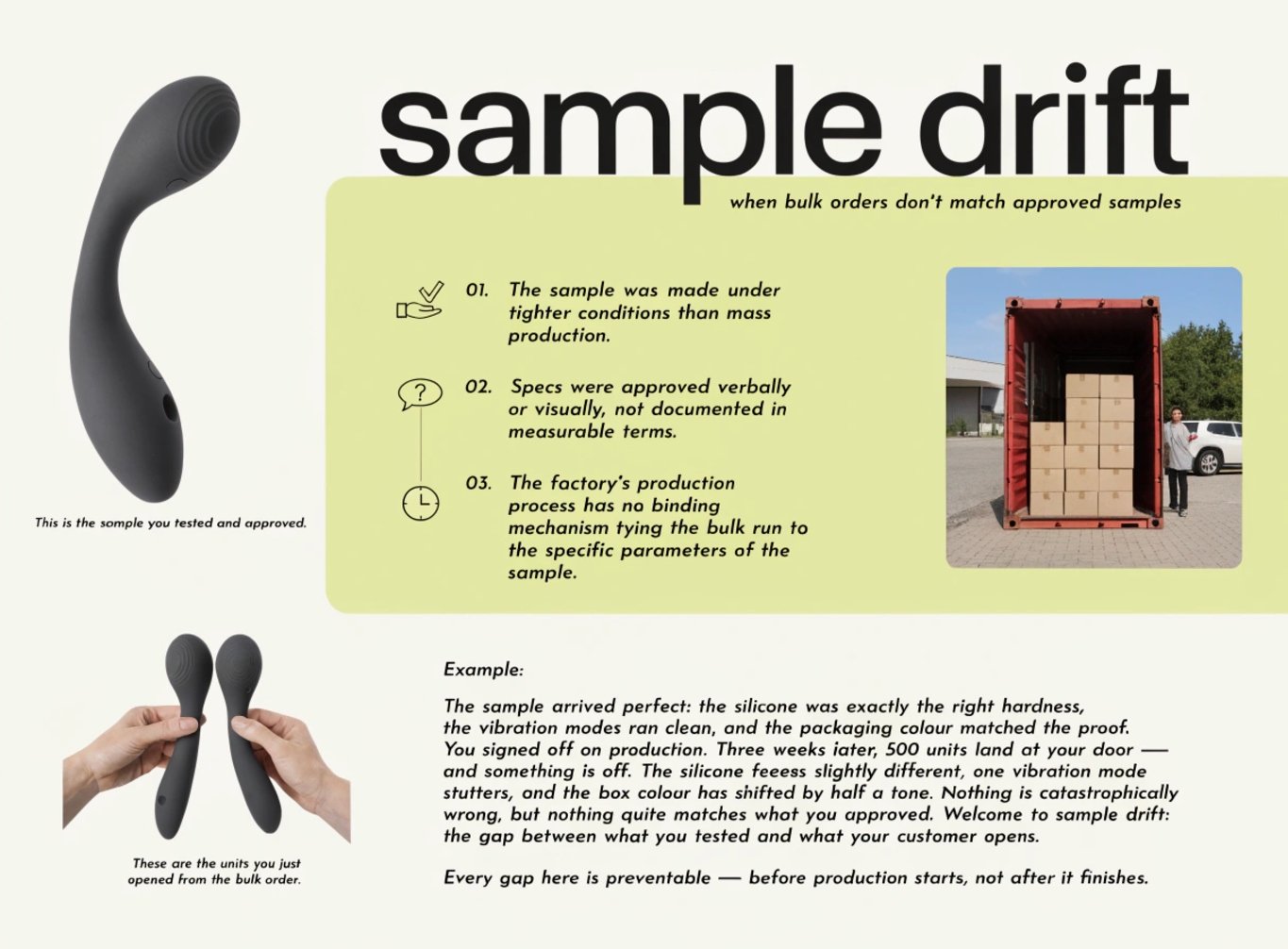
Methodology: Sampled units are placed alongside the approved pre-production sample under standardised lighting. Surface texture is assessed by touch. Hardness comparison is made by compression feel. Colour is compared under daylight-equivalent lighting. Surface is examined for seam marks, contamination, or finish irregularities.
Pass criteria: Surface texture matches the approved sample. Hardness is consistent with the approved sample. Colour falls within the approved colour range (defined by retained Pantone reference or physical colour swatch). Surface is free from marks, contamination, or visible seam defects.
Fail signals: Noticeably softer or harder silicone than the approved sample. Visible colour deviation from the approved reference. Surface marks, bubbles, or seam visibility beyond the approved tolerance. Any contamination or foreign material in the silicone surface.
📦 Physical Test 5 — Structural Integrity Under Transport Stress
What to test: Packaging structural integrity and product protection under simulated transport conditions.
Methodology: A representative sample of packaged units is subjected to drop testing and compression testing consistent with typical transit conditions. At VF Pleasure, packaging drop testing uses a 3-metre height simulator and stress testing uses 50kg pressure rigs.
Pass criteria: Box structure intact after drops. Packaging closure mechanisms function after drops. Product moves minimally within the packaging — no rattling or unsecured movement. Product shows no damage after packaging compression test.
Fail signals: Box corners crushed or opened after drops. Magnetic closure fails after drop. Product visibly shifts position in packaging. Any product function failure after transport simulation.
What Material and Compliance Documents Must Be Present Before Shipment?
A product that passes every physical test can still fail at customs, on a retail buyer's compliance desk, or in a platform listing review — because the compliance documentation set is incomplete, incorrectly named, or tied to a different production batch than the one being shipped. Document verification is not bureaucracy. It is the bridge between your factory's quality commitment and your brand's legal standing in every market you sell in.
The compliance documents that must be present and verified before a private label sex toy shipment is released are: food-grade silicone migration test report from a named accredited laboratory referencing this specific batch, CE Declaration of Conformity naming your brand as responsible person, RoHS compliance certificate for all electronic components, CA65 or Prop 65 documentation if shipping to California-market distribution, and UN38.3 battery certification for all rechargeable products.3
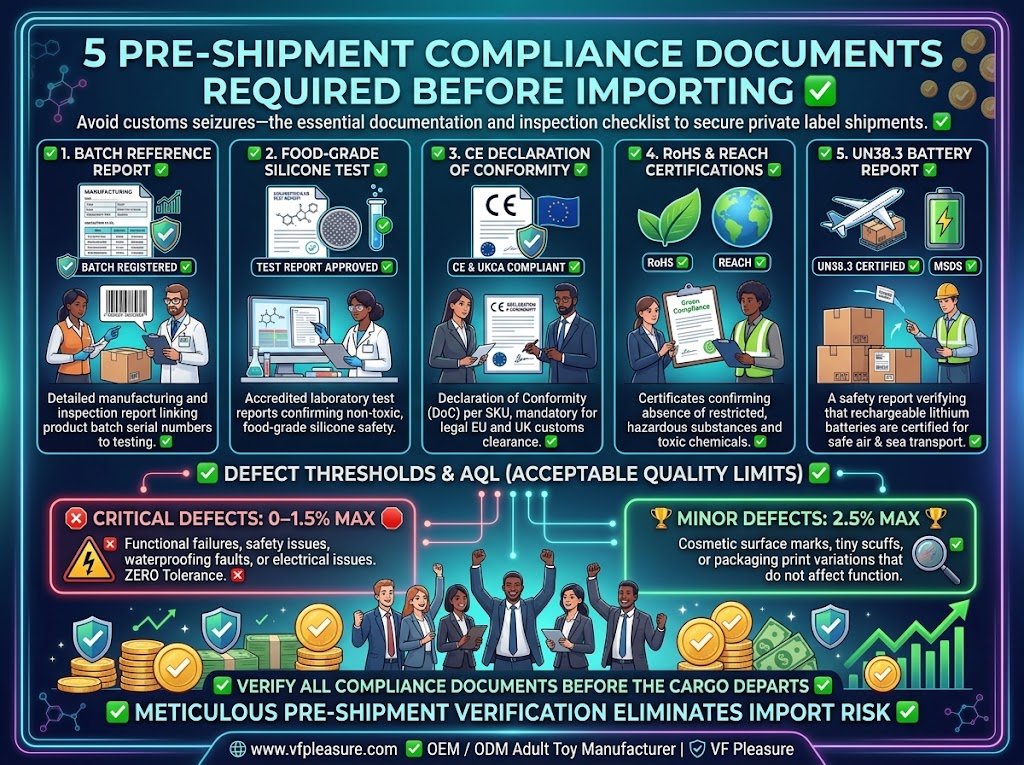
Here is the document verification checklist — with what to check in each document and what constitutes a pass.
📋 Document Verification Checklist
Document 1 — Food-Grade Silicone Migration Test Report
| Check | Pass Signal | Fail Signal |
|---|---|---|
| Laboratory name | Named ISO 17025-accredited laboratory | No lab named; generic company logo only |
| Sample reference | Batch or SKU reference matching this shipment | Generic material batch reference |
| Test method | EN 71-3, FDA CFR 21, or equivalent named | No test method cited |
| Measured values | Migration values listed per compound | Pass/fail stamp only — no measured values |
| Report date | Within 12 months for same material batch | Undated or expired |
⚠️ Important: VF Pleasure manufactures exclusively to food-grade silicone standards — the appropriate, verifiable, and correctly stated material certification for adult toy body-contact surfaces. Any document that claims "medical-grade silicone" should be treated as inaccurate — adult toy manufacturers do not hold medical device regulatory status. Your product copy and compliance files should consistently state "food-grade silicone."
Document 2 — CE Declaration of Conformity
| Check | Pass Signal | Fail Signal |
|---|---|---|
| Responsible person | Your brand name (for private label) | Factory name only |
| Product reference | Your SKU reference | Generic model number |
| Directives listed | LVD, EMC, RoHS directives named | No directives cited |
| Supporting tech file | Reference to technical file available | No technical file reference |
At VF Pleasure, all products comply with CE, RoHS, REACH, and CA65 standards, with full documentation for smooth importation. CE re-declaration under the buyer's brand name is supported for private label programs — ensuring your shipment carries documentation that names your brand as the EU responsible person.
Document 3 — RoHS Certificate
| Check | Pass Signal | Fail Signal |
|---|---|---|
| Component coverage | Specific electronic components listed | Blanket factory statement |
| Testing lab | Named laboratory | Self-declaration only |
| Substance list | All 10 RoHS restricted substances addressed | Partial list |
Document 4 — UN38.3 Battery Certification
| Check | Pass Signal | Fail Signal |
|---|---|---|
| Battery specification | Matches battery in this product | Different battery model referenced |
| Test summary | All 8 UN38.3 tests listed with results | No test detail, certificate only |
| Validity | Current for this product design | Expired or for a superseded design |
Document 5 — Packing List and Commercial Invoice Accuracy
| Check | Pass Signal | Fail Signal |
|---|---|---|
| Quantity match | Matches purchase order | Discrepancy between invoice and PO |
| HS code | Correct HS classification for your product | Missing or incorrect HS code |
| Country of origin | China (or correct origin) | Missing or incorrect |
| Unit value | Consistent with agreed pricing | Value understatement that creates customs risk |
How Do You Inspect Private Label Packaging and Brand Accuracy?
Your packaging is the first physical contact your customer has with your brand. A pre-shipment inspection that passes the product but misses a packaging colour shift, a logo misprint, or a text error sends your brand story into the market in a form you never approved. Packaging inspection is not aesthetic nitpicking. It is brand integrity protection.
Private label packaging inspection must verify six elements against your approved artwork: colour accuracy of all printed elements against the approved Pantone or print proof, logo placement dimensions and alignment within stated tolerance, required compliance marks present and correctly sized, brand copy accuracy including product name and any regulatory language, internal packaging structure matching the approved specification, and insert card accuracy for any printed brand story, care instructions, or warranty language.4
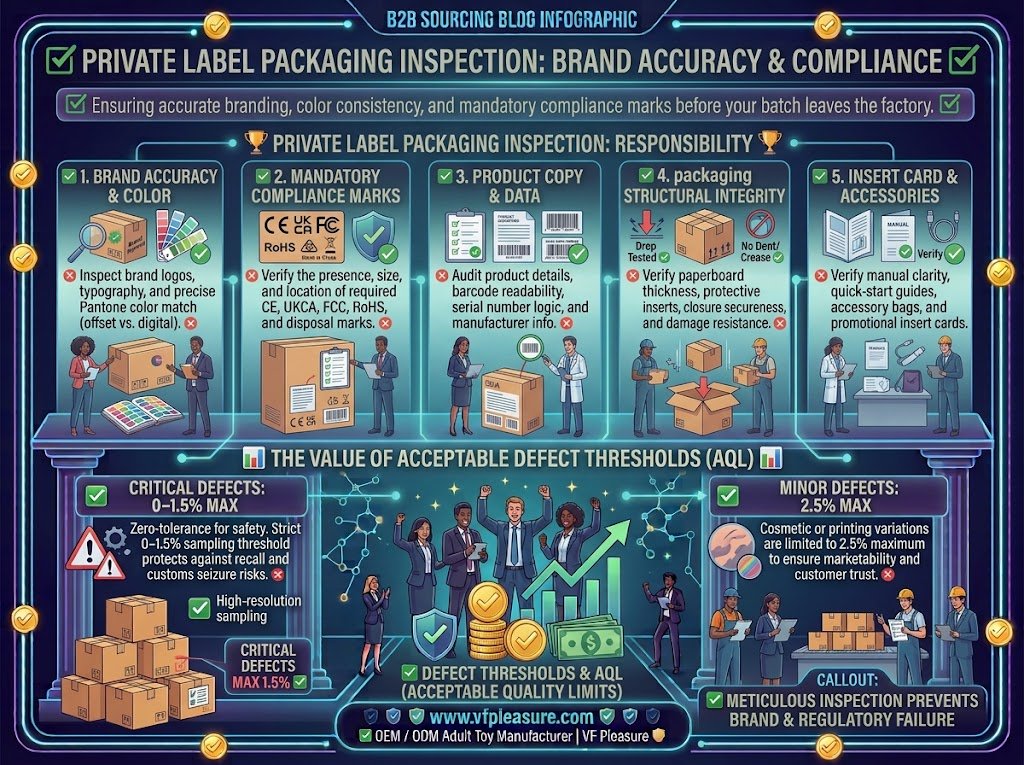
Here is each packaging inspection element — with what to check and the comparison reference required.
🎨 Packaging Inspection Element 1 — Colour Accuracy
What to compare against: The approved physical print proof, retained from the pre-production packaging approval stage.
How to inspect: Place the production box alongside the approved print proof under daylight-equivalent lighting. Assess all printed colour elements for tone, saturation, and finish consistency.
Common failures: Printed colour appearing lighter or darker than the proof due to press calibration drift. Matte finish appearing glossy or vice versa. Metallic elements (foil, embossing) appearing different in depth or coverage.
Pass threshold: Colour variation falls within the agreed tolerance — typically no more than one Delta E unit of perceptible colour difference for the primary brand colour. If no tolerance was formally agreed, the print must match the approved proof without visible colour shift.
🔤 Packaging Inspection Element 2 — Logo and Brand Name Accuracy
What to check: Logo size, placement relative to the box edge, typographic rendering of the brand name, and any trademark symbols.
Common failures: Logo printed 10–15% smaller than specified. Trademark ™ or ® symbol missing. Brand name text in wrong typeface weight (bold printed as regular, for example).
Pass threshold: Logo dimensions within ±5% of specification. All text elements match the approved artwork file. All required legal marks present.
✅ Packaging Inspection Element 3 — Required Compliance Marks
What to check: CE mark (for EU market shipments), RoHS indicator, Prop 65 warning (for California distribution), IPX7 rating mark, and recycling symbols where required.
Common failures: CE mark printed at non-compliant scale (minimum 5mm height required). IPX7 rating claim appearing without the waterproof testing documentation to support it. Prop 65 warning missing from products confirmed to require it.
Pass threshold: All required marks present. All marks at compliant minimum sizes. CE mark consistent with the brand name on the CE Declaration.
📝 Packaging Inspection Element 4 — Copy Accuracy
What to check: Product name (exactly matching the CE Declaration reference), product description copy, usage instructions, care instructions, and warranty language.
Common failures: Product name on packaging does not match the product name in the CE Declaration. Care instructions omit the food-grade silicone claim or misstate cleaning requirements. USB charging description does not match the charging system in the product.
Pass threshold: Every text element on the packaging matches the approved artwork file exactly. No substantive copy differences from the approved artwork.
📦 Packaging Inspection Element 5 — Internal Structure Accuracy
What to check: Insert tray dimensions and product fit, tissue or pouch wrap where specified, insert card placement, and accessory completeness (USB cable, user manual, etc.).
Common failures: Insert tray cut incorrectly — product moves more than the approved sample showed. Insert card missing or placed incorrectly. USB cable absent from a package where it was specified.
Pass threshold: Product sits securely in the insert without movement beyond the approved sample. All specified inserts and accessories present. Insert card correctly placed and facing the right direction.
Should You Use a Third-Party Inspector or Rely on the Factory's QC Report?
This is the question most private label buyers face when planning their inspection budget. The factory's QC report is free and already done. A third-party inspector costs money and time. The temptation to skip the independent step is real — and it is the temptation that produces the most expensive post-shipment problems.
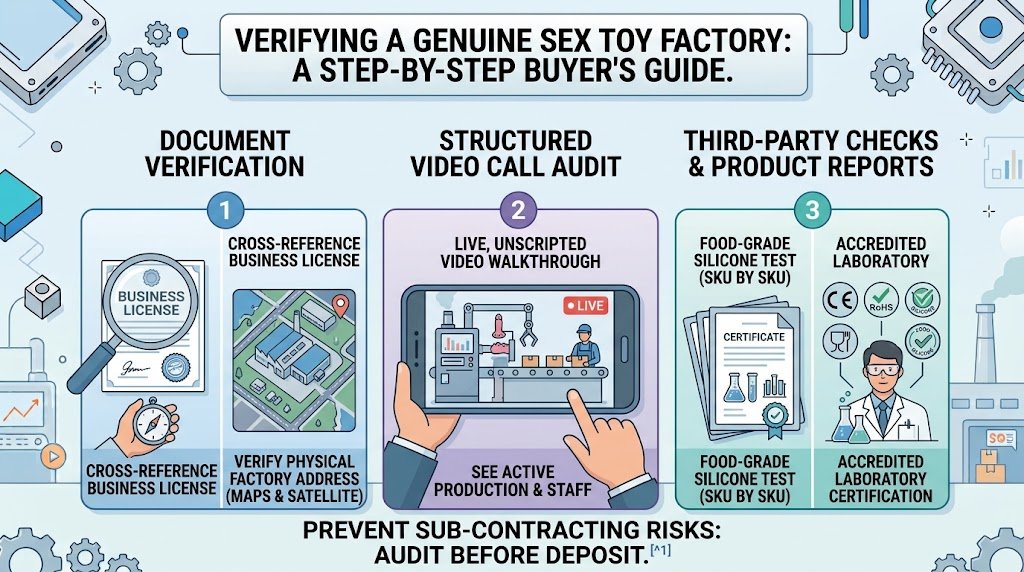
For private label sex toy orders, a third-party pre-shipment inspection is always preferable to relying solely on the factory's QC report because the factory's report has an inherent conflict of interest — the factory has a financial incentive to pass the shipment. A third-party inspector from a recognised firm has no such incentive. For private label orders specifically, where your brand carries the compliance liability, an independent pre-shipment report is the documentable evidence that your brand exercised due diligence.5
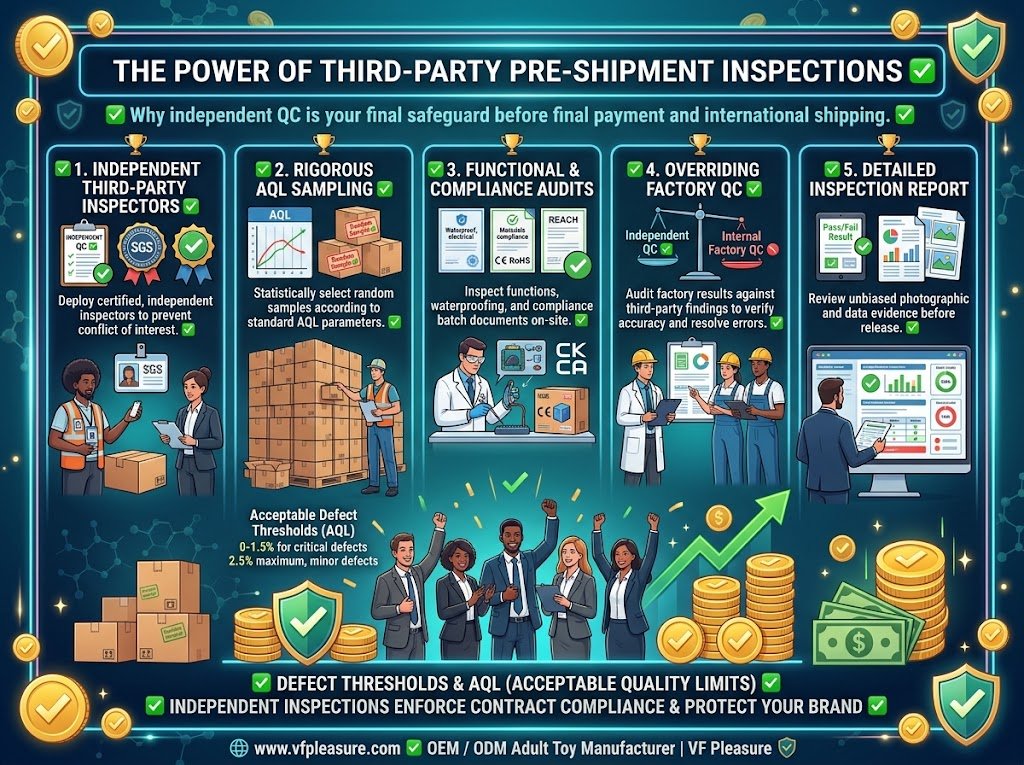
Here is how to structure the decision — and how to use both the factory QC report and independent inspection most effectively.
🔍 When Factory QC Report Alone Is Sufficient
Factory QC reports can be used as the primary (and potentially only) inspection documentation when:
- The order is a reorder of a previously inspected and approved design with a documented track record of consistent quality
- The order volume is below the threshold where AQL sampling provides meaningful statistical protection (typically below 50 units)
- The factory has a documented 12-point inspection system with four stages of checkpoint, provides QC reports with measured results rather than pass/fail stamps, and has a demonstrated history of transparent problem communication
At VF Pleasure, our QC team inspects raw materials, production processes, and finished products at every stage — with measured results and signed inspection reports per batch. This level of documentation transparency reduces — but does not eliminate — the value of independent inspection for private label orders.
🔍 When Third-Party Inspection Is Non-Negotiable
A third-party pre-shipment inspection is non-negotiable when:
- This is your first order with a new factory and you have no track record of their quality consistency
- The order includes your private label brand on CE compliance documentation naming you as the EU responsible person
- You are distributing through retail channels where platform or buyer compliance teams may request your inspection documentation
- The order includes a new design or new food-grade silicone colour specification not previously tested at your factory
For private label orders, VF Pleasure offers third-party lab verification through SGS or Bureau Veritas — giving buyers an independent compliance check alongside our own internal QC. This is not an alternative to our QC process. It is an independent layer on top of it.
📊 Factory QC vs Third-Party Inspection: What Each Provides
| Function | Factory QC Report | Third-Party Inspection |
|---|---|---|
| Conflict of interest | Factory has incentive to pass | No financial incentive either way |
| Sample coverage | Full batch or stated AQL | AQL sampling selected randomly on-site |
| Compliance documentation | Factory's own certification | Independent verification of claimed certificates |
| Packaging accuracy | Factory's own artwork comparison | Independent comparison against your approved files |
| Report admissibility | Useful but not independent | Accepted by customs, retail buyers, platforms |
| Cost | Included in production | $150–500 per inspection (SGS, BV, other firms) |
For an order of 500 private label units at $15 per unit ($7,500 total), a $300 third-party inspection represents 4% of the order value. One batch of returns generated by a defect the inspection would have caught represents the full order value plus the reputational cost of the returns.
💡 Sally's note: The clients who have never had a returns wave from a private label order are the ones who treat the third-party inspection as a fixed cost line in their sourcing budget — not as an optional expense when they are feeling cautious. The inspection that finds nothing is not a waste. It is proof that your factory's QC delivered what it claimed.
What Happens If Your Pre-Shipment Inspection Finds Problems?
Finding a problem during pre-shipment inspection is not a disaster. It is the QC system working exactly as intended — catching a defect before it reaches your customer, while you still have options. What you do with the finding determines whether it costs you a week of delay or a wave of returns.
When a pre-shipment inspection finds problems in a private label sex toy order, you have four options in order of preference: request factory rework within an agreed timeline and re-inspect, accept the batch with a documented written concession and price adjustment for the non-conforming units, reject the batch and negotiate replacement production on a priority timeline, or accept the batch with a partial fulfilment strategy that separates conforming units from non-conforming ones. The right choice depends on the defect classification and the severity.6
Here is the decision framework for each defect scenario.
✅ Option 1 — Rework and Re-Inspect (Preferred for Critical Defects)
When to use it: The defect is structural and correctable — a charging contact geometry issue, a waterproof seal failure, a surface treatment non-compliance — and the factory has the engineering capability and the production time to rework within your delivery window.
How to structure it: Confirm in writing: the specific defect found, the rework action required, the timeline for completion, and the re-inspection requirement before release. Do not accept a factory's verbal assurance that the rework is complete. Require a second independent inspection confirmation.
When we adapted to updated QA color fastness requirements for a client, rather than shipping non-compliant product, we replaced specific surface treatments, conducted internal validation, and resubmitted for inspection. This is the factory response pattern a rework conversation should produce.
💰 Option 2 — Written Concession and Price Adjustment (For Minor Defects)
When to use it: The defect is minor — cosmetic, packaging-related, or within the minor defect tolerance — and does not affect product function or compliance. The non-conforming units can be sold or fulfilled without quality compromise.
How to structure it: Document the defect in writing. Calculate the per-unit impact on your margin and customer experience. Negotiate a credit against the balance payment or the next order equal to the quantified impact. Ensure the factory acknowledges the defect in writing — this protects you from a future dispute about whether the goods were accepted as is.
❌ Option 3 — Batch Rejection and Replacement Production
When to use it: The defect is critical — food-grade silicone material non-compliance, waterproofing failure across the batch, or packaging accuracy errors affecting compliance marking — and rework cannot address it within your timeline.
How to structure it: Formal written notice referencing the inspection report. Clear statement of the defect category and why it constitutes a critical failure. Request for replacement production on a priority timeline. Confirmation of whether the balance payment is withheld pending replacement completion (it should be).
⚡ Option 4 — Partial Fulfilment with Conforming Units
When to use it: The batch has a mix of conforming and non-conforming units — conforming units can be shipped now to meet your timeline, while non-conforming units are set aside for rework or credit.
How to structure it: This requires the inspector to clearly segregate conforming from non-conforming units during the inspection. Boxes must be marked and the segregation confirmed in writing before any units are loaded for shipment.
📋 Defect Response Decision Matrix
| Defect Type | Severity | Preferred Response |
|---|---|---|
| Food-grade silicone non-compliance | Critical | Batch rejection, replacement production |
| Waterproofing failure (functional) | Critical | Rework + re-inspect |
| Charging contact failure | Critical | Rework + re-inspect |
| CE mark missing or incorrect | Critical | Rework (packaging reprint) + re-inspect |
| Colour deviation from approved proof | Major | Written concession + partial credit |
| Logo size below specification | Major | Written concession + partial credit OR rework |
| Insert card missing | Major | Rework (add inserts) + re-inspect |
| Minor surface mark | Minor | Accept with documented concession if within AQL |
| Batch code documentation misalignment | Documentation | Proactive communication to inspector, documented explanation |
The batch code scenario specifically — where documentation timing creates an apparent inspection risk — was resolved for one of our clients through proactive communication rather than a shipment hold. We clearly documented the production and inspection timeline, provided a written explanation for the inspector, and maintained delivery. This is why transparent communication is a quality management tool, not just a relationship preference.
Our adult toy manufacturing challenges and solutions guide, adult toy quality compliance guide, and verify adult toy quality Chinese suppliers guide document the full quality management framework — including the engineering responses to each common defect type.
Conclusion
Your pre-shipment inspection is the last line of defence between your production investment and your brand's customer experience. A complete checklist covering functionality, food-grade silicone material standards, compliance documentation, and packaging accuracy — verified by an independent inspector — is the only way to confirm your factory's QC claims before your shipment releases.
🚀 Source from a Factory Where Pre-Shipment Inspection Is Already Built In
At VF Pleasure, our 12-point inspection system runs four quality checkpoints from raw material intake through pre-shipment batch testing — with QC reports generated before every shipment dispatch. For private label orders, third-party verification through SGS or Bureau Veritas is available, giving your brand an independent compliance layer on top of our internal system.
Every private label order includes:
- ✅ Food-grade platinum silicone standard — per-batch migration test reports from named accredited laboratories
- ✅ CE, RoHS, REACH, CA65 documentation — per SKU, with CE re-declaration under your brand name
- ✅ Pre-shipment QC report — covering all four inspection stages, sent before shipment authorisation
- ✅ Third-party lab verification — SGS or Bureau Veritas on request for private label sex toys
- ✅ IPX7 waterproof validation — including pre-use simulation, not static submersion only
- ✅ Full product range — vibrators, female sex toys, couples toys, thrusting toys, and male adult toys
📬 Start Your Pre-Shipment Ready Sourcing Conversation:
1. What product category and order volume are you planning?
(AQL sample size and third-party inspection scope vary by order volume — I can tell you exactly what inspection structure fits your order)2. Which markets are you shipping to?
(EU needs CE documentation with your brand name; US needs CA65 and food-grade silicone reports; Japan needs PSE — each affects the documentation checklist)3. Have you had a private label quality failure before — and what specifically went wrong?
(This tells me which part of our inspection system and case history is most relevant to your specific concern)👉 Request Pre-Shipment QC Documentation + Free Samples from VF Pleasure →
References & Source Notes
-
VF Pleasure — Adult Toy Quality Compliance Guide
| Field | Detail |
|---|---|
| 📌 Supports | Pre-shipment inspection for private label sex toy orders covers six areas: physical functionality, food-grade silicone verification, compliance documentation, waterproofing and charging, packaging accuracy, and AQL batch sampling. VF Pleasure's 12-point inspection system with four checkpoints and QC failures causing 22% of industry shipment delays underline why independent pre-shipment verification matters for private label brands. |
| 🔍 Evidence Role | Definition + General Support |
| 📁 Source Type | Industry Guide |
⚠️ Scope Note: Pre-shipment inspection protocols described reflect VF Pleasure's internal QC standards and general industry best practice. Specific inspection requirements vary by product type, destination market, and distribution channel. All inspection protocols should be confirmed with a qualified third-party inspection firm for the specific order context.
-
VF Pleasure — Sex Toy Manufacturing Behind the Scenes
| Field | Detail |
|---|---|
| 📌 Supports | Physical product tests must include vibration mode confirmation, charging cycle testing with use-simulation cycles, IPX7 waterproofing with pre-use simulation, surface and silicone finish comparison, and structural integrity testing. VF Pleasure's QC system uses IPX7 chambers, 50kg pressure rigs, and 3m drop simulators. Charging contact failures traced to DC pin geometry and waterproof failures traced to sealing architecture are documented cases where pre-shipment testing would have caught the issue before delivery. |
| 🔍 Evidence Role | Mechanism + Case Reference |
| 📁 Source Type | Industry Guide |
⚠️ Scope Note: Physical test methodologies described represent best practice standards for adult toy pre-shipment inspection. Specific test parameters (submersion duration, drop height, pressure load) should be confirmed against the product's specification and applicable standards. Third-party inspection firms will apply their own standardised protocols — confirm these match your product requirements before engagement.
-
VF Pleasure — Body-Safe Adult Toys Manufacturing Standards Guide
| Field | Detail |
|---|---|
| 📌 Supports | Compliance documents required before shipment: food-grade silicone migration test report from a named accredited laboratory (per batch), CE Declaration naming the buyer's brand as EU responsible person, RoHS certificate, CA65/Prop 65 documentation for California distribution, and UN38.3 battery certification. VF Pleasure provides CE, RoHS, REACH, and CA65 documentation per SKU with full technical file support for private label brand re-declaration. |
| 🔍 Evidence Role | Definition |
| 📁 Source Type | Industry Guide |
⚠️ Scope Note: Compliance document requirements vary by destination market, product type, and distribution channel. The checklist provided reflects requirements for EU, US, and general market access. Specific compliance obligations for additional markets should be confirmed with a qualified compliance advisor before shipment release. VF Pleasure manufactures to food-grade silicone standards — not medical-grade — and documentation should reflect this accurately.
-
VF Pleasure — Private Label Adult Products Development Process
| Field | Detail |
|---|---|
| 📌 Supports | Private label packaging inspection must verify six elements: colour accuracy against Pantone or approved print proof, logo placement dimensions, required compliance marks, brand copy accuracy, internal packaging structure, and insert card accuracy. VF Pleasure offers custom packaging solutions including eco-friendly materials, luxury gift boxes, and discreet minimalist designs — all verified against approved artwork at pre-shipment stage. |
| 🔍 Evidence Role | Mechanism |
| 📁 Source Type | Industry Guide |
⚠️ Scope Note: Packaging inspection pass tolerances (e.g., ±5% logo size, 1 Delta E colour variation) are general industry references. Specific tolerances should be agreed between buyer and factory in the pre-production packaging approval documentation. Without formally agreed tolerances, "matching the approved proof" is the operative standard.
-
VF Pleasure — Verify Adult Toy Quality Chinese Suppliers Guide
| Field | Detail |
|---|---|
| 📌 Supports | Third-party pre-shipment inspection is always preferable for private label orders because factory QC reports have an inherent conflict of interest. VF Pleasure offers third-party verification through SGS or Bureau Veritas for private label orders. The cost of a $300 independent inspection represents approximately 4% of a $7,500 order — far less than the cost of a returns wave from a defect the inspection would have caught. |
| 🔍 Evidence Role | General Support |
| 📁 Source Type | Industry Guide |
⚠️ Scope Note: Third-party inspection cost estimates are approximate and vary by location, inspection scope, product category, and inspection firm. Actual costs should be confirmed directly with SGS, Bureau Veritas, or an equivalent accredited inspection firm. Factory QC reports from factories with documented inspection systems and transparent reporting standards can supplement — but should not replace — independent pre-shipment inspection for private label orders.
-
VF Pleasure — Adult Toy Manufacturing Challenges and Solutions
| Field | Detail |
|---|---|
| 📌 Supports | When inspection finds problems, four response options exist in order of preference: rework and re-inspect for critical defects, written concession and price adjustment for minor defects, batch rejection and replacement for critical non-correctable failures, and partial fulfilment with conforming units separated. Documented VF Pleasure cases show color fastness rework, waterproof architecture redesign, charging contact engineering, and batch code documentation communication — all resolved before shipment impact. |
| 🔍 Evidence Role | Case Reference + Mechanism |
| 📁 Source Type | Industry Guide |
⚠️ Scope Note: Defect response options and the decision matrix provided are general frameworks based on VF Pleasure's manufacturing experience. Specific rights in any defect scenario depend on the purchase order terms, the manufacturing agreement, and applicable contract law. Buyers should have written quality specifications and remediation obligations in their purchase order or supplier agreement before production begins.