Skip to content
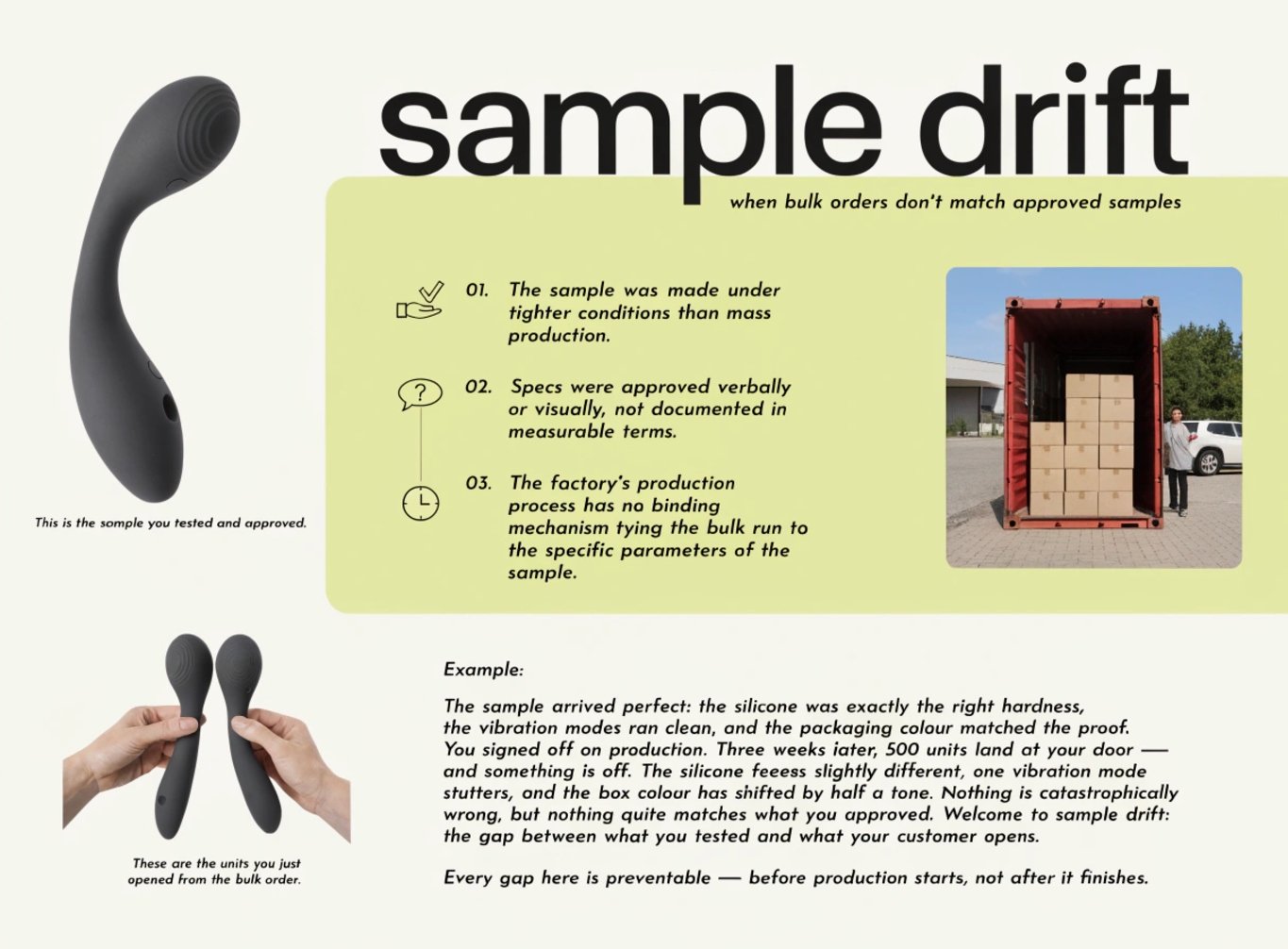
The sample arrived perfect. The silicone was exactly the right hardness. The vibration modes ran clean. The packaging colour matched the proof. You signed off on production. Three weeks later, 500 units land at your door — and something is off. The silicone feels slightly different. One vibration mode stutters. The box colour has shifted by half a tone. Nothing is catastrophically wrong, but nothing quite matches what you approved. Welcome to sample drift: the gap between what you tested and what your customer opens.
Bulk orders diverge from approved samples in adult toy manufacturing for three reasons: the sample was made under tighter conditions than mass production, specifications were approved verbally or visually rather than documented in measurable terms, and the factory's production process has no binding mechanism tying the bulk run to the specific parameters of the sample you signed off on. Every one of these gaps is preventable — before production begins, not after it finishes.1

I'm Sally. I run VF Pleasure — a direct adult toys factory in Dongguan, China, with 15+ years of manufacturing experience. We maintain strict quality control procedures at every stage of production — our QC team inspects raw materials, production processes, and finished products to guarantee consistent quality and reliability. That consistency does not happen by accident. It happens because of the documentation, inspection, and communication structure that connects your approved sample to every unit in your bulk order.
This article explains the specific mechanisms behind sample drift — and the exact prevention steps that eliminate the gap between what you approved and what your customer receives.
- 1 Why Does the Sample-to-Bulk Gap Happen in the First Place?
- 2 What Are the Most Common Ways Bulk Orders Diverge from Samples?
- 3 What Must You Specify in Writing Before Production Begins?
- 4 How Does a Multi-Stage QC System Bridge the Sample-to-Bulk Gap?
- 5 What Production Milestones Should You Monitor Between Sample and Shipment?
- 6 What Real Production Scenarios Show How Sample Drift Gets Caught and Fixed?
- 7 Conclusion
- 8 References & Source Notes
Why Does the Sample-to-Bulk Gap Happen in the First Place?
The most common explanation buyers give for sample drift is that the factory "lowered quality" for the bulk run. Sometimes that is true. More often, it is a structural problem that has nothing to do with intent — and everything to do with the conditions under which samples are produced versus the conditions under which 500 units roll off the line.
The sample-to-bulk gap in adult toy manufacturing happens because samples are typically produced by skilled technicians under close supervision using hand-selected materials, while bulk production runs automated or semi-automated processes with less individual unit attention. Without a documented specification bridge — a written record of every measurable parameter from the approved sample — the bulk run has no binding reference point to match against.1
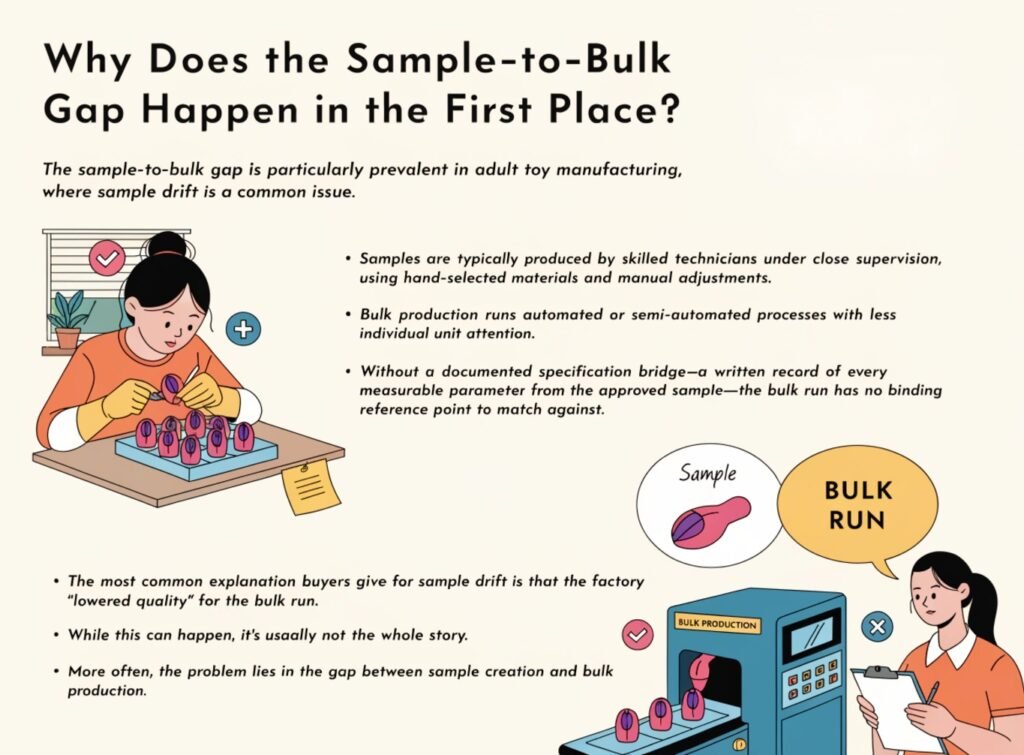
Here is exactly what changes between sample production and bulk production — and why each change creates drift risk.
🔬 Why Sample Conditions Are Structurally Different from Bulk Conditions
Condition 1 — Material sourcing
A sample may be produced from a specific batch of food-grade silicone compound in stock at the time. The bulk order may be produced from a different batch of the same compound purchased weeks later. Even within the same food-grade silicone specification, minor lot-to-lot variation in hardness, colour, and surface texture is possible — and visible to a customer comparing the two products side by side.
Condition 2 — Operator skill and attention density
A sample is typically assembled by an experienced technician who knows the buyer is evaluating the unit specifically. One or three units receive individual attention. In a 500-unit bulk run, the same unit goes through a production line at scale — with per-unit attention time that is a fraction of what the sample received. Sealing consistency, vibration mode tuning, and surface finish quality all degrade when attention is distributed across 500 units rather than concentrated on three.
Condition 3 — Component sourcing
Electronic components — motors, charging modules, vibration controllers — may be from a different sub-supplier batch at bulk production time than at sample time. A motor from a different production lot that meets the same specification sheet may still feel slightly different in use. Unless your specification document explicitly captures the measurable vibration parameters (strength, frequency, noise level under load), the factory has no binding reference to match.
Condition 4 — No written specification to enforce
This is the core problem behind every other condition listed above. If your sample approval was visual ("looks good") and tactile ("feels right") without a written measurement document, the factory floor team running your bulk order has no specific parameters to produce to. They produce to their own judgment of "matching the sample" — which is subjective, varies by operator, and has no enforcement mechanism.
Our adult toy manufacturing challenges and solutions guide and crafting high-quality adult toys guide document the specific structural mechanisms behind quality consistency — and what needs to be in place before production begins to enforce it.
What Are the Most Common Ways Bulk Orders Diverge from Samples?
Not all sample drift is equal. Some divergences are visible and immediate. Others surface only after your customer has used the product for two or three weeks. Understanding the specific drift types — and the mechanisms behind each — tells you exactly what to specify, test, and document at the sample approval stage.
The most common ways adult toy bulk orders diverge from samples are: silicone hardness and colour variation between material batches, vibration performance shift from motor lot differences, charging reliability variance from assembly tolerance changes, surface finish degradation under scale production conditions, and packaging colour or print accuracy drift between proof and bulk print run. Each has a measurable specification that can prevent it.2
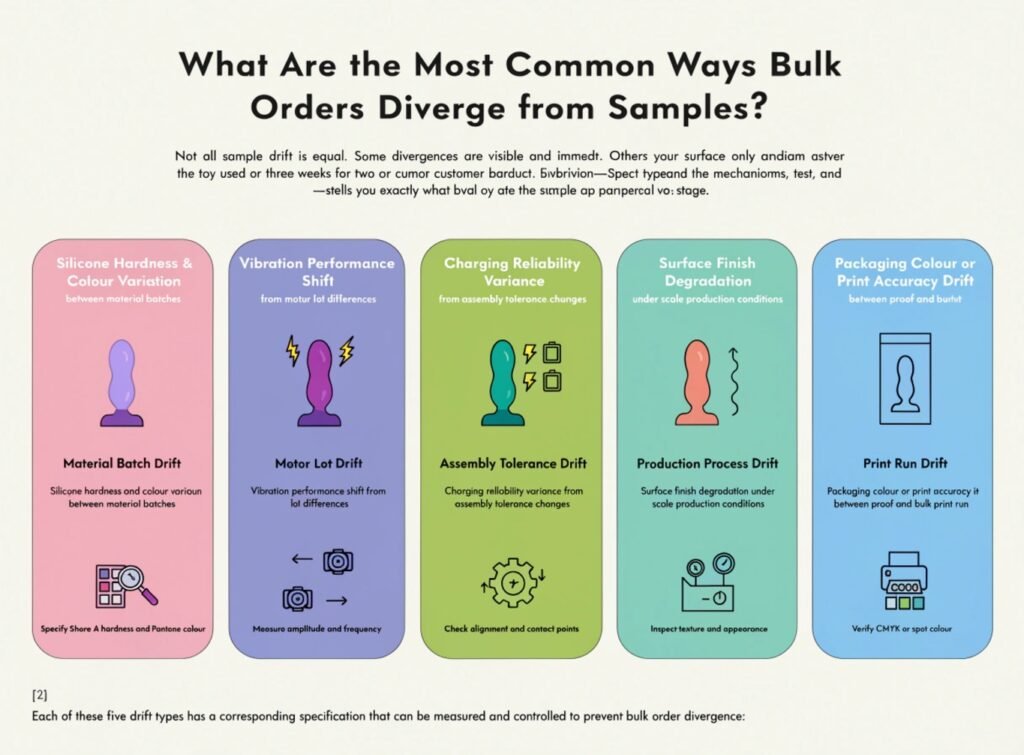
Here is each divergence type, the mechanism behind it, and the specification that prevents it.
🧬 Divergence 1 — Silicone Hardness and Colour Variation
Food-grade platinum silicone is the right material standard for adult toy body-contact surfaces — non-porous, hypoallergenic, and verifiable by third-party laboratory testing. But food-grade silicone comes in hardness grades (measured in Shore A) and the same colour specification can produce slightly different visual results from batch to batch depending on pigment distribution.
If your sample approval was based on holding the unit and saying it "feels right," you have not captured the hardness grade that produced that feeling. If you approved a colour visually without a Pantone or CMYK reference, you have not captured the specification that your bulk print run or silicone pigmentation needs to match.
Prevention: Specify silicone hardness in Shore A alongside your sample approval. Specify colour using a physical colour swatch retained by both you and the factory as a bound reference. At VF Pleasure, food-grade platinum silicone is our manufacturing baseline — verified per batch through phthalate screening at our raw material intake checkpoint. Our material library includes 50+ certified options, all documented to material specification rather than visual approximation.
⚙️ Divergence 2 — Vibration Performance Shift from Motor Lot Differences
This is the divergence that generates the most damaging review pattern: "the new one isn't as powerful as my previous one." It is also the divergence least likely to be noticed during pre-shipment QC — because a motor that meets the pass/fail threshold for "vibrates" may still perform detectably differently from the approved sample when the customer holds both products side by side.
Motor performance variation between production lots is a real supply chain phenomenon. When a key motor component increased significantly in cost for one of our clients due to supply chain disruption, we benchmarked multiple alternative motors against the original's vibration strength, noise level under load, and operational stability profile — not against a simple pass/fail threshold. We selected the replacement that maintained performance consistency within the partner's brand positioning. The client's product arrived with no detectable change.
Prevention: Capture vibration performance at sample approval in measurable terms: vibration frequency range, amplitude at each mode, and noise level under load. Request these measurements at the pre-production milestone and compare against the sample specification. Any motor substitution — even for a "equivalent specification" alternative — should require your written approval.
🔌 Divergence 3 — Charging Reliability Variance
Charging failures in bulk that did not appear in the sample are almost always caused by assembly tolerance drift under scale production conditions — specifically, the contact geometry between the charging port and the magnetic or pin charging system.
One of our clients received feedback identifying intermittent charging failures across a product batch. We traced the root cause to DC pin contact geometry — specifically how pin length interacted with the natural flex of the silicone body under repeated use. The sample, assembled by an experienced technician, likely had slightly better pin alignment than units assembled at scale. We redesigned the pin structure and validated long-term durability under simulated use. The fix eliminated the failure mode at the structural level.
Prevention: Specify assembly tolerance requirements for charging connection geometry. Include charging cycle testing as a pre-shipment QC requirement — not just a visual inspection. Charging connections should be tested with simulated use conditions (insertion and removal cycles) not just clean-connection tests.
🎨 Divergence 4 — Surface Finish Degradation at Scale
The smooth, even silicone surface finish on your approved sample results partly from the skill and attention of the technician who produced it. At scale, surface finish consistency depends on mold condition, release agent application consistency, and post-mold handling. Minor mold wear, inconsistent release agent coverage, or rough handling during extraction can create surface marks, seam visibility, or texture variations that your sample did not show.
Updated QA standards for one of our partners required higher color fastness performance on silicone and ABS surfaces. Their existing surface treatment failed the updated criteria at scale — not in the sample run. Rather than shipping non-compliant product, we reviewed the full material and coating process, replaced specific surface treatments with compliant alternatives, conducted internal validation, and re-submitted. Every SKU passed. No large-scale rejection.
Prevention: Specify surface finish requirements with a physical reference sample — ideally multiple units from the sample run — retained as a bound reference set for both you and the factory. Include surface inspection in your pre-shipment QC criteria with reference comparison against the retained samples.
📦 Divergence 5 — Packaging Colour and Print Accuracy Drift
Packaging is your brand. A magnetic box with a colour that has drifted half a tone from your proof is noticeable to your customer, especially if they are placing a second order and comparing the boxes side by side. Print accuracy drift is almost always caused by the difference between a proof produced on a digital printer and a bulk run produced on an offset or flexographic press without precise colour matching.
Prevention: Specify packaging colours with Pantone references (not just RGB or CMYK values from a monitor). Require a printed production proof in the actual packaging substrate before bulk print run approval — not a digital proof sent by email. Retain the approved print proof physically, and compare the bulk run against it before shipment.
What Must You Specify in Writing Before Production Begins?
The sample approval process fails when it stays visual and tactile rather than becoming documented and measurable. Everything your approved sample represents — every material property, functional parameter, and dimensional characteristic — needs to exist in a written specification document before the factory floor team begins bulk production. Without this document, they cannot match your standard. Not because they will not try, but because they have no precise target to aim at.
Before bulk production begins, you need a written specification document covering eight elements: silicone hardness grade, colour references, vibration mode performance parameters, charging connection geometry and cycle test requirements, waterproofing test methodology, surface finish reference samples, packaging colour references and print substrate, and the specific materials and components used in the approved sample. This document becomes the legal and operational reference for your bulk production run.3
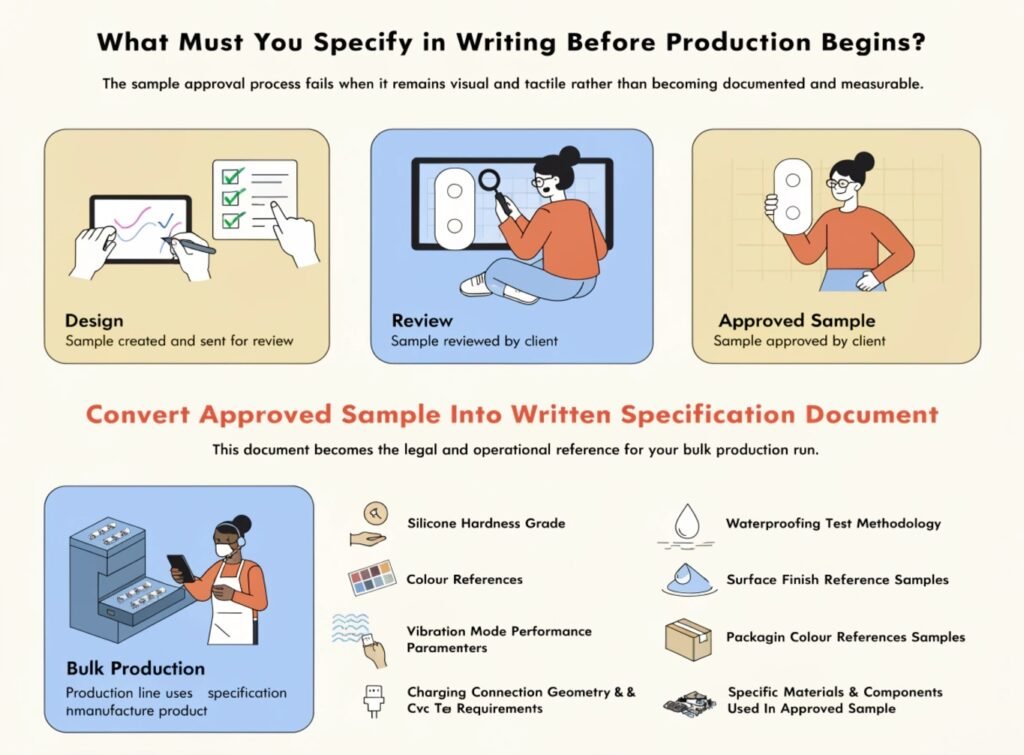
Here is the complete specification document structure — with what to include in each element.
📋 The Eight-Element Pre-Production Specification Document
Element 1 — Silicone Specification
- Silicone grade: food-grade platinum-cured (mandatory)
- Hardness: Shore A value (e.g., Shore A 30 for soft feel, Shore A 50 for firm)
- Colour reference: Pantone number or physical colour swatch retained by both parties
- Surface finish: smooth / matte / textured — with physical reference unit retained
Element 2 — Vibration Performance
- Number of vibration modes and patterns
- Minimum vibration amplitude at each mode (measurable in g-force or equivalent)
- Maximum noise level under load (measured in dB at stated distance)
- Any approved motor brand/model or approved substitute list requiring prior notification
Element 3 — Charging System
- Charging type: USB-C / magnetic / pin
- Pin contact geometry if applicable (length, contact area, alignment tolerance)
- Charging cycle requirement: minimum number of consecutive successful charges
- Test methodology: include use-simulation cycles before connection testing
Element 4 — Waterproofing
- IPX rating: IPX6 / IPX7 (standard)
- Test methodology: must include pre-use simulation (insertion cycles before submersion)
- Number of test cycles required
- Test duration and submersion depth for IPX7
Element 5 — Material Compliance
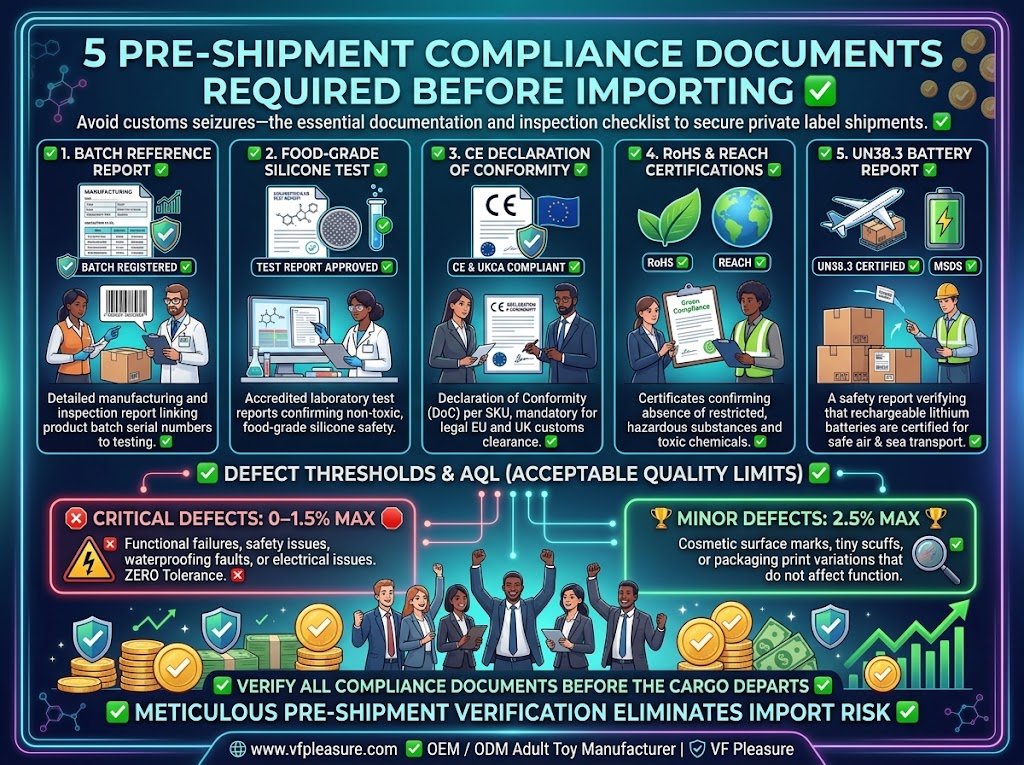
- Food-grade silicone: reference to test report from named accredited laboratory for approved sample
- RoHS compliance: per SKU, not per factory catalog
- Any restricted substances with specific maximum thresholds
Element 6 — Surface Finish Reference Set
- Three physical units from sample run retained by buyer
- Three matching units retained by factory
- Comparison method: visual inspection under standardised lighting conditions
Element 7 — Packaging Specification
- Outer box: Pantone colour references for each printed element
- Substrate: paper weight/type for box construction
- Finish: matte / gloss / soft-touch lamination — with physical reference retained
- Print proof: physical proof on production substrate required before bulk approval
Element 8 — Component Traceability
- Motor supplier and model as used in approved sample
- Charging module specification
- PCB supplier reference
- Notification requirement: any component substitution requires written buyer approval before production begins
This document should be signed by both parties before the production deposit is transferred. It converts a visual approval process into an enforceable production specification. Our adult toy quality compliance guide and verify adult toy quality Chinese suppliers guide include specification document templates adapted to the adult toy category.
How Does a Multi-Stage QC System Bridge the Sample-to-Bulk Gap?
A written specification document tells the factory what to produce. A multi-stage QC system verifies at every production stage that they are producing to it. Without both, you either have a standard nobody is checking against or a checking process with no consistent standard to enforce.
A multi-stage QC system bridges the sample-to-bulk gap by catching specification drift at the earliest possible production stage — where rework is cheap and timeline impact is minimal. A factory with four QC checkpoints across production catches a food-grade silicone batch issue before a unit enters assembly, catches a motor performance issue before 500 units are finished, and catches a surface finish deviation before packaging is applied.4
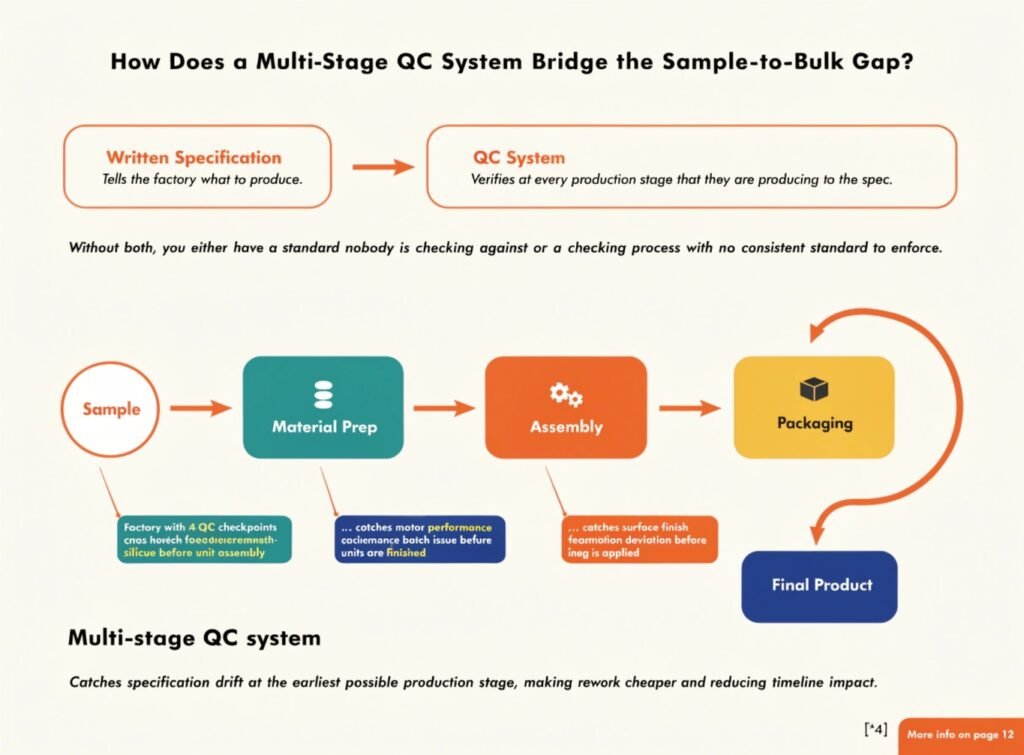
Here is how our four-checkpoint system at VF Pleasure maps to the specific sample-drift types described earlier — catching each one at the stage where it is cheapest to correct.
🏭 The Four-Checkpoint QC Bridge
Checkpoint 1 — Raw Material Intake
Every production batch begins with material validation. Food-grade platinum silicone compound is verified through phthalate screening using gas chromatography before a single unit enters production. Silicone hardness grade is checked against the specification document. Colour pigment batches are compared against the approved colour reference.
This checkpoint catches Divergence 1 (silicone hardness and colour variation) before any production begins. The cost of a material non-compliance at this stage is zero — you replace the batch before production starts. The cost of the same issue discovered at the finished product stage is 500 units of rework.
Checkpoint 2 — Pre-Assembly
Component specifications are checked before assembly begins. Motor performance is verified against the specification document's vibration parameters. Charging module geometry is checked against tolerance specifications. This is where component substitution — the risk captured in Element 8 of the specification document — is caught before it produces a finished unit.
Checkpoint 3 — Finished Product
Completed units are tested against the full functional specification. Waterproofing is tested using IPX7 chambers — including pre-use simulation cycles matching the test methodology in the specification document. Vibration mode performance is tested against the approved parameter ranges. Charging cycle testing runs through the specified number of consecutive cycles under use-simulation conditions.
This checkpoint catches Divergences 2, 3, and 4 (vibration, charging, surface finish) before a single unit reaches packaging. QC failures at this stage are still manageable — rework or rejection of finished units before packaging, not after.
Checkpoint 4 — Batch Testing
Pre-shipment batch testing applies AQL sampling against the full specification. Packaging drop tests using a 3-metre height simulator confirm structural integrity. Packaging colour and print accuracy are compared against the retained approved proof. A full QC batch report is generated and sent to the buyer before shipment dispatch.
This checkpoint catches Divergence 5 (packaging drift) and provides documentary evidence that the shipped batch was validated against the approved specification at every stage.
At VF Pleasure, QC failures cause 22% of industry shipment delays. Our 12-point inspection system is specifically designed to catch failures at the earliest possible stage — reducing both the cost of correction and the delay impact on your launch timeline. For private label orders, third-party lab verification through SGS or Bureau Veritas is available, providing independent confirmation that our QC results match the delivered goods.
💡 Sally's 15-year note: The buyers who never have sample drift problems are not working with magical factories. They are working with factories whose QC system is tied to their written specification document — so the inspection team knows exactly what the accepted sample parameter was for every measurable characteristic, and compares the bulk run against that number rather than against their own judgment of "close enough."
What Production Milestones Should You Monitor Between Sample and Shipment?
Preventing sample drift is not only a factory responsibility. The buyer's role in the monitoring process determines whether problems surface at the correction stage or the delivery stage. Proactive milestone monitoring between sample approval and shipment converts production into a collaborative process — where issues become two-day corrections rather than two-week crises.
Between sample approval and bulk shipment, buyers should request confirmation at five production milestones: material specification confirmation at production start, mid-production inline QC report, finished product QC results before packaging begins, packaging approval on physical production proof, and pre-shipment batch QC report with measurable results referenced against the specification document.5
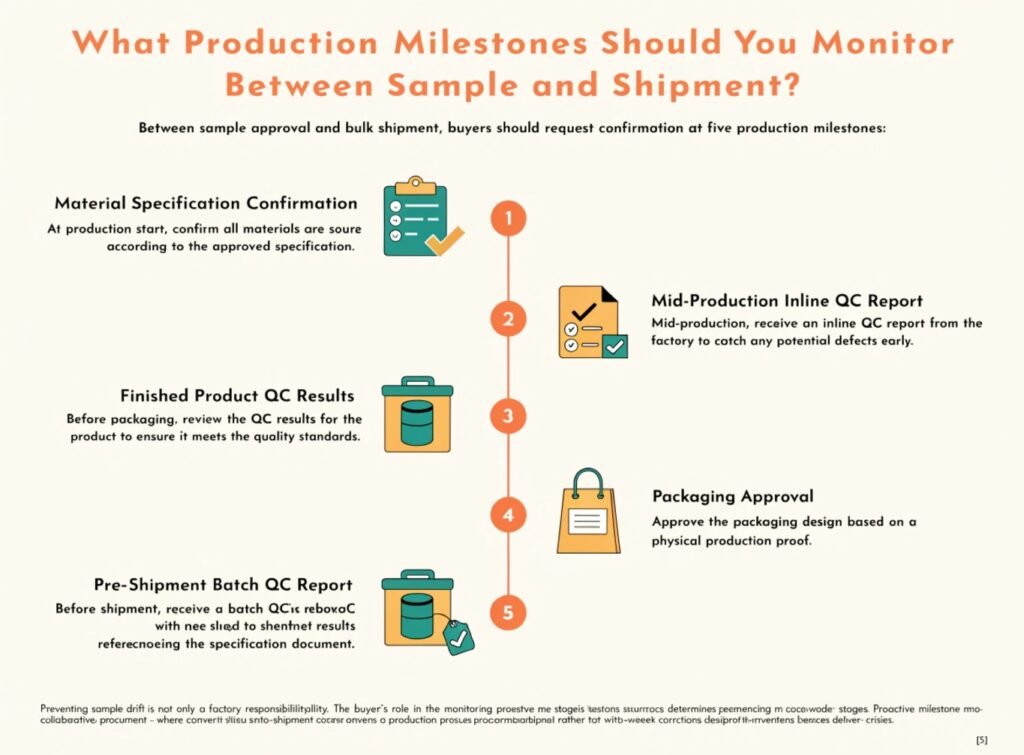
Here is each milestone, what to request, and what a satisfactory response looks like.
✅ Milestone 1 — Material Specification Confirmation (Production Start)
When: Within two days of production start date
What to request: Confirmation that the food-grade silicone batch for your order has been validated and matches the specification document, with the specific batch reference noted
Satisfactory response: Written confirmation from QC with batch reference; if a different batch is used due to supply, proactive notification before production begins
✅ Milestone 2 — Mid-Production Inline QC Report (Day 3–5 of Production)
When: Midway through the production run
What to request: An inline QC report showing the number of units produced, the number of units that passed or failed checkpoint 2 (pre-assembly), and the specific failure categories if any
Satisfactory response: Written report with unit counts and failure categories; zero failures is possible but a factory that reports zero failures at every inline check without ever identifying any correction opportunities may not be running genuine inline QC
✅ Milestone 3 — Finished Product QC Results Before Packaging
When: Before units move to packaging
What to request: Checkpoint 3 results covering waterproofing test results (including confirmation that pre-use simulation was used), vibration performance results against specification document ranges, and charging cycle test results
Satisfactory response: Measurable results referenced against your specification document parameters — not just "all passed"
✅ Milestone 4 — Physical Packaging Proof Approval
When: Before bulk packaging print run
What to request: A physical printed proof on production substrate — not a PDF, not a digital image — for colour comparison against your retained approved proof
Satisfactory response: Physical proof delivered by DHL or equivalent; approval given in writing by you before bulk print proceeds
✅ Milestone 5 — Pre-Shipment Batch QC Report
When: Before goods are loaded for shipment
What to request: Full batch QC report showing the number of units inspected under AQL sampling, the defect categories and counts for any failures, and confirmation that the shipped batch has been validated against the approved specification document
Satisfactory response: Written report with measurable results; QC report sent before shipment dispatch, not after goods are already loaded
The five-step production standards framework we share with clients aligns exactly with these milestones: provide detailed product specifications, conduct pre-production sampling, monitor production progress, perform third-party inspections, and review post-production quality before shipment. Our sample lead time is 7–10 days and mass order lead time is 25–35 days depending on complexity — with expedited options for urgent orders. Within this timeline, all five milestone checks are achievable without extending the production schedule.
What Real Production Scenarios Show How Sample Drift Gets Caught and Fixed?
Abstract prevention frameworks are useful. Real production scenarios are more useful — because they show how sample drift actually manifests under production pressure, and how a factory with genuine engineering discipline catches and resolves it before the problem reaches your customer.
The five most instructive real production scenarios in adult toy manufacturing each show the same pattern: a specification parameter that was not adequately captured at sample approval, a divergence that surfaced during inline QC or finished product testing, and a factory response that either resolved the issue at source or allowed it to ship. The difference between the two outcomes is almost entirely determined by the QC architecture — specifically, whether the factory has a binding written specification to enforce against.6
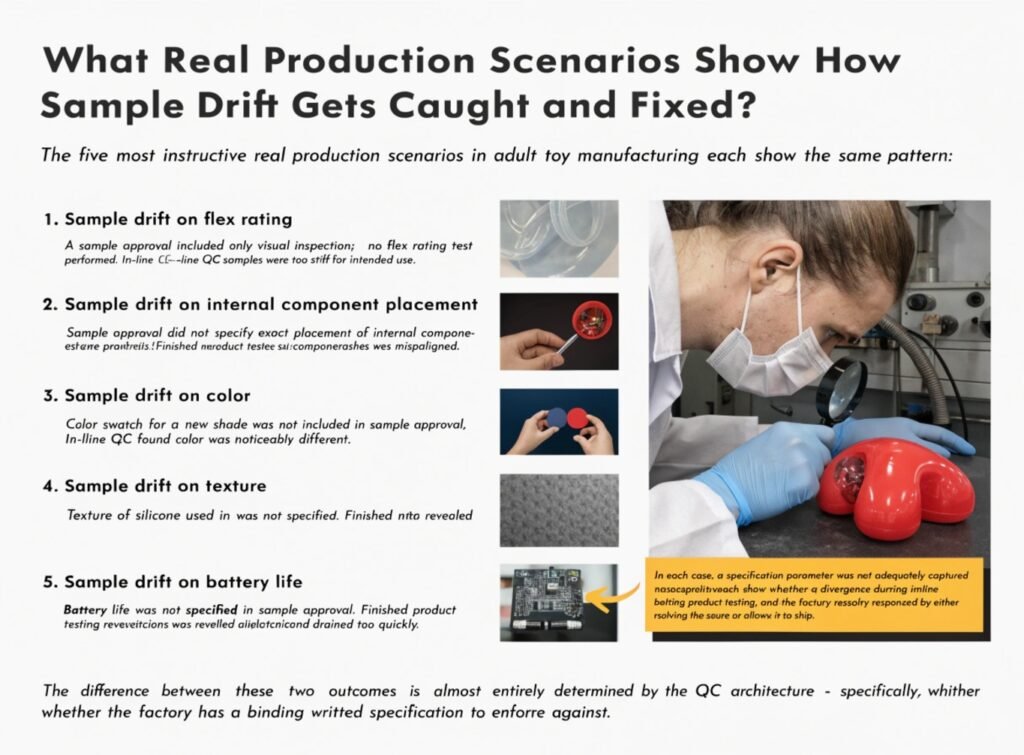
Here are five real scenarios from VF Pleasure's production floor — each illustrating a specific sample-drift mechanism and the engineering response that resolved it.
🧪 Scenario 1 — Waterproof Performance Drift Under Updated Testing
A partner updated their waterproof testing methodology to include pre-use simulation — insertion cycles before the IPX7 submersion test. The existing product, produced to the original static submersion standard, failed the updated methodology.
This is a classic specification drift scenario: the sample was approved under a different test standard than the bulk was subsequently evaluated against. Rather than shipping under the old standard, we analyzed the sealing architecture, identified specific assembly sequence weaknesses, redesigned the internal waterproof structure, optimised sealing consistency across the production line, and conducted repeated internal validation before formal resubmission. The product passed the updated standard without external redesign.
Specification lesson: Test methodology is a specification parameter. If your testing methodology changes, your production specification must be updated to match — before bulk production, not as an afterthought at final inspection.
⚙️ Scenario 2 — Motor Performance Drift from Supply Chain Substitution
A key motor component cost increased due to supply chain disruption. The original motor was no longer economically viable at the agreed product price. Without proactive management, a factory facing this scenario may substitute the nearest available motor that meets the specification's pass/fail threshold — even if it performs detectably differently in use.
We benchmarked multiple alternative motors against the original's vibration strength, noise level under load, and operational stability profile. We selected the replacement that maintained performance consistency within the partner's brand positioning. The client was notified before substitution occurred and approved the replacement in writing. No detectable performance change reached the customer.
Specification lesson: Motor substitution should require written buyer approval. Component traceability in the specification document — naming the approved motor model and requiring notification of any substitution — is the mechanism that makes this possible rather than hoping the factory does it voluntarily.
🔌 Scenario 3 — Charging Reliability Drift from Assembly Tolerance Change
Post-production customer feedback flagged intermittent charging failures across a batch. Root cause investigation traced the failure to DC pin contact geometry — specifically how pin length interacted with the silicone body's natural flex under repeated use cycles. The sample, assembled by an experienced technician, had better pin alignment consistency than the bulk assembly.
We evaluated pin length and structural tolerance, tested extended pin design variants under simulated use conditions, and confirmed long-term durability. The structural fix eliminated the failure mode — not as a warranty replacement program, but as an engineering correction to the production specification.
Specification lesson: Assembly tolerance specifications for charging connection geometry prevent this drift. A charging cycle test requirement in the pre-shipment QC specification catches it before shipment if it occurs despite the specification.
🎨 Scenario 4 — Surface Compliance Drift After QA Standard Update
Updated QA standards required higher colour fastness performance on silicone and ABS surfaces. The existing surface treatment process met the previous standard but failed the updated one when tested at bulk production scale. The sample had not revealed this because the sample was produced before the updated standard was published.
We reviewed the full material and coating process, replaced specific surface treatments with compliant alternatives, conducted internal validation, and resubmitted. Every SKU passed. No large-scale product rejection.
Specification lesson: Compliance standards are not static. Specification documents should include a version reference to the applicable QA standard, and surface treatment specifications should be updated when standards change — proactively, not reactively.
📦 Scenario 5 — Documentation Drift Creating Inspection Risk
An adjusted delivery schedule created a mismatch between batch codes and inspection dates. Packaging and product marking were already completed when the schedule shifted — meaning the batch code printed on the packaging no longer aligned with the formal inspection timing.
Rather than leaving this as an unresolved documentation gap, we clearly documented the full production and inspection timeline, communicated proactively with the client before the inspection date, and provided written QA explanation for the inspector. The documentation was accepted without rework. Delivery was maintained on schedule.
Specification lesson: Documentation accuracy is itself a specification parameter. Batch code alignment to inspection timing should be confirmed at Milestone 5 (pre-shipment) — before goods are loaded, not after they have been inspected.
🧠 Five Scenarios, Five Specification Lessons
| Scenario | Drift Type | Specification That Prevents It |
|---|---|---|
| Waterproofing failure | Test methodology change | Test method specified in writing, including pre-use simulation |
| Motor performance shift | Component substitution | Named component with written buyer approval required for substitution |
| Charging reliability | Assembly tolerance drift | Contact geometry specification + charging cycle test requirement |
| Surface compliance | QA standard update | Version-referenced compliance standard + proactive update process |
| Documentation misalignment | Schedule change | Batch code alignment confirmed at pre-shipment milestone |
Conclusion
Bulk orders match samples when specifications exist in writing before production begins, a multi-stage QC system enforces them at four checkpoints through the production run, and five milestone confirmations give the buyer visibility at every stage where drift is cheapest to correct — not after 500 units are boxed and waiting for a container.
🚀 Want to Source from a Factory That Ties Every Bulk Order to Your Approved Sample?
At VF Pleasure, our 12-point inspection system with four production checkpoints, food-grade silicone material verification per batch, and milestone reporting structure are specifically designed to prevent sample drift — not explain it after delivery.
We provide every buyer with:
- ✅ 3 free samples to start — evaluate food-grade silicone quality, vibration performance, and surface finish before any specification document is written (~$39 shipping)
- ✅ Food-grade platinum silicone — phthalate screening per batch via gas chromatograph, compliance certificates for every production run
- ✅ 12-point QC system — four checkpoints from raw material intake through pre-shipment batch testing
- ✅ QC batch reports — measurable results referenced against your specification document, sent before shipment dispatch
- ✅ Third-party verification — SGS or Bureau Veritas for private label orders
- ✅ Full product range — vibrators, female sex toys, couples toys, thrusting toys, male adult toys
📬 Start Your Sample Conversation — Three Questions:
1. What product are you sourcing — and have you had a sample-to-bulk mismatch before?
(Describing what went wrong previously helps me show you exactly which specification element and QC checkpoint addresses that specific drift type)2. What is your target bulk order quantity and timeline?
(This determines which production milestones are relevant and how to build the monitoring schedule)3. Which market is your product entering — and do you need compliance documentation tied to the approved sample batch?
(CE, RoHS, food-grade silicone test reports can be issued per batch to give your compliance file traceability back to the production run)👉 Request Free Samples + Specification Document Template from VF Pleasure →
References & Source Notes
-
VF Pleasure — Crafting High-Quality Adult Toys
| Field | Detail |
|---|---|
| 📌 Supports | Bulk orders diverge from approved samples because samples are made under tighter conditions, specifications are approved visually rather than in measurable terms, and no binding specification bridge ties the bulk run to the sample parameters. VF Pleasure maintains strict QC procedures at every stage to guarantee consistent quality and reliability. |
| 🔍 Evidence Role | Definition + General Support |
| 📁 Source Type | Industry Guide |
⚠️ Scope Note: Sample drift mechanisms described are based on VF Pleasure's 15+ years of manufacturing experience and commonly observed adult toy sourcing outcomes. Individual factory processes and specific drift causes vary. All prevention steps described should be implemented through formal written agreements with the specific factory before production begins.
-
VF Pleasure — Adult Toy Manufacturing Challenges and Solutions
| Field | Detail |
|---|---|
| 📌 Supports | The five most common bulk-to-sample divergence types are silicone hardness/colour variation, vibration performance shift, charging reliability variance, surface finish degradation, and packaging colour drift. VF Pleasure's case studies document real engineering responses to motor substitution, charging contact geometry, surface compliance, and waterproofing methodology failures. |
| 🔍 Evidence Role | Case Reference + General Support |
| 📁 Source Type | Industry Guide |
⚠️ Scope Note: Divergence type descriptions and engineering responses are drawn from real anonymised VF Pleasure production projects. Specific failure modes, root causes, and resolution timelines vary by product complexity and factory capabilities. These patterns are instructive references — not predictions of the outcome in any specific production scenario.
-
VF Pleasure — Adult Toy Quality Compliance Guide
| Field | Detail |
|---|---|
| 📌 Supports | Pre-production specification documents covering eight elements — silicone grade, colour reference, vibration parameters, charging geometry, waterproofing methodology, surface finish reference, packaging specification, and component traceability — convert visual approvals into enforceable production standards. To ensure high-quality production, detailed product specifications including materials, dimensions, and safety standards must be established before manufacturing begins. |
| 🔍 Evidence Role | Mechanism |
| 📁 Source Type | Industry Guide |
⚠️ Scope Note: The eight-element specification document framework is an industry best-practice guide based on VF Pleasure's manufacturing experience. Specific specification parameters and tolerance requirements vary by product type, complexity, and target market. Buyers should adapt this framework to their specific product requirements and confirm all specification elements with their factory in writing before production approval.
-
VF Pleasure — Sex Toy Manufacturing Process Guide
| Field | Detail |
|---|---|
| 📌 Supports | Multi-stage QC bridges the sample-to-bulk gap through four checkpoints: raw material intake (phthalate screening via gas chromatograph), pre-assembly (component specification), finished product (IPX7 waterproof testing, vibration, charging cycle), and batch testing (stress testing, drop testing, AQL sampling). QC failures cause 22% of industry shipment delays. VF Pleasure's 12-point system is designed to catch failures at the lowest-cost correction stage. |
| 🔍 Evidence Role | Mechanism |
| 📁 Source Type | Industry Guide |
⚠️ Scope Note: QC checkpoint descriptions and testing tools described reflect VF Pleasure's documented production process. The 22% shipment delay statistic attributable to QC failures is sourced from VF Pleasure's published content. Individual factory QC systems vary significantly. Buyers should request equivalent checkpoint documentation from any factory candidate before committing to production.
-
VF Pleasure — Verify Adult Toy Quality Chinese Suppliers
| Field | Detail |
|---|---|
| 📌 Supports | Five production milestones between sample approval and bulk shipment — material confirmation, mid-production inline QC, finished product results before packaging, physical packaging proof approval, and pre-shipment batch QC report — give buyers visibility at every stage where drift is cheapest to correct. VF Pleasure's lead times (7–10 days sample, 25–35 days mass order) allow all five milestones within the standard production schedule. |
| 🔍 Evidence Role | Mechanism |
| 📁 Source Type | Industry Guide |
⚠️ Scope Note: Milestone timeline descriptions are based on VF Pleasure's standard production schedule. Actual milestone timing varies by factory, product complexity, and order volume. All milestone confirmation requests should be formally agreed with the factory as part of the production agreement before the deposit is placed — not requested informally during production.
-
VF Pleasure — Adult Toy Manufacturing Challenges and Solutions
| Field | Detail |
|---|---|
| 📌 Supports | Five real production scenarios from VF Pleasure's floor illustrate sample drift mechanisms and engineering resolutions: waterproofing methodology update failure and structural redesign; motor substitution under supply chain cost pressure with performance benchmarking; charging reliability from DC pin geometry with structural fix; surface compliance under updated colour fastness standards; and batch code documentation realignment through proactive communication. |
| 🔍 Evidence Role | Case Reference |
| 📁 Source Type | Industry Guide |
⚠️ Scope Note: All five scenarios are drawn from real anonymised VF Pleasure production projects and reflect the factory's engineering problem-solving approach. Outcomes depend on the specific failure mode, product construction, QA standard, and project timeline. These cases illustrate the value of a factory with documented engineering discipline — they are not a guarantee of identical outcomes in all production situations.