Skip to content
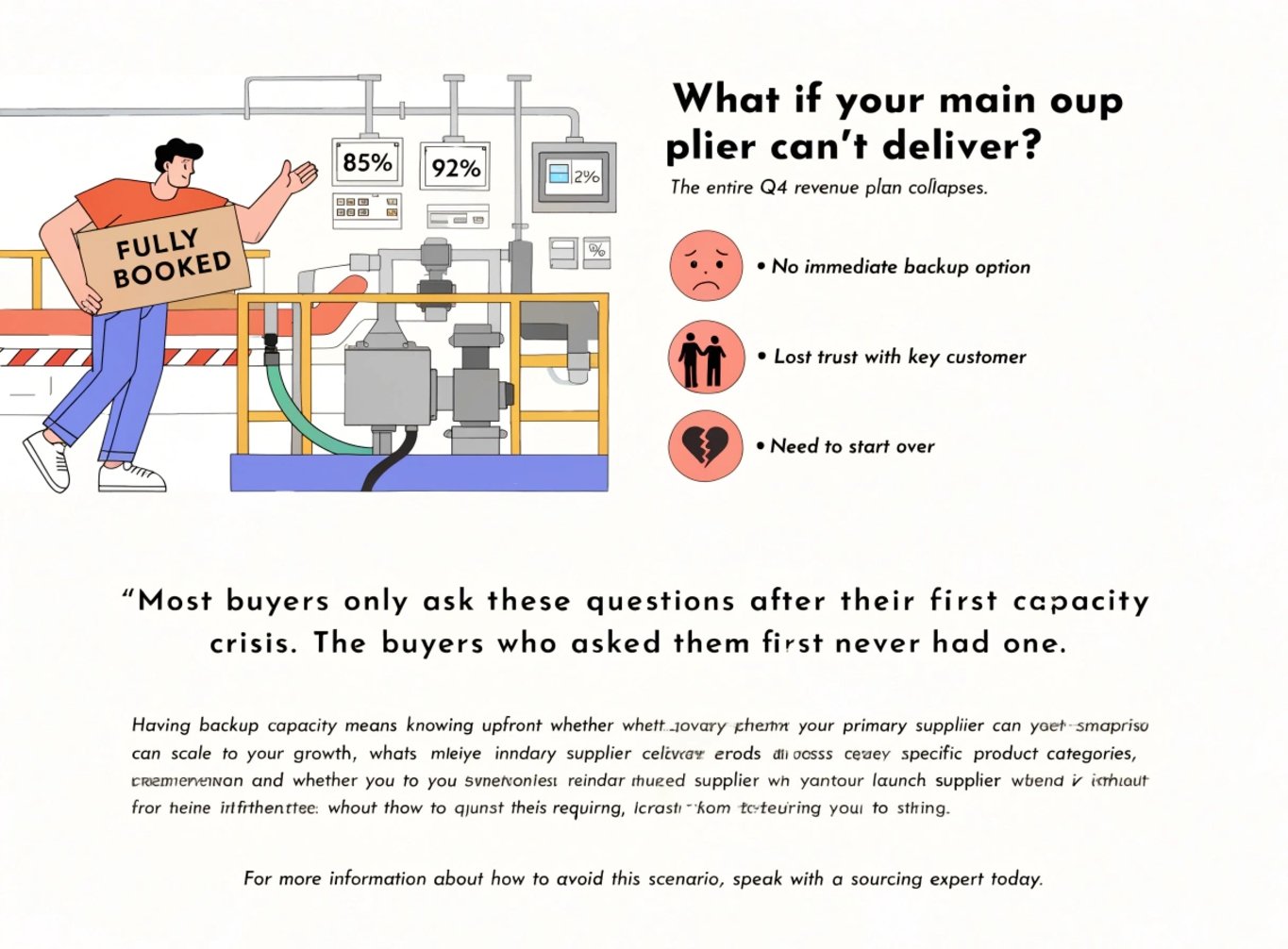
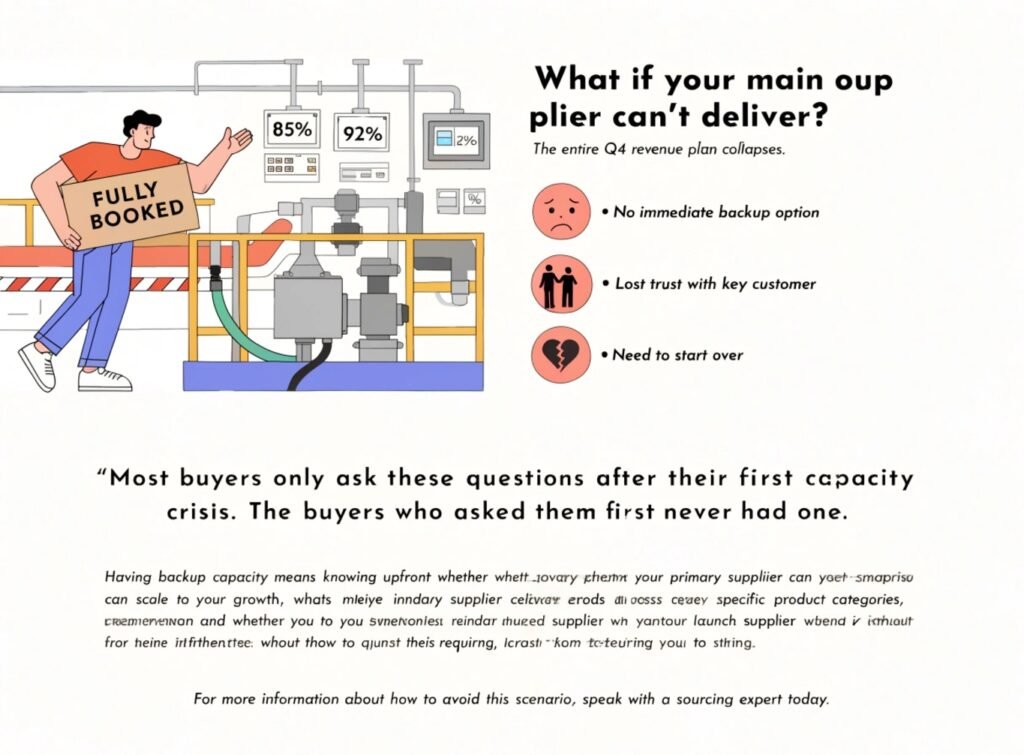
Your brand just landed its biggest retail account. The buyer wants 3,000 units by Q4. You call your factory and discover they are already running at full capacity for another client, have a component shortage on your SKU's motor, and cannot commit to your timeline. Your entire Q4 revenue plan just collapsed — not because of anything wrong with your brand, your product, or your market. Because you never asked one question: "What happens if you can't deliver?"
Backup capacity in adult toy sourcing means knowing — before you need it — whether your primary supplier can scale to your growth, what their actual production ceiling is across your specific product categories, and whether you have a pre-qualified secondary supplier who can step in within your launch timeline without requiring you to start from scratch. Most buyers only ask these questions after their first capacity crisis. The buyers who asked them first never had one.1
I'm Sally. I run VF Pleasure — a direct adult toys factory in Dongguan, China, with 15+ years of B2B manufacturing experience, trusted by over 1,000 businesses globally. Our monthly production capacity is 50,000 units with scalability for seasonal or promotional surges — and expedited options are available for urgent orders. I've seen what happens when buyers discover their supplier's capacity ceiling at the worst possible moment, and I've watched the brands that avoided this scenario do it the same way: by asking the right questions before they needed the answers.
This guide gives you every question, the right framing for each, and what the factory's response tells you about whether their capacity claims are real.
- 1 Why Is Backup Capacity the Most Ignored Risk in Adult Toy Sourcing?
- 2 What Capacity Questions Should You Ask Your Primary Supplier Before You Sign?
- 3 How Do You Evaluate Whether a Factory Can Actually Handle Surge Demand?
- 4 What Does a Real Backup Supply Strategy Actually Look Like?
- 5 How Do You Pre-Qualify a Backup Supplier Without Compromising Your Primary Relationship?
- 6 What Questions Reveal a Factory's True Crisis Response Culture?
- 7 Conclusion
- 8 References & Source Notes
Why Is Backup Capacity the Most Ignored Risk in Adult Toy Sourcing?
Ask any buyer about quality and they can name five things they check. Ask them about backup capacity and most will describe their primary supplier's stated capacity as if that is the same thing. It is not. A factory's stated capacity is the ceiling they claim to operate at. Your backup capacity is what you can actually access when that ceiling is reached or breached.
Backup capacity is the most ignored risk in adult toy sourcing because buyers evaluate suppliers at a specific moment in time — typically when their volume is small and capacity is not a constraint. The capacity risk only becomes visible when the business grows faster than anticipated, when a seasonal spike overwhelms the factory's schedule, or when a production problem forces the factory to deprioritise your order in favour of a larger client. All three scenarios are predictable. None of them require a crisis to plan for.1
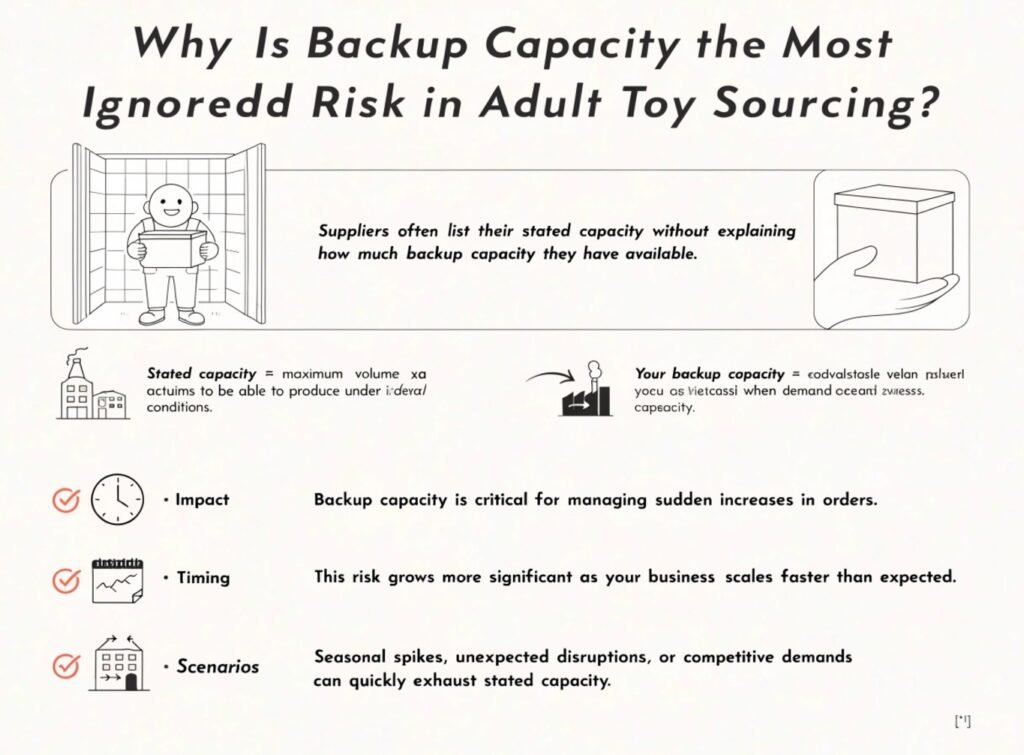
Here is what the three capacity risk scenarios look like in practice — and why each one is entirely preventable with the right planning.
📈 Scenario 1 — You Grow Faster Than Your Supplier Can Scale
You launch, validate your market, and reorder. Then reorder again. Your third order is three times the size of your first. Your factory confirms the order — and delivers six weeks late with quality inconsistencies you did not see on the smaller runs. The factory was not lying about its capacity. It just could not maintain the same quality standards at scale without a ramp-up plan you never discussed.
The prevention question: "At what order volume does your quality or timeline performance change? What does your ramp plan look like for a client whose orders double or triple over 12 months?"
🗓️ Scenario 2 — Seasonal Spike You Planned For Meets Capacity You Did Not Audit
Q4 is adult toy wholesale's highest-volume quarter. Your factory is everyone's factory. The client that placed a large order in September has already claimed the production slots you were counting on for October delivery. Your holiday shipment is pushed to December — after your retail window has closed.
The prevention question: "During your peak production period — typically August through October — what percentage of your capacity is committed to existing clients? How do you allocate production slots when multiple clients have Q4 deadlines simultaneously?"
⚙️ Scenario 3 — A Production Problem Forces Deprioritisation
A quality failure, a component shortage, or a machinery maintenance issue reduces the factory's available production time. Factories — rationally — protect their highest-revenue or most strategically important client relationships first. If you are not one of their top clients by volume, your order gets pushed.
The prevention question: "If a production problem reduces your available capacity by 25% in a given month, how do you decide which client orders are affected? Has this happened before — and how was it handled?"
Our evaluate Chinese adult toy factory delivery capability guide and adult toy manufacturer partnership strategies guide cover the full capacity risk framework in detail.
What Capacity Questions Should You Ask Your Primary Supplier Before You Sign?
Most buyers ask one capacity question: "Can you handle our order volume?" Every factory says yes. The useful capacity questions are the ones that test whether that yes is real — by requesting the specific evidence that either confirms it or reveals the constraint behind it.
The capacity questions every adult toy buyer should ask their primary supplier cover six areas: verified monthly production output in units across relevant product categories, current utilisation rate across active production lines, component sourcing redundancy for critical electronic parts, minimum and maximum single-order size for your specific product type, production timeline during peak season versus off-peak, and their internal policy for handling capacity conflicts between simultaneous client orders.2
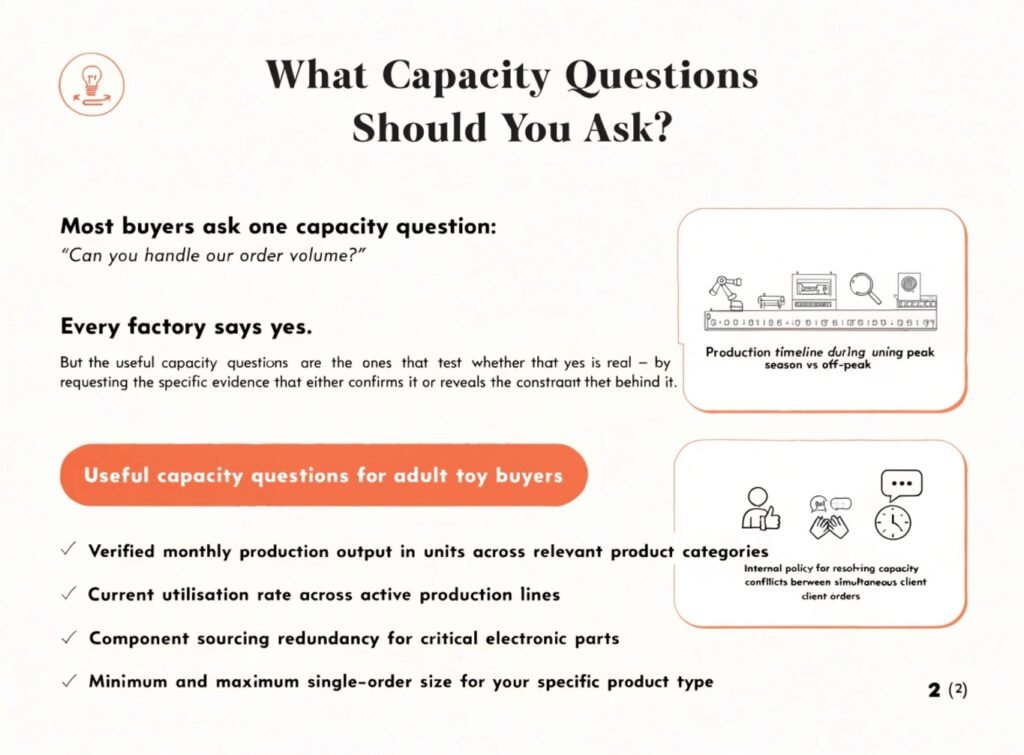
Here is each question — with the framing that produces useful answers rather than marketing responses.
🔢 Question 1 — Verified Monthly Production Output
"What is your verified monthly production capacity in units for [your specific product category — vibrators / thrusting toys / couples toys]? Please provide this as a named figure with a breakdown by production line if possible."
At VF Pleasure, our monthly production capacity is 50,000 units across our full range of vibrators, female sex toys, thrusting sex toys, couples toys, and male adult toys, with scalability for seasonal or promotional surges. This is a named figure — not a range or a vague claim. Any factory that cannot give you a specific monthly unit figure for your product category has not measured its own production systematically.
What a good answer looks like: A specific unit figure, broken down by product line or production line where possible, with a statement about current utilisation rate.
What a concerning answer looks like: "We have large capacity." "We can handle any order." "Our factory can produce as many as you need." None of these is a capacity statement.
📊 Question 2 — Current Utilisation Rate
"What is your current production utilisation rate across your relevant product lines? How much unallocated capacity do you have in your next three production cycles?"
A factory running at 95% utilisation has almost no buffer. A disruption — machine maintenance, component shortage, one client's urgent reorder — cascades directly into your order's timeline. A factory at 70% utilisation has headroom to absorb unexpected demand without affecting existing orders.
Useful follow-up: "Can you show me your current production schedule — even anonymised — that confirms available capacity for my order in the proposed production window?"
🔩 Question 3 — Component Sourcing Redundancy
"For the critical components in my product — motor, charging module, PCB — how many qualified sub-suppliers do you maintain? Have you tested alternatives for each?"
When a key motor component cost increased significantly for one of our clients due to supply chain disruption, we benchmarked multiple alternative motors against the original's vibration and noise profile and selected the replacement that maintained performance. This was possible because we maintained relationships with multiple qualified motor sub-suppliers.
A factory with a single motor supplier is one supply chain event away from a production stop on every vibrating product they make. This is not theoretical — it is a documented industry failure pattern.
🏗️ Question 4 — Maximum Single Order Size
"What is the largest single order you can reliably fulfil within your standard 25–35 day lead time without affecting other client orders? What happens to your lead time if my order doubles in size from [your current volume]?"
The answer to this question reveals the factory's true operational capacity rather than their marketing capacity. Most factories can tell you what they claim to produce at maximum output. Fewer can tell you the specific point at which a single order becomes difficult to deliver without affecting other clients — and that number is the one you need to know.
📅 Question 5 — Peak Season vs Off-Peak Timeline
"What is your lead time during your peak production period (typically August–October) versus your off-peak period? How far in advance do I need to place orders to guarantee my production slot during Q4?"
At VF Pleasure, our standard mass order lead time is 25–35 days depending on complexity and quantity, with expedited options available for urgent orders. During peak season, we advise clients to place orders 10–15 days earlier than standard to ensure their production slot is secured before competing Q4 orders fill the schedule.
A factory that cannot give you a Q4 booking deadline is a factory that does not manage production slots proactively — which means your Q4 order competes on a first-come-first-served basis with every other buyer who forgot to ask.
⚔️ Question 6 — Capacity Conflict Policy
"If two clients have simultaneous production deadlines and your capacity cannot accommodate both fully, what is your policy for allocating available production? How do you decide whose order gets priority?"
Listen carefully to this answer. A factory that says "we prioritise by order placement date" has a transparent policy. A factory that says "we always find a way to deliver for all clients" is either lying or has never faced this situation. A factory that says "larger orders receive priority" is telling you exactly where your order sits in their queue.
How Do You Evaluate Whether a Factory Can Actually Handle Surge Demand?
A factory that can reliably handle your current order volume may not be able to reliably handle 3x that volume when you need it. Evaluating surge capacity requires a different set of questions from baseline capacity — because surge demand tests a factory's organisational headroom, not just its production line throughput.
You evaluate an adult toy factory's surge capacity by asking five specific questions: whether they have physical production line redundancy that allows them to bring additional lines online for large orders, whether their component inventory model allows for rapid material scaling, whether their QC system maintains the same standard at 3x volume as at baseline, whether they have handled a similar surge order before and can reference it, and whether their workforce structure supports rapid scaling without quality degradation.3
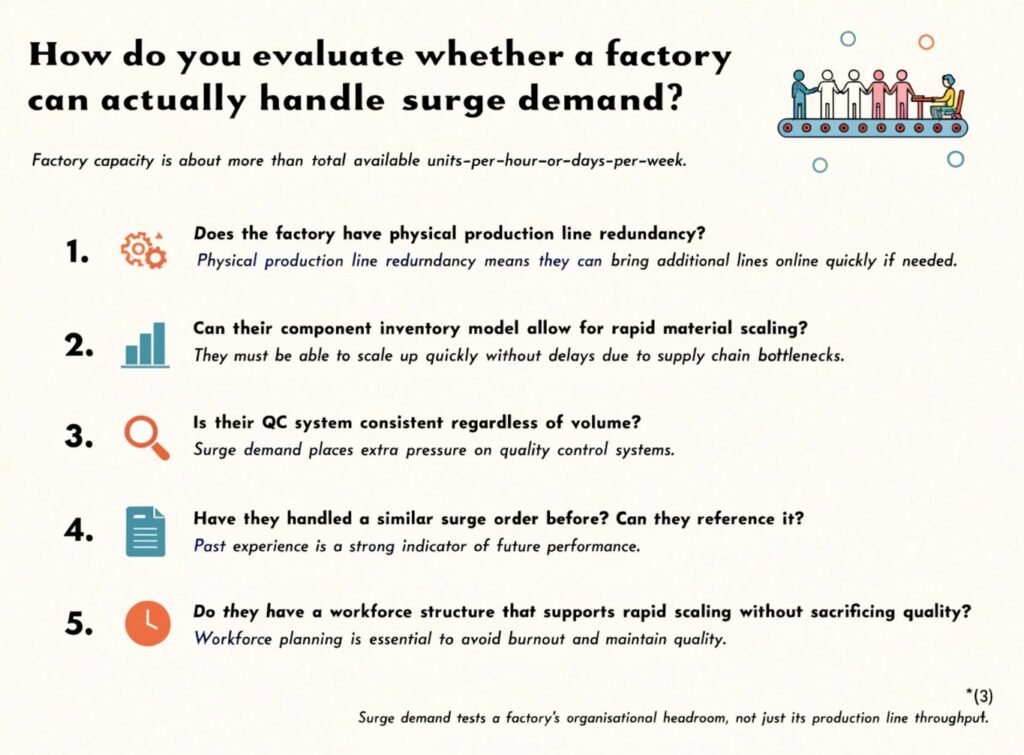
Here is each surge capacity evaluation — with the specific evidence request that confirms or challenges the factory's claim.
🏭 Surge Evaluation 1 — Production Line Redundancy
"How many production lines do you currently run, and how many could you activate within 5–10 business days for a large surge order? Please describe the physical setup of each active line."
VF Pleasure operates 5–10 production lines at our Dongguan facility. Our 12-step production process is documented, stage-gated, and consistent across every line — which means adding a line for a surge order does not require retraining a new process. It adds production throughput using the same validated system.
A factory with a single production line is a factory whose throughput has a hard ceiling. Any surge demand above that ceiling requires either outsourcing — which affects quality and compliance — or a longer lead time. Neither outcome is compatible with a genuine surge response.
📦 Surge Evaluation 2 — Component Inventory Model
"How do you manage raw material and component inventory for a client whose order size doubles with four weeks' notice? Do you maintain safety stock for your food-grade silicone and key electronic components?"
Our food-grade platinum silicone material library includes 50+ certified options, and we maintain production-ready inventory across our most active product lines. A factory that orders components per order has a natural lag between your purchase order and production start — which means a last-minute surge order extends your effective lead time by the component procurement window (typically five to ten additional days for standard components, longer for specialist items).
The right answer: The factory maintains safety stock for food-grade silicone and key electronic components across their core product lines, and can start production on a surge order within two to three days of deposit receipt.
The concerning answer: "We order components when you place your order." This translates to: your effective lead time is your stated lead time plus their procurement lead time, which buyers almost never account for.
🔬 Surge Evaluation 3 — QC Consistency at Scale
"Does your QC process change at higher production volumes? At what order size does your 12-point inspection system face constraints?"
QC failures cause a significant share of shipment delays in the adult toy industry. At our standard production volume, we run four quality checkpoints: raw material intake, pre-assembly, finished product, and batch testing. Our testing tools — gas chromatograph for phthalate screening, IPX7 chambers for waterproof testing, 50kg pressure rigs for stress testing — are fixed infrastructure. They do not scale down as volume goes up.
A factory whose QC process is people-dependent rather than systems-dependent will see quality consistency degrade as volume increases — because the same number of inspectors are now covering more units. Ask specifically: "Is your QC system based on fixed infrastructure (test chambers, equipment) or is it primarily dependent on inspector headcount?"
📋 Surge Evaluation 4 — Reference for a Previous Surge Order
"Can you give me an example of a client whose order volume doubled or tripled within a single year — and describe how you managed the production scaling? I am not asking for client names, just the production story."
A factory that has managed surge demand before can describe it in specifics: how much the order increased, what they did to accommodate it, and how the delivery timeline compared to their standard lead time. A factory that has never managed surge demand cannot describe this experience — and that gap is the information you need.
👥 Surge Evaluation 5 — Workforce Scaling Capacity
"What is your workforce structure during peak and off-peak seasons? Do you run overtime or bring in additional operators for large surge orders — and how does this affect your food-grade silicone quality consistency?"
This question matters specifically for food-grade silicone production because silicone injection molding and assembly quality is sensitive to operator consistency. Factories that rely on temporary workers during surge periods may maintain throughput while degrading the consistency of sealing, surface finish, and assembly tolerances — which affects the IPX7 waterproof rating, charging contact geometry, and silicone surface quality that your product's body-safe claim depends on.
What Does a Real Backup Supply Strategy Actually Look Like?
Most buyers describe their backup supply strategy as: "We'll find another supplier if our current one fails." This is not a strategy. It is a contingency plan with a 60-day execution lag, no pre-qualified second source, and no existing food-grade silicone compliance documentation ready for a new supplier's product. A real backup strategy is built before you need it — which is the only time it can actually protect you.
A real backup supply strategy for adult toys has three components: a primary supplier with documented capacity and a verified delivery track record, a pre-qualified secondary supplier who has produced and delivered at least one test order, and a maintained safety stock level calculated against your market demand and your primary supplier's average lead time. Together, these three components eliminate the scenario where a single supplier failure stops your business.4
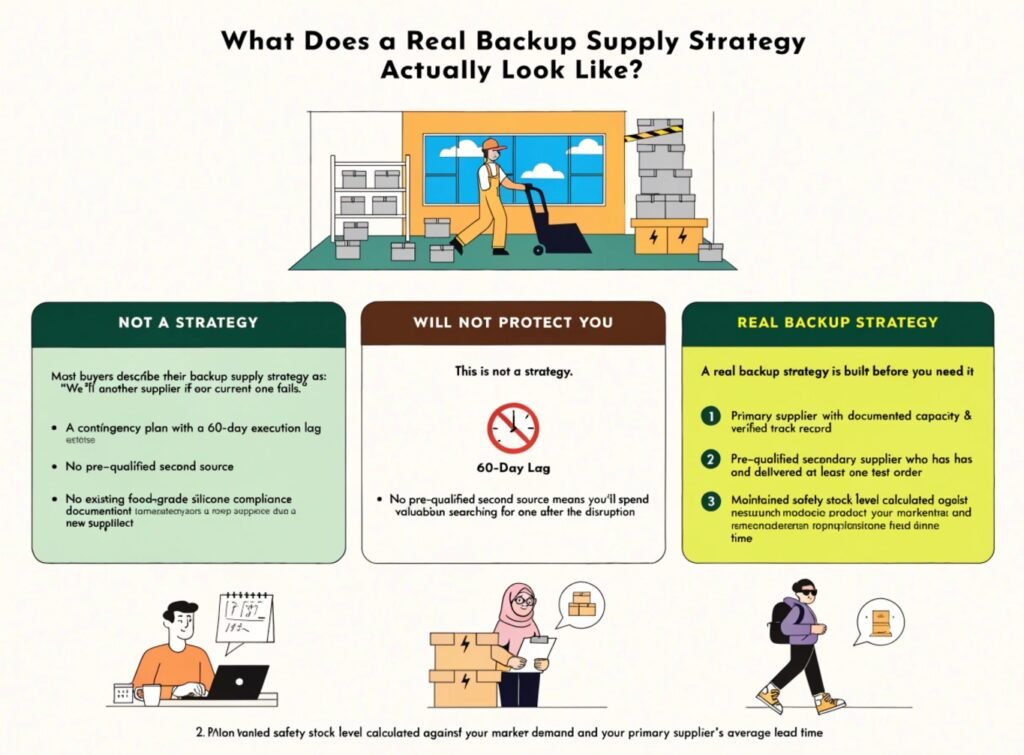 "What a Real Adult Toy Backup Supply Strategy Looks Like")
Here is how to build each component — with the specific actions required for each.
🔑 Component 1 — Primary Supplier with Documented Capacity
Your primary supplier must be able to provide documented evidence of their capacity — not just claim it. This means: a named monthly unit output per product category, a production schedule showing available capacity for your planned order cycles, and a track record of at least three consecutive on-time deliveries with QC reports.
The documentation at this stage serves two purposes: it confirms your primary supplier's reliability and creates the performance baseline against which you can evaluate whether you need to activate your backup.
🔑 Component 2 — Pre-Qualified Secondary Supplier
Pre-qualification means the secondary supplier has produced at least one real order at a volume that confirms their capacity claim — and you have the resulting product in hand, with CE certification, food-grade silicone test reports, and compliance documentation verified.
Pre-qualifying a secondary supplier does not mean placing a large parallel order. It means placing a sample order and a small test batch — enough to confirm quality, compliance, and lead time consistency. The entire point of pre-qualification is that when you need the secondary supplier, the qualification work is already done.
At VF Pleasure, we actively work with buyers who are pre-qualifying us as a secondary source for an existing primary supplier. We are not offended by this — it is good supply chain management. We provide 3 free samples for initial quality evaluation (you only cover shipping at approximately $39), and our full compliance documentation package per SKU is available from the first test order.
🔑 Component 3 — Safety Stock Calculation
Safety stock is the inventory buffer that covers your market demand during the gap between discovering your primary supplier cannot deliver and receiving your first shipment from your secondary supplier. The calculation:
Safety stock = (Average weekly sales + emergency buffer) × Secondary supplier lead time in weeks
Example: You sell 100 units per week. Your secondary supplier's lead time is 5 weeks. Your secondary supplier activation and first delivery takes approximately 6–8 weeks from the point of crisis recognition. Your safety stock target is:
100 units/week × 8 weeks = 800 units minimum safety stock
Most brands carry 30–60 days of safety stock. The right number for your business depends on your sales velocity, your primary supplier's lead time, and how much your business can afford to stop.
How Do You Pre-Qualify a Backup Supplier Without Compromising Your Primary Relationship?
The most common reason buyers fail to pre-qualify a backup supplier is the fear that their primary supplier will discover it and interpret it as a signal that the relationship is ending. This fear is not irrational — but it is almost always overweighted. Most professional manufacturers understand supply chain risk management. The ones that do not are telling you something important about their partnership culture.
You pre-qualify a backup supplier without compromising your primary relationship by framing the test order as product development or market expansion rather than competitive evaluation, using a different SKU from your primary supplier's core range to reduce the direct comparison, and being transparent with your primary supplier about the general principle of supply chain diversification without naming the specific backup.5
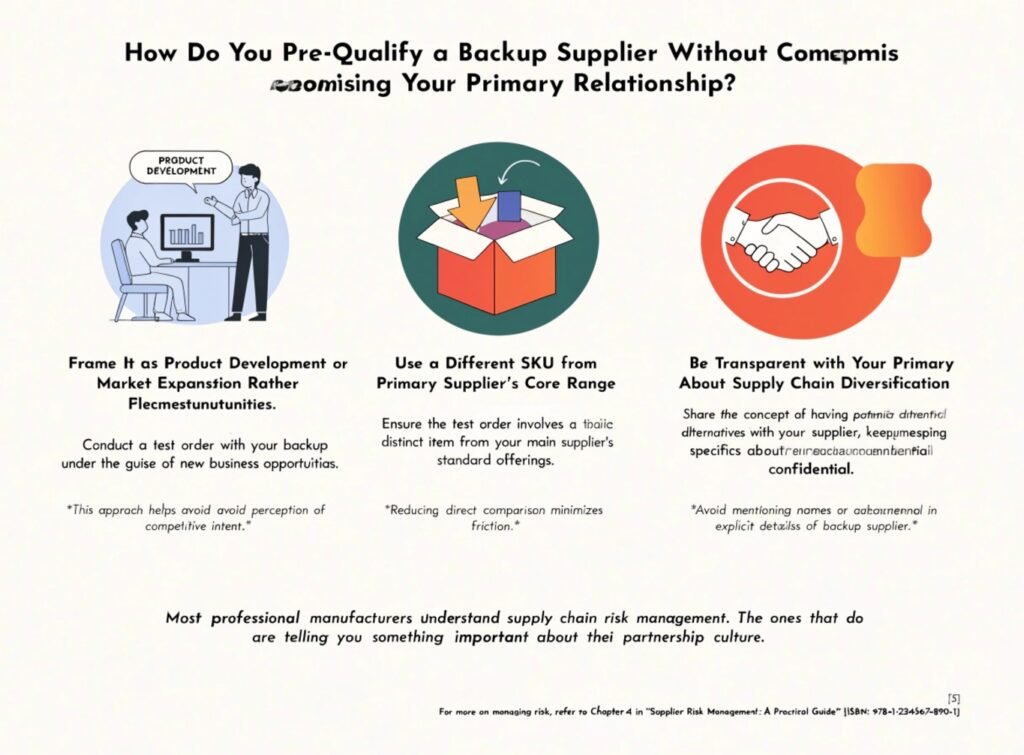
Here is the three-approach framework — with the right communication strategy for each.
🤝 Approach 1 — Frame as Product Expansion
If your primary supplier specialises in vibrators and you approach a secondary supplier about thrusting toys or male adult toys — categories the primary does not cover or produces less competitively — the pre-qualification serves a genuine product expansion purpose. You are not sourcing a competing product from a competing factory. You are expanding your range through a complementary supplier.
This framing is honest, commercially sensible, and provokes no defensiveness from your primary supplier when they learn about it — because there is no competitive threat to their relationship with you.
🤝 Approach 2 — Different SKU, Different Category
Even if your secondary pre-qualification is for the same product type, using a different SKU from your primary supplier's range creates separation between the two relationships. Your primary supplier does not need to know that a specific SKU they produce for you has been tested at another factory — unless you are planning to move volume away from them.
Keep your pre-qualification order discreet. Do not mention it to your primary factory. Do not use the same brand name, artwork, or packaging on the test order. This is standard supply chain practice — not disloyalty.
🤝 Approach 3 — Transparent Risk Management Conversation
Some primary supplier relationships are strong enough to have an honest conversation about supply chain risk management. A factory partner that responds to "we are building a backup supply strategy as standard risk management — not because of any specific concern about you" with professionalism and even support is a partner worth keeping. A factory that responds with defensiveness or threats is telling you something about their confidence in their own reliability.
At VF Pleasure, we welcome these conversations. We have helped clients structure their backup strategies, referred them to complementary suppliers for product categories we do not cover, and provided the documentation they needed for their primary supply chain review. This is what a genuine long-term manufacturing partnership looks like.
What Questions Reveal a Factory's True Crisis Response Culture?
The final test of backup capacity is not about numbers — it is about culture. A factory with 100,000 units monthly capacity and a defensive, late-communicating crisis response culture will cause as much damage to your business as a factory with 5,000 units monthly capacity and a proactive, problem-solving culture. The questions in this section test the culture.
The questions that reveal an adult toy factory's true crisis response culture are: whether they can name a specific production problem they communicated proactively before it became a delivery crisis, how they handled a situation where they knew they could not meet a client's deadline, what their policy is for allocating expedited production capacity when multiple clients are affected simultaneously, and whether they provide engineering solutions to problems or just substitutions and workarounds.6
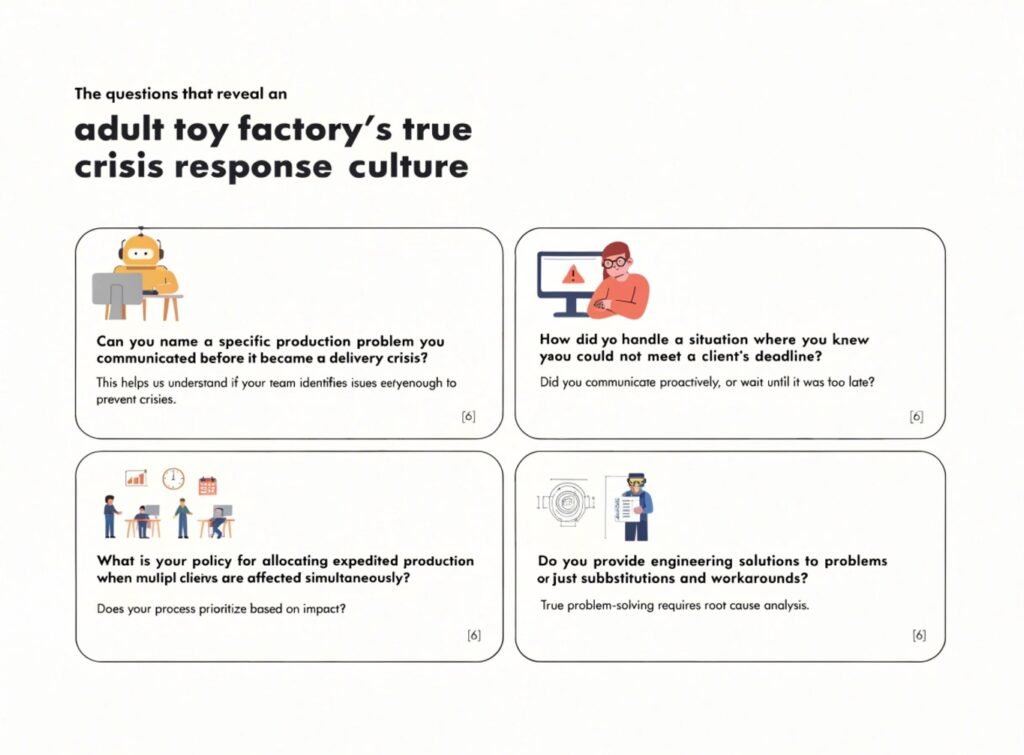
Here is each question and what the answer tells you.
🗣️ Culture Question 1 — Proactive Communication Example
"Can you give me a specific example of a production problem you communicated to a client proactively — before the delivery deadline was affected — with the specific timing and outcome?"
When an adjusted delivery schedule created a batch code and documentation misalignment for one of our clients, we clearly documented the full production and inspection timeline, communicated proactively with the client before the inspection date, and provided written QA explanation for the inspector. The issue was accepted. Delivery was maintained. The key word is before — the communication happened before the problem became a delivery crisis, not after.
A factory that can answer this question with specifics has a proactive communication culture. A factory that deflects, claims "we have never had problems," or describes only reactive responses has a culture that will hide problems until they become crises.
🗣️ Culture Question 2 — Capacity Crisis Management
"Has there been a period when your production capacity was insufficient for all your client orders simultaneously? How did you decide whose orders were fulfilled on time, and how did you communicate with the clients whose orders were affected?"
This question tests both the factory's capacity management competence and their communication culture. A factory that has never faced a capacity constraint either has never been busy enough for capacity to matter, or is not being honest. Every factory at meaningful production scale has faced moments of pressure. The question is how they handled it.
🗣️ Culture Question 3 — Engineering Response vs. Substitution Response
"When a production problem requires a change to a product — a component substitution, a material update, a design adjustment — what is your process for making that change? Do you notify the client before or after?"
When a key motor component cost increased significantly due to supply chain disruption, we benchmarked multiple alternatives against the original's vibration and noise profile and obtained the client's written approval before any substitution occurred. The product arrived with no detectable performance change.
A factory that answers "we find the nearest equivalent and swap it in" without mentioning client notification has a substitution culture rather than an engineering culture. A factory that answers "we benchmark alternatives, test against the original specification, and notify the client before making any change" has the engineering discipline that protects your product's food-grade silicone quality standards and compliance documentation through every production cycle.
📊 The Crisis Culture Assessment Summary
| Question | Strong Culture Signal | Weak Culture Signal |
|---|---|---|
| Proactive communication example | Specific case with timing before deadline | "We always deliver" / no specific case |
| Capacity crisis management | Named prioritisation policy + client communication | Denial that capacity pressure has occurred |
| Engineering vs substitution | Client notification before any change | Silent substitution as standard practice |
| Multiple simultaneous crises | Priority policy stated, backup options offered | "We will figure it out" |
Our adult toy manufacturing challenges and solutions guide, red flags OEM adult toy manufacturer guide, and crafting high-quality adult toys guide document this culture assessment in full — including the specific response patterns that distinguish engineering-first factories from throughput-first factories.
Conclusion
Backup capacity planning is not pessimism — it is the supply chain architecture that keeps your brand running when a single supplier's capacity, timing, or crisis response falls short. Ask the questions before you need the answers, pre-qualify before you need the supplier, and stock before you need the buffer.
🚀 VF Pleasure: Built for Backup Capacity Planning and Primary Scale
At VF Pleasure, our 50,000-unit monthly production capacity with scalability for seasonal surges, expedited options for urgent orders, and documented production milestone system make us both a reliable primary supplier and a credible pre-qualification target for buyers building backup supply strategies.
What we provide for capacity planning:
- ✅ Named monthly capacity — 50,000 units across vibrators, female sex toys, couples toys, thrusting toys, male adult toys, and private label programs
- ✅ Scalability for surges — production line redundancy built for Q4 and seasonal volume spikes
- ✅ Expedited production options — for urgent orders when your primary supplier cannot deliver
- ✅ 3 free samples for pre-qualification — verify food-grade silicone quality and compliance before your first production commitment (~$39 shipping)
- ✅ Full compliance per SKU per batch — CE, RoHS, REACH, CA65, food-grade platinum silicone test reports
- ✅ Documented crisis response — five real engineering cases available as evidence of our communication and problem-solving culture
📬 Start Your Capacity Planning Conversation — Three Questions:
1. What is your current monthly order volume — and what is your 12-month growth projection?
(This determines whether we can serve as primary at your projected scale, or whether a backup pre-qualification test order is the right starting point)2. What specific product categories are you trying to secure backup capacity for?
(e.g., food-grade silicone vibrators / thrusting toys / couples app-controlled products — each has different capacity and lead time parameters)3. Has your current supplier ever missed a delivery window — and if so, how much warning did you receive?
(This tells me which of our capacity and communication structures is most relevant to your specific risk exposure)👉 Request Capacity Confirmation + Free Samples from VF Pleasure →
References & Source Notes
-
VF Pleasure — Evaluate Chinese Adult Toy Factory Delivery Capability
| Field | Detail |
|---|---|
| 📌 Supports | Backup capacity risk surfaces when a business grows faster than the supplier can scale, during seasonal spikes, or when production problems force deprioritisation. VF Pleasure's 50,000-unit monthly capacity with scalability for seasonal surges and expedited options for urgent orders addresses all three scenarios. Most buyers only ask capacity questions after their first crisis — this guide enables pre-crisis planning. |
| 🔍 Evidence Role | Definition + General Support |
| 📁 Source Type | Industry Guide |
⚠️ Scope Note: Capacity risk scenarios described are general patterns observed across adult toy sourcing relationships and are not specific to any individual factory or client. Actual capacity constraints depend on the specific factory, product category, production period, and concurrent client load. All capacity claims should be verified through production documentation requests before any sourcing commitment.
-
VF Pleasure — Adult Toy Manufacturer Partnership Strategies
| Field | Detail |
|---|---|
| 📌 Supports | Six capacity questions cover: verified monthly output (VF Pleasure: 50,000 units/month), current utilisation rate, component sourcing redundancy, maximum single-order size, peak season lead time, and capacity conflict policy. A factory that cannot provide specific answers to these questions has not measured or managed its production capacity systematically. |
| 🔍 Evidence Role | Mechanism |
| 📁 Source Type | Industry Guide |
⚠️ Scope Note: VF Pleasure's stated capacity of 50,000 units monthly reflects the company's documented production capability. All capacity figures for any specific factory should be confirmed through production schedule documentation and reference checks from existing clients before making sourcing commitments based on capacity claims.
-
VF Pleasure — Sex Toy Manufacturing Process Guide
| Field | Detail |
|---|---|
| 📌 Supports | Surge capacity evaluation covers five dimensions: production line redundancy (VF Pleasure: 5–10 lines), component inventory model with safety stock, QC system consistency at scale (12-point, 4-checkpoint system with fixed infrastructure tools), reference for a previous surge order, and workforce scaling approach. Food-grade platinum silicone quality consistency under surge conditions depends on systems-based QC rather than headcount-dependent inspection. |
| 🔍 Evidence Role | Mechanism |
| 📁 Source Type | Industry Guide |
⚠️ Scope Note: QC infrastructure descriptions reflect VF Pleasure's documented production process. Individual factory QC systems vary significantly. All surge capacity claims should be tested through a pre-qualification order before being relied upon in a genuine surge scenario.
-
VF Pleasure — Reliable Adult Novelty Wholesale Suppliers Guide
| Field | Detail |
|---|---|
| 📌 Supports | A real backup supply strategy has three components: a primary supplier with documented capacity and delivery track record, a pre-qualified secondary supplier with at least one completed test order, and a safety stock level calculated against market demand and secondary supplier lead time. VF Pleasure provides free samples for pre-qualification evaluation (~$39 shipping for 3 units). |
| 🔍 Evidence Role | Mechanism |
| 📁 Source Type | Industry Guide |
⚠️ Scope Note: Safety stock calculation example (100 units/week × 8-week activation window = 800 units) is illustrative. Actual safety stock requirements depend on individual business sales velocity, primary supplier lead time, and secondary supplier activation timeline. Businesses should calculate their own safety stock targets based on their specific operational parameters.
-
VF Pleasure — Choose Reliable OEM Adult Toy Factory China Checklist
| Field | Detail |
|---|---|
| 📌 Supports | Pre-qualifying a backup supplier without compromising the primary relationship uses three approaches: framing as product expansion, using a different SKU from the primary's core range, or having a transparent risk management conversation with the primary. VF Pleasure welcomes backup pre-qualification engagements and provides documentation support for supply chain risk management processes. |
| 🔍 Evidence Role | General Support |
| 📁 Source Type | Industry Guide |
⚠️ Scope Note: Relationship management approaches described are general best-practice guidance. Individual supplier relationships vary in their tolerance for parallel supplier qualification. Buyers should assess their specific primary supplier relationship context before deciding on the most appropriate pre-qualification approach.
-
VF Pleasure — Adult Toy Manufacturing Challenges and Solutions
| Field | Detail |
|---|---|
| 📌 Supports | A factory's crisis response culture is revealed by four questions: proactive communication examples before delivery impact, capacity crisis management policy, engineering vs substitution approach, and multiple simultaneous crisis handling. VF Pleasure's documented cases show proactive communication on batch code timing issues and engineering benchmarking on motor substitution — both resolved without delivery delay. |
| 🔍 Evidence Role | Case Reference + General Support |
| 📁 Source Type | Industry Guide |
⚠️ Scope Note: Crisis response culture assessment questions and factory response signals are evaluative guidelines based on VF Pleasure's manufacturing experience. Individual factory cultures vary. These questions are a starting framework — not a guaranteed predictor of any specific factory's behaviour under pressure. Buyers should supplement culture assessment with reference checks from existing clients who have experienced the factory's crisis response first-hand.