Skip to content

A supplier sends you a PDF. It has a CE logo. It has your product name. It has a stamp. It looks official. It looks exactly like the CE certificate your previous supplier provided — and your previous supplier's certificate turned out to be a template file downloaded from a Chinese business services website, modified in five minutes, and used to satisfy dozens of different buyers asking the same compliance question. Fake compliance certificates in adult toy sourcing are not rare. They are common. And they look authentic until you know what to check.
A CE or RoHS certificate for an adult toy is genuine when it contains four verifiable elements: a named testing laboratory with an ISO 17025 accreditation number you can cross-check in a public database, measured test results for specific parameters referenced against named regulatory standards, a product reference that matches the specific SKU you are purchasing, and a Declaration of Conformity that lists the specific EU directives and technical standards the product was tested against — not a generic statement that the product "complies with CE requirements."1
![Verify CE RoHS sex toy certificate genuine authentic not PDF template testing laboratory accreditation]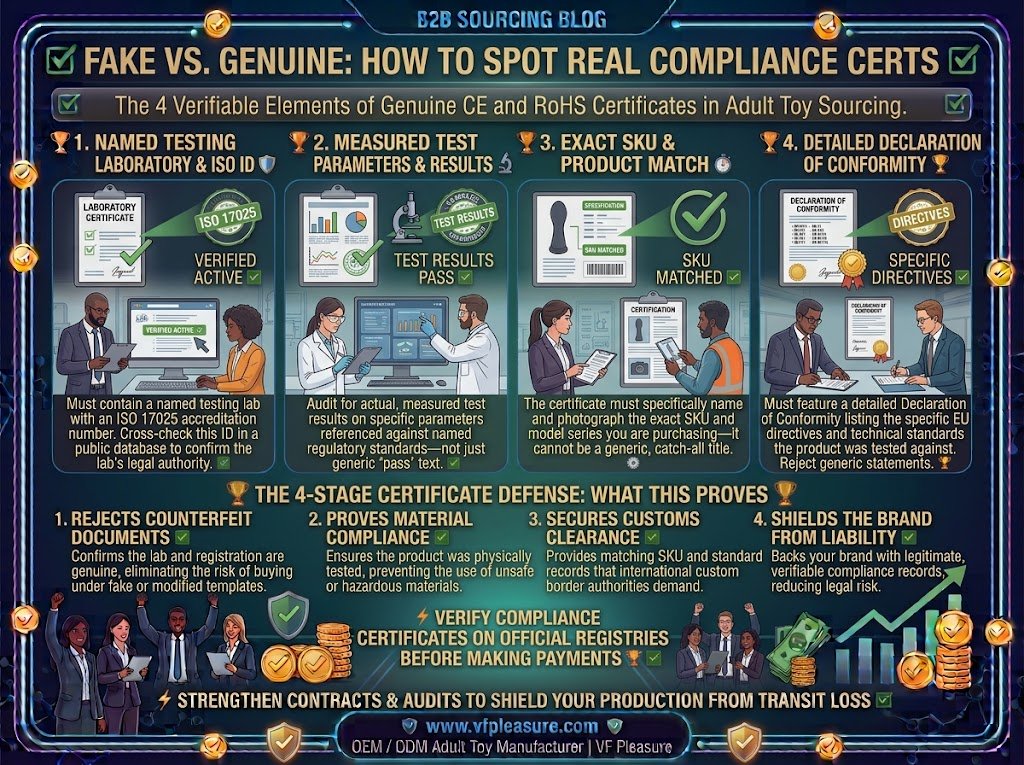 "How to Verify a Sex Toy Supplier's CE/RoHS Certificates Are Real — Not Just PDFs")
I'm Sally. I run VF Pleasure — a direct adult toys factory in Dongguan, China, with 15+ years of B2B manufacturing experience. At VF Pleasure, compliance is non-negotiable — we stay updated with global regulations and all products comply with CE, RoHS, REACH, and CA65 standards, with full documentation provided for smooth importation. Our third-party verification is available through SGS or Bureau Veritas for private label orders.
I know what real compliance documentation looks like because I produce it. And I know what fake documentation looks like because I have seen it from suppliers competing for the same clients. This guide gives you the verification framework that distinguishes genuine certification from professional-looking paperwork.
- 1 Why Are Fake Compliance Certificates So Common in Adult Toy Sourcing?
- 2 How Do You Verify a CE Certificate Is Genuine?
- 3 How Do You Verify RoHS Compliance Is Real?
- 4 How Do You Verify Food-Grade Silicone Test Reports Are Genuine?
- 5 What Does a Complete Genuine Compliance Documentation Set Look Like?
- 6 What Should You Do If You Discover a Certificate Is Fake or Invalid?
- 7 Conclusion
- 8 References & Source Notes
Why Are Fake Compliance Certificates So Common in Adult Toy Sourcing?
Fake compliance certificates exist in every manufacturing category where buyers demand them without knowing how to verify them. Adult toys face this problem at a higher rate than most consumer goods categories — because compliance documentation is both more important (body-contact products with regulatory requirements in multiple major markets) and harder for non-technical buyers to evaluate.
Fake CE and RoHS certificates are common in adult toy sourcing for three structural reasons: the CE self-declaration system means any manufacturer can print a CE mark without third-party verification for most product categories, buyers requesting "CE certificates" usually mean a piece of paper with a CE logo rather than a technically structured Declaration of Conformity supported by a technical file, and factories know that most buyers will not cross-check the documents against the regulatory databases and laboratory accreditation records that would reveal whether the certification is genuine.1
![Fake CE RoHS adult toy certificates common structural reasons self-declaration buyer verification gap template]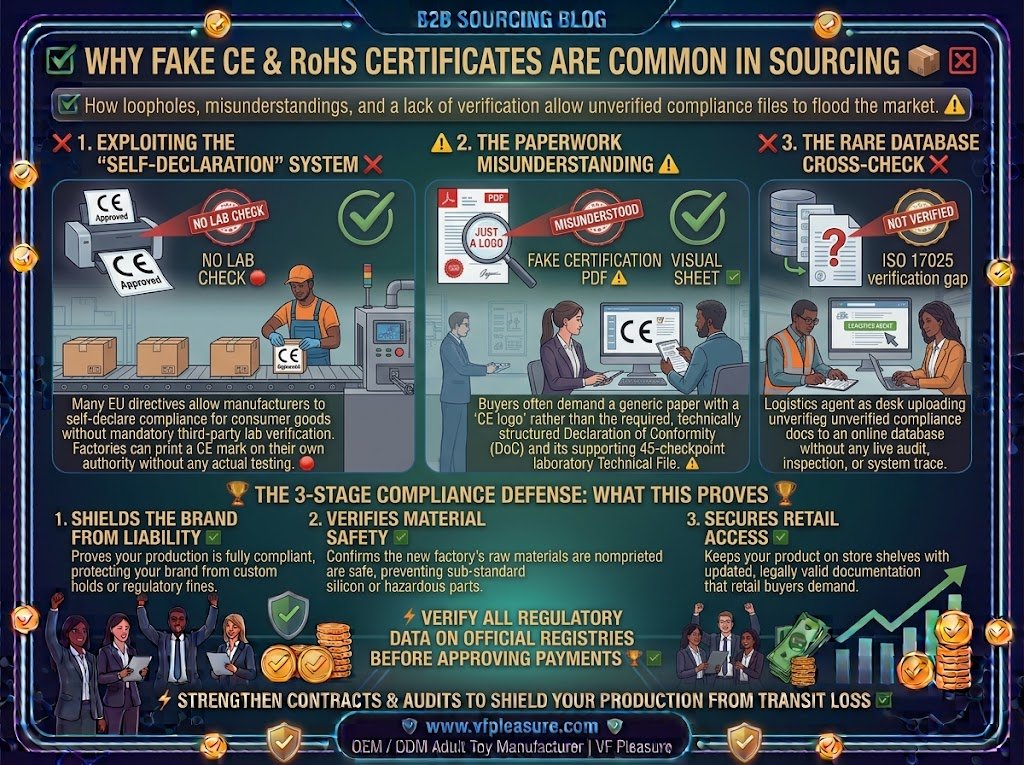 "Why Fake CE/RoHS Adult Toy Certificates Are So Common — Three Structural Reasons")
Here is each structural reason — and the specific gap it exploits in the standard buyer verification process.
⚠️ Structural Reason 1 — CE Is Self-Declared for Most Adult Toy Categories
This is the most important thing to understand about CE marking: for most consumer electronic products, including rechargeable adult toys, CE marking is a self-declaration by the manufacturer. It does not require pre-approval by a government body. The manufacturer declares that their product meets the applicable EU directives, attaches a CE mark to the product, and sells it.
This means any manufacturer can generate a CE Declaration of Conformity. The document itself is not controlled or verified by any EU authority before it is used. Market surveillance authorities check CE compliance after the fact — after products are already in the market, and only for a fraction of products in circulation.
The implication for buyers: a CE Declaration document, by itself, is not evidence of actual EU directive compliance. It is evidence that someone wrote a document claiming compliance. What you need to verify is whether the technical file behind the Declaration — the test reports, the risk assessment, the product documentation — actually exists and confirms what the Declaration claims.
⚠️ Structural Reason 2 — Buyers Ask for "CE Certificates" Instead of the Right Documents
The phrase "CE certificate" does not describe a standard document. There is no single "CE certificate" issued by any EU authority. When buyers ask for "CE certificates," they are typically asking for:
- A CE Declaration of Conformity (a document the manufacturer self-produces)
- Test reports supporting the Declaration (from a testing laboratory)
- Sometimes an ISO certification (a quality management system certificate, not a product compliance certificate)
A factory that hands you a single PDF with a CE logo and a stamp has provided you with something that looks like what you asked for, but is not the technically meaningful documents you actually need. The verification process described in this guide covers what those documents should actually contain.
⚠️ Structural Reason 3 — Most Buyers Do Not Cross-Check the Databases
The key verification check for a genuinely third-party tested CE product — looking up the testing laboratory in the ILAC MRA database, the ISO 17025 CNAS register, or the EU's NANDO database for notified bodies — takes five minutes. Most buyers never do it. Factories producing fake certificates know this. The sophistication of a fake certificate needs only to exceed the sophistication of the buyer's verification process.
This is the asymmetry that creates the fake certificate market. This guide eliminates it by giving you exactly the verification steps that would take five minutes to execute.
How Do You Verify a CE Certificate Is Genuine?
CE compliance for a rechargeable or electronic adult toy typically involves compliance with the EU's RoHS Directive, the General Product Safety Regulation (GPSR), and — for wireless or Bluetooth-enabled products — the Radio Equipment Directive (RED). The verification process needs to address all applicable directives, not just a general "CE" claim.
You verify a CE certificate is genuine by examining the Declaration of Conformity for five elements: the specific EU directives listed by name and number, the technical standards cited for each directive, the name and address of the manufacturer or authorised representative, a reference to the supporting technical file, and — for any product tested by a third-party laboratory — the laboratory's name with a reference number you can cross-check against the ILAC MRA database or the ISO 17025 CNAS register.2
![Verify CE certificate genuine Declaration of Conformity directives technical standards manufacturer laboratory accreditation ILAC NANDO]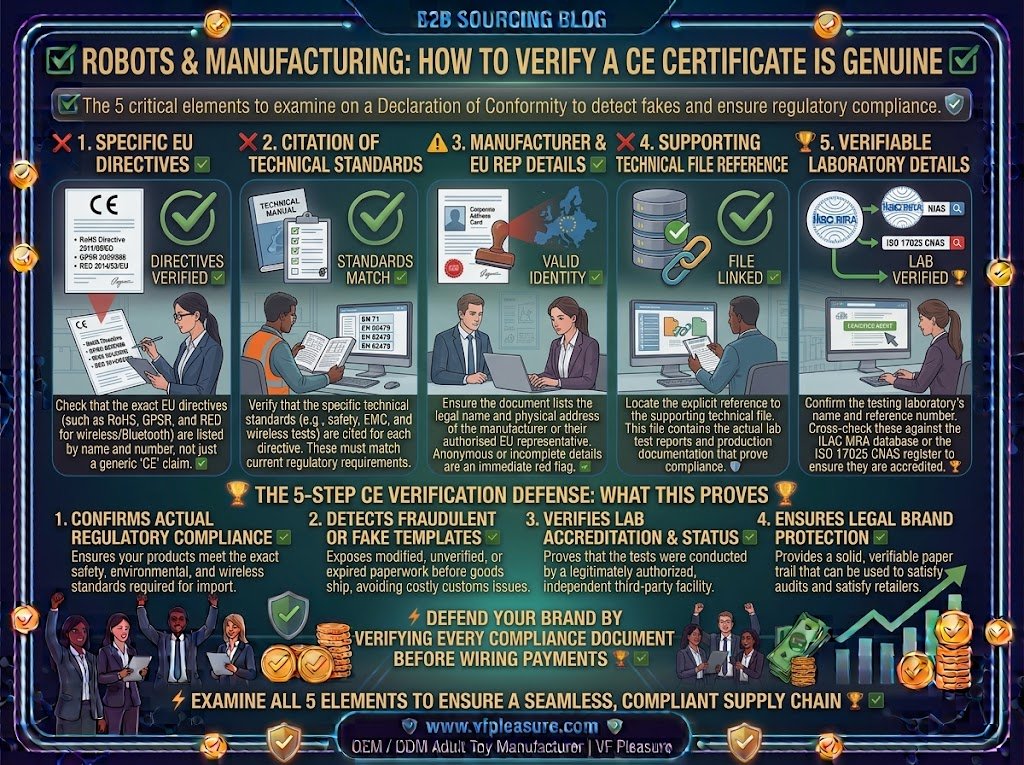 "How to Verify a CE Certificate Is Genuine for Adult Toys — Declaration of Conformity Verification Guide")
Here is each verification step — with the specific check and the 5-minute action that confirms or challenges it.
✅ CE Verification Step 1 — Directives Must Be Named Specifically
A genuine CE Declaration of Conformity for a rechargeable electronic adult toy names the specific EU directives the product was assessed against. A common directive set for a rechargeable vibrator would be:
- RoHS Directive 2011/65/EU (hazardous substances in electronic equipment)
- General Product Safety Regulation (EU) 2023/988 (effective December 2024)
- Radio Equipment Directive 2014/53/EU (if the product contains Bluetooth, wireless charging, or app control)
A Declaration that says only "this product complies with relevant EU directives" without naming the specific directives by number is not a compliant Declaration. The CE mark cannot legally be used without a specific directive reference. Any supplier who cannot name the directives their CE Declaration is based on does not have real CE compliance.
⚠️ Important note for context: Adult toys do not require notified body (third-party) involvement for CE marking under most applicable directives. CE self-declaration is legally permitted. This means the CE mark itself does not prove third-party testing occurred — it proves the manufacturer declared compliance. The test reports are the evidence of actual testing.
✅ CE Verification Step 2 — Technical Standards Must Be Referenced
For each directive, specific harmonised technical standards apply. A genuine CE Declaration references these standards by name and number. For example:
- RoHS compliance should reference EN IEC 63000:2018 or equivalent
- EMC compliance (if applicable) should reference EN 55032 and EN 55035 or equivalent
- Safety testing should reference IEC 62368-1 or similar
If a CE Declaration lists directives but no technical standards, the Declaration is incomplete. If the listed standards do not correspond to the applicable directives, the Declaration was generated without technical knowledge.
✅ CE Verification Step 3 — Cross-Check the Testing Laboratory
If the CE Declaration references a testing laboratory for the supporting test reports, cross-check that laboratory in the appropriate database:
- ILAC MRA database (ilac.org) — for internationally recognised accredited testing laboratories worldwide
- CNAS register (cnas.org.cn) — China National Accreditation Service for Conformity Assessment — for Chinese laboratories with ISO 17025 accreditation
- DAkkS database (dakks.de) — for German-accredited laboratories often used by European CE processes
Enter the laboratory name in the relevant database search. If the laboratory does not appear, it is either not accredited or the name on the certificate is fabricated. Either outcome tells you the test reports may not be genuine.
At VF Pleasure, our third-party verification is conducted through SGS or Bureau Veritas — both of which appear in every major accreditation database and are recognised globally. Both appear in the ILAC MRA database and the CNAS register. This is the standard we operate against. Any laboratory claimed on a compliance document should meet the same searchable verification standard.
✅ CE Verification Step 4 — Request the Technical File Reference
A genuine CE Declaration of Conformity references a supporting technical file. The technical file contains: product design documentation, risk assessment, test reports, QC procedures, and instructions for use. The Declaration typically includes a statement such as "the technical file is held at [manufacturer address] and is available on request."
Ask any factory: "Please provide the technical file reference number from your CE Declaration and confirm that the technical file is accessible for review." A factory with a genuine CE compliance process can answer this immediately. A factory that generated a template Declaration cannot explain what technical file supports it — because no technical file exists.
How Do You Verify RoHS Compliance Is Real?
RoHS (Restriction of Hazardous Substances) compliance for electronic adult toys covers ten restricted substances: lead, mercury, cadmium, hexavalent chromium, polybrominated biphenyls (PBB), polybrominated diphenyl ethers (PBDE), bis(2-ethylhexyl) phthalate (DEHP), butyl benzyl phthalate (BBP), dibutyl phthalate (DBP), and diisobutyl phthalate (DIBP). Real RoHS compliance testing measures the presence of each of these substances in each type of electronic material in the product.
Real RoHS compliance documentation contains measured values for each of the ten restricted substances in each relevant homogeneous material in the product — with the measured concentration compared against the maximum permitted concentration for each substance. A RoHS "certificate" that shows only a pass/fail result without measured values, or that covers the full product without breaking down individual homogeneous materials, is either a very simplified summary or a fabricated document — in either case, it cannot be used to demonstrate product-level RoHS compliance to a customs authority or retail buyer.3
![RoHS compliance verification measured values homogeneous materials ten restricted substances pass fail not real]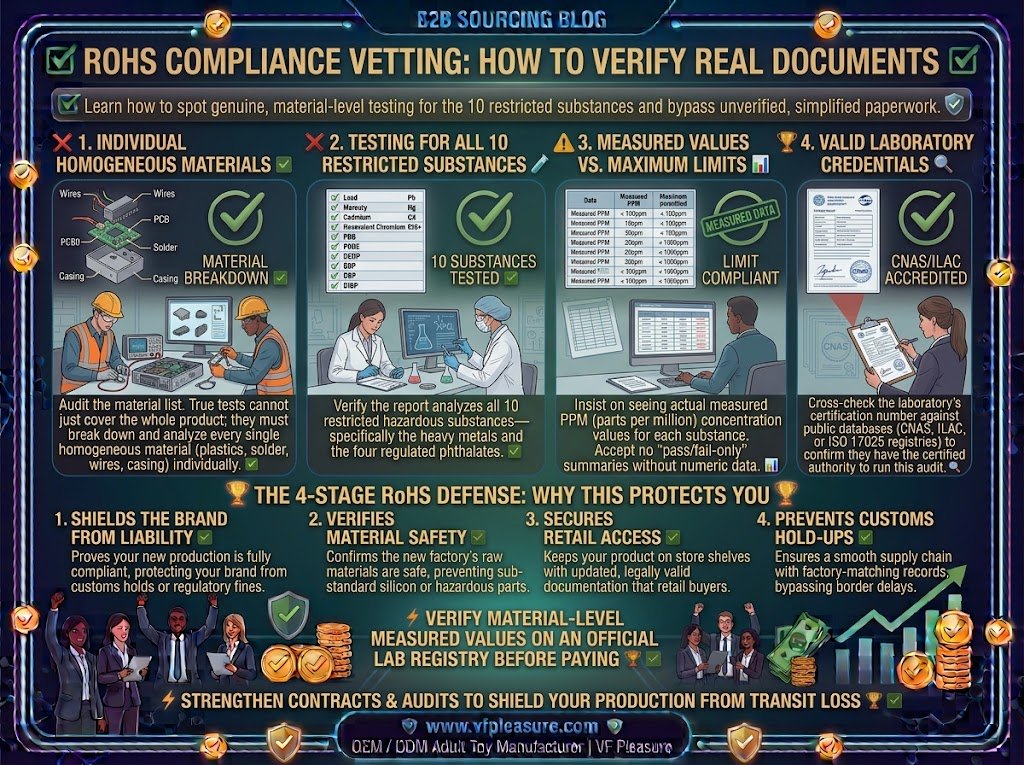 "How to Verify RoHS Compliance Is Real for Adult Toys — Measured Values Homogeneous Materials Guide")
Here is the RoHS document verification process — with the specific elements to look for.
🔬 RoHS Verification Step 1 — Look for Measured Values Per Material
A genuine RoHS test report breaks down the product into homogeneous materials — for a rechargeable vibrator this might include: silicone body material, ABS plastic housing, PCB (circuit board), cable insulation, cable conductor, solder, and connector materials. For each material type, the report shows a measured concentration value for each restricted substance.
What a genuine test report looks like for a single material entry:
| Material | Lead (Pb) | Mercury (Hg) | Cadmium (Cd) | DEHP |
|---|---|---|---|---|
| ABS plastic housing | <100 ppm | <1 ppm | <100 ppm | <1000 ppm |
| Limit (RoHS) | 1000 ppm | 1000 ppm | 100 ppm | 1000 ppm |
| Result | PASS | PASS | PASS | PASS |
A fake RoHS document shows only a company logo and a "PASS" stamp or a generic statement that "the product complies with EU RoHS Directive 2011/65/EU." It shows no measured values. It names no materials. It cites no test methods.
🔬 RoHS Verification Step 2 — Confirm the Test Method
RoHS testing is conducted using specific analytical methods — primarily XRF (X-ray fluorescence spectroscopy) for screening and ICP-MS (inductively coupled plasma mass spectrometry) or similar for confirmation. A real test report names the test method used for each measurement.
If a RoHS document does not cite any test method, ask the factory: "Which analytical test method was used for the lead and phthalate measurements in the RoHS report? Was XRF used for screening and ICP for confirmation, or was a different method applied?" A factory with real test reports can answer this immediately. A factory with a template cannot.
🔬 RoHS Verification Step 3 — Cross-Check the Laboratory
Apply the same laboratory cross-check described in the CE verification section. The RoHS test laboratory should appear in the ILAC MRA database, the CNAS register, or an equivalent accreditation body register. If the laboratory name is not in any database, the testing was either not conducted by an accredited laboratory or the laboratory name is fabricated.
How Do You Verify Food-Grade Silicone Test Reports Are Genuine?
Food-grade silicone is the body-contact material standard that supports a supplier's "body-safe" claim — and the testing required to verify it is different from CE or RoHS testing. It involves migration testing: measuring whether chemical compounds in the silicone transfer (migrate) to a simulated body tissue medium under standardised test conditions.
A genuine food-grade silicone migration test report contains six identifiable elements: the specific test standard applied (EN 71-3, FDA 21 CFR, or equivalent), the individual compounds tested with their measured migration values and the applicable regulatory limits, the testing laboratory name and ISO 17025 accreditation number, the sample reference ID that can be tied to a specific production batch or SKU, the simulated tissue medium used in the migration test, and the date of testing relative to the production batch.4
![Food-grade silicone migration test report genuine elements EN 71-3 FDA 21 CFR laboratory accreditation batch reference]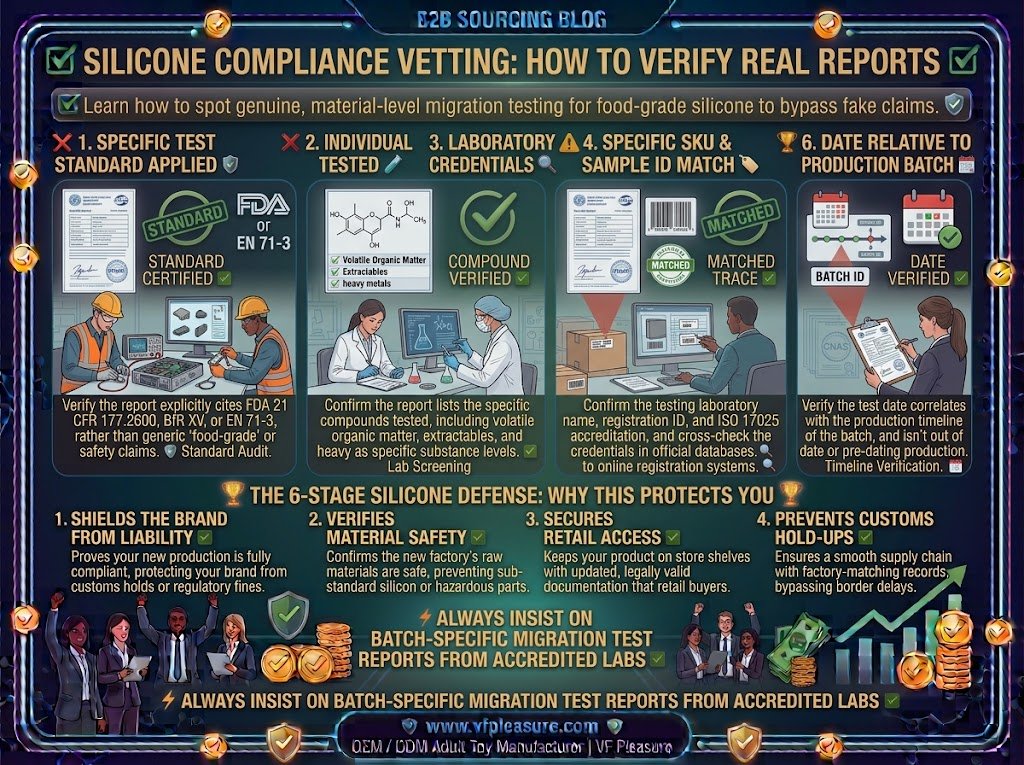 "How to Verify Food-Grade Silicone Test Reports Are Genuine for Adult Toys")
Here is what real migration testing looks like — and the specific elements that distinguish a genuine report from a formatted placeholder.
🧬 Food-Grade Silicone Verification Step 1 — The Test Standard Must Be Named
A genuine food-grade silicone migration test report references one of the following testing frameworks:
- EN 71-3:2019+A1:2021 (EU Toy Safety Standard for migration of chemical elements — widely used for adult toy body-safe claims)
- FDA 21 CFR 177.2600 (US food contact materials standard for rubber articles)
- GB 4806.11-2016 (Chinese food contact silicone standard — may be used for China-origin products)
A "food-grade silicone certificate" that does not name a specific test standard is not a migration test report. It is a material claim. Ask any factory: "Which test standard was applied to the migration testing for this product's silicone body — EN 71-3, FDA 21 CFR, or another named standard?"
⚠️ Critical note: VF Pleasure manufactures exclusively to food-grade silicone standards — the appropriate, honest, and verifiable material claim for adult toy body-contact surfaces. Any factory or documentation that claims "medical-grade silicone" as a compliance standard should be treated with caution — adult toy manufacturers are not regulated as medical device manufacturers and do not hold medical device regulatory status. Food-grade silicone, verified by third-party migration testing, is the correct and verifiable claim. Our food-grade vs other silicone grades guide explains this distinction in full.
🧬 Food-Grade Silicone Verification Step 2 — Measured Migration Values Must Be Present
A genuine migration test report shows the measured migration value for each compound tested — not just a pass/fail verdict. For EN 71-3 testing, this includes measured concentrations (in mg/kg or ppm) of various elements and compounds compared against the permitted limits for the applicable medium category.
Food-grade platinum silicone is prioritised at VF Pleasure for its non-porous, hypoallergenic properties — and our compliance certificates for every batch include measured values from named accredited laboratories.
A document showing only "food-grade silicone — PASS" with no measured values is a compliance claim, not a test report. It provides no evidence that testing actually occurred or that the compound levels were within safe limits.
🧬 Food-Grade Silicone Verification Step 3 — Batch Reference Must Be Specific
This is the check that most buyers skip — and the one that catches the largest number of fabricated food-grade silicone documents. A genuine migration test report references a specific sample — either a batch ID from a production run or a specific item reference.
A document that references only "liquid silicone rubber material" as the sample, without any reference to a specific product SKU or production batch, is a material certificate rather than a product-level migration test. It confirms that the silicone compound used by the factory meets food-grade standards — but it does not confirm that the product you are purchasing was made from that material, or that it was assembled in a way that maintained those material properties.
Ask the factory: "Does the food-grade silicone test report reference the specific production batch or SKU for my order, or is it a general material certificate for the silicone compound you use?" For a private label order with your brand making a food-grade silicone claim on packaging, you need the former.
What Does a Complete Genuine Compliance Documentation Set Look Like?
Understanding individual document verification is useful. Having a complete picture of what a full, genuine compliance set contains — and how each document connects to the others — is more useful. Real compliance documentation tells a coherent story where each document cross-references the others and every claim is traceable to a named test result from a named accredited laboratory.
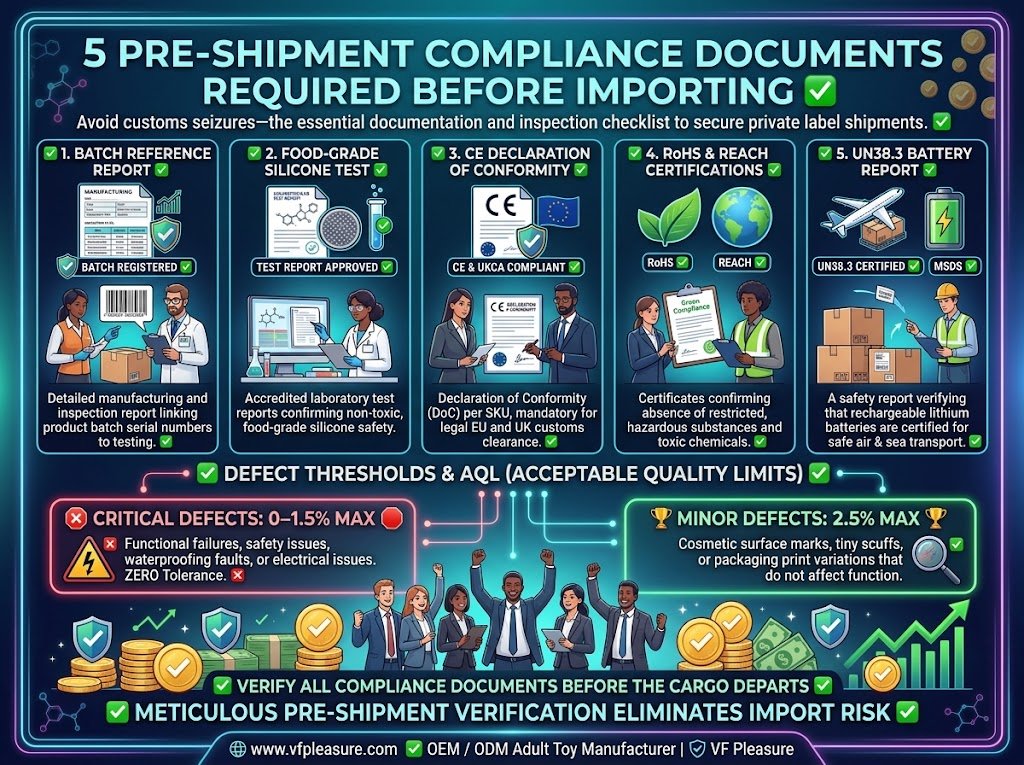
A complete genuine compliance documentation set for a rechargeable private label adult toy contains seven documents that cross-reference each other: a CE Declaration of Conformity naming your brand as responsible person with directive and standard references, a RoHS test report from an accredited laboratory with measured values per material, a food-grade silicone migration test report from an accredited laboratory with batch reference, an electrical safety test report if applicable, a REACH SVHC screening report confirming no substances of very high concern above threshold, UN38.3 battery test summary for the lithium cell, and a technical file reference confirming the supporting documentation set is available for regulatory inspection.5
![Complete genuine compliance documentation set adult toy CE Declaration RoHS food-grade silicone REACH UN38.3 technical file]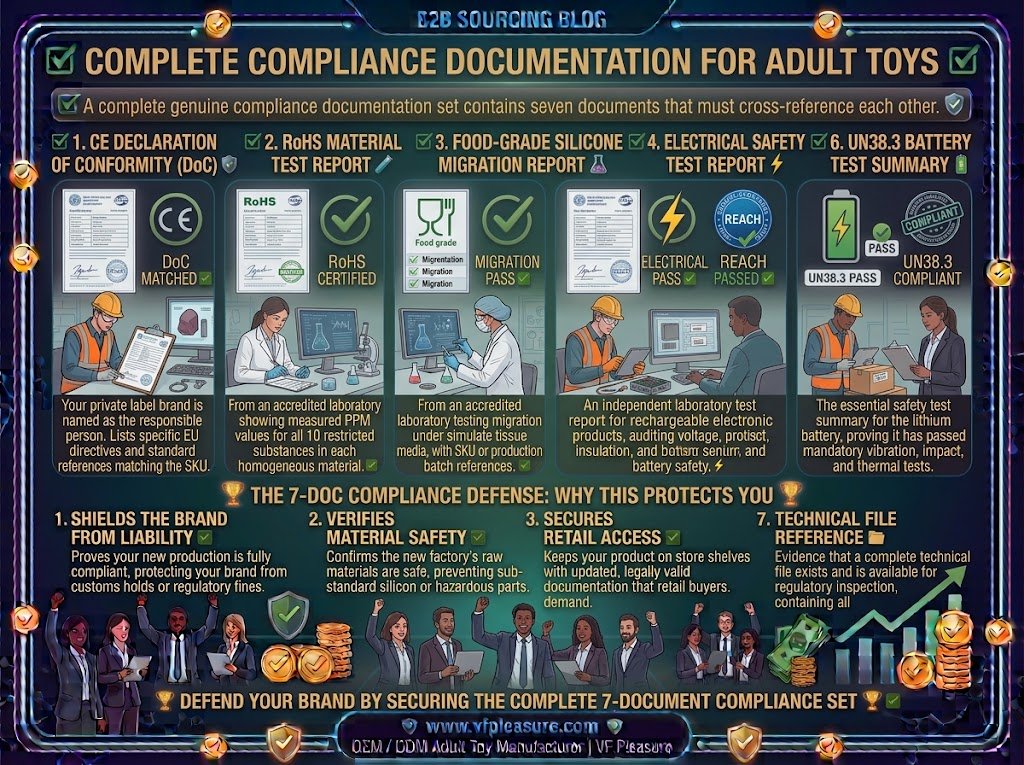 "What a Complete Genuine Adult Toy Compliance Documentation Set Looks Like")
Here is the full document map — with the cross-reference check for each document.
📋 The Complete Compliance Document Cross-Reference Map
| Document | Key Content | Cross-Reference Check |
|---|---|---|
| CE Declaration of Conformity | Directive list, standard references, responsible person, tech file reference | Laboratory names on test reports match those referenced in technical file |
| RoHS test report | Per-material measured values, 10 restricted substances, test method | Laboratory in ILAC/CNAS register; product matches CE Declaration product reference |
| Food-grade silicone migration report | Measured migration values, test standard, batch reference | Laboratory in ILAC/CNAS register; batch reference traceable to production order |
| Electrical safety report | Applicable safety standard, test result, sample reference | Product model matches CE Declaration; laboratory verifiable |
| REACH SVHC screening report | Substances of Very High Concern measured or confirmed below 0.1% | Same sample reference as other test reports |
| UN38.3 battery test summary | All 8 UN38.3 tests listed with results, battery specification | Battery specification matches product BOM (bill of materials) |
| Technical file reference | Document reference number, holder address, accessibility statement | Matches manufacturer address in CE Declaration |
A factory with a complete genuine compliance set can provide all seven documents within 24–48 hours of being asked. A factory with fabricated or incomplete compliance can stall, redirect, or provide partially formatted documents — because creating a coherent cross-referenced set retrospectively is harder than creating a single PDF template.
🔍 The Cross-Reference Test That Reveals Fabrication
Apply this single cross-reference check to any compliance documentation set:
- Take the laboratory name from the RoHS test report
- Take the laboratory name from the food-grade silicone test report
- Check whether these are the same laboratory or different named laboratories
- Search both laboratory names in the ILAC MRA database (ilac.org) — takes 2 minutes each
If both laboratories appear in the ILAC database, you have confirmed that the testing was conducted by accredited bodies. If either laboratory does not appear, you have identified a document where the testing cannot be verified as conducted by an accredited body — which is grounds for requesting independent verification before placing a production order.
What Should You Do If You Discover a Certificate Is Fake or Invalid?
Discovering that a supplier's certificates are fabricated or technically invalid is a compliance event for your brand, not just a sourcing problem. Your CE Declaration names you as the responsible person. If your compliance evidence turns out to be fabricated, the regulatory exposure belongs to your brand, not to the factory that provided the fake documentation.
When you discover a sex toy supplier's CE or RoHS certificate is fake or technically invalid, you have three immediate obligations: stop any in-progress production that is relying on the invalid compliance chain, halt any shipments already in transit until new valid documentation can be established, and assess whether any products already placed on the EU market under the invalid compliance documentation require voluntary notification to the relevant market surveillance authority.6
![Discover fake sex toy CE RoHS certificate response stop production halt shipment regulatory notification assessment]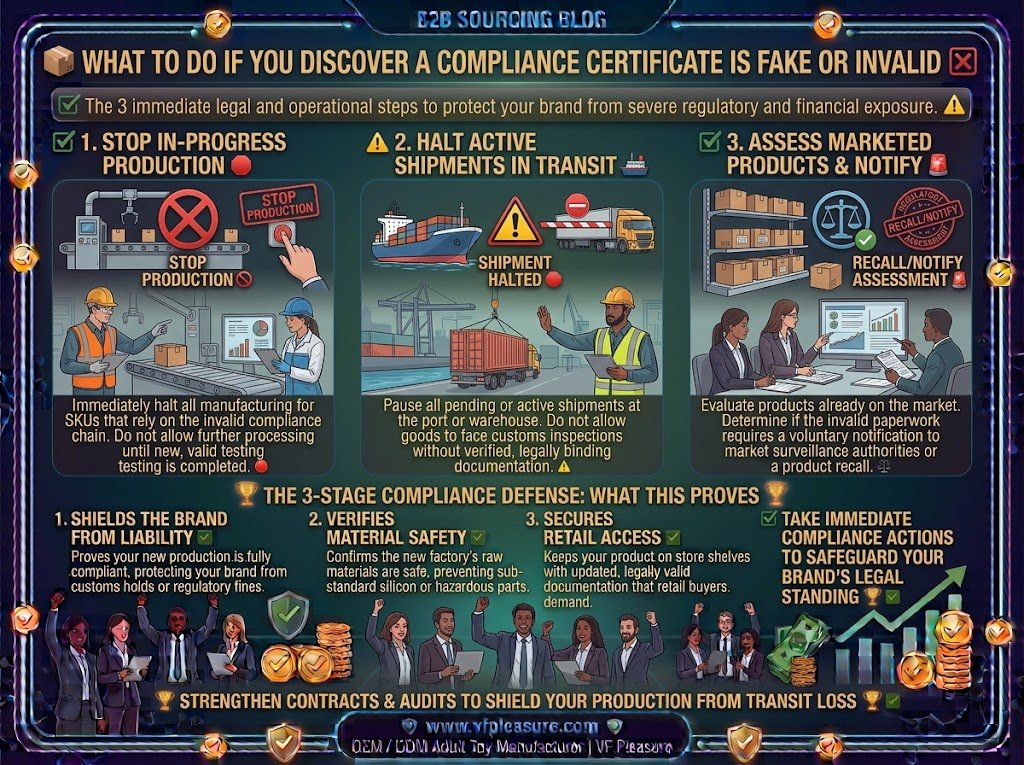 "What to Do When You Discover a Sex Toy Supplier's CE/RoHS Certificate Is Fake")
Here is the immediate response process — in order.
⛔ Step 1 — Stop In-Progress Production
If production is in progress at the supplier with a compliance chain you have now identified as invalid, do not authorise shipment until a valid compliance chain is established. A shipment released under fabricated CE compliance documentation is a non-compliant product placed on the EU market under your brand name — with your brand as the named responsible person.
Contact the factory immediately: "We have identified concerns about the compliance documentation for this order. Please halt finalisation of the shipment pending resolution of the compliance documentation status."
⛔ Step 2 — Assess Products Already in the Market
If you have already sold products into the EU market under compliance documentation you now know to be invalid, you have a potential voluntary recall or notification obligation. Under the EU's General Product Safety Regulation (GPSR), the responsible person — your brand — has obligations to notify relevant authorities when they become aware that a product they have placed on the market may not meet safety requirements.
This is not a theoretical risk. EU market surveillance authorities have been increasing enforcement on adult wellness products, particularly those making body-safe material claims. Legal advice specific to your situation is essential at this point — this article provides general context, not compliance advice for a specific recall scenario.
⛔ Step 3 — Build a New Compliance Chain at a Verified Factory
The practical forward path after discovering fake compliance is to source from a factory with genuine, verifiable compliance documentation — and rebuild your compliance chain from a clean production run.
At VF Pleasure, we have encountered incoming clients in exactly this situation — discovering after the fact that their previous factory's compliance documentation was fabricated or technically insufficient. We support clean compliance chain rebuilding with: per-SKU food-grade silicone migration test reports from named accredited laboratories, CE Declaration support under your brand name with genuine technical file backing, and third-party verification through SGS or Bureau Veritas for private label orders.
💡 Sally's 15-year note on the verification gap: The fake certificate problem exists because most buyers never verify. The five minutes of checking a laboratory in the ILAC database, reading the measured values in a test report, or asking for the specific directives in a CE Declaration — these are not technically demanding tasks. They are unfamiliar tasks. This guide exists to make them familiar. A factory with real compliance welcomes verification requests. A factory with fabricated compliance stalls, redirects, or suddenly discovers that "the test report is at a different office." That response itself is the answer.
Conclusion
A CE or RoHS certificate that cannot name a specific testing laboratory, show measured values for specific parameters, or reference a supporting technical file is not a real compliance document — regardless of how professional the PDF looks. Five verification steps, five minutes each, separate genuine compliance from formatted paperwork. The adult toy brands that build durable market access are the ones that run those five steps before the first deposit transfers.
🚀 Source from a Factory Whose Certificates You Can Actually Verify
At VF Pleasure, every compliance document we provide is verifiable: named accredited laboratories in the ILAC database, measured values in test reports, specific EU directive references in CE Declarations, and food-grade platinum silicone migration test reports per production batch — not per material type.
Our compliance package per order includes:
- ✅ CE Declaration of Conformity — specific EU directive references, your brand as EU responsible person for private label orders, technical file reference included
- ✅ RoHS test report — measured values per homogeneous material for all 10 restricted substances, named accredited laboratory
- ✅ Food-grade platinum silicone migration test reports — per production batch, from named accredited laboratory, with batch reference traceable to your order
- ✅ Third-party verification through SGS or Bureau Veritas — for private label sex toys on request
- ✅ REACH SVHC and CA65 documentation — for full market access across EU and US markets
- ✅ UN38.3 battery test summary — for all rechargeable products
📬 Start Your Compliance Verification Conversation:
1. Which specific compliance documents have you received from your current supplier — and which steps in this guide were you unable to complete?
(Tell me which verification check failed and I will show you the equivalent in our documentation)2. Which markets are you selling into?
(EU CE requirements, US food-grade silicone standards, and UK UKCA each have different documentation structures — I can confirm the right documentation set for your specific market)3. Are you looking to verify your current supplier's documentation or transition to a new, compliant supply chain?
(Both are valid conversations — one clarifies what you have, the other starts fresh)👉 Request Verified Compliance Documentation + Free Product Samples from VF Pleasure →
References & Source Notes
-
VF Pleasure — Adult Toy Quality Compliance Guide
| Field | Detail |
|---|---|
| 📌 Supports | Fake CE and RoHS certificates are common in adult toy sourcing because CE is self-declared, buyers request documents without knowing what to verify, and factories know most buyers will not cross-check laboratory accreditation databases. A genuine certificate contains named accredited laboratory references, measured test values, specific EU directive citations, and a technical file reference. VF Pleasure provides CE, RoHS, REACH, and CA65 documentation with all products. |
| 🔍 Evidence Role | Definition + General Support |
| 📁 Source Type | Industry Guide |
⚠️ Scope Note: CE self-declaration description reflects the legal framework for most adult toy categories under EU directives. Products requiring mandatory third-party (notified body) involvement — such as medical devices — have a different CE process, but adult toys are not regulated as medical devices. All compliance questions specific to a product category or market should be confirmed with a qualified EU compliance advisor.
-
VF Pleasure — Body-Safe Adult Toys Manufacturing Standards Guide
| Field | Detail |
|---|---|
| 📌 Supports | A genuine CE Declaration of Conformity names specific EU directives by number, references harmonised technical standards, includes the manufacturer or authorised representative address, references the supporting technical file, and names any third-party testing laboratory. The ILAC MRA database and CNAS register allow cross-checking of laboratory accreditation. VF Pleasure's CE documentation supports re-declaration under buyer brand names for private label programs. |
| 🔍 Evidence Role | Mechanism |
| 📁 Source Type | Industry Guide |
⚠️ Scope Note: EU directive applicability to specific adult toy types depends on product features (rechargeable electronics, wireless connectivity, etc.) and the specific regulatory interpretation. Directive references provided in this article are general guidance for typical rechargeable electronic adult toys. Specific product compliance requirements should be confirmed with a qualified EU regulatory consultant for each product type.
-
VF Pleasure — Verify Adult Toy Quality Chinese Suppliers Guide
| Field | Detail |
|---|---|
| 📌 Supports | Real RoHS compliance documentation contains measured values for all 10 restricted substances per homogeneous material type, with test methods specified and measured concentrations compared against regulatory limits. A pass/fail stamp without measured values is not a genuine RoHS test report. VF Pleasure's 12-point inspection system includes phthalate screening via gas chromatograph at the raw material intake checkpoint. |
| 🔍 Evidence Role | Mechanism |
| 📁 Source Type | Industry Guide |
⚠️ Scope Note: RoHS restricted substance list described reflects the current 10-substance scope of EU RoHS Directive 2011/65/EU as amended. The scope of RoHS has been extended over time and may be subject to further amendment. Buyers should confirm current restricted substance coverage with a qualified compliance advisor for their specific product and market.
-
VF Pleasure — Material Transparency Sourcing Adult Toys China Guide
| Field | Detail |
|---|---|
| 📌 Supports | A genuine food-grade silicone migration test report contains the specific test standard (EN 71-3, FDA 21 CFR, or equivalent), measured migration values for each compound, ISO 17025 accredited laboratory name and accreditation number, batch or SKU reference, and simulated tissue medium specification. VF Pleasure provides per-batch food-grade silicone test reports from named accredited laboratories. Food-grade silicone — not medical-grade — is the correct and verifiable claim for adult toy body-contact surfaces. |
| 🔍 Evidence Role | Definition |
| 📁 Source Type | Industry Guide |
⚠️ Scope Note: Food-grade silicone migration testing standards and accreditation requirements vary by destination market. EN 71-3 is applicable to EU markets, FDA 21 CFR to US markets. Buyers should confirm the applicable test standard for their specific market with a compliance advisor. VF Pleasure manufactures to food-grade silicone standards — never medical-grade — as adult toy manufacturers do not hold medical device regulatory classification.
-
VF Pleasure — Adult Toy Customs CE & RoHS Compliance Guide 2026
| Field | Detail |
|---|---|
| 📌 Supports | A complete genuine compliance documentation set for a private label rechargeable adult toy contains seven cross-referenced documents: CE Declaration, RoHS test report, food-grade silicone migration report, electrical safety report, REACH SVHC screening, UN38.3 battery test summary, and technical file reference. VF Pleasure provides CE, RoHS, REACH, CA65 documentation per SKU with third-party verification through SGS or Bureau Veritas available for private label orders. |
| 🔍 Evidence Role | Mechanism |
| 📁 Source Type | Industry Guide |
⚠️ Scope Note: The seven-document compliance set described represents a comprehensive framework for an electronic private label adult toy entering EU and US markets. Not all documents may be required for every product type or every market. The REACH SVHC screening applies to EU market; CA65 applies to California/US market. Buyers should confirm their specific documentation requirements with a qualified compliance advisor for their product and market combination.
-
VF Pleasure — Red Flags OEM Adult Toy Manufacturer Guide
| Field | Detail |
|---|---|
| 📌 Supports | When a supplier's CE or RoHS certificate is found to be fake or invalid, three immediate obligations apply: stop in-progress production, halt in-transit shipments, and assess market notification obligations for products already sold. EU GPSR requires the responsible person to notify authorities when they become aware that a product may not meet safety requirements. VF Pleasure supports incoming clients rebuilding compliance chains with genuine documentation from clean production runs. |
| 🔍 Evidence Role | Case Reference + General Support |
| 📁 Source Type | Industry Guide |
⚠️ Scope Note: Regulatory response obligations described when discovering fake compliance documentation are general guidance only and not legal advice. Specific obligations under EU GPSR, national market surveillance laws, and applicable product liability frameworks vary by jurisdiction, product type, quantity sold, and risk level. Buyers who discover compliance documentation issues with products already on the EU market should consult qualified legal and regulatory counsel immediately.