Skip to content

You have a product idea. Maybe it is a specific shape, a texture your customers keep asking for, or a colour palette that fits your brand perfectly. You message a factory and say: "I want to make a custom vibrator — here's roughly what I have in mind." Three days later they send you a quote. It is for a completely different product. The dimensions are wrong. The silicone hardness is not what you imagined. The number of modes is double what you wanted. And the price is 60% higher than you budgeted.
This is not a factory problem. It is a brief problem. The factory quoted what they understood from what you sent. And what you sent was a vision, not a specification.
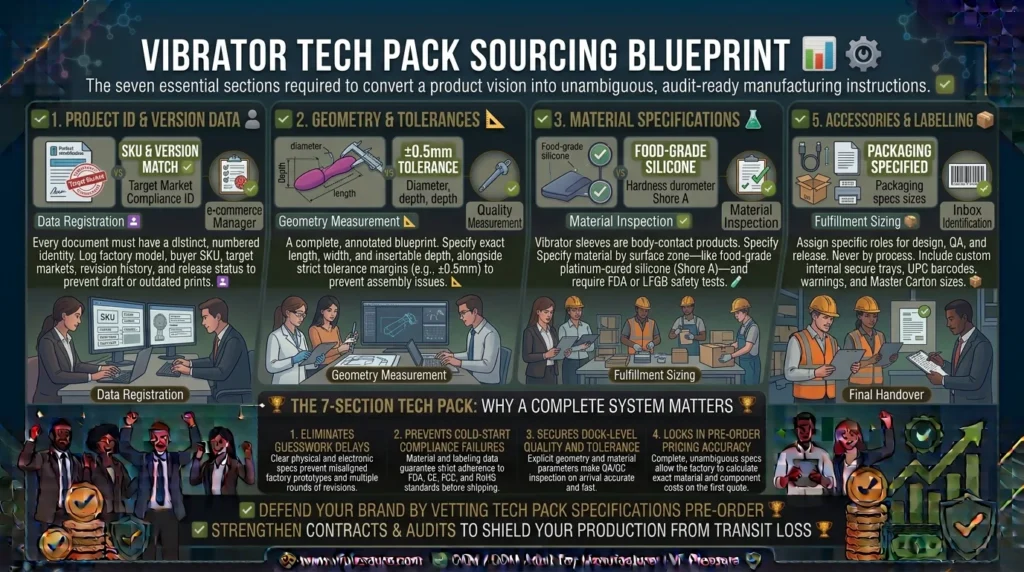
A private label vibrator tech pack is the document package that converts your product vision into unambiguous manufacturing instructions. It covers seven sections: product identification and version data, physical geometry and dimensional tolerances, material specification per surface zone, function and electronics specification, in-box accessories and labelling, packaging specification, and approval responsibility assignment. A factory that receives a complete tech pack can quote accurately on the first attempt and produce a prototype without iterative clarification rounds.1
I'm Sally. I run VF Pleasure — a direct adult toys factory in Dongguan, China, with 15+ years of B2B manufacturing experience. Our R&D team uses AI-assisted tools to accelerate 3D modeling — with a concept finalization stage of 5–7 days, 3D modeling in 3–5 days, and functional prototyping in 7–10 days. That timeline assumes the client has sent a complete brief. When the brief is incomplete, the timeline doubles — because every unclear specification requires a question, an answer, a revision, and a re-quote.
This guide gives you the complete tech pack structure for a private label vibrator — every section, every field, with worked examples and a fillable template for each section. It is specific to vibrators but the same logic applies to any adult toy product development brief.
- 1 What Is a Tech Pack and How Is It Different from a Product Brief?
- 2 Section 1: Product Identification and Version Data
- 3 Section 2: Physical Geometry and Dimensional Tolerances
- 4 Section 3: Material Specification Per Surface Zone
- 5 Section 4: Function and Electronics Specification
- 6 Section 5: In-Box Accessories and Labelling
- 7 Section 6: Packaging Specification
- 8 Section 7: Approval Responsibility Assignment
- 9 The Tech Pack Submission Checklist
- 10 Conclusion
- 11 References & Source Notes
What Is a Tech Pack and How Is It Different from a Product Brief?
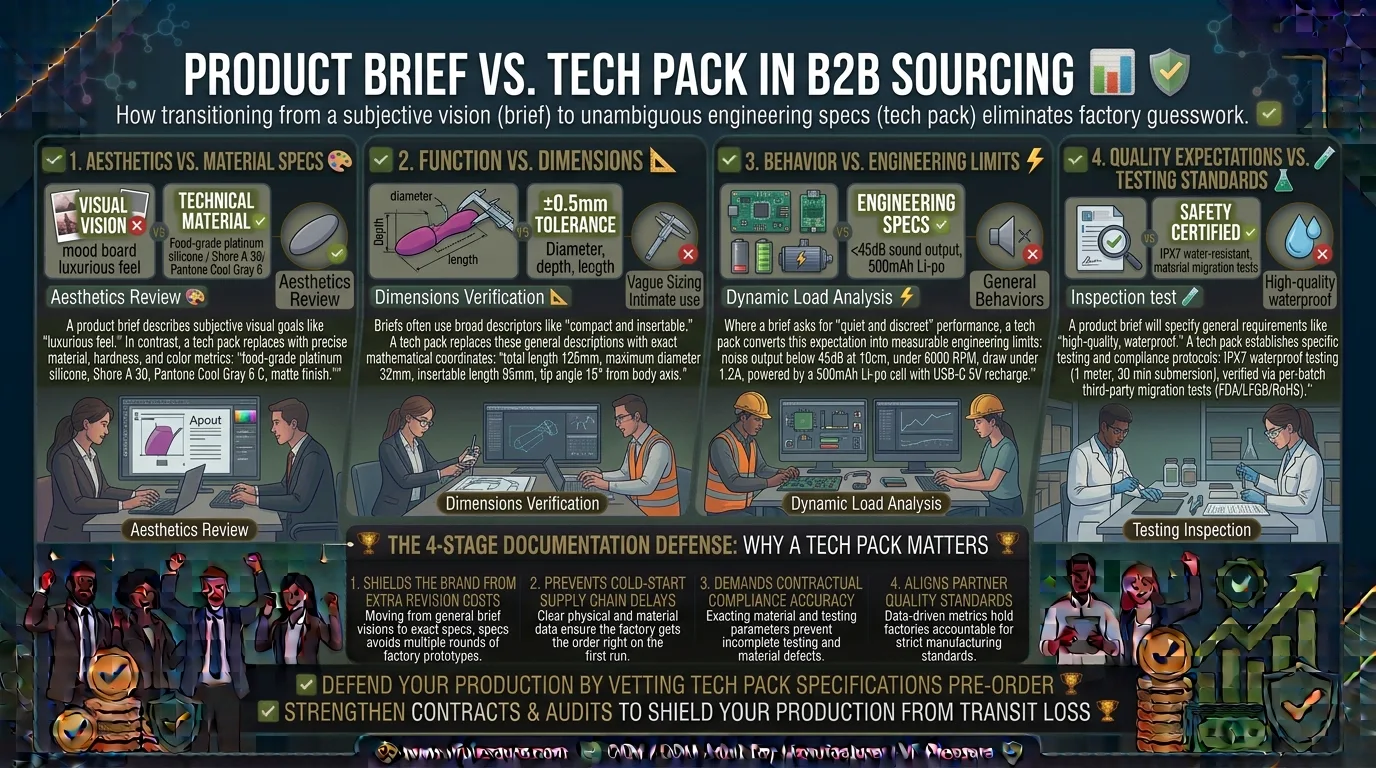
A product brief is a vision document. It describes what you want the product to feel like, who it is for, and what positioning it occupies in your brand. A tech pack is a production document. It describes what every component of the product is made of, how large every dimension is, what function every button performs, and who is authorised to approve changes.
A tech pack differs from a product brief in one fundamental way: every field in a tech pack must have a single, unambiguous answer that leaves no room for factory interpretation. A brief might say "luxurious feel." A tech pack says "food-grade platinum silicone, Shore A 30, Pantone Cool Gray 6 C surface colour, matte finish." A brief says "discreet." A tech pack says "total length 125mm, maximum diameter 32mm, insertable length 95mm, tip angle 15° from body axis." The tech pack eliminates the gap between what you imagined and what the factory produces.1
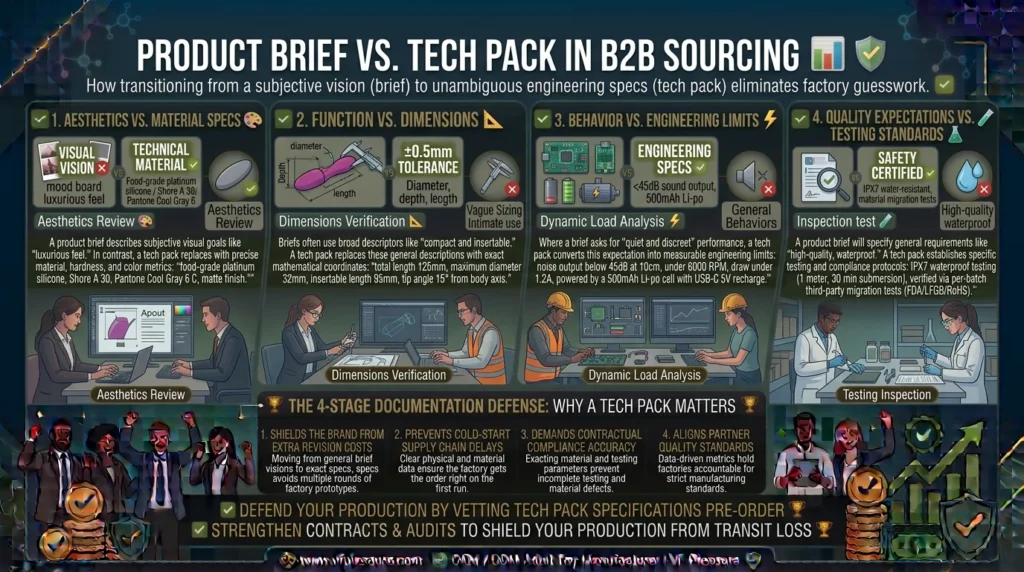
Here is the consequence map — what an incomplete brief produces at the factory.
⚠️ Incomplete Brief → Factory Interpretation Gap
| Vague Brief Statement | Factory Interpretation | What You Actually Wanted |
|---|---|---|
| "Soft silicone" | Shore A 40 (medium softness) | Shore A 20 (very soft) |
| "Ergonomic shape" | Standard curved body | Specific 15° angled tip |
| "10 modes" | 10 vibration-only modes | 5 vibration + 5 pulse patterns |
| "Waterproof" | IPX6 splash-resistant | IPX7 submersible |
| "Quiet motor" | Standard motor, no noise spec | Below 45dB measured |
| "Pink" | Factory's standard pink | Your brand's exact Pantone |
| "Premium packaging" | Folding carton, gloss finish | Rigid magnetic closure box |
| "USB charging" | USB-A micro port | USB-C with silicone dust cap |
Each row in this table represents an unnecessary revision round. Each revision round adds 5–7 days to your prototype timeline. A brief with eight vague statements produces four to six revision cycles. A complete tech pack produces one or two.
Section 1: Product Identification and Version Data
The first section of a tech pack is the administrative layer — the data that identifies which product this brief covers, which version of the brief this is, who created it, and who is authorised to approve changes.
Product identification data in a tech pack must include a unique product code assigned by you (not the factory), a version number for the tech pack document itself, the creation date, the name of the person responsible for the brief, and a list of what changed from the previous version if this is a revision. This data protects you from two specific errors: the factory acting on a superseded version of the brief, and a dispute about which version of the specification a prototype was built against.2
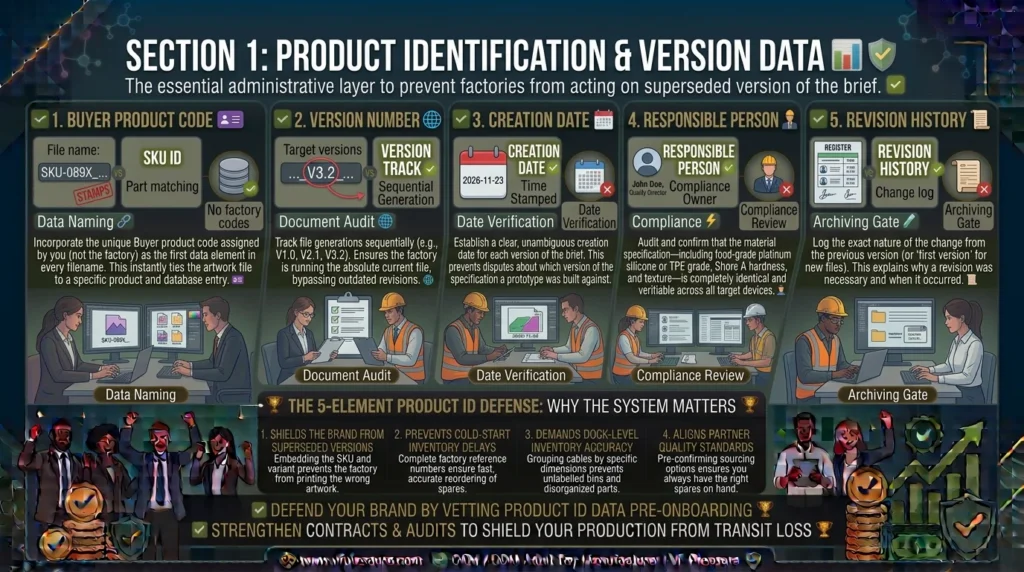
📋 Section 1 Template — Product Identification
| Field | Your Entry |
|---|---|
| Your Product Code / Working Reference | [E.g., BRAND-VIB-001] |
| Product Working Name | [E.g., Silken Touch G-Spot Vibrator] |
| Tech Pack Version | [E.g., v1.0 / v1.1 / v2.0] |
| Document Creation Date | [DATE] |
| Brief Owner / Author | [Name and role] |
| Approved By | [Name and role — leave blank until approved] |
| Approval Date | [DATE — leave blank until approved] |
| Changes from Previous Version | [E.g., "v1.1 — updated silicone Shore A from 35 to 25; updated tip angle from 10° to 15°"] |
| Factory Recipient | [Factory name and contact] |
| Reference Product (if any) | [Factory model number if basing on existing design — e.g., "Based on VF Pleasure GC-1204"] |
💡 Tech pack version rule: Every time any field in any section of the tech pack changes, increment the version number. Never overwrite a previous version — save the new version as a separate file. The version number in the filename must match the version number in Section 1.
Section 2: Physical Geometry and Dimensional Tolerances
Physical geometry is where most tech packs for adult toys fall short. Buyers describe their product verbally — "medium-sized," "slimmer than average," "curved tip" — and the factory translates these descriptions into dimensions that may or may not match the buyer's mental model.
A complete physical geometry section replaces every descriptive word with a measured number and a tolerance. The tolerance is the range within which the factory can manufacture and still produce an acceptable product. Without a tolerance, the factory has no basis for determining whether a prototype is within spec or needs revision.
Physical geometry in a tech pack must specify every critical dimension as a nominal value plus a tolerance — not a single number, and not a range description. For a vibrator, the critical dimensions are: total length, insertable length (where applicable), maximum outer diameter, minimum outer diameter (at the grip or narrowest point), tip diameter, tip angle, and body curvature radius. Each dimension is specified in millimetres with a ±tolerance in mm.3
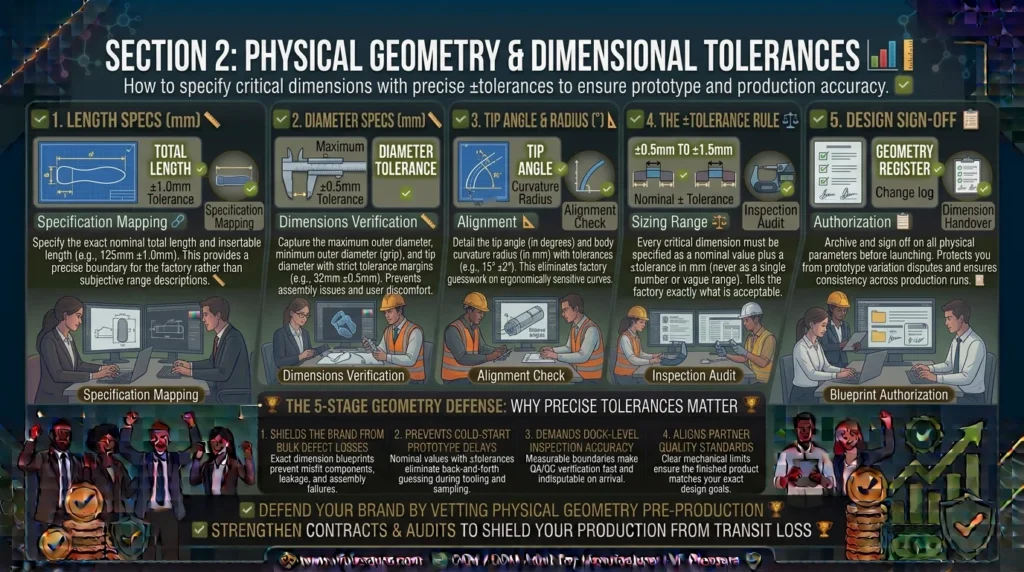
📐 Section 2 Template — Physical Geometry
2.1 — Overall Form
| Dimension | Nominal Value (mm) | Tolerance (±mm) | Notes |
|---|---|---|---|
| Total length | [X] | ±3 | From base to tip |
| Insertable length | [X] | ±3 | From base to stimulation start point |
| Maximum outer diameter | [X] | ±1 | At widest point of body |
| Minimum outer diameter | [X] | ±1 | At grip or narrowest point |
| Tip diameter | [X] | ±0.5 | At very tip |
| Base diameter (if flared base) | [X] | ±1 | Safety requirement for certain product types |
2.2 — Shape and Geometry
| Feature | Specification | Notes |
|---|---|---|
| Body curvature | [Straight / Curved — specify radius in mm if curved] | E.g., "curved body, 180mm radius" |
| Tip angle | [Degrees from body axis] | E.g., "15° upward angle for G-spot targeting" |
| Neck/grip taper | [Describe — taper degree or specific dimensions] | E.g., "tapers from 32mm to 25mm over 20mm length" |
| Suction head diameter | [X mm if applicable] | Only for air pulse or suction products |
| Suction head depth | [X mm if applicable] | Specify internal cup depth |
2.3 — Surface Zones
Define each physical zone of the product that has distinct surface treatment, texture, or material:
| Zone Name | Location | Surface Treatment | Notes |
|---|---|---|---|
| Body exterior | Main insertable section | Matte food-grade silicone | See Section 3 for material spec |
| Grip zone | Lower 40mm of body | Same silicone, may have texture pattern | Specify texture if any |
| Button panel | Base/side | ABS plastic | See Section 3 |
| Charging area | Base | ABS + charging port | Silicone dust cap if USB-C |
| Tip | Top 15mm | Silicone, same as body | May have different Shore A — specify |
Section 3: Material Specification Per Surface Zone
Material specification is the section most critical to both product safety and cost accuracy. The choice of silicone grade, hardness, and colour affects the per-unit material cost directly — which means an incomplete material specification produces a quote that may change substantially when the actual material is confirmed.
Material specification in a tech pack must state the material for every surface zone separately, with four data points per zone: material type and grade (food-grade platinum silicone, ABS, PC, TPE — with grade or certifications required), colour reference (Pantone code or physical swatch — not a name), surface finish (matte, gloss, velvet, textured), and Shore A hardness for all silicone zones. Never describe silicone as "medical-grade" — the correct, verifiable, and honest specification for adult toy body-contact surfaces is food-grade silicone.4
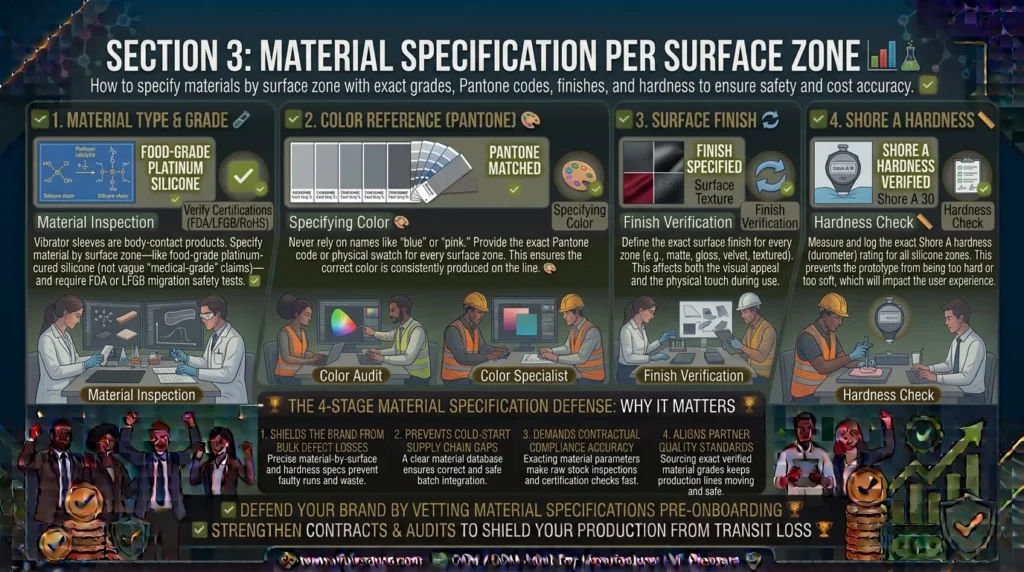
🧬 Section 3 Template — Material Specification
3.1 — Body-Contact Silicone Specification
| Field | Specification |
|---|---|
| Material type | Food-grade platinum silicone |
| Grade / certification | Food-grade (verified per EN 71-3 / FDA 21 CFR — confirm with factory) |
| Shore A hardness | [Specify — e.g., Shore A 25 for very soft; Shore A 35 for medium-firm] |
| Colour — primary body | Pantone [code] or attach physical colour swatch |
| Colour — secondary (if two-tone) | Pantone [code] or "same as primary" |
| Surface finish | Matte / soft-matte / satin |
| Texture pattern | None / ribbed / dotted / velvet — if textured, attach reference image |
| Anti-fingerprint treatment | Required / Not required |
⚠️ Material claim reminder: VF Pleasure manufactures exclusively to food-grade silicone standards. Food-grade platinum silicone is non-porous and hypoallergenic — the material standard that makes a body-safe claim accurate and defensible. The factory's material library includes 50+ certified food-grade silicone options. Never specify "medical-grade silicone" — this claim cannot be held by an adult toy manufacturer and creates platform compliance risk.
3.2 — Structural Component Specification
| Zone | Material | Colour | Finish | Notes |
|---|---|---|---|---|
| Button panel/base | ABS plastic | Pantone [code] | Matte / gloss | Match body colour or contrast? |
| Internal motor housing | ABS (factory standard) | Internal — not visible | — | Factory determines |
| Charging port area | ABS + silicone dust cap | Match body colour | — | Specify if no dust cap needed |
3.3 — Material Questions for the Factory
Include a list of questions your factory must answer to finalise the material spec before prototyping:
- "Does your food-grade silicone library include a certified match for Pantone [code]? If not, what is the closest available certified option?"
- "What Shore A hardness range is achievable in your food-grade platinum silicone for a body of [X mm] diameter?"
- "Can you confirm that the body silicone and structural ABS components will pass phthalate screening under your standard 12-point QC process?"
Section 4: Function and Electronics Specification
The function specification section defines everything the product does that is not shape or material. For a rechargeable vibrator, this covers the motor system, the control logic, the charging system, and any wireless or connectivity features. This is the section buyers most frequently leave incomplete — because function feels like it can be described quickly ("10 modes, USB charging, waterproof") — but each of those descriptors contains multiple engineering choices that affect cost, timeline, and product performance.
Function specification in a tech pack must define five subsystems for a rechargeable vibrator: motor configuration (single/dual/multiple, vibration intensity range in RPM or amplitude, noise level requirement if relevant), control interface (button count, button placement, button function logic), vibration patterns (exact count, with descriptions of each pattern type), power system (battery chemistry, capacity in mAh, charge interface type, charge time and run time targets), and waterproofing standard (IPX rating and whether the standard is met under real-use simulation or static lab conditions).5
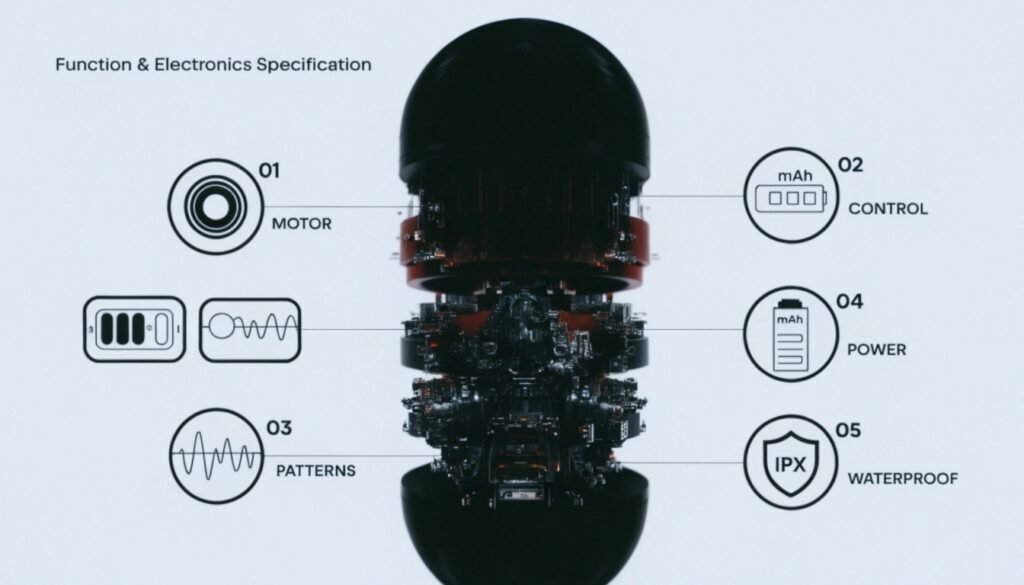
⚙️ Section 4 Template — Function and Electronics
4.1 — Motor Configuration
| Field | Specification |
|---|---|
| Number of motors | [1 / 2 / other] |
| Motor location(s) | [E.g., "one at tip, one at base"] |
| Desired vibration intensity (max) | [High / Medium-high — or specify amplitude if known] |
| Noise level target | [E.g., Below 50dB measured at 30cm / No noise requirement] |
| Vibration type | [Standard vibrating / suction/air pulse / thrusting / combination] |
4.2 — Control Interface
| Field | Specification |
|---|---|
| Number of buttons | [E.g., 1 / 2 / 3] |
| Button location | [E.g., "one power/mode button at base front"] |
| Power on/off logic | [E.g., "hold 2 seconds to power on; hold 3 seconds to power off"] |
| Mode cycling logic | [E.g., "press once to cycle to next mode; hold to return to mode 1"] |
| Travel lock function | Required / Not required |
| LED indicator | [None / charging indicator only / power status LED] |
4.3 — Vibration Patterns
List every pattern. Do not say "10 modes" — name and describe each one:
| Mode # | Pattern Type | Description |
|---|---|---|
| 1 | Steady | Continuous vibration, low intensity |
| 2 | Steady | Continuous vibration, medium intensity |
| 3 | Steady | Continuous vibration, high intensity |
| 4 | Pulse | Slow rhythmic pulse |
| 5 | Pulse | Fast rhythmic pulse |
| 6 | Escalation | Builds from low to high over 5 seconds, holds, repeats |
| 7 | Wave | Alternating low-high-low pattern |
| 8 | Stutter | Short rapid burst pulses |
| 9 | Random | Pseudo-random variation |
| 10 | Custom | [Specify or leave as factory standard] |
💡 Sally's tip: If you are basing this on an existing factory product, ask for a mode description sheet for that model — most factories have this for their active SKUs. At VF Pleasure, we can provide mode maps for any product in our vibrator range to help clients brief their customisation accurately.
4.4 — Power System
| Field | Specification |
|---|---|
| Battery chemistry | Lithium-ion / Lithium-polymer |
| Battery capacity (mAh) | [E.g., 500mAh / 800mAh] |
| Target run time (high intensity) | [E.g., 60 minutes minimum] |
| Target charge time | [E.g., 90 minutes maximum] |
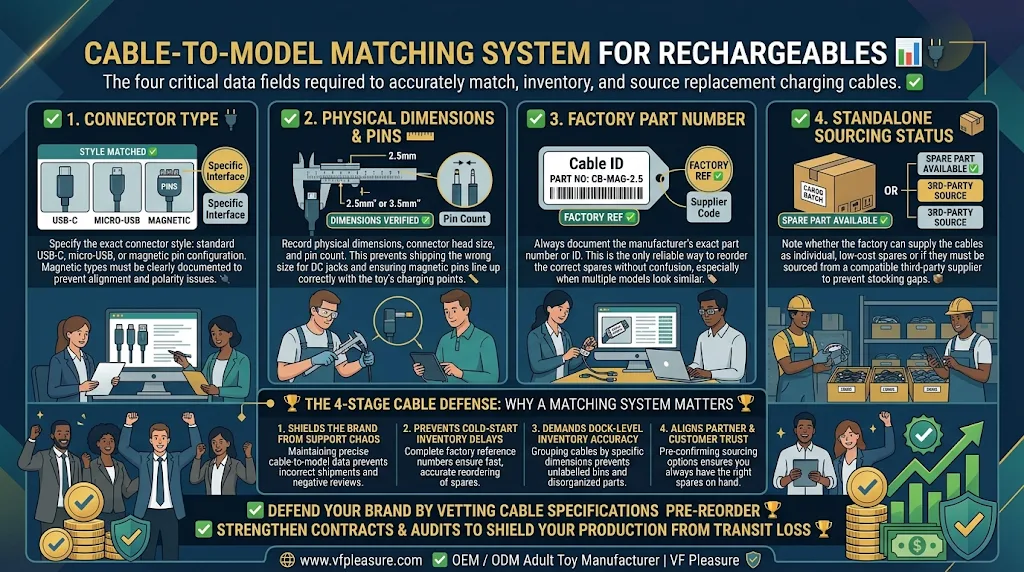
| Charge interface type | USB-C / USB-A micro / Magnetic 2-pin |
| Dust cap required? | Yes / No (required if USB-C for waterproofing) |
| Charge cable included in box? | Yes — specify type / No |
4.5 — Waterproofing
| Field | Specification |
|---|---|
| IPX rating required | IPX6 / IPX7 / Not required |
| Test method | Static submersion / Pre-use simulation (submersion after 10 insertion/removal cycles) |
| Test documentation required | Yes — from named accredited laboratory |
Section 5: In-Box Accessories and Labelling
The accessories section defines everything that goes into the retail box alongside the product. This section is not optional — missing or vague accessory specifications produce samples that arrive with wrong cable types, missing manuals, or no storage pouch when you planned for one.
The in-box accessories section must list every item that will be in the retail box as an explicit inventory — not "accessories as appropriate" but a named list with one line per item and a specification for each. For a rechargeable vibrator, the standard items are the product unit, charging cable, user manual, and any optional add-ons. Each item must be specified fully enough that the factory can confirm it without asking a follow-up question.6
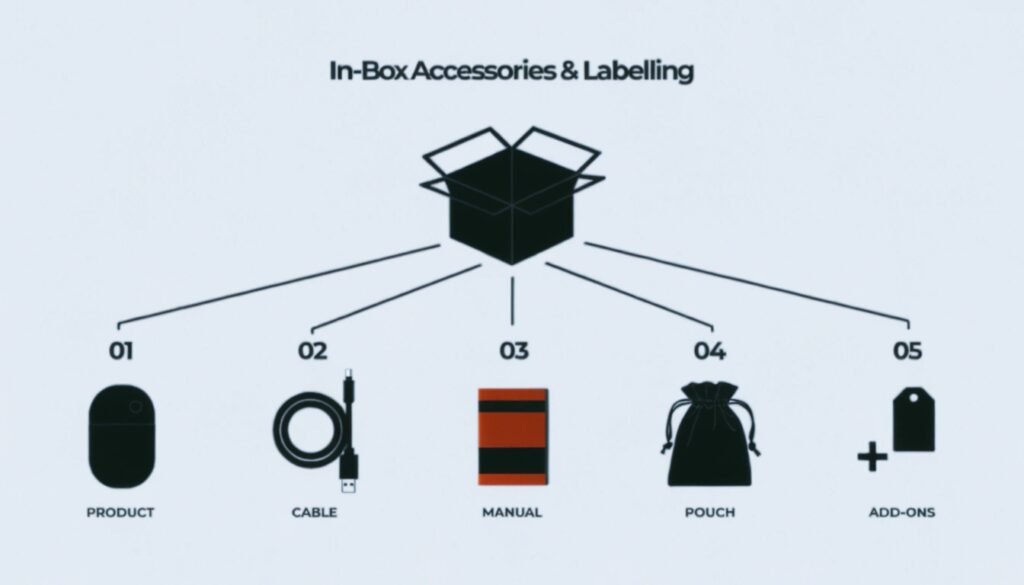
📦 Section 5 Template — In-Box Accessories
| Item | Included? | Specification |
|---|---|---|
| Product unit | Yes | As specified in Sections 2–4 |
| Charging cable | Yes / No | Type: USB-C to USB-A / Length: 80cm / Colour: Black |
| User manual | Yes | Languages: English + [specify]; format: folded A6 card |
| Warranty/guarantee card | Yes / No | Period: [X months]; brand contact: [specify] |
| Storage pouch | Yes / No | Material: Satin / Cotton; colour: [specify]; dimensions: [approx.] |
| Protective film on product | Yes / No | Thin film over body surface at time of boxing |
| Product wrapped within box | Yes / No | Tissue paper / Satin wrap / None |
| Brand insert card | Yes / No | Specify if included; provide artwork file separately |
5.1 — Labelling Requirements
| Label | Required? | Specification |
|---|---|---|
| Retail box barcode | Yes | UPC-A [number] / EAN-13 [number] |
| FNSKU label (Amazon FBA) | Yes / No | [Provide label file if required] |
| Batch/lot code on box | Yes | Format: [specify or confirm factory assigns] |
| Country of origin | Yes | "Made in China" on box base |
| Material claim on box | Yes | "Food-grade silicone" — not medical-grade |
Section 6: Packaging Specification
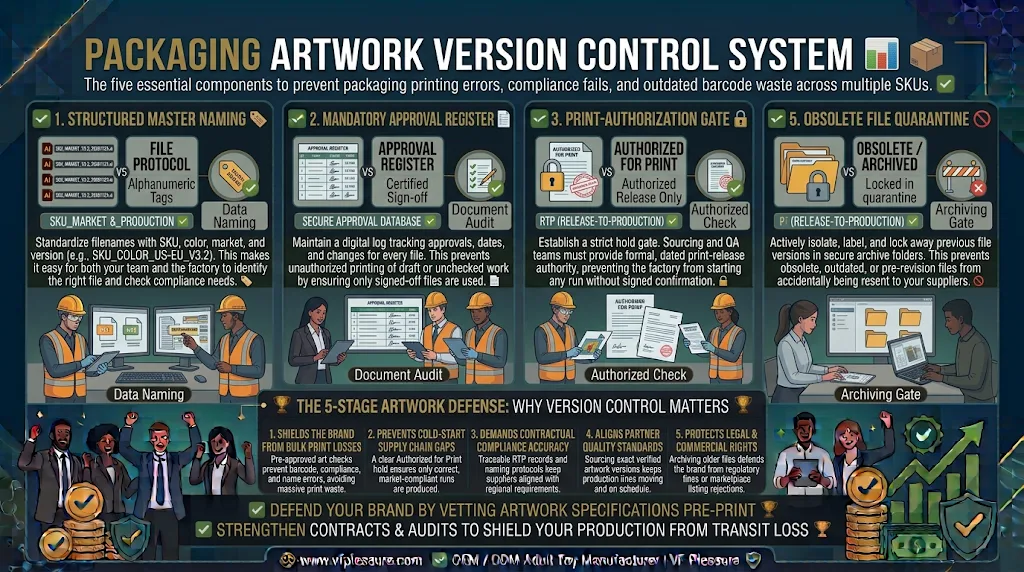
Packaging specification in the tech pack is the brief for the physical box — dimensions, structure, finish, and printing requirements. This is distinct from the artwork file (which is covered in packaging artwork management) — the tech pack describes the physical box specification that the artwork will be applied to.
Packaging specification in a tech pack covers the structural packaging brief — not the artwork. It specifies the box type, dimensions, board grade, surface finish, closure mechanism, insert type, and any special treatment (embossing, foiling, spot UV). These fields must be confirmed before artwork is designed, because the artwork must be built to the confirmed box die-line.7
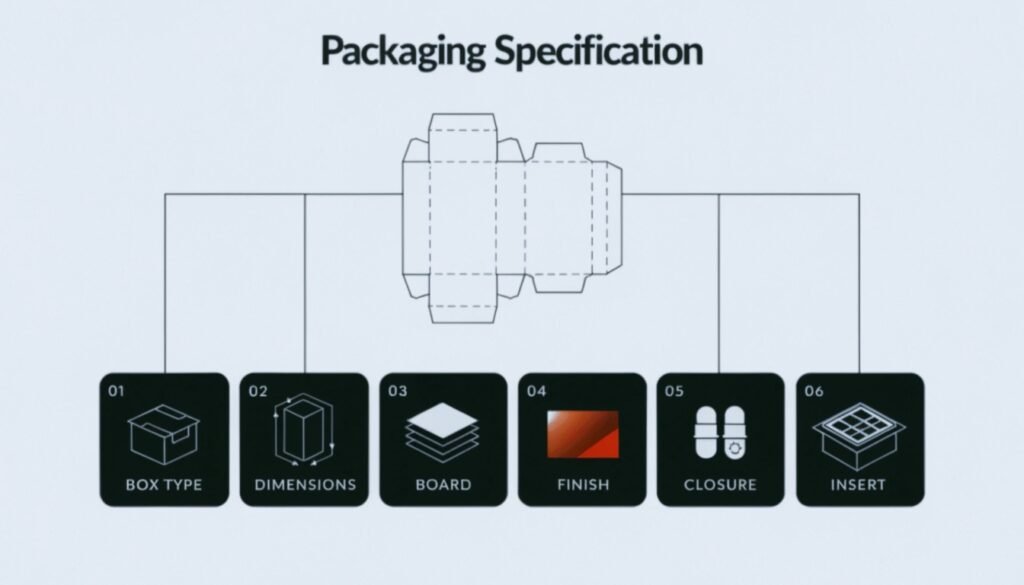
📦 Section 6 Template — Packaging Specification
6.1 — Retail Box Structure
| Field | Specification |
|---|---|
| Box type | Rigid telescoping box / Folding carton / Sleeve and tray / Magnetic closure box |
| Box dimensions (L × W × H) | [X × X × X mm — or "factory to suggest based on product dimensions"] |
| Board grade | 350gsm (folding carton) / 2mm greyboard (rigid) |
| Outer surface finish | Matte laminate / Gloss laminate / Soft-touch laminate |
| Special treatment | None / Spot UV on logo / Foil stamp / Embossed brand name |
| Closure mechanism (if applicable) | Magnetic closure / Ribbon pull / Tuck flap |
6.2 — Insert / Product Holder
| Field | Specification |
|---|---|
| Insert type | Foam cut-out / Pulp tray / Vacuum-formed tray / No insert (product free in box) |
| Insert material | EVA foam / Paper pulp / PET |
| Insert colour | Match box interior / Black / Custom |
6.3 — Discreet Packaging
| Field | Specification |
|---|---|
| Discreet outer box? | Yes — no explicit product description on exterior |
| Plain outer carton for shipping? | Yes / No |
Section 7: Approval Responsibility Assignment
The last section of the tech pack is the most operationally important — it defines who is authorised to approve each stage of development, what constitutes approval, and what happens if the factory needs to deviate from a specification during prototype production.
Approval responsibility assignment in a tech pack must name a specific person for each of three approval decisions: physical prototype approval (confirming the prototype's shape, feel, and function match the specification), material approval (confirming the food-grade silicone colour, hardness, and surface treatment match the brief), and packaging sample approval. Each named approver must provide written confirmation — not verbal — before the factory proceeds to the next stage.8
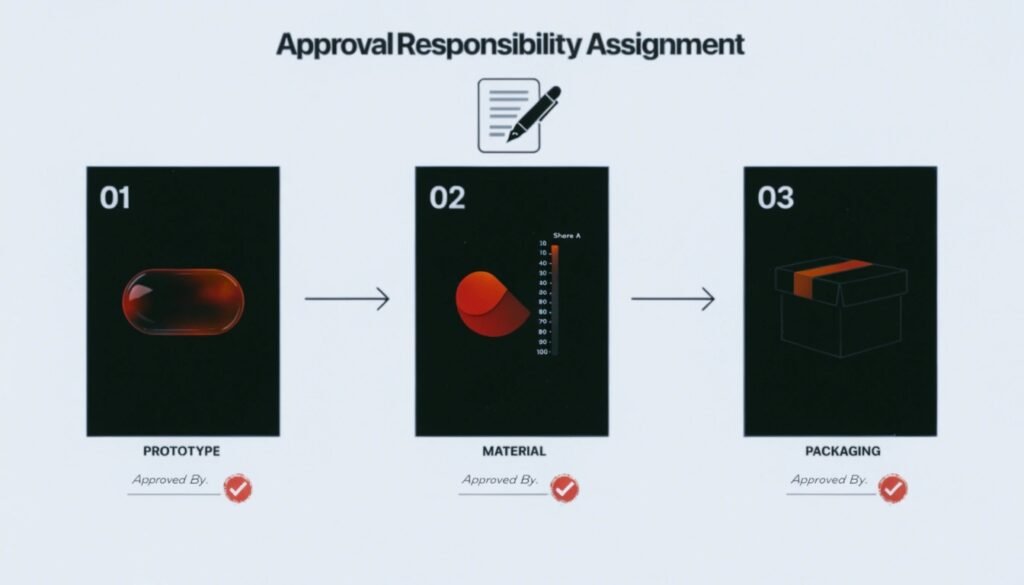
📋 Section 7 Template — Approval Assignment
| Approval Stage | Approver Name | Approver Role | Approval Method | Timeline |
|---|---|---|---|---|
| Concept sketch / 3D render | [Name] | [Role] | Email confirmation | Before mold cutting |
| Physical prototype — shape and function | [Name] | [Role] | Email + written sign-off | Within 5 days of sample receipt |
| Silicone material sample (colour and hardness) | [Name] | [Role] | Physical swatch + written confirmation | Before production |
| Packaging structural sample | [Name] | [Role] | Physical sample + written confirmation | Before print run |
| Pre-production sample (full assembled unit) | [Name] | [Role] | Email + written sign-off | Before mass production |
7.1 — Deviation Protocol
Include this statement in the tech pack:
"If the factory identifies any specification in this tech pack that cannot be achieved within the stated tolerance, the factory must notify [name, email] in writing within 3 business days of prototype production beginning. The factory must not proceed with an out-of-specification item without written approval of the deviation from [name]. No deviation is considered approved until written confirmation is received."
7.2 — Change Protocol
"Any change to any field in this tech pack must be documented as a new version. The factory must not act on verbal or messaging-app instructions to change a specification — all changes must be confirmed in an updated tech pack document with an incremented version number."
The Tech Pack Submission Checklist
Before you send the tech pack to your factory, run through this checklist to confirm it is ready for a first-round accurate quote and prototype.
✅ Tech Pack Submission Checklist
Section 1 — Identification
- ☐ Unique product code assigned
- ☐ Version number stated (v1.0 for first submission)
- ☐ Approver name and role completed
Section 2 — Physical Geometry
- ☐ All dimensions stated in mm with ±tolerance
- ☐ No descriptive language used without an accompanying measured value
- ☐ Surface zones defined
Section 3 — Material Specification
- ☐ Silicone specified as "food-grade platinum silicone" — not medical-grade
- ☐ Shore A hardness specified per zone
- ☐ Colour references are Pantone codes or physical swatches — not colour names
- ☐ Surface finish specified per zone
Section 4 — Function and Electronics
- ☐ Motor count and location specified
- ☐ All vibration patterns listed by type and description
- ☐ Battery capacity and charge interface type specified
- ☐ IPX rating and test method specified
Section 5 — Accessories
- ☐ Every in-box item listed explicitly
- ☐ Charging cable type and length specified
- ☐ User manual language confirmed
- ☐ Barcode numbers provided
Section 6 — Packaging
- ☐ Box type and board grade specified
- ☐ Surface finish and special treatment specified
- ☐ Discreet packaging requirement confirmed
Section 7 — Approvals
- ☐ Named approvers assigned for each stage
- ☐ Deviation protocol included
- ☐ Change protocol included
Conclusion
A complete tech pack does not make product development complicated. It makes it predictable. The factory receives unambiguous instructions, quotes accurately on the first attempt, and builds the prototype that matches your specification — not their interpretation of it. VF Pleasure's prototype timeline is 7–10 days for functional sample production once a confirmed specification is received. The brief is what creates that speed.
🚀 Send Your Tech Pack to VF Pleasure — We Build to Your Specification
At VF Pleasure, our R&D team accepts tech packs at the level of detail described in this guide — from complete engineering specifications through to simpler "based on existing model + customisations" briefs. We provide weekly video updates and physical samples via DHL. Our material library includes 50+ certified food-grade silicone options across hardness grades and colour references.
Our development process supports:
- ✅ Full OEM development from your tech pack — concept finalization, 3D modeling, prototyping, feedback loop
- ✅ Food-grade platinum silicone — 50+ options by hardness and colour, CE, RoHS, and food-grade certified per batch
- ✅ 3 free samples — you cover shipping (~$39), we cover sample production, to evaluate material and function before production commitment
- ✅ Full product range — vibrators, female sex toys, couples toys, thrusting toys, male adult toys, and private label programs
- ✅ IP protection — NDA and mold ownership documentation as standard for OEM development projects
📬 Submit Your Tech Pack — Or Start With These Three Questions:
1. Are you starting from a completely new design (OEM) or adapting an existing factory design (private label)?
(If you are adapting an existing design, share the factory model number and I will send you the base specification to modify — cutting your tech pack preparation time by 60%)2. What is your target retail price point — and therefore your target per-unit cost?
(This tells me which food-grade silicone grade, motor system, and packaging structure to recommend for your budget)3. Which market is this product launching into first?
(US, EU, UK, or AU — each has different compliance documentation requirements that affect the packaging spec in Section 6)👉 Submit Your Tech Pack or Request a Development Brief Template from VF Pleasure →
References & Source Notes
-
VF Pleasure — Custom Adult Toy Manufacturing Guide
| Field | Detail |
|---|---|
| 📌 Supports | A complete tech pack converts a product vision into unambiguous manufacturing instructions across seven sections. VF Pleasure's R&D process includes concept finalization (5–7 days), 3D modeling (3–5 days), functional prototyping (7–10 days), and feedback loop (3–5 days) — a timeline that depends on receiving a complete specification. VF Pleasure streamlines OEM development through their OEM service portal with weekly video updates and physical samples via DHL. |
| 🔍 Evidence Role | Definition + General Support |
| 📁 Source Type | Industry Guide |
⚠️ Scope Note: Tech pack structure described is a general framework based on adult toy product development best practice. Individual factories may have different information requirements or preferred brief formats. Confirm your factory's specific brief requirements before finalising your tech pack structure. VF Pleasure's R&D timeline assumes a complete specification — partial briefs will extend the timeline.
-
VF Pleasure — Private Label Adult Products Development Process
| Field | Detail |
|---|---|
| 📌 Supports | Product identification data must include a unique product code, version number, creation date, responsible person, and change log. This protects against factory acting on a superseded brief or disputes about which version a prototype was built against. |
| 🔍 Evidence Role | Mechanism |
| 📁 Source Type | Industry Guide |
⚠️ Scope Note: Version numbering and document control recommendations reflect general product development best practice. For simple one-SKU developments with a single revision, a lightweight version record is sufficient. For complex multi-SKU developments with multiple revision rounds, a formal version control system is essential.
-
VF Pleasure — Adult Toy Manufacturing Challenges and Solutions
| Field | Detail |
|---|---|
| 📌 Supports | Physical geometry specification must state every critical dimension as a nominal value plus a tolerance — not a single number or a descriptive range. VF Pleasure's R&D team performs ergonomic testing during the 3D modeling stage and can flag when specified dimensions create structural or manufacturing challenges. |
| 🔍 Evidence Role | Mechanism |
| 📁 Source Type | Industry Guide |
⚠️ Scope Note: Tolerance recommendations (±3mm for overall length, ±1mm for diameter, ±0.5mm for tip dimensions) are general starting points. Tighter tolerances are achievable but increase tooling cost. The factory should confirm achievable tolerances for each dimension based on their specific manufacturing process before finalising the tech pack.
-
VF Pleasure — Body-Safe Adult Toys Manufacturing Standards Guide
| Field | Detail |
|---|---|
| 📌 Supports | Material specification must state food-grade silicone (not medical-grade) with Shore A hardness, Pantone colour reference, and surface finish per surface zone. VF Pleasure's material library includes 50+ certified food-grade silicone options. Food-grade platinum silicone is non-porous and hypoallergenic — the material standard for adult toy body-contact surfaces. |
| 🔍 Evidence Role | Definition |
| 📁 Source Type | Industry Guide |
⚠️ Scope Note: Shore A hardness values described (25 for very soft, 35 for medium-firm) are general reference ranges. Available hardness options vary by silicone grade and factory formulation. Confirm available Shore A options for the specific colour and certification required with your factory before finalising the material specification.
-
VF Pleasure — Sex Toy Manufacturing Process Guide
| Field | Detail |
|---|---|
| 📌 Supports | Function specification must define motor configuration, control interface, vibration patterns (by type and description), power system (battery chemistry, capacity, charge interface), and waterproofing standard (IPX rating and test method). VF Pleasure uses IPX7 chambers for waterproof validation and simulates real-use conditions during testing. |
| 🔍 Evidence Role | Mechanism |
| 📁 Source Type | Industry Guide |
⚠️ Scope Note: Mode descriptions should be confirmed with the factory during concept finalization — some pattern types (escalation sequences, random algorithms) may be achievable only within certain motor and chip configurations. Confirm feasibility of all specified patterns before the brief is finalised.
-
VF Pleasure — Private Label Sex Toys Business Guide
| Field | Detail |
|---|---|
| 📌 Supports | In-box accessories must be listed as an explicit inventory — one line per item with a full specification. VF Pleasure provides custom packaging solutions including eco-friendly materials, luxury gift boxes, and discreet minimalist designs as part of private label programs. |
| 🔍 Evidence Role | General Support |
| 📁 Source Type | Industry Guide |
⚠️ Scope Note: Accessory specifications should be confirmed with the factory for feasibility and cost implications — some items (satin pouches, rigid inserts) carry incremental per-unit costs that affect the final product pricing. Confirm accessory availability and pricing during the initial brief review before finalising the tech pack.
-
VF Pleasure — Wholesale Private Label Adult Products Guide 2025
| Field | Detail |
|---|---|
| 📌 Supports | Packaging specification in the tech pack covers the structural brief — box type, dimensions, board grade, finish, closure mechanism, and insert type. VF Pleasure offers multiple packaging structure options across eco-friendly, luxury, and discreet minimalist designs. The die-line must be confirmed before artwork is commissioned. |
| 🔍 Evidence Role | Mechanism |
| 📁 Source Type | Industry Guide |
⚠️ Scope Note: Packaging type and board grade recommendations carry significant cost variation. Rigid magnetic closure boxes cost considerably more per unit than folding cartons. Confirm packaging cost implications for each structural option with your factory during brief review to ensure the packaging specification fits your target unit economics.
-
VF Pleasure — Adult Toy Manufacturer Partnership Strategies
| Field | Detail |
|---|---|
| 📌 Supports | Approval responsibility must assign a named person to each approval stage — prototype, material, and packaging — with written confirmation required before proceeding. The deviation protocol and change protocol protect against undocumented factory-side modifications and ensure all changes are reflected in an updated tech pack version. |
| 🔍 Evidence Role | Mechanism |
| 📁 Source Type | Industry Guide |
⚠️ Scope Note: Approval timeline recommendations (5 days for prototype review, 3 days for deviation notification) are general targets. Adjust timelines based on your internal decision-making process and the factory's production schedule. The critical requirement is that written approval is received before the factory proceeds — the specific timeline is secondary to the written confirmation requirement.