Skip to content

A customer emails you on a Saturday. Their vibrator stopped charging after three weeks. They want a replacement. You issue the replacement — and then you stare at the 47 other customer returns from the same batch sitting in your warehouse and realise you have no documented process for taking this back to your factory. No claim number. No fault evidence package. No written record that this conversation ever happened. By the time you contact the factory on Monday, two things are already working against you: time, and the absence of the specific evidence they will need to accept liability.
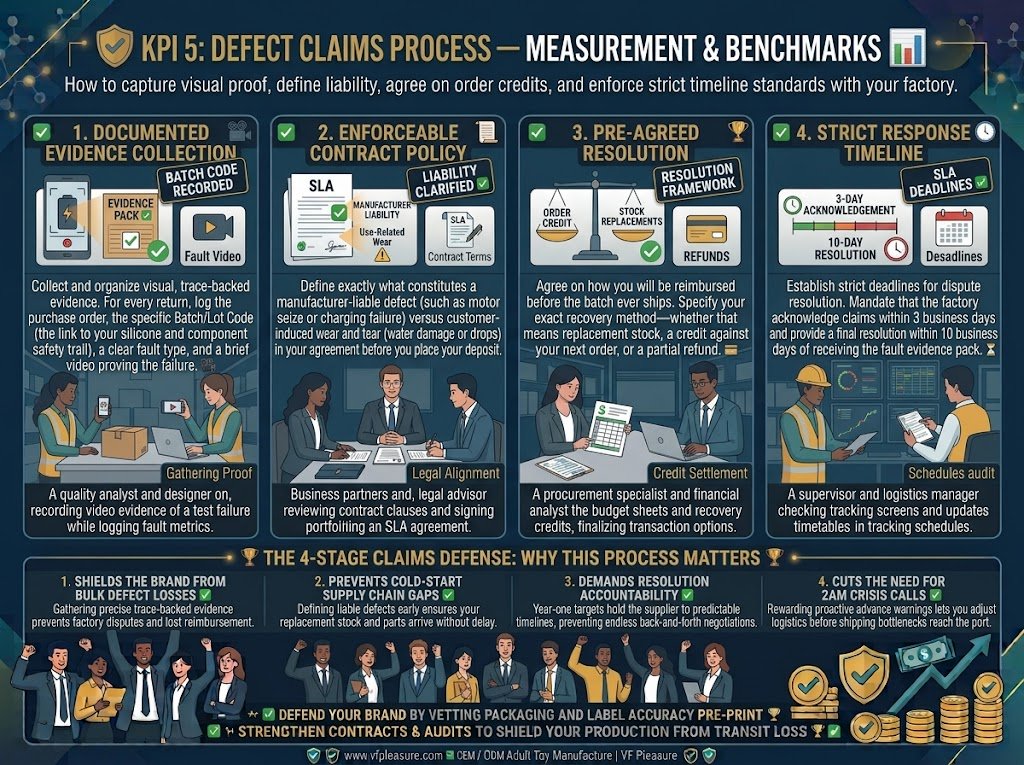
Setting up a supplier claims process for private label adult toy defects requires three things before a single defect reaches the factory: a documented evidence collection procedure that captures order number, batch code, fault type, and visual proof; a written claims policy in your manufacturing agreement that defines what constitutes a manufacturer-liable defect versus a use-related issue; and a resolution framework that specifies whether your remedy is replacement stock, a credit against the next order, or a partial refund — and the timeline within which the factory must respond.1
I'm Sally. I run VF Pleasure — a direct adult toys factory in Dongguan, China, with 15+ years of B2B manufacturing experience. I have processed claims from the factory side. I know exactly what evidence a factory needs to evaluate a defect claim responsibly — and I know what evidence packages are so incomplete that no professional factory can action them, regardless of how justified the complaint is.
This guide covers the full B2B claims process for post-sale product defects: the evidence you need, the claim document structure, how to distinguish manufacturer-liable faults from use-related ones, and what "resolution" looks like in practice when both parties are acting in good faith.
⚠️ Important note: Supplier claims policies vary between factories. The framework in this article reflects standard industry practice for B2B wholesale relationships. Confirm the specific claims terms, evidence requirements, and remedies with your factory in writing before any defect event occurs — not after.
- 1 Why Does a Claims Process Need to Exist Before Defects Do?
- 2 What Evidence Package Does Your Factory Need to Evaluate a Defect Claim?
- 3 How Do You Distinguish a Manufacturer-Liable Defect from a Use-Related Issue?
- 4 How Do You Structure the Formal Claim Document?
- 5 What Resolution Options Are Available — and How Do You Negotiate Them?
- 6 How Do You Negotiate When the Factory Disputes Liability?
- 7 How Do You Build This Into Your Manufacturing Agreement Before the First Order?
- 8 Conclusion
- 9 References & Source Notes
Why Does a Claims Process Need to Exist Before Defects Do?
The most expensive time to design a claims process is after a defect wave hits. At that point, you are managing three problems simultaneously: the customer relationship problem, the inventory problem, and the factory conversation problem. Trying to negotiate a claims framework while all three are active means the factory is negotiating from a position of relative strength — you need a resolution now, and they know it.
A claims process needs to exist before defects occur because the evidence required to support a valid factory claim must be collected at the point of the defect report — not retroactively. A customer who reports a charging fault today has the information your factory needs: the purchase date, the fault description, and potentially photographic evidence. That information is most accessible today. Three weeks later, after you have issued a replacement and moved on, the evidence chain is incomplete and your claim weakens.1
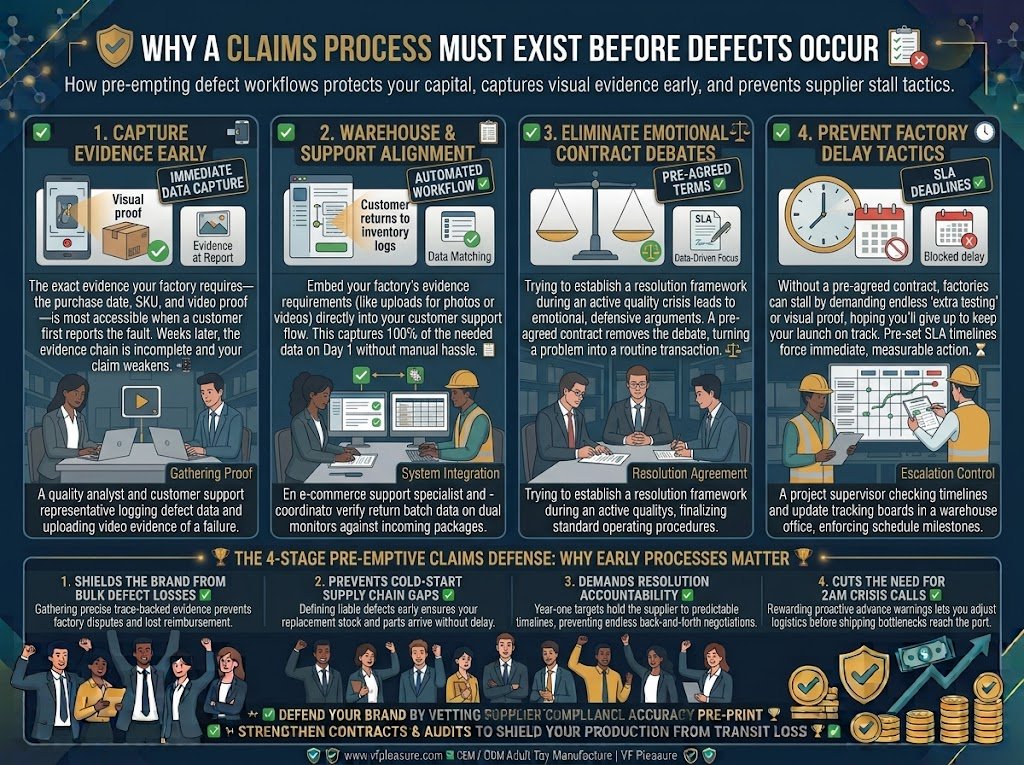
Here is what a retroactively assembled claim typically looks like versus a proactively built one — and why the difference matters.
📊 Proactive vs Retroactive Claim Evidence Quality
| Element | Collected at Point of Report | Collected 4 Weeks Later |
|---|---|---|
| Customer purchase date | Available from order record | Usually available |
| Batch code from packaging | Customer has product in hand | Customer may have disposed of packaging |
| Fault description detail | Customer can describe exactly what failed | Memory is imprecise; details are lost |
| Photographic/video evidence | Customer can provide video of the fault | Customer may have discarded the unit |
| Complaint volume pattern | Visible as reports accumulate | Pattern unclear; timing uncertain |
| Product in customer's possession | Yes — can be returned if needed | Likely discarded or unavailable |
The batch code is the element most often missing from retroactively assembled claims — and it is the most important single piece of evidence for the factory. Without it, the factory cannot trace the defective units to a specific production run, cannot retrieve the QC data for that run, and cannot confirm whether the fault was present at the production stage or developed post-shipment.
Our adult toy manufacturing challenges and solutions guide documents how production problems are tracked, identified, and resolved at the factory level — the same traceability infrastructure that a well-documented claim taps into.
What Evidence Package Does Your Factory Need to Evaluate a Defect Claim?
Different factories have different specific requirements — but the core evidence needed to evaluate any post-sale defect claim follows a consistent logic: the factory needs to be able to identify the specific production batch, verify the defect type against the QC records for that batch, and assess whether the fault pattern is consistent with a manufacturing failure or a post-sale usage scenario.
A complete defect claim evidence package for a private label adult toy must include six elements: the purchase order number from your original order with the factory, the batch or lot code from the product packaging, the specific fault type described in technical terms (not "it stopped working"), photographic or video evidence of the defect, the number of units affected and the percentage of the batch that figure represents, and the date range during which the defects were reported.2
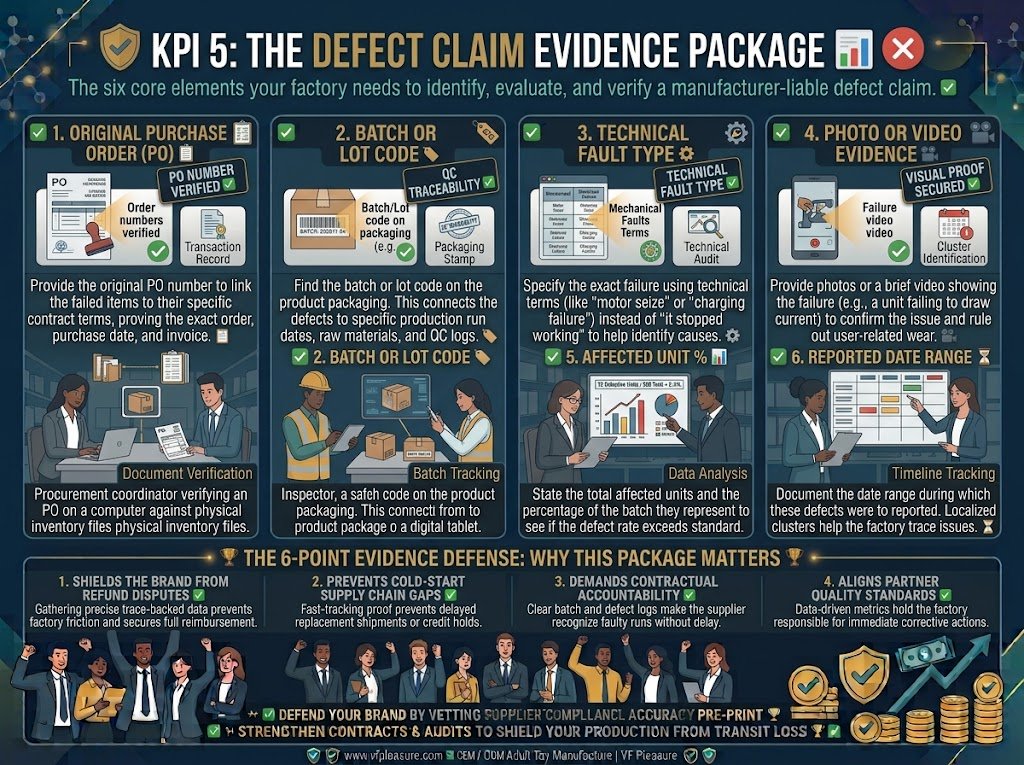
Here is each element — what it contains, why the factory needs it, and how to collect it efficiently.
📋 Evidence Element 1 — Purchase Order Number
Your factory's internal tracking starts with your PO number. It links to the specific production batch, the QC records from that batch, the components used, and the production timeline. Without the PO number, the factory cannot begin tracing the issue.
How to collect: Pull from your order records. If you have multiple orders with this factory, confirm which PO the defective units came from by matching the batch code on the product to the batch codes referenced in your packing list.
📋 Evidence Element 2 — Batch or Lot Code
The batch code is the most critical piece of traceability data in any defect claim. It tells the factory exactly which production run produced the defective units — which allows them to retrieve the QC batch report for that run, check which raw materials were used, and identify whether the fault was present in the factory's own pre-shipment testing.
How to collect: The batch or lot code appears on the retail product box — typically on the bottom in small print as an alphanumeric string. Train your customer service team to request this from every customer reporting a fault, or include it as a required field in your returns/complaint form.
What if the customer has discarded the packaging? For customers who cannot provide a batch code, you may still be able to identify the batch from your sales records — if you track which batch each customer order was fulfilled from. This requires maintaining batch-level inventory records.
What it tells the factory: Food-grade platinum silicone manufacturing at a professional adult toy facility involves per-batch compliance certificates. The batch code links the defective units to these certificates, the production QC records, and the raw material documentation — this is the traceability chain that makes a claim evaluable.
📋 Evidence Element 3 — Fault Type in Technical Terms
"It stopped working" is not a fault description. "The product powers on but the charging indicator light does not illuminate when the USB-C cable is connected, and the battery depletes within 20 minutes of use despite a full overnight charge" is a fault description.
Why it matters: A charging fault, a motor failure, a silicone surface issue, and a waterproof failure each have different root causes, different production-stage indicators, and different remediation paths. The factory's engineering team needs to know what specifically failed to determine whether it is consistent with a manufacturing defect, a component batch issue, or a post-sale use pattern.
Common fault type categories for adult toys:
| Fault Category | Specific Description Examples |
|---|---|
| Charging failure | Does not charge / charges intermittently / battery drains unusually fast |
| Motor/vibration failure | No vibration / specific modes not functioning / vibration weaker than approved sample |
| Waterproofing failure | Water ingress after submersion / moisture inside unit |
| Silicone surface issue | Colour change / texture change / tackiness / surface marks |
| Structural failure | Component separation / button not functioning / charging port damage |
📋 Evidence Element 4 — Photographic or Video Evidence
For every claim above a single unit, photographic or video evidence is the document that converts a customer complaint into verifiable evidence.
What to request from customers:
- A video showing the fault occurring (charging failure, motor not activating)
- A photograph showing the fault condition (silicone surface issue, structural damage)
- A photograph of the batch code label on the packaging (or the unit bottom if the code appears there)
Format: Standard smartphone photos and videos are sufficient. File them by batch code and fault type in your claims management system.
📋 Evidence Element 5 — Affected Unit Count and Batch Percentage
Provide both the number of affected units and what percentage of the total batch those units represent. If 15 units failed out of a 300-unit batch from PO-2024-047, state both figures.
Why percentage matters: A 5% failure rate on a 300-unit batch (15 units) has different implications from a 5% failure rate on a 1,000-unit batch (50 units). The factory needs to assess whether the failure pattern is consistent with normal AQL statistical variation or whether it represents a systemic issue that may affect more units currently in your inventory or in transit.
📋 Evidence Element 6 — Defect Report Date Range
Record the earliest and latest date on which the defects were reported. A cluster of reports in a single week suggests a batch issue. Reports spread over several months suggest either intermittent use patterns or multiple sources.
This is the most contentious part of any defect claim — and the part most likely to produce a stalled conversation if not addressed systematically. Not every product failure is a manufacturing defect. Understanding the difference, being able to document it, and being able to discuss it professionally with your factory is the difference between a productive claim conversation and a defensive one.
Manufacturer-liable defects in adult toys are failures that occur under normal use conditions within a reasonable product lifespan, where the failure mode is consistent with a manufacturing process defect rather than physical abuse, misuse, or normal wear. Charging connection failures within 30 days, waterproofing failures under IPX-rated submersion conditions, motor failures under normal vibration use cycles, and silicone surface failures where food-grade silicone standards were not maintained are all manufacturer-liable categories.3
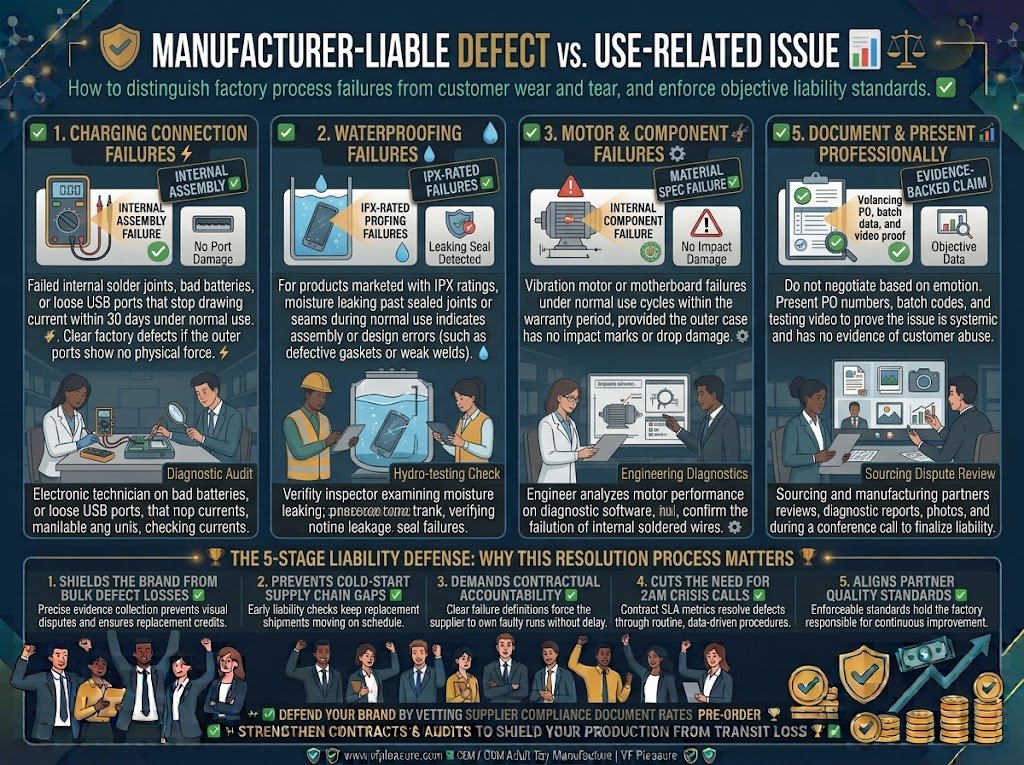
Here is the framework — with specific examples in each category and the evidence that distinguishes one from the other.
⚖️ Manufacturer-Liable vs Use-Related Defect Framework
| Defect Type | Manufacturer-Liable Indicator | Use-Related or Excluded Indicator |
|---|---|---|
| Charging failure | Fails within 30 days / consistent with DC pin geometry case | Water ingress into charging port from non-waterproof submersion |
| Waterproofing failure | Fails under IPX-rated conditions / pattern matches other units from same batch | Submerged beyond rated depth or duration / dropped impact before use |
| Motor failure | No vibration on first use / all modes affected equally | Single mode failure after extended high-intensity use |
| Silicone surface change | Colour change inconsistent with approved sample / tackiness at standard temperature | Deterioration after contact with silicone-incompatible lubricants |
| Structural failure | Component separation without force application | Component separation with visible impact damage |
The food-grade silicone standard is particularly important in the silicone surface category. At VF Pleasure, food-grade platinum silicone is the manufacturing baseline for all body-contact surfaces. A genuine food-grade silicone product should not show surface degradation under normal use conditions. If a brand discovers that a silicone surface has degraded in a way inconsistent with food-grade quality, this is potentially a material specification failure — and the per-batch food-grade silicone test report is the document that either confirms or challenges the factory's material standard for that run.
📏 The 30/90/180 Day Timeframe Framework
Different defect categories have different reasonable claim windows:
| Defect Category | Reasonable Claim Window | Rationale |
|---|---|---|
| DOA (Dead on arrival) / first-use failure | 30 days from sale | Should have been caught by QC; immediate use reveals manufacturing gap |
| Early life failure (charging, motor) | 90 days from sale | Normal failure modes under reasonable use; manufacturing quality issue |
| Mid-life failure (waterproofing, structure) | 180 days from sale | Engineering design or assembly quality issue |
| Silicone surface compliance | 90 days from sale | Material quality issue; should be stable under normal use |
These are reference frames based on general adult toy industry practice — your specific claims window should be negotiated with your factory in writing before the relationship begins, not at the point of a claim.
How Do You Structure the Formal Claim Document?
A verbal complaint to your factory contact is not a claim. A WhatsApp message with a customer screenshot is not a claim. A formal defect claim is a structured written document that the factory can route to its engineering team, reference against production records, and use as the basis for a formal response. The difference between a verbal complaint and a formal claim document is the difference between a conversation and a process.
A formal defect claim document for a private label sex toy supplier must include: a unique claim reference number you assign for tracking; the factory's order number and batch code; the fault category and description; the affected unit count and percentage; the date range of reports; the evidence files attached or linked; your proposed resolution; and a response deadline. It should be submitted by email — not WeChat — so there is a permanent written record.4
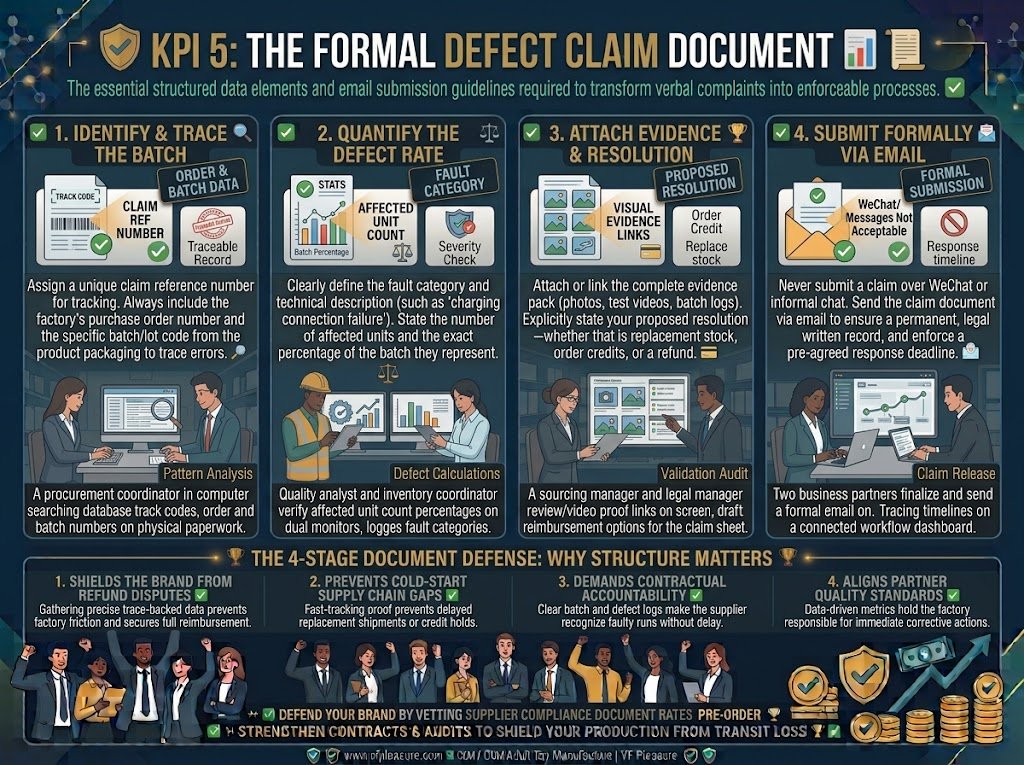
Here is the claim document template — ready to use with your factory.
📝 Defect Claim Document Template
DEFECT CLAIM NOTICE
Claim Reference: [YOUR BRAND]-CLAIM-[YEAR]-[SEQUENTIAL NUMBER]
Date Submitted: [DATE]
Submitted By: [YOUR NAME AND COMPANY]
Section 1 — Order Information
- Factory Order / PO Number: [PO NUMBER]
- Product SKU / Model Number: [SKU]
- Production Batch Code: [BATCH CODE FROM PACKAGING]
- Original Delivery Date: [DATE GOODS RECEIVED]
Section 2 — Fault Description
- Fault Category: [Charging / Motor / Waterproofing / Silicone Surface / Structural]
- Detailed Fault Description: [Specific technical description of what fails, when it fails, under what conditions]
- Failure Rate: [X units affected out of Y total units from this batch = Z%]
- Defect Report Date Range: [First report date] to [Most recent report date]
Section 3 — Evidence Attached
- [ ] Video evidence (link or attachment)
- [ ] Photographic evidence (attached)
- [ ] Customer complaint log excerpt (attached)
- [ ] Batch code photograph (attached)
- [ ] Returned unit(s) available for inspection: Yes / No
Section 4 — Proposed Resolution
We are requesting the following resolution option (select one or propose combination):
- [ ] Replacement stock: [X units] shipped with next order at no cost
- [ ] Credit note: [$ value = X units × per-unit price] applied against next order
- [ ] Partial refund: [$ value] within [X] business days
- [ ] Other: [Specify]
Section 5 — Response Deadline
We request your written acknowledgement and initial response to this claim within [5 business days] of this notice.
💡 Why email, not WeChat: Email creates a timestamped, searchable, persistent record that can be referenced months later. WeChat message histories are device-dependent and not reliably recoverable if a phone is lost or changed. Every formal claim, every factory acknowledgement, and every resolution agreement should exist in email — with your factory contact's email address, not just a messaging app username.
What Resolution Options Are Available — and How Do You Negotiate Them?
The resolution conversation is where claims processes most often stall — because the brand wants full replacement, the factory wants to minimise exposure, and neither party has a framework for a fair settlement in advance.
The three primary resolution options for a post-sale B2B defect claim on a private label adult toy are: replacement stock (the factory ships a quantity of units equal to the defective quantity on the next order at no cost), credit note (a dollar value equal to the defective units is deducted from the next order invoice), and partial refund (a cash value is returned to cover the defective units). Each option has different implications for cash flow, inventory timing, and the factory relationship — and the right choice depends on your specific situation.5
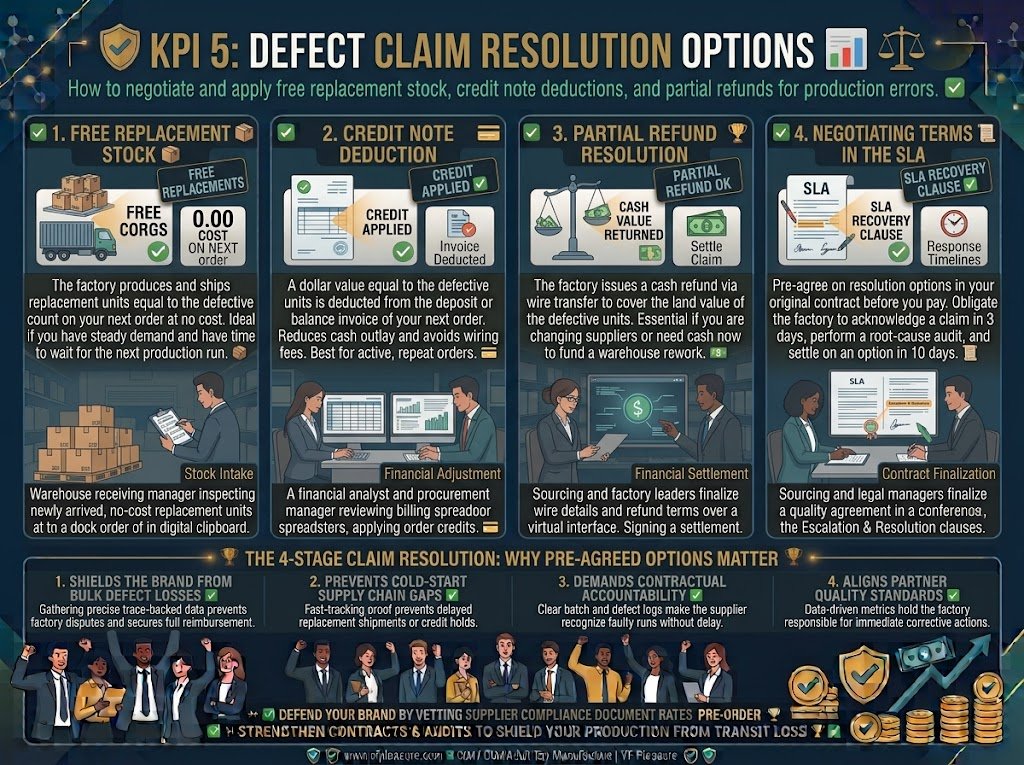
Here is each option — the circumstances where it is most appropriate and how to negotiate it.
💰 Resolution Option 1 — Replacement Stock
When it works best: You are planning a reorder, your defect rate is high but not catastrophic, and the factory accepts liability. Replacement units are added to your next order at no cost to you.
Negotiation approach: "We have confirmed [X] units from PO [number] with [fault type]. We are planning a reorder in [timeframe]. We are proposing that you include [X] replacement units in that reorder at no cost, in lieu of a cash settlement."
Advantages: No cash changes hands; factory absorbs the cost in production; relationship continues with minimal friction.
Disadvantages: You do not receive compensation until the next order arrives. If your defect rate is causing active customer service costs, replacement stock does not cover those costs.
💰 Resolution Option 2 — Credit Note Against Next Order
When it works best: The defect rate is moderate, you plan to continue ordering, and you want a financial acknowledgement without cash flow disruption.
Negotiation approach: "We are claiming [X] units at [per-unit price] = [total value]. We propose this is applied as a credit against our next invoice rather than a cash refund."
Advantages: Keeps the financial relationship clean without requiring the factory to process an international bank transfer.
Disadvantages: Same as replacement stock — you carry the defect cost until the next order is placed.
💰 Resolution Option 3 — Partial Refund
When it works best: The defect rate is high enough to materially affect your business, you are not planning an immediate reorder, or the defects have caused significant downstream costs (customer refunds, shipping, platform fees) that cannot wait.
Negotiation approach: "The defect rate from this batch has resulted in [X customer refunds at Y each] and [Z in associated costs]. We are requesting a partial refund of [$ amount] within [30 days] to cover the cost of the defective units."
Advantages: Actual financial recovery without waiting for a next order.
Disadvantages: More friction in the relationship; may require factory to process an international bank transfer, which some Chinese factories prefer to avoid.
📊 Resolution Selection Guide
| Situation | Recommended Resolution |
|---|---|
| Defect rate 1–3%, planning reorder in <60 days | Credit note or replacement stock |
| Defect rate 1–3%, no reorder planned | Partial refund |
| Defect rate 3–8%, factory accepts full liability | Replacement stock + credit for associated costs |
| Defect rate >8%, systemic batch issue | Partial refund + corrective action plan + pre-shipment inspection on next order |
How Do You Negotiate When the Factory Disputes Liability?
A factory that disputes a defect claim is not automatically acting in bad faith. Disputed claims often reflect genuine ambiguity about whether the failure is manufacturing-caused or use-related. The professional response is to follow the evidence — and to have the evidence strong enough that the conversation is about the correct quantum of the remedy, not about whether a failure occurred at all.
When a factory disputes liability for a defect claim, your response should follow three steps: share the complete evidence package you assembled (not just a summary), request the factory's specific reason for disputing — citing their own QC batch records for the relevant batch code, and if the dispute cannot be resolved through factory-level dialogue, propose independent third-party testing of returned units through a named accredited laboratory.6
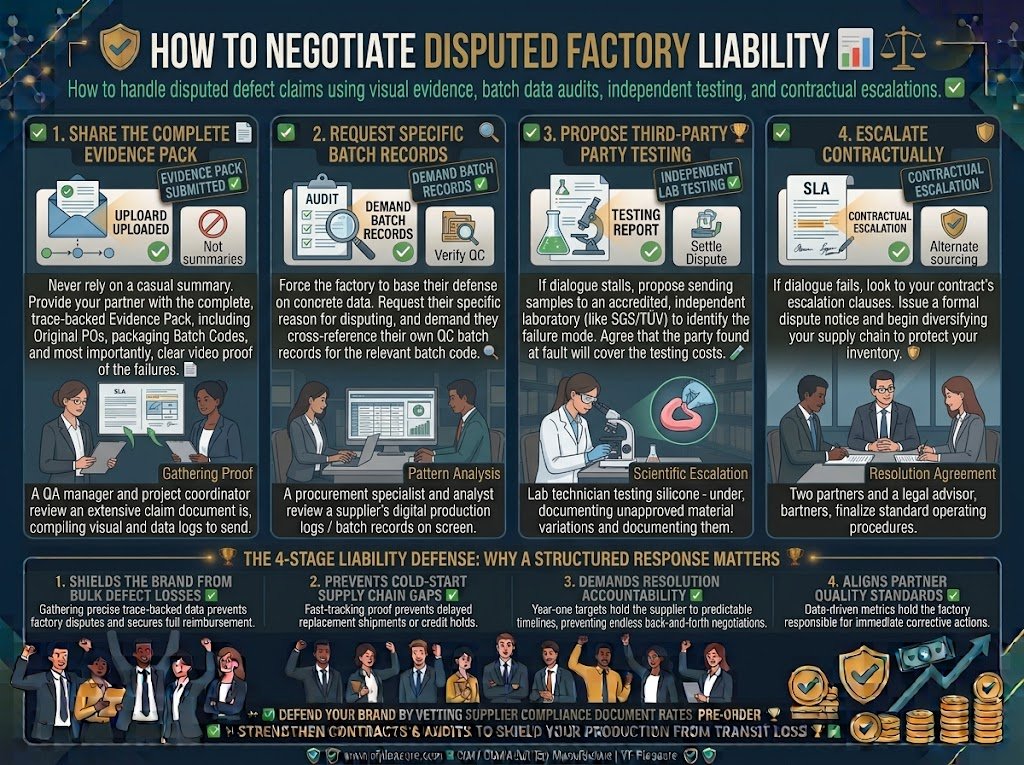
Here is the escalation sequence — with the specific language for each step.
📨 Step 1 — Submit the Full Evidence Package
Many initial factory responses to defect claims are based on incomplete information — the factory contact has received a verbal complaint without the batch code, evidence files, or unit count data needed to involve their QC team. Submit the formal claim document template above before having a phone or WeChat conversation about the claim.
"Please find our formal defect claim [Claim Reference] attached, including order number, batch code, fault description, unit count, and photographic evidence. We request your acknowledgement within 5 business days and your initial assessment within 10 business days."
📨 Step 2 — Request Specific QC Batch Record Reference
If the factory disputes liability without providing specific evidence, request that they reference the QC batch report for the relevant production run.
"We would like to understand the basis for disputing this claim. Could you provide the QC batch report for order [PO number], specifically the results of the [charging test / waterproof test / motor function test] conducted on this batch? If the batch QC records show the units passed the relevant tests, we are willing to discuss whether the issue arose post-shipment."
At VF Pleasure, our 12-point inspection system produces QC reports at four checkpoints — raw material intake, pre-assembly, finished product, and batch testing — using IPX7 chambers, 50kg pressure rigs, and gas chromatography for material testing. A factory with this level of documentation infrastructure can pull batch QC records quickly. A factory that cannot reference specific QC records for the disputed batch either does not maintain them or does not want to share them — either of which is meaningful information.
📨 Step 3 — Propose Independent Third-Party Testing
For high-value disputes where neither party can conclusively prove their position from documentation alone, independent testing through a named accredited laboratory provides objective evidence.
"To resolve this dispute fairly, we propose sending [X] units from the affected batch to [SGS / Bureau Veritas / equivalent] for independent testing of the [specific fault]. We are prepared to split the cost of this testing 50/50. The results would determine the basis for any settlement. Does this approach work for you?"
A factory with genuine confidence in their production quality will accept this proposal. A factory that declines independent testing of units they claim are not defective is implicitly acknowledging that testing may not support their position.
Our red flags OEM adult toy manufacturer guide and adult toy manufacturer partnership strategies guide both address the broader framework for managing difficult supplier conversations — including how to distinguish genuine dispute from evasion.
How Do You Build This Into Your Manufacturing Agreement Before the First Order?
The most effective time to establish a claims process with your factory is at the relationship-building stage — before the first order, as part of the manufacturing agreement or purchase order terms. A factory that agrees to a claims framework in advance is a factory that has accepted the legitimacy of post-sale quality accountability.
A manufacturing agreement clause covering post-sale defect claims should specify four things: the evidence required to submit a valid claim (order number, batch code, fault type, affected unit count), the timeframe within which the factory must acknowledge the claim, the timeframe within which the factory must propose a resolution, and the resolution options available and their respective conditions.7
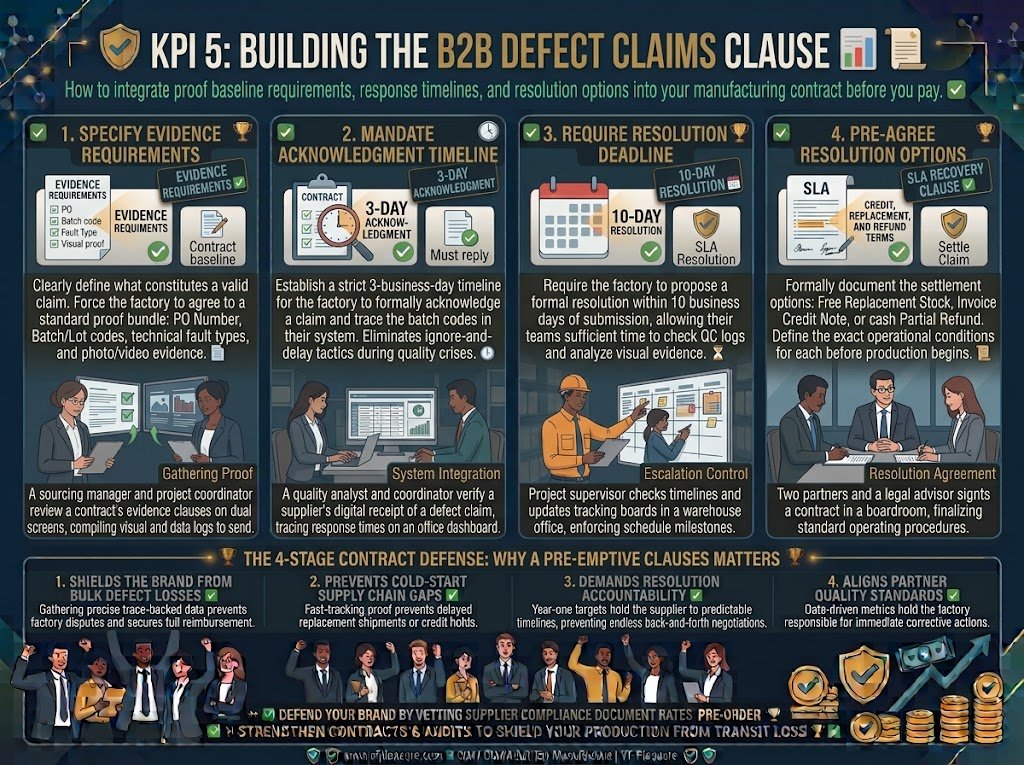
Here is the clause language:
"In the event that Buyer identifies product defects in goods delivered under this Agreement, Buyer may submit a formal defect claim within [90] days of original shipment date. A valid claim shall include: (a) Purchase order number; (b) Batch/lot code from product packaging; (c) Written fault description specifying the defect type; (d) Photographic or video evidence of the defect; (e) Number of affected units and percentage of relevant batch. Supplier shall acknowledge any valid claim within [5] business days of receipt and propose a written resolution within [15] business days. Resolutions may include replacement stock on the next order, credit note against the next invoice, or partial cash refund, to be agreed between the parties based on defect severity, affected quantity, and evidence of manufacturing causation."
This clause does not predetermine the outcome of any specific claim. It establishes the process — which is what both parties need to resolve claims professionally rather than through escalating disputes.
Conclusion
A supplier claims process is not pessimism about your factory's quality. It is the operational infrastructure that makes your relationship with any factory sustainable over time — because every production run at scale will eventually produce some defective units, and the question is never whether defects will occur but whether your brand has the process to handle them without losing the customer relationship, the revenue, or the supplier relationship simultaneously.
🚀 Source from a Factory That Supports Post-Sale Accountability
At VF Pleasure, our 12-point inspection system — with four QC checkpoints including gas chromatography, IPX7 waterproof chambers, and stress testing — is designed to minimise post-sale defect rates. Every batch includes batch codes tied to compliance documentation, QC reports, and food-grade silicone test records.
We encourage every private label client to:
- ✅ Establish batch code tracking from their first order — this is the link between customer complaints and our production records
- ✅ Request per-batch QC reports as a standard delivery item alongside compliance documentation
- ✅ Formalise claims process terms in the purchase order before production begins
- ✅ Use the evidence package template above to submit any claim — it makes our evaluation faster and the resolution more straightforward
Our compliance package per batch includes CE, RoHS, REACH, CA65 documentation and food-grade silicone test reports — the evidence base that a claims conversation draws from when a fault needs to be traced to its production origin.
👉 Discuss Post-Sale Claims Terms + Request Free Samples from VF Pleasure →
References & Source Notes
-
VF Pleasure — Adult Toy Manufacturing Challenges and Solutions
| Field | Detail |
|---|---|
| 📌 Supports | A supplier claims process requires documented evidence collection procedure, a written policy covering manufacturer-liable versus use-related defects, and a resolution framework with timelines. Evidence collected at the point of the customer complaint — particularly the batch code — is far more useful than retroactively assembled documentation. |
| 🔍 Evidence Role | Definition + General Support |
| 📁 Source Type | Industry Guide |
⚠️ Scope Note: The claims process framework described reflects general B2B industry best practice for wholesale adult toy relationships. Specific claims policies, evidence requirements, and resolution options vary between factories. Buyers must establish and confirm specific claims terms with their factory in writing before any defect event occurs. This article does not represent VF Pleasure's specific warranty or claims policy — buyers should confirm VF Pleasure's current terms directly before relying on any specific claims process.
-
VF Pleasure — Adult Toy Quality Compliance Guide
| Field | Detail |
|---|---|
| 📌 Supports | A complete defect claim evidence package includes purchase order number, batch/lot code, specific fault type description, photographic or video evidence, affected unit count and batch percentage, and defect report date range. VF Pleasure provides per-batch compliance certificates including batch codes that link physical units to production records, food-grade silicone test reports, and QC documentation. |
| 🔍 Evidence Role | Mechanism |
| 📁 Source Type | Industry Guide |
⚠️ Scope Note: The six evidence elements described represent a complete claims package based on general B2B manufacturing practice. Individual factories may require different or additional elements. Confirm specific evidence requirements with your factory before the first order.
-
VF Pleasure — Body-Safe Adult Toys Manufacturing Standards Guide
| Field | Detail |
|---|---|
| 📌 Supports | Manufacturer-liable defects include charging failures within 30 days, waterproofing failures under IPX-rated conditions, motor failures under normal use, and silicone surface failures inconsistent with food-grade material standards. Food-grade platinum silicone is prioritised for its non-porous, hypoallergenic properties — surface degradation inconsistent with food-grade quality is a potential material specification failure. |
| 🔍 Evidence Role | Definition |
| 📁 Source Type | Industry Guide |
⚠️ Scope Note: The 30/90/180-day timeframe framework and manufacturer-liable versus use-related defect categories are general reference frames based on industry practice. Actual claims eligibility depends on the specific purchase order terms, manufacturing agreement, and the evidence available for each specific defect type. These are planning frameworks — not legal determinations of liability.
-
VF Pleasure — Adult Toy Manufacturer Partnership Strategies
| Field | Detail |
|---|---|
| 📌 Supports | A formal defect claim document must include a claim reference number, factory order and batch code, fault category and description, affected unit count and percentage, evidence files, proposed resolution, and a response deadline — submitted by email for permanent written record. |
| 🔍 Evidence Role | Mechanism |
| 📁 Source Type | Industry Guide |
⚠️ Scope Note: The claim document template provided is a general framework. Buyers should adapt it to their specific factory relationship and obtain confirmation that the factory will accept claims in this format before relying on it for a live claim.
-
VF Pleasure — Sex Toy Wholesale Pricing Breakdown Guide
| Field | Detail |
|---|---|
| 📌 Supports | Three primary resolution options exist for post-sale B2B defect claims: replacement stock on the next order, credit note against the next invoice, and partial cash refund. Each option has different implications for cash flow, inventory timing, and the factory relationship. |
| 🔍 Evidence Role | General Support |
| 📁 Source Type | Industry Guide |
⚠️ Scope Note: Resolution options described reflect general B2B wholesale industry practice. Specific resolution terms depend on the manufacturing agreement, the factory's policy, and the specific facts of each defect claim. These are framework options for negotiation — not guarantees of outcome.
-
VF Pleasure — Verify Adult Toy Quality Chinese Suppliers Guide
| Field | Detail |
|---|---|
| 📌 Supports | When a factory disputes liability, the three-step response is: submit the complete evidence package, request the factory's specific QC batch records for the relevant batch code, and propose independent third-party testing if the dispute cannot be resolved through documentation. VF Pleasure's 12-point inspection system generates QC batch reports at four production checkpoints that can be referenced in a claim dispute. |
| 🔍 Evidence Role | Mechanism |
| 📁 Source Type | Industry Guide |
⚠️ Scope Note: Independent third-party testing as a dispute resolution mechanism is general B2B practice. Individual factory agreements may or may not include specific dispute resolution provisions. The testing cost-sharing approach described is one common arrangement — actual terms depend on negotiation. Confirm any dispute escalation process with your factory before it is needed.
-
VF Pleasure — Adult Toy Manufacturer Partnership Strategies
| Field | Detail |
|---|---|
| 📌 Supports | A manufacturing agreement claims clause should specify: evidence required for a valid claim, factory acknowledgement timeframe, factory resolution proposal timeframe, and available resolution options and their conditions. Establishing this framework before the first order converts post-sale quality accountability from a negotiation into a process. |
| 🔍 Evidence Role | Mechanism |
| 📁 Source Type | Industry Guide |
⚠️ Scope Note: The claims clause language provided is a general template. All contract language should be reviewed by qualified legal counsel familiar with Chinese contract law and the buyer's home jurisdiction before use in any binding manufacturing agreement. Clause terms, timeframes, and resolution options should be negotiated and confirmed with the specific factory before the agreement is signed.