Skip to content
Your first order went well. The food-grade silicone vibrators matched the sample, the CE documentation was clean, the delivery hit its window. You were happy. You placed your reorder — and the factory quoted you 12% higher than the original price. No explanation. No advance notice. Just a higher number, presented as if nothing had changed. Welcome to one of the most common — and most avoidable — margin surprises in adult toy sourcing.
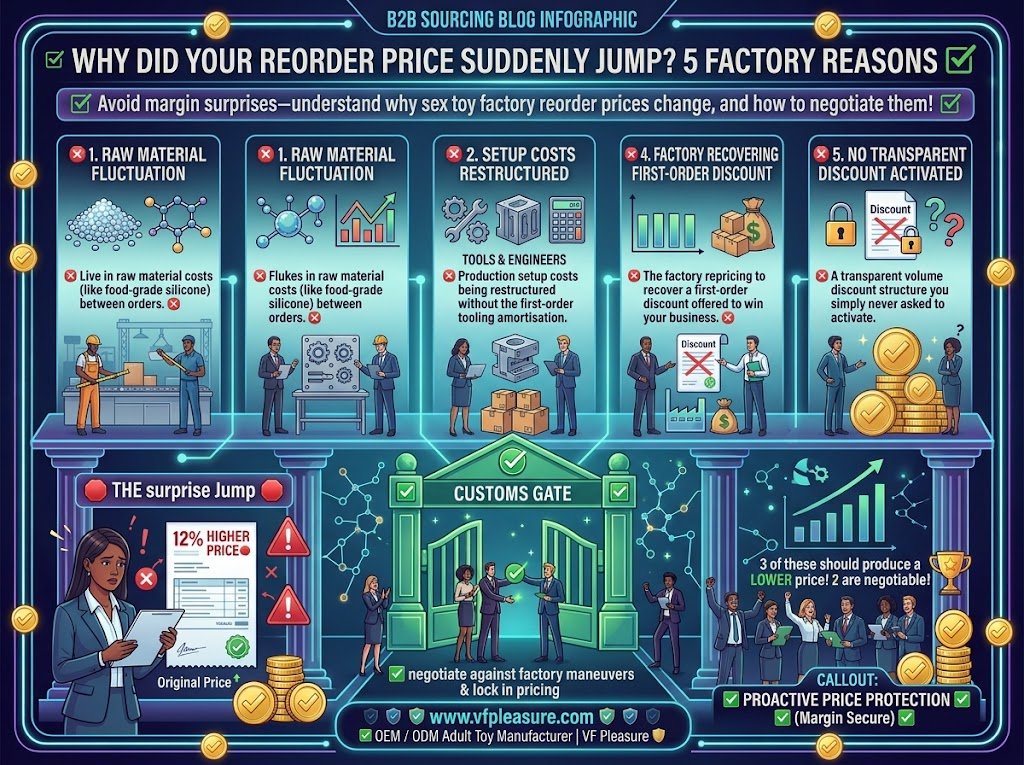
Your sex toy factory reorder price changes for five reasons: raw material cost fluctuation between orders, production setup costs being restructured without the first-order tooling amortisation, volume not increasing enough to trigger a per-unit reduction, the factory repricing to recover a first-order discount they offered to win your business, or a transparent volume discount structure you simply never asked to activate. Three of these reasons should produce a lower reorder price. Two are factory-side manoeuvres you can negotiate against if you know they are coming.1
I'm Sally. I run VF Pleasure — a direct adult toys factory in Dongguan, China, with 15+ years of B2B manufacturing experience. Our mission is competitive pricing, flexible MOQs, and tailored solutions that drive mutual success and long-term growth for our partners. "Thanks to VF Pleasure's flexible MOQ options, we scaled our business without breaking our budget" — James Carter, CEO, a client who understood from his first order how volume would affect his per-unit cost over time.
This guide explains every factor that legitimately changes a reorder price, the manoeuvres that inflated prices do not have a legitimate basis, and — most practically — how to lock in the reorder pricing structure before your first order ever ships.
- 1 Why Is Your Reorder Price Different from Your First Order Price?
- 2 Why Should Your Reorder Price Be Lower — and by How Much?
- 3 Why Do Some Factories Raise Prices on Reorder — and How Do You Spot It?
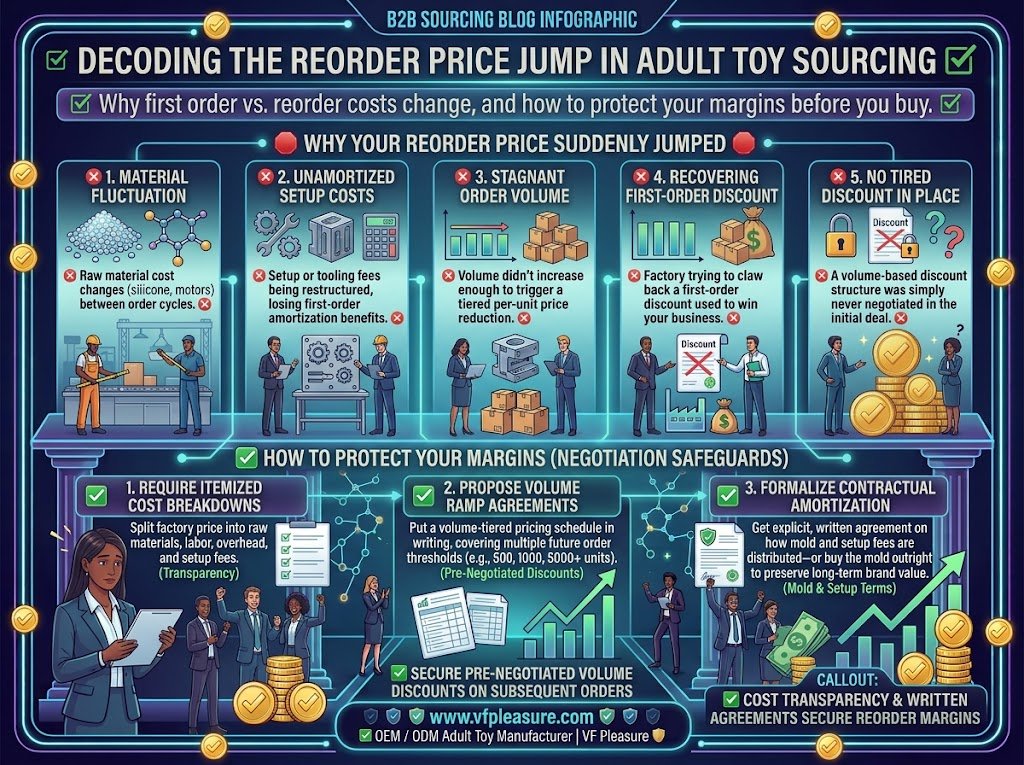
- 4 How Do You Negotiate a Better Reorder Price Before Your First Order Ships?
- 5 What Volume Triggers Should Unlock Per-Unit Price Reductions?
- 6 How Do You Lock In Long-Term Pricing Stability for Ongoing Orders?
- 7 Conclusion
- 8 References & Source Notes
Why Is Your Reorder Price Different from Your First Order Price?
Most buyers assume their factory reorder price is simply a reflection of the same production cost. It is not. The first order and the reorder are structurally different production events — in ways that genuinely affect per-unit cost. Understanding the structure tells you which price changes are legitimate and which ones require negotiation.
Your sex toy factory reorder price is different from your first order price because the two orders have fundamentally different cost structures. The first order carries one-time costs — tooling, packaging setup, compliance documentation, sample production, and new material qualification — that are either amortised into the per-unit price or charged separately. The reorder carries none of these. The legitimate direction of a reorder price, all else being equal, is lower — not higher.1
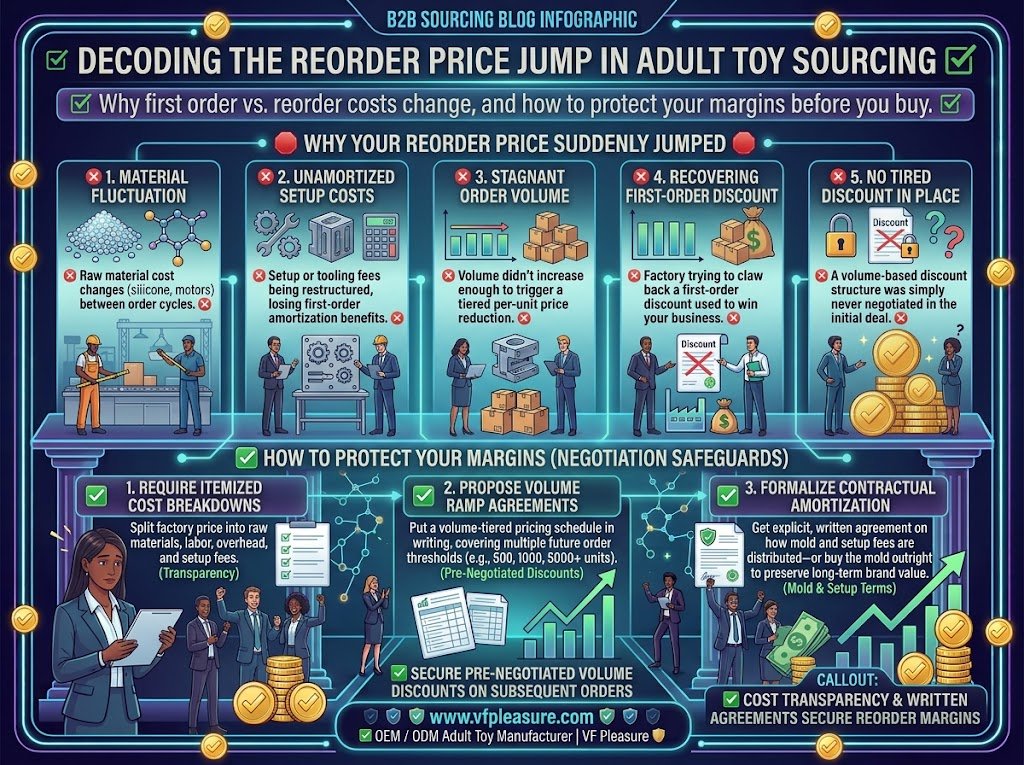
Here is every cost element that changes between first order and reorder — and whether it should move your price up or down.
📊 First Order vs Reorder Cost Structure Comparison
| Cost Element | First Order | Reorder | Direction |
|---|---|---|---|
| Mold/tooling fee | Charged (if custom) or amortised | Already paid / already amortised | ⬇️ Lower |
| Packaging setup (dieline, plates) | Full setup cost | Plates already made | ⬇️ Lower |
| Sample production | Full sample cycle | Sample re-run if approved | ⬇️ Lower |
| CE re-declaration | Full documentation cost | Existing, reissued if needed | ⬇️ Lower |
| Food-grade silicone test report | Per SKU, first test | Per new batch (smaller scope) | ⬇️ Slightly lower |
| Material qualification | New supplier validation | Existing qualified material | ⬇️ Lower |
| Raw material cost | Market price at order date | Current market price | ↕️ Variable |
| Volume | First order (often smaller) | Reorder (often larger) | ⬇️ Lower at higher volume |
| Production familiarity | Factory learning the product | Factory already trained | ⬇️ Lower |
Every fixed cost element moves the reorder price down. The only legitimate upward pressure is raw material cost change — which is real but typically modest for established silicone and electronics supply chains. A reorder that comes back 12% higher without a documented raw material cost increase is a reorder that deserves negotiation.
Our sex toy wholesale pricing breakdown guide explains each cost element and how it should behave across multiple order cycles — useful reference when building your reorder pricing model.
Why Should Your Reorder Price Be Lower — and by How Much?
The question is not just whether a reorder price should be lower — it obviously should. The question is: by how much? And what specific factors drive each reduction? Without quantifying the legitimate price reduction factors, you cannot negotiate with evidence. You can only argue with feelings.
A sex toy factory reorder price should be lower than the first order price because three structural cost reductions compound simultaneously: setup and tooling costs are already absorbed, production familiarity reduces assembly time per unit, and food-grade silicone compliance documentation requires only batch-level updates rather than full SKU-level testing. The combined effect of these three factors typically justifies a 5–15% per-unit reduction from your first order price at the same volume — and more if your reorder volume is larger.2
Here is the quantification for each legitimate price reduction factor.
💰 Reduction Factor 1 — Setup and Tooling Already Absorbed
On a first order of 500 units with a packaging setup fee of $400 and a dieline development fee of $200, those costs add $1.20 per unit to your effective first order cost. On your reorder, the plates and dieline already exist. The $600 setup cost is zero on the reorder — so your effective per-unit cost is $1.20 lower before production even starts.
For custom OEM orders where you paid a tooling fee — say $2,000 for a custom mold on a 1,000-unit first order — that adds $2.00 per unit to your effective first order cost. The reorder carries zero tooling cost, because the mold exists and belongs to you. Your effective reorder per-unit cost is $2.00 lower than your effective first order cost at the same production price.
When you negotiate reorder pricing, these setup costs should be explicitly removed from the production quote. A factory that maintains the same production price on a reorder as on a first order — without separating setup costs — is either double-recovering setup costs or not being transparent about their cost structure.
💰 Reduction Factor 2 — Production Familiarity
The factory already knows your product. The assembly sequence is documented, the silicone colour specification is on file, the packaging artwork is approved and plated. The time a new operator requires to learn a production process — what factory managers call the "learning curve" — does not apply to a reorder.
Industry estimates for learning curve effects on repeat production typically range from 5–10% reduction in assembly time per unit by the third or fourth production run. At a $12 per-unit production cost, a 7% production time reduction is $0.84 per unit. Smaller than the setup cost reduction — but real, and worth acknowledging in the negotiation.
💰 Reduction Factor 3 — Compliance Documentation at Batch Level
Your first order required a full food-grade silicone migration test report from a named accredited laboratory per SKU. Your reorder requires a batch-level update to the same report — confirming the new production batch uses the same material specification. At VF Pleasure, food-grade platinum silicone is our manufacturing baseline for every body-contact surface. We issue compliance certificates for every batch — but the batch certificate for a reorder is a smaller scope of work than the full SKU-level first certification.
The cost difference is not enormous — perhaps $100–200 per SKU for a batch update versus $300–600 for a full new SKU test. But on a 500-unit order, that is $0.20–$0.80 per unit that should reflect in your reorder quote.
💰 Reduction Factor 4 — Volume Growth (If Your Reorder Is Larger)
This is the biggest and most straightforward lever. If your first order was 200 units and your reorder is 500 units, your effective per-unit production cost drops because:
- Fixed overhead is spread across more units
- Material purchasing is at higher volume (often unlocking a supplier discount)
- Production line setup cost per unit is lower
Typical adult toy manufacturing volume pricing curves show meaningful per-unit cost reductions at the following volume thresholds:
| Volume Range | Typical Per-Unit Reduction vs Previous Tier |
|---|---|
| 50 → 100 units | 8–12% |
| 100 → 300 units | 5–10% |
| 300 → 500 units | 4–8% |
| 500 → 1,000 units | 5–10% |
| 1,000 → 3,000 units | 8–15% |
At VF Pleasure, our flexible MOQ options support businesses of all sizes — from small test orders through to large bulk runs. The production capacity of 50,000 units monthly means our per-unit economics genuinely improve at higher volumes, and we pass that improvement to our clients through volume-linked pricing.
Why Do Some Factories Raise Prices on Reorder — and How Do You Spot It?
Some reorder price increases are legitimate. Others are not. The difference is in the mechanism — and knowing the mechanism tells you whether to accept the increase, challenge it, or walk.
Some adult toy factories raise prices on reorder for four illegitimate reasons: recovering a first-order discount they offered to win the initial inquiry, exploiting the buyer's switching cost once a relationship exists, adding undisclosed surcharges to a quote that looks similar to the original, and passing through inflated material cost increases that are either unverifiable or larger than the actual raw material movement. All four are negotiable — if you can identify them before your deposit transfers.3
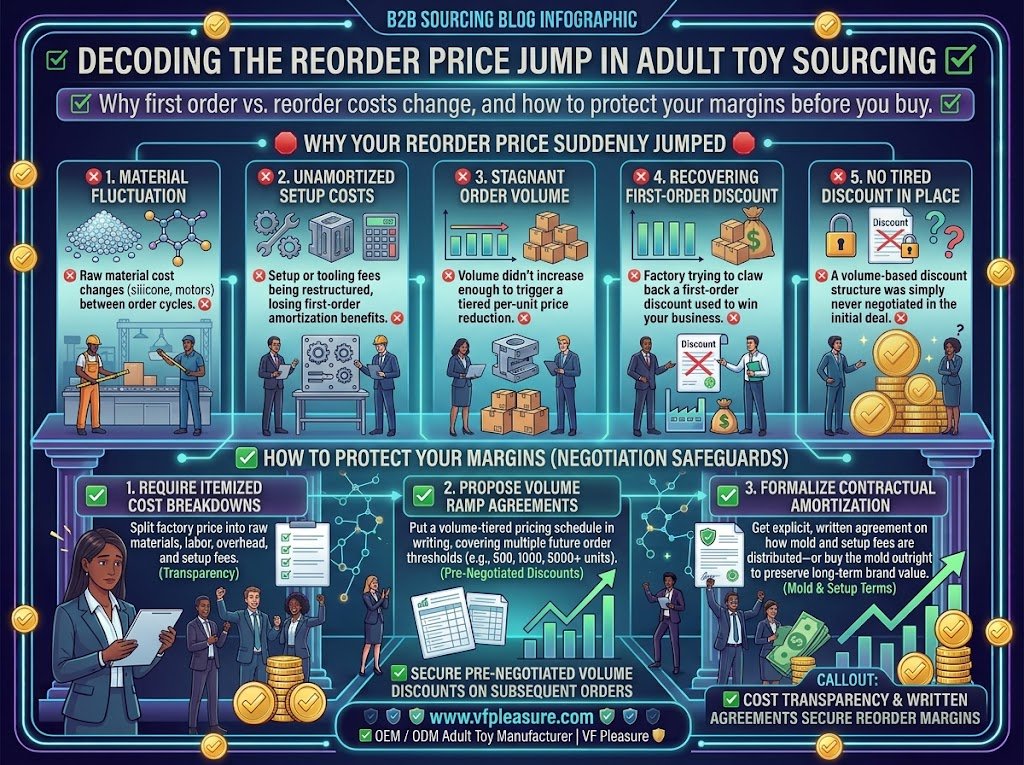
Here is each illegitimate price increase mechanism — and the specific question that surfaces it.
🚩 Mechanism 1 — Recovering a First-Order Discount
Some factories quote below their standard production cost for first orders — knowing that if the buyer is happy, the reorder is almost guaranteed. The first-order discount is an acquisition cost. The reorder is where they recover it.
How to spot it: Ask your factory at the first order stage: "Is this your standard production price for this product at this volume, or does it include a first-order promotional discount?" A factory that confirms it is a promotional price is at least being transparent. The reorder at standard price is then expected — and you can plan for it. A factory that does not disclose the discount at first order, then raises the price at reorder without explanation, is extracting value through opacity.
🚩 Mechanism 2 — Exploiting Switching Cost
Once you have placed your first order with a factory — approved samples, set up packaging artwork, obtained compliance documentation — switching to a different factory for your reorder carries real cost: re-sampling, re-approval, new compliance documentation. The factory knows this. A factory with low integrity will use this switching cost as implicit leverage to raise prices without justification.
How to spot it: Compare your reorder quote against the cost of actually switching. If switching would cost you $500–1,000 in re-sampling and approval time, and the factory has raised your price by $0.50 per unit on a 500-unit order ($250 total), the switching cost exploitation is small enough to be almost invisible — but it compounds over every subsequent order.
The prevention: Negotiate reorder pricing at first order stage, before you have any switching cost. This is the most important single timing decision in reorder price management.
🚩 Mechanism 3 — Hidden Surcharges in a Similar-Looking Quote
A reorder quote that looks nearly identical to the original but includes a new line item — "reorder setup fee," "packaging reprint fee," "material restocking fee" — may be adding charges that have no cost basis in the actual production. Packaging was already set up. Material is the same grade. There is nothing to restock.
How to spot it: Request a fully itemised reorder quote with every cost element listed separately, and compare it line by line against your original quote. Any new line item requires an explanation of what cost it is recovering. A "setup fee" on a reorder of a product the factory has previously run requires: the specific setup activities it covers, why they are necessary on a reorder, and the actual cost basis. If the factory cannot explain it in those terms, it is a surcharge, not a legitimate cost.
🚩 Mechanism 4 — Inflated or Unverifiable Raw Material Cost Claims
Raw material costs do change — food-grade silicone compound, motor components, and electronics have genuine commodity price movements. A factory that passes these through as per-unit price increases on reorders is doing something legitimate. A factory that inflates the claimed material cost movement, or cites general "market conditions" without providing any documentation of the actual cost change, is not.
When a key motor component cost increased significantly for one of our clients, we benchmarked multiple alternative components against the original's performance profile, found a replacement that maintained performance consistency, and maintained the original production price. The material cost increase was absorbed at the component sourcing level — not passed through to the client as a per-unit increase they had no basis to verify.
How to spot it: Ask for documentation of the raw material cost change the factory is claiming as the basis for the price increase. A legitimate material cost increase can be supported with: the name of the specific material, the previous price per kg or unit, the new price per kg or unit, and the name of the sub-supplier confirming the change. If the factory cannot produce this documentation, the "material cost increase" is unverified and negotiable.
How Do You Negotiate a Better Reorder Price Before Your First Order Ships?
This is the timing decision that most buyers miss. Reorder price negotiation is most powerful at first order stage — before you have any switching cost, before the factory has demonstrated that you will reorder without negotiating, and before the first order's volume baseline has been established. The factory has the most incentive to offer favourable reorder terms at this moment because they want the first order relationship.
You negotiate a better reorder price before your first order ships by requesting a formalised volume pricing schedule as part of the first order documentation — showing the per-unit price at each volume tier you expect to pass through within 12 months. A factory that agrees to this structure before taking your first deposit has given you the reorder negotiation framework in advance. A factory that refuses to provide forward volume pricing at this stage is likely planning to reprice opportunistically.4
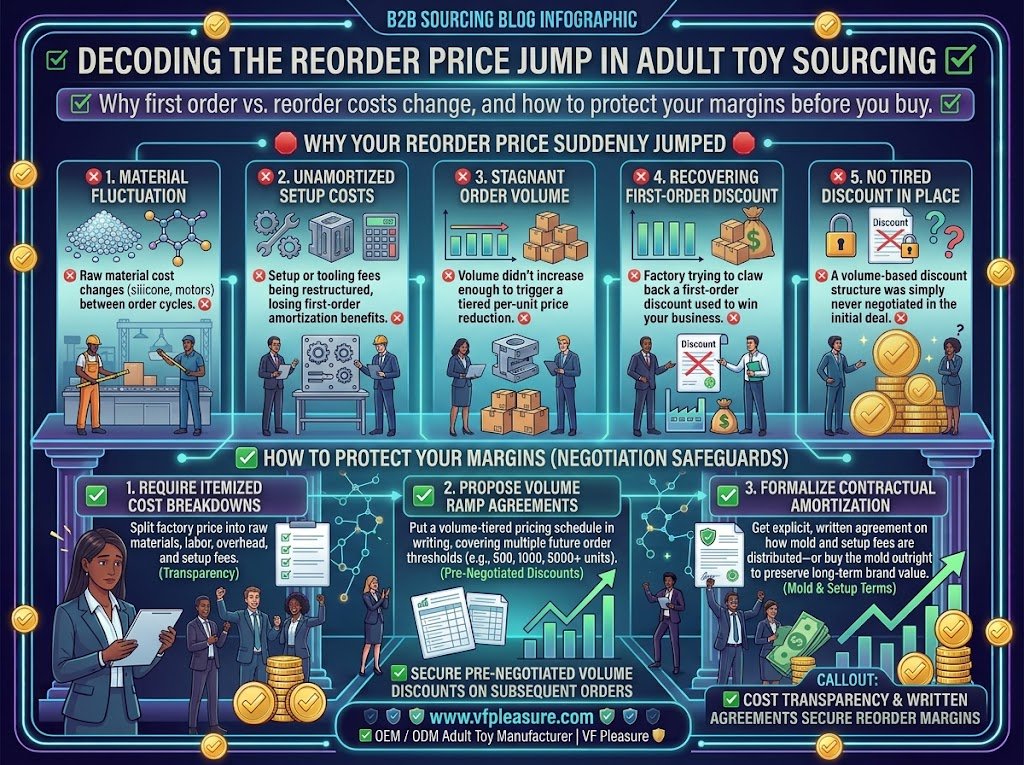
Here is the exact negotiation approach — with language for each stage.
✍️ Step 1 — Request a Volume Pricing Schedule at First Inquiry
Include this in your initial RFQ alongside your first order quantity:
"In addition to your quote for [first order quantity], please provide a pricing schedule showing your per-unit production cost at the following volumes: [100 / 300 / 500 / 1,000 / 3,000 units]. We plan to scale our orders over the next 12 months and want to understand the pricing model before we select a long-term manufacturing partner."
A factory that provides a volume pricing schedule without hesitation is a factory that has a structured, transparent pricing model. A factory that refuses, deflects, or provides only vague statements about "better pricing at higher volumes" is a factory that manages pricing situationally rather than systematically.
✍️ Step 2 — Reference First-Order Cost Elements in the Reorder Frame
In the same first-order stage, confirm which cost elements are one-time:
"Please confirm which of the following are one-time costs that will not recur on reorders: packaging dieline and plate setup, any mold or tooling fee, CE re-declaration, and food-grade silicone SKU-level testing. I want to understand the reorder base price structure before I commit to the first order."
This question does two things: it establishes the legitimacy of a reorder price lower than the first order, and it creates a documented reference for the reorder negotiation.
✍️ Step 3 — Anchor the Reorder Price in Writing
"Based on your volume pricing schedule, my first reorder at [projected reorder quantity] should be approximately [quoted per-unit price for that volume]. Can you confirm this in writing as the expected reorder pricing structure, noting that it may be adjusted only for documented raw material cost changes?"
This is the clause that converts a verbal expectation into a written reference. Most factories will agree to this at the first order stage — because they are confident the relationship will go well. The written confirmation is your insurance against opportunistic repricing when the reorder arrives.
What Volume Triggers Should Unlock Per-Unit Price Reductions?
Volume discount triggers are the formal mechanism that ties your per-unit price reduction to your order growth — converting the pricing negotiation from a recurring transaction to a structured progression. When you have agreed volume triggers in writing, every reorder automatically generates a price reduction conversation rather than a factory-initiated price increase.
Volume triggers for adult toy per-unit price reductions should be set at the order quantity levels where the factory's production economics genuinely improve: typically at 100, 300, 500, 1,000, and 3,000 units. Each threshold unlocks a percentage reduction from the baseline price — stated explicitly, not as a negotiable concession to be requested every order cycle. This structure protects your margin growth as your volume grows, rather than letting volume gains be captured by factory repricing.5
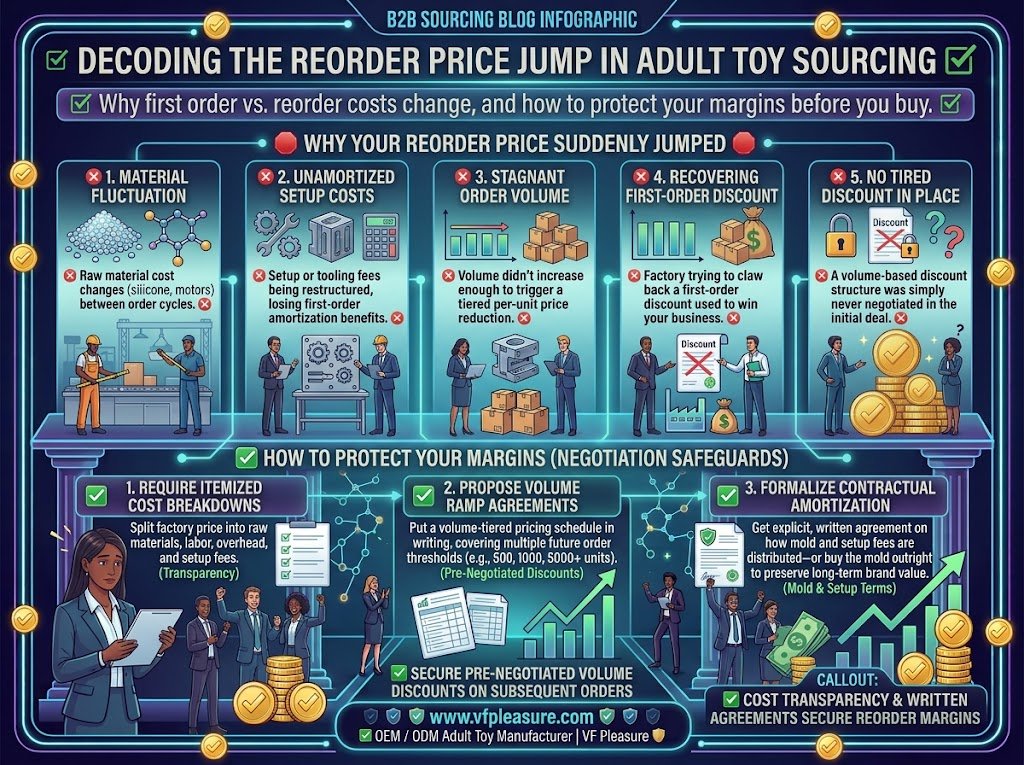
Here is the volume trigger structure — with typical reduction ranges at each tier.
📊 Volume Trigger Price Reduction Schedule Template
| Volume Tier | Typical Per-Unit Reduction vs 100-Unit Baseline | Notes |
|---|---|---|
| 100 units | Baseline price | First order or first reorder |
| 200 units | –3 to –5% | Small volume growth, modest reduction |
| 300 units | –5 to –8% | Mid-tier, setup costs more diluted |
| 500 units | –8 to –12% | Material purchasing starts to move |
| 1,000 units | –12 to –18% | Meaningful production economics shift |
| 2,000 units | –18 to –25% | Component purchasing at scale |
| 3,000+ units | –22 to –30% | Near production tier price |
These are indicative ranges — actual numbers depend on the product, the factory's cost structure, and the specific food-grade silicone and electronics specification. The ranges here are based on general adult toy manufacturing volume economics rather than any single factory's price sheet.
When you negotiate this schedule, frame it as a bilateral commitment:
"We are committing to grow with you. We expect to reach [volume tier] within [timeframe]. In exchange for this volume commitment, we want a structured pricing schedule that reduces per-unit cost as we hit each threshold — documented in our agreement so neither party has to renegotiate at each order."
This framing works because it converts the discount from a favour into a commercial exchange — the same volume commitment logic that makes exclusivity negotiations work. The factory's mission is to drive mutual success and long-term growth. A structured volume pricing schedule is the operational expression of exactly that.
At VF Pleasure, our flexible MOQ options and competitive pricing exist specifically to support clients at every stage of their growth — from the first small test order through to large-scale recurring production. "VF Pleasure's OEM services helped us launch a unique product line that boosted our sales by 40%." — Sarah Thompson, Product Manager.
How Do You Lock In Long-Term Pricing Stability for Ongoing Orders?
Volume discounts address the positive price movement — your prices should decrease as you grow. Long-term pricing stability addresses the negative risk — your prices should not increase arbitrarily between orders. Without explicit price stability terms, both sides of this equation are exposed to the factory's current commercial circumstances rather than your planned cost structure.
You lock in long-term adult toy pricing stability through three specific contract provisions: a price validity clause defining how long a quoted price holds, a raw material cost escalation clause defining the only legitimate basis for price increases (documented material cost change, not general market conditions), and a reorder price confirmation clause requiring the factory to confirm pricing in writing before each production cycle begins rather than at dispatch.6
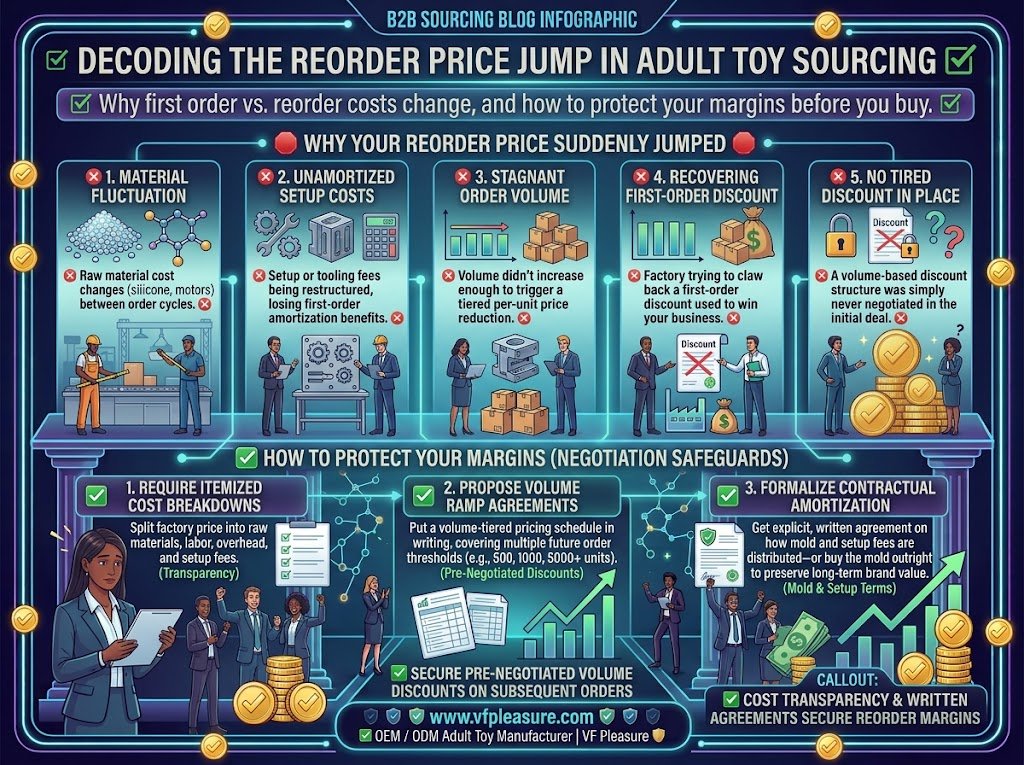
Here is each provision — with the specific language that makes each one enforceable.
📄 Provision 1 — Price Validity Clause
"The unit prices confirmed in this Agreement are valid for a period of [12 months] from the date of first production order, subject only to the raw material cost adjustment provision below. Supplier shall not increase unit prices during the validity period except as provided by the material cost adjustment provision."
Twelve months is the standard validity window for most adult toy supply agreements. It covers two to four order cycles for most brands and gives the factory enough time horizon to manage their own cost structure without being locked into a price that becomes genuinely unworkable.
📄 Provision 2 — Raw Material Cost Escalation Clause
"Unit prices may be adjusted upward only to reflect documented increases in food-grade silicone compound or electronic component costs, provided that: (a) Supplier provides documentation of the actual cost change from a named sub-supplier; (b) the price adjustment applies only to the specific cost element that changed; (c) Buyer has the right to request competitive sourcing of the affected component before accepting the price adjustment; and (d) any downward movement in material costs of [3%] or more shall trigger a corresponding reduction in unit pricing."
The symmetry clause — that material cost reductions also flow through to your pricing — is the provision that many buyers forget to include. It is also the provision that most factories will initially resist, because they prefer the asymmetry. Insist on it. If material costs can go up and affect your price, material costs can go down and benefit your price.
📄 Provision 3 — Reorder Price Confirmation Clause
"Prior to each production cycle, Supplier shall issue a written production confirmation confirming the per-unit price for that order, the applicable volume tier discount, any material cost adjustment applied (with supporting documentation), and the final invoiced per-unit price. Buyer's production approval shall constitute acceptance of the confirmed pricing. Any price not confirmed in writing before production start is not binding on Buyer."
This clause shifts the timing of the price dispute from post-delivery — where your goods are in transit and your leverage is minimal — to pre-production, where you can either approve or renegotiate before any production costs are incurred.
💡 Sally's 15-year factory-side note: The buyers who never have reorder price surprises are the ones who spent 30 minutes on the first order documentation. They asked for the volume schedule. They confirmed which costs were one-time. They attached a price validity clause to their purchase agreement. And they get a written price confirmation before every production cycle starts. None of this is complicated. It is just timing — and the difference between building a growing business and watching your margin shrink with every reorder.
Conclusion
Your reorder price should be lower than your first order price — because setup costs are absorbed, production is familiar, and food-grade silicone compliance documentation is already established. Lock in the pricing structure before your deposit clears, confirm it in writing before each production cycle, and your margin grows as your volume does.
🚀 Want a Factory That Builds Volume Pricing Into Your First Order Agreement?
At VF Pleasure, our mission is competitive pricing and tailored solutions for mutual long-term growth. We provide direct factory pricing for better profitability — with volume pricing schedules, one-time cost itemisation, and written price confirmations before each production cycle as standard practice.
What we provide for reorder pricing clarity:
- ✅ Volume pricing schedule on request — per-unit prices at each volume tier, provided at first inquiry stage
- ✅ One-time cost itemisation — setup, tooling, compliance documentation listed separately so reorder base price is transparent
- ✅ Food-grade platinum silicone — CE, RoHS, REACH, CA65 certified per batch; batch-level updates on reorders, not full re-certification costs
- ✅ Written price confirmation — before each production cycle begins, not after production starts
- ✅ Flexible MOQ options — small and bulk orders for businesses at every growth stage
- ✅ 50,000 units monthly capacity — genuine production economics that improve with your volume
👉 Request a Volume Pricing Schedule + First Order Quote from VF Pleasure →
References & Source Notes
-
VF Pleasure — Sex Toy Wholesale Pricing Breakdown Guide
| Field | Detail |
|---|---|
| 📌 Supports | Reorder prices change because first orders and reorders have different cost structures. Setup costs (tooling, packaging plates, compliance documentation, sample production) are one-time or amortised — their removal on reorders should produce a lower price. Raw material cost fluctuation is the only legitimate upward pressure. VF Pleasure's mission is competitive pricing and flexible MOQs driving mutual long-term growth. |
| 🔍 Evidence Role | Definition + General Support |
| 📁 Source Type | Industry Guide |
⚠️ Scope Note: The first-order vs reorder cost structure comparison reflects general adult toy manufacturing economics as observed through VF Pleasure's 15+ years of manufacturing experience. Specific cost element values vary by product type, factory, volume, and customisation scope. All pricing analysis should be conducted with actual itemised quotes from the specific factory for the specific product.
-
VF Pleasure — Adult Toy Manufacturer Partnership Strategies
| Field | Detail |
|---|---|
| 📌 Supports | A reorder price should be 5–15% lower than the first order price at the same volume due to three structural reductions: absorbed setup costs, production familiarity reducing assembly time, and batch-level compliance updates replacing full SKU certification. At higher reorder volumes, additional per-unit reductions of 8–30% are achievable through volume pricing tiers. VF Pleasure provides compliance certificates for every batch. |
| 🔍 Evidence Role | Mechanism |
| 📁 Source Type | Industry Guide |
⚠️ Scope Note: Price reduction ranges (5–15% at same volume, 8–30% at higher volumes) are directional estimates based on typical adult toy manufacturing volume economics. Actual reductions depend on the specific product, factory cost structure, volume tier, and material composition. All pricing should be confirmed through factory-specific volume pricing schedules rather than these general ranges.
-
VF Pleasure — Red Flags OEM Adult Toy Manufacturer Guide
| Field | Detail |
|---|---|
| 📌 Supports | Four illegitimate reorder price increase mechanisms are: recovering a first-order acquisition discount, exploiting switching costs, adding undisclosed surcharges, and passing through inflated or unverifiable material cost increases. When a motor component cost increased for one of VF Pleasure's clients, alternatives were benchmarked and the production price was maintained rather than passed through. |
| 🔍 Evidence Role | Case Reference |
| 📁 Source Type | Industry Guide |
⚠️ Scope Note: The four illegitimate price increase mechanisms described are general patterns observed in adult toy sourcing relationships. Not all price increases from these categories are illegitimate in every context — undisclosed first-order discounts may reflect different commercial practices across markets. Buyers should request transparent documentation for any reorder price increase before accepting or rejecting it.
-
VF Pleasure — How to Negotiate with Chinese Adult Toy Factories Guide
| Field | Detail |
|---|---|
| 📌 Supports | The optimal timing for reorder price negotiation is the first order stage — before switching costs exist, before reorder patterns are established, and when the factory has the most incentive to offer favourable forward pricing. A formalised volume pricing schedule and written confirmation of one-time costs at first order stage eliminates most reorder pricing disputes. |
| 🔍 Evidence Role | Mechanism |
| 📁 Source Type | Industry Guide |
⚠️ Scope Note: Negotiation language provided is a general framework. Specific phrasing and approach should be adapted to the specific factory relationship and communication style. Written confirmations should be reviewed by legal counsel for any high-value or exclusive manufacturing agreement.
-
VF Pleasure — Adult Toy Market Forecast 2025–2030
| Field | Detail |
|---|---|
| 📌 Supports | Volume trigger price reduction schedules should be set at thresholds (100, 300, 500, 1,000, 3,000 units) where production economics genuinely improve. VF Pleasure's flexible MOQ options support businesses at every growth stage, and competitive pricing at scale reflects genuine production economics improvements. Client testimony: "Thanks to VF Pleasure's flexible MOQ options, we scaled our business without breaking our budget." — James Carter, CEO. |
| 🔍 Evidence Role | General Support + Case Reference |
| 📁 Source Type | Industry Guide |
⚠️ Scope Note: Volume tier reduction ranges in the pricing table (3–30% across tiers) are directional industry estimates. Actual percentage reductions vary by factory, product complexity, material cost proportion, and volume relative to the factory's production scale. All volume pricing schedules must be confirmed with specific factory quotes at each volume tier before being relied upon for margin planning.
-
VF Pleasure — Adult Toy Manufacturing Challenges and Solutions
| Field | Detail |
|---|---|
| 📌 Supports | Three contract provisions lock in long-term adult toy pricing stability: a price validity clause (12-month standard), a raw material cost escalation clause requiring documentation and applying symmetrically to cost reductions, and a reorder price confirmation clause requiring written pricing before production start. Hidden costs should be requested as a detailed pricing breakdown upfront. |
| 🔍 Evidence Role | Mechanism |
| 📁 Source Type | Industry Guide |
⚠️ Scope Note: Contract clause language provided is general drafting guidance only. Enforceability depends on jurisdiction, governing law, and specific contract context. The symmetry clause requiring downward material cost pass-through may face resistance from some factory partners — its inclusion and enforceability should be evaluated as part of a broader contract review with qualified legal counsel.