Skip to content
You locked in a factory price, approved samples, confirmed production. Then your freight forwarder sends the import cost breakdown — and the number that lands on your screen is 30–45% higher than the factory quote that started this whole conversation. Tariffs, duties, VAT, compliance fees, broker charges, and a Section 301 surcharge nobody mentioned in the sourcing conversation have quietly stacked up between your factory in Dongguan and your warehouse shelf.
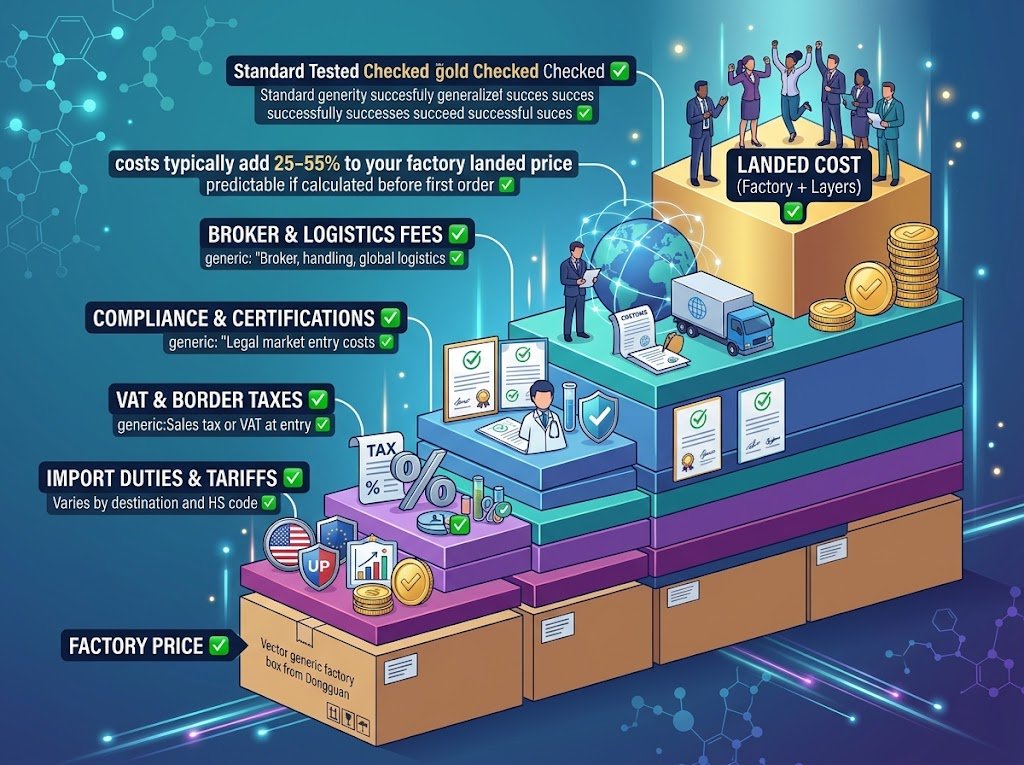
The real cost of importing sex toys from China includes four layers beyond the factory price: import duties and tariffs (which vary significantly by destination market and HS code classification), VAT or sales tax applied at the border, compliance certification costs required for legal market entry, and customs broker and logistics fees. In the US, EU, and Japan combined, these costs typically add 25–55% to your factory landed price — and they are almost entirely predictable if you calculate them before you place your first order.1
I'm Sally. I run VF Pleasure — a direct adult toys factory in Dongguan, China, with 15+ years of manufacturing experience. Every product we manufacture is CE, RoHS, REACH, and CA65 certified, with full documentation designed to ensure smooth importation and compliance in our clients' target markets. We use food-grade silicone, ABS plastic, and other non-toxic body-safe materials on every product we produce.
I have watched clients lose margin they could not recover because they calculated their selling price against factory cost and forgot to add the full import stack. This guide gives you that full stack — by market — so you can build the real landed cost into every product decision before production begins.
⚠️ Important note: Tariff rates, HS codes, and import regulations change frequently — especially between China and major trading partners. All rates cited in this article reflect general industry guidance at time of writing and should be verified with a licensed customs broker or freight forwarder for your specific shipment before finalising pricing. This article is not legal or customs compliance advice.
- 1 What Are HS Codes for Sex Toys — and Why Do They Matter?
- 2 What Are the Real Import Costs When Shipping Sex Toys to the United States?
- 3 What Does Importing Sex Toys Into the EU Actually Cost?
- 4 What Are the Import Requirements for Sex Toys in Japan?
- 5 Which Compliance Documents Protect You Across All Three Markets?
- 6 How Do You Build Import Costs Into Your Pricing Before You Source?
- 7 Conclusion
- 8 References & Source Notes
What Are HS Codes for Sex Toys — and Why Do They Matter?
Before you can calculate tariff costs for any market, you need the correct Harmonised System (HS) commodity code for your product. The same product can legitimately fall under two or three different HS codes — and the tariff rate can differ by 10–25% between them. Getting this classification wrong is one of the most common and most expensive customs mistakes in adult toy importing.
Sex toy HS code classification determines both the tariff rate applied at import and which product safety regulations your shipment must comply with at the border. Rechargeable electronic vibrators typically classify under HS 8543.70 (electrical machines and apparatus) or HS 9503 (toys and games) depending on the customs authority's interpretation — and the same product may receive different classifications in the US, EU, and Japan, each carrying a different duty rate.2
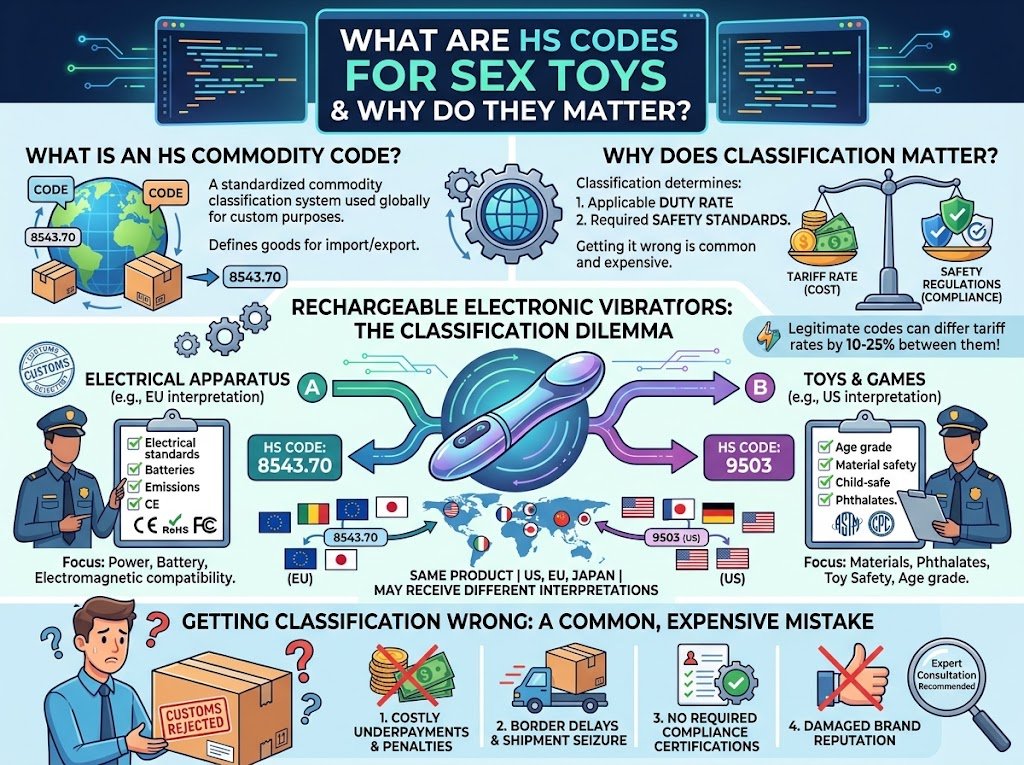
Here is how the classification works in practice — and why it requires specific attention for each destination market.
📋 Sex Toy HS Classification Guide by Product Type
| Product Type | Common HS Code | Alternative Code | Classification Basis |
|---|---|---|---|
| Electronic vibrator (rechargeable) | 8543.70 (electrical apparatus) | 9503 (toys) | Electronic function vs. play/recreation purpose |
| Manual/non-electronic dildo | 9503 (toys and games) | 3926 (plastic articles) | Material and intended use |
| Couples toy with app/Bluetooth | 8543.70 or 8517 (comms equipment) | — | Wireless function may trigger different code |
| Kegel/pelvic health device | 9003 or 3926 | 8543.70 | Wellness positioning vs. electronic function |
| Male masturbator (non-electronic) | 9503 or 3926 | — | Material-based classification |
The classification that carries the lowest tariff rate is not automatically the correct one — you need a licensed customs broker to advise on the appropriate classification for your specific product in each destination market. Misclassification creates back-duty exposure that can follow your brand through multiple import cycles.
💡 Why This Matters Specifically for Food-Grade Silicone Products
Products with food-grade silicone material documentation are sometimes classified differently from equivalent products without certified material documentation — because the certification package changes how customs authorities assess the product's intended use and material composition. At VF Pleasure, we provide full compliance certificates for every batch and full documentation for smooth importation. Having CE, RoHS, REACH, and CA65 documentation ready before shipment prevents the classification disputes that hold goods at customs while documentation is gathered under time pressure.
Our adult toy quality compliance guide and adult toy customs compliance guide explain how your compliance documentation set influences customs clearance outcomes in each major market.
What Are the Real Import Costs When Shipping Sex Toys to the United States?
The United States is the largest single market for adult toy imports from China — and currently one of the most complex for cost calculation, because Section 301 tariffs have added a significant cost layer to Chinese goods across multiple HS categories, including most electronic adult toys.
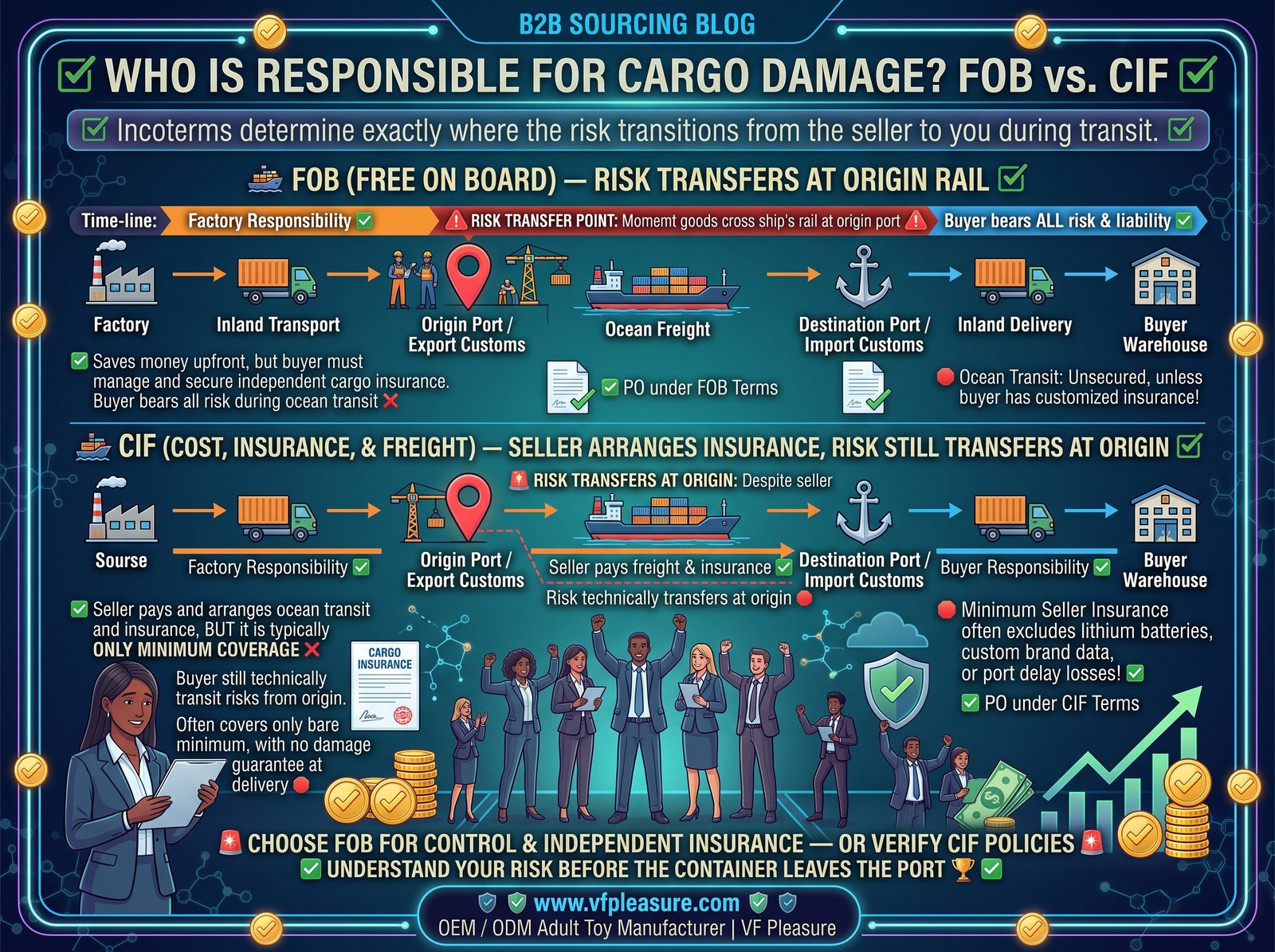
Importing sex toys into the United States from China carries a total import cost stack of factory price plus Section 301 tariffs (25% on most electronic adult toy categories), basic HTS duty rates (typically 0–6.5%), US customs bond and broker fees, FCC documentation costs for wireless products, and Proposition 65 compliance costs for California market sales. The effective duty burden on a Chinese-origin electronic vibrator can reach 27–35% of the declared customs value before broker fees.3
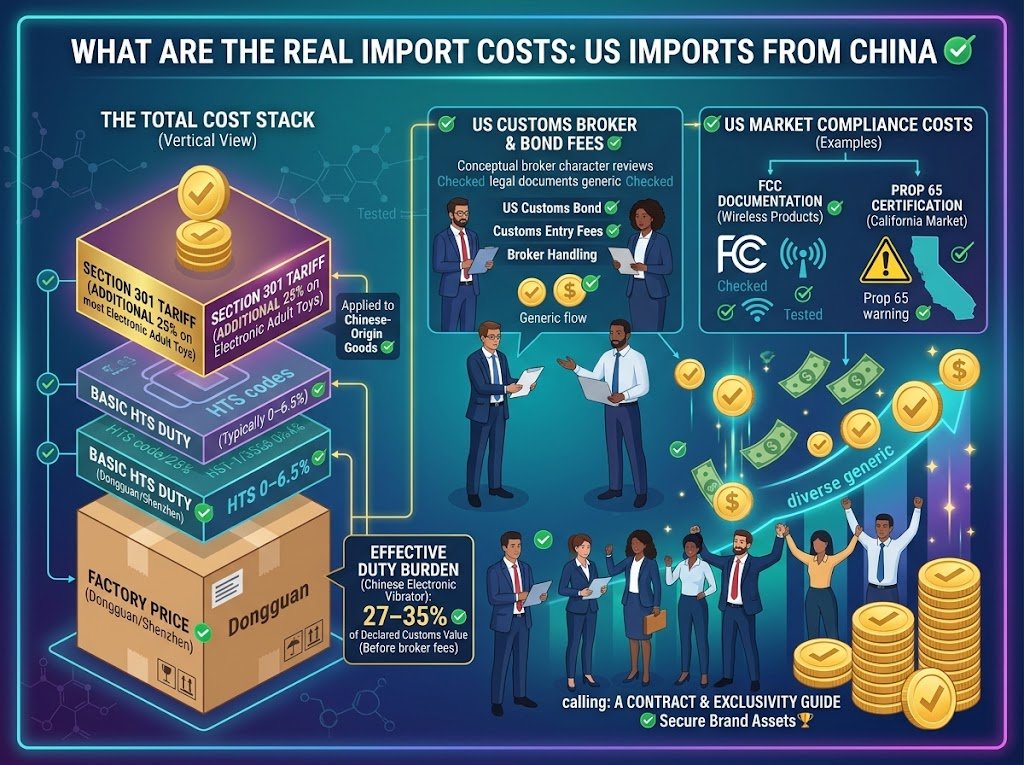
Here is each cost element in the US import stack — with the specific rates and the documentation requirements behind each one.
🇺🇸 US Import Cost Layer 1 — Section 301 Tariffs
Section 301 tariffs, imposed as part of US-China trade tensions, apply to a wide range of Chinese goods including most categories that cover electronic adult toys. For products classified under HS 8543.70, the Section 301 List 3 rate is 25% of the declared customs value. For products classified under HS 9503 (toys), rates have varied but also carry Section 301 exposure.
This is the largest single cost line for most adult toy importers from China — and it does not appear in the factory invoice. It is assessed at the US border on the declared value of your goods, before freight and insurance are stripped out.
There are two ways to approach Section 301 exposure:
- First sale valuation: In some circumstances, US CBP allows importers to use the first sale price (factory to trading company) rather than the last sale price (to the importer) as the dutiable value. This can reduce the Section 301 base — but requires documentation from each sale in the chain.
- Tariff engineering: Some importers have explored whether partial assembly in a third country (Vietnam, for example) could change the country of origin determination. This requires careful legal advice — the rules of substantial transformation are strict and enforcement has tightened significantly.
🇺🇸 US Import Cost Layer 2 — HTS Basic Duty Rates
The basic MFN (Most Favoured Nation) duty rate for adult toys classified under HTS 9503 is typically 0–3%. For products under HTS 8543.70, the basic rate is also typically in the 0–3.5% range. Section 301 tariffs are applied on top of this basic rate.
🇺🇸 US Import Cost Layer 3 — FCC Documentation
Any adult toy with a wireless, Bluetooth, or app-controlled feature requires FCC equipment authorisation before it can be legally imported and sold in the US. The FCC certification process typically involves testing by an accredited laboratory (often the same SGS or Bureau Veritas labs used for CE compliance), a filing with the FCC database, and label markings on the product.
FCC certification adds to your production timeline — typically four to eight weeks if not scoped from the start — and a per-product certification cost that varies by product complexity. This is one of the most consistently underplanned cost lines in new OEM product development. It must be scoped at the product design stage, not discovered at the pre-shipment stage.
🇺🇸 US Import Cost Layer 4 — Proposition 65
California's Proposition 65 requires businesses to provide clear warnings before knowingly and intentionally exposing anyone to listed chemicals. For adult toys, this typically means labelling for certain substances that may be present above threshold levels. The cost is primarily a compliance labelling and documentation cost — not a high per-unit cost, but a meaningful setup cost for each new SKU entering the California market.
CA65 documentation is already part of VF Pleasure's standard compliance package for products entering the US market. Having it ready at import prevents the California market distribution delays that catch brands off guard when retail or e-commerce partners request documentation.
📊 US Import Cost Stack Example: $10,000 Declared Value Shipment
| Cost Element | Rate | Estimated Amount |
|---|---|---|
| Declared customs value | — | $10,000 |
| HTS basic duty (HS 8543.70) | ~3.5% | $350 |
| Section 301 tariff | 25% | $2,500 |
| Customs broker fee | Flat rate, varies | $150–$400 |
| ISF filing fee | $35–$50 per shipment | $50 |
| Customs bond (single entry) | ~$50–200 | $150 |
| Total estimated import cost | — | $3,200–$3,450 |
| Effective import rate on declared value | — | ~32–35% |
What Does Importing Sex Toys Into the EU Actually Cost?
The European Union market requires a different import calculation framework from the US — because the cost structure combines an import duty, a VAT layer that varies by member state, and compliance certification costs that must be in place before goods can legally enter the EU market at all. Missing any one of these three layers does not just create a cost surprise — it can create a legal market access problem.
Importing sex toys into the EU from China requires three cost layers: EU Common Customs Tariff duties (typically 4.7% for electronic adult toys under CN 8543.70, or 4.7% for most vibrators), VAT at the destination member state rate (18–27% depending on country), and CE compliance plus REACH documentation costs. Unlike the US, EU market entry is legally blocked without a CE Declaration of Conformity for electronic products — making compliance a market access gate, not just a cost line.4
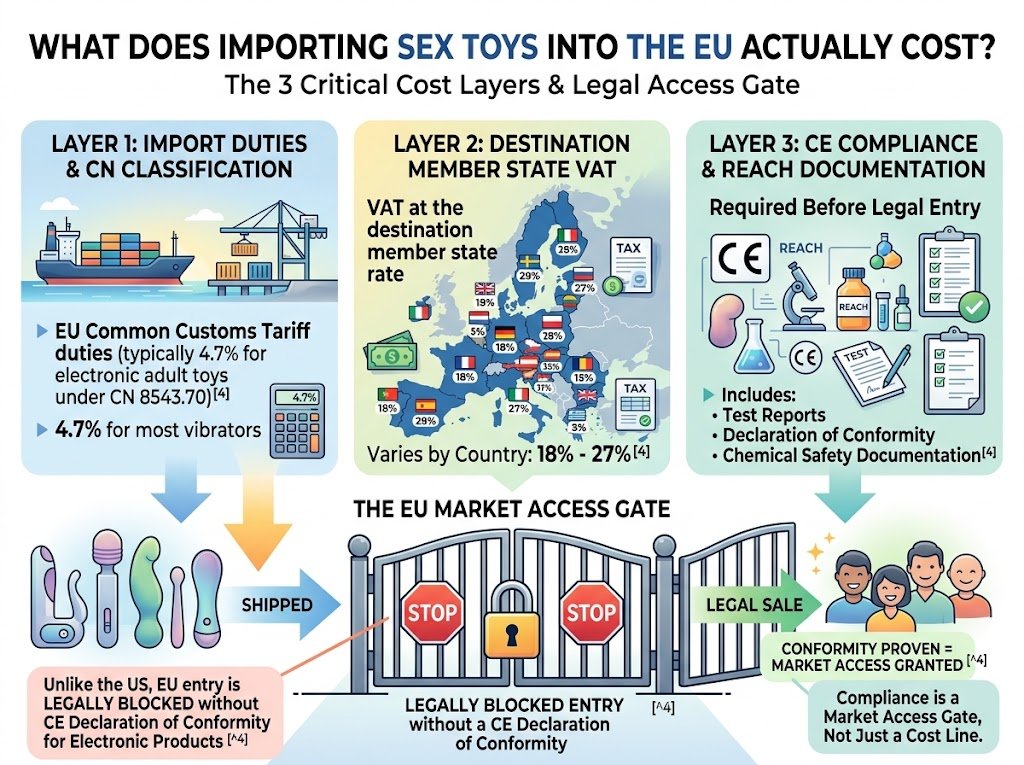
Here is the full EU import cost structure — with the compliance requirements that determine whether goods clear at all.
🇪🇺 EU Import Cost Layer 1 — Common Customs Tariff Duty
The EU applies a Common External Tariff (CET) to imports from China, with country of origin determined by standard rules of origin. For adult toys classified under CN 8543.70.90 (other electrical machines and apparatus), the CET rate is typically around 3–4.7%. For products classified under CN 9503 (toys), the rate varies by subcategory.
The tariff base is the CIF value (cost + insurance + freight) of the shipment — meaning EU duties are calculated on a larger base than US HTS duties, which typically use the FOB value.
🇪🇺 EU Import Cost Layer 2 — Value Added Tax
VAT applies to all imports entering EU member states. The rate varies by country but typically sits at 20–25% for most goods in most major EU markets:
| EU Market | Standard VAT Rate | VAT Applied On |
|---|---|---|
| Germany | 19% | CIF + duty |
| France | 20% | CIF + duty |
| Netherlands | 21% | CIF + duty |
| Sweden | 25% | CIF + duty |
| Italy | 22% | CIF + duty |
| Poland | 23% | CIF + duty |
VAT is typically recoverable by registered VAT businesses — meaning it is a cash flow cost rather than a permanent cost for B2B importers. For D2C brands selling directly to consumers, however, VAT is a real cost that must be factored into retail pricing for each EU market.
🇪🇺 EU Import Cost Layer 3 — CE Compliance and REACH Documentation
CE marking is a legal requirement for placing electronic products on the EU market — including all rechargeable or motorised adult toys. A shipment without a CE Declaration of Conformity for electronic products can be refused entry, held for inspection, or destroyed at the EU border. This is not a cost risk — it is a market access risk.
At VF Pleasure, all products comply with CE, RoHS, REACH, and CA65 certification standards, and we provide full documentation for smooth importation across target markets. For private label brands, CE re-declaration under your brand name as the EU responsible person is supported — meaning your CE Declaration names your brand, not VF Pleasure, as the entity responsible for the product's compliance in the EU market.
REACH compliance — confirming that no restricted substances exceed permitted thresholds in the product's material composition — is also required for EU market entry. Our food-grade silicone documentation, verified through gas chromatography per batch, provides the underlying material data that REACH compliance declarations draw from.
🇬🇧 UK Post-Brexit: UKCA Marking
The UK now requires UKCA (UK Conformity Assessed) marking rather than CE marking for products entering the Great Britain market (England, Scotland, Wales). Northern Ireland maintains CE compliance. For brands selling into both EU and UK markets, this creates a dual certification requirement. The testing and technical file content largely overlaps with CE — but the Declaration of Conformity document and the product marking itself must reflect UKCA specifically for UK customs clearance.
📊 EU Import Cost Stack Example: €10,000 CIF Value Shipment
| Cost Element | Rate | Estimated Amount |
|---|---|---|
| CIF declared value | — | €10,000 |
| EU customs duty (CN 8543.70) | ~4.7% | €470 |
| VAT base (CIF + duty) | — | €10,470 |
| VAT at 20% (France example) | 20% | €2,094 |
| Customs broker fee | Variable | €150–€350 |
| Total estimated import cost | — | €2,714–€2,914 |
| Effective import rate | — | ~27–29% |
💡 Sally's EU compliance note: The General Product Safety Regulation (GPSR), which took effect across the EU in December 2024, has strengthened obligations on brands selling into EU markets — including requirements for an EU responsible person, product traceability, and serious incident reporting. For adult toy brands entering the EU through private label or OEM programs, ensuring your compliance documentation includes a named EU responsible person before your first shipment is no longer optional. Our adult toy quality compliance guide and body-safe adult toys manufacturing standards guide cover the compliance documentation stack required for EU market access.
What Are the Import Requirements for Sex Toys in Japan?
Japan represents a significant premium adult toy market — but it carries a distinct set of import requirements that differ fundamentally from both the US and EU frameworks. Many adult toy importers either underestimate Japan's regulatory complexity or focus only on tariff rates while missing the product safety and obscenity law dimensions that actually determine whether your shipment clears Japanese customs at all.
Importing sex toys into Japan from China involves a low customs duty rate (typically 0–3% for most adult toy categories), but requires specific attention to three Japan-specific factors: PSE (Product Safety of Electrical Appliances and Materials) compliance for electronic products, Japan's obscenity law framework under Article 175 of the Penal Code which affects certain product presentations, and Japanese customs' heightened inspection rates for shipments with adult product descriptions.[^5]
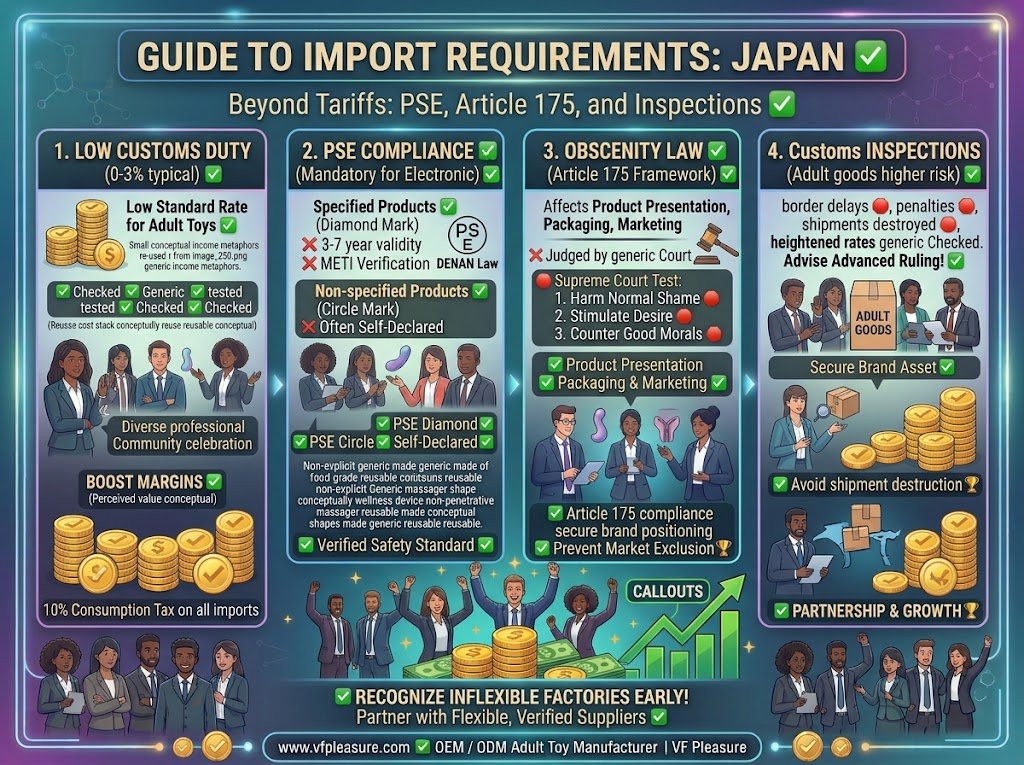
Here is what each of these factors means in practical import planning terms.
🇯🇵 Japan Import Cost Layer 1 — Customs Duty Rates
Japan generally maintains low MFN tariff rates for most consumer goods as part of its trade policy framework. Adult toy categories typically attract duties in the 0–3% range depending on HS classification — significantly lower than both the US (with Section 301 surcharges) and the EU (CET rates).
However, Japan also applies Consumption Tax (similar to VAT) at the standard rate of 10% on most imported goods. This applies to the CIF value plus any applicable duty, and must be factored into landed cost calculations for the Japanese market.
🇯🇵 Japan Import Cost Layer 2 — PSE Compliance for Electronic Products
Japan's PSE (Product Safety of Electrical Appliances and Materials) marking system requires that certain electronic products sold in Japan carry PSE certification — either a diamond PSE mark for "specified electrical appliances" with higher safety risk, or a circle PSE mark for "non-specified electrical appliances." Rechargeable electronic adult toys typically require circle PSE certification.
PSE certification involves product testing by a registered inspection body in Japan and an annual inspection of the importer or manufacturer's quality management system. The certification process can take two to three months for new products — and the mark must appear on the product label before import. Products entering Japan without appropriate PSE marking for their product category may be detained or returned at customs.
This is the single most common Japan-specific compliance omission I see from adult toy brands that have successfully exported to the US and EU but are entering Japan for the first time. CE certification does not substitute for PSE. The two systems are entirely separate.
🇯🇵 Japan Import Cost Layer 3 — Obscenity Law Considerations
Article 175 of Japan's Penal Code restricts obscene materials. In the adult toy context, this primarily affects products with explicit visual representations or highly realistic anatomical features on product packaging. Japan customs officers have discretion in making this determination — and inspection rates for adult product shipments are higher than for most other consumer goods categories.
Practical approach: For adult toy brands importing into Japan, packaging design should be functional and brand-forward rather than visually explicit. The product itself is typically not the issue. The packaging presentation — particularly outer box imagery — is what triggers inspection delays.
Many established adult toy brands produce Japan-specific packaging variants that omit explicit imagery while retaining brand identity. This is a packaging line item, not a production line item — but it needs to be planned before your Japanese launch, not after your first shipment is held at Narita.
📊 Japan Import Cost Stack Example: ¥1,000,000 CIF Value Shipment
| Cost Element | Rate | Estimated Amount |
|---|---|---|
| CIF declared value | — | ¥1,000,000 |
| Customs duty (typical adult toy) | ~0–3% | ¥0–30,000 |
| Consumption Tax (10%) | 10% on CIF + duty | ¥100,000–¥103,000 |
| PSE certification (annual, amortised) | Varies by product | ¥15,000–¥50,000 est. |
| Customs broker + inspection fees | Variable | ¥20,000–¥50,000 |
| Total estimated import cost | — | ¥135,000–¥233,000 |
| Effective import rate | — | ~14–23% |
Which Compliance Documents Protect You Across All Three Markets?
A buyer who is systematic about compliance documentation before production begins can reduce customs delays, eliminate border holds, and avoid the retroactive compliance costs that typically hit brands at the worst possible time — when a shipment is sitting at the port and a retail buyer is waiting for it.
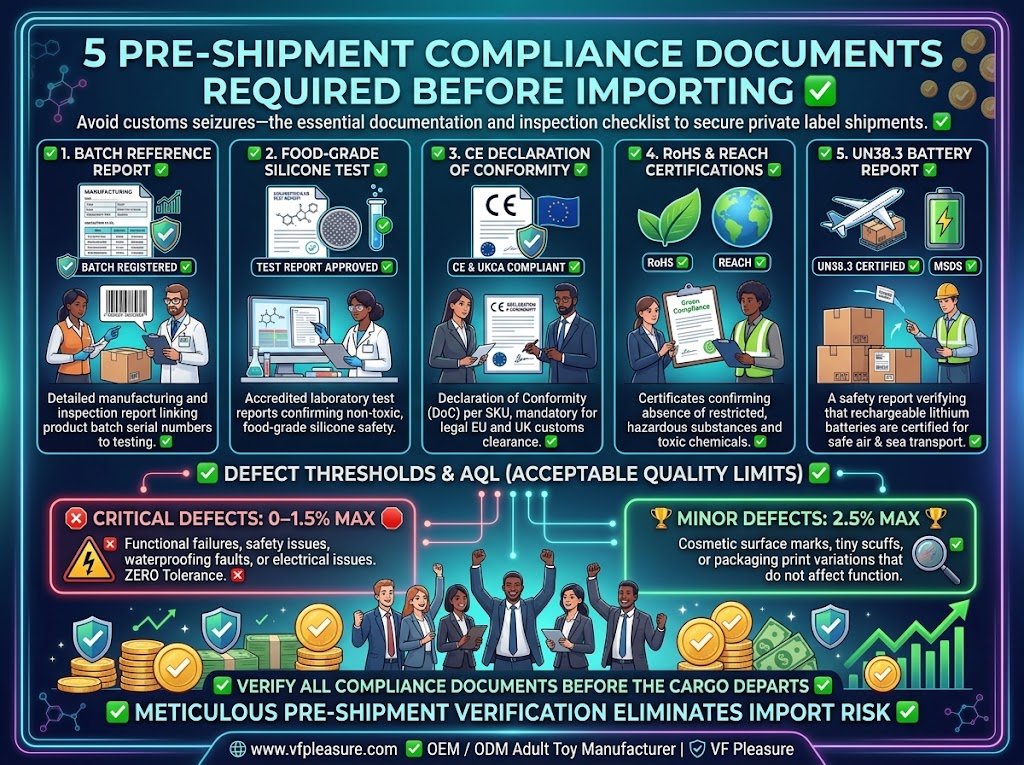
The compliance document set that protects adult toy imports across the US, EU, and Japan simultaneously is: a CE Declaration of Conformity per SKU (EU and UK), a food-grade silicone migration test report from a named accredited laboratory per batch (all markets), RoHS and REACH compliance certificates (EU mandatory, supported evidence for US and Japan), UN38.3 battery certification for rechargeable products (required for all air freight), and FCC documentation for wireless products (US-specific).[^6]

![]()
Here is the complete market-by-market compliance document matrix — and what VF Pleasure provides as standard versus what requires additional planning.
📋 Market-by-Market Compliance Document Matrix
| Document | US | EU | UK | Japan | VF Pleasure Status |
|---|---|---|---|---|---|
| CE Declaration of Conformity | Informational | ✅ Mandatory | ⚠️ UKCA needed | Not required | ✅ Per SKU, re-declaration support |
| Food-grade silicone test report | Supported evidence | ✅ REACH support | ✅ Required | ✅ Import support | ✅ Per batch, named laboratory |
| RoHS compliance certificate | Informational | ✅ Mandatory | ✅ Mandatory | Informational | ✅ Per SKU |
| REACH compliance | Informational | ✅ Mandatory | ✅ Mandatory | Informational | ✅ Included |
| CA65 / Prop 65 documentation | ✅ California | Not applicable | Not applicable | Not applicable | ✅ Included |
| UN38.3 battery certification | ✅ Air freight | ✅ Air freight | ✅ Air freight | ✅ Air freight | ✅ Per rechargeable SKU |
| FCC authorisation | ✅ Wireless/BT products | Not applicable | Not applicable | Not applicable | Scoped at design stage |
| PSE certification | Not applicable | Not applicable | Not applicable | ✅ Electronic products | Buyer-managed (Japan-specific) |
| UKCA Declaration | Not applicable | Not applicable | ✅ Mandatory | Not applicable | Available on request |
The two market-specific certifications that require buyer initiative beyond VF Pleasure's standard package are FCC (for US wireless products — scoped at product design stage) and PSE (for Japan — managed through a Japan-registered inspection body by the importing brand).
🏭 How VF Pleasure Prepares Your Documentation Set
At VF Pleasure, we provide full documentation to ensure smooth importation and compliance across your target markets. Our compliance package per SKU includes CE, RoHS, REACH, and CA65 documentation, with food-grade silicone test reports per production batch from named accredited laboratories. For private label orders, third-party verification through SGS or Bureau Veritas is available.
We provide compliance certificates for every batch — so your importation documentation is tied to specific production runs, not to a generic factory-level certificate that customs authorities increasingly reject as insufficient evidence. Our 12-step production process includes QC checkpoints at raw material intake, pre-assembly, finished product, and batch testing stages, with waterproof testing through IPX7 chambers and material testing through gas chromatography.
How Do You Build Import Costs Into Your Pricing Before You Source?
The brands that get pricing right consistently are not the ones with the lowest factory costs. They are the ones that calculate their full landed cost before they place a purchase order — and price their retail product against the landed cost, not the factory invoice. Import cost surprises do not destroy margins. Ignoring import costs in the pricing model does.
You build import costs into adult toy pricing by calculating landed cost as: factory price (FOB) + international freight + import duties + local taxes/VAT + compliance costs amortised per unit + customs broker fees. The resulting landed cost is your true cost basis for margin calculation. Retail price should be set against landed cost — not factory price — in every market where your product will be sold.[^7]
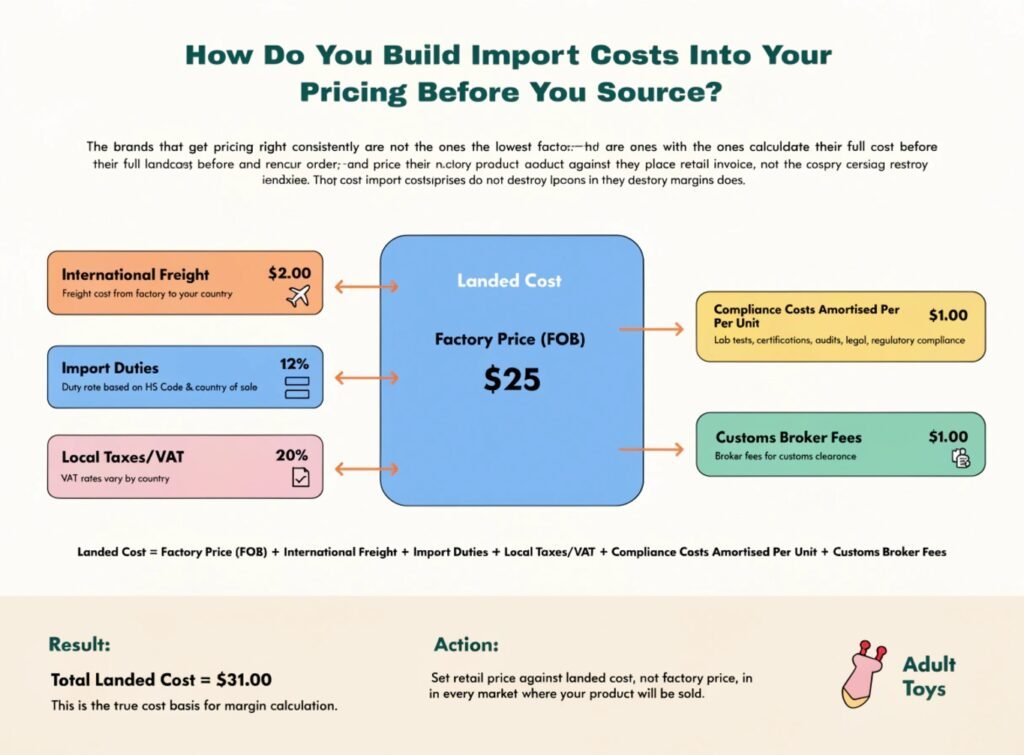
![]()
Here is the practical pricing model — built around a real adult toy scenario across three destination markets.
🧮 Landed Cost Calculation: $15 FOB Factory Price
Scenario: A food-grade silicone rechargeable vibrator, CE certified, food-grade documentation complete, no wireless function. FOB factory price: $15.
| Cost Element | US | EU (Germany) | Japan |
|---|---|---|---|
| FOB factory price | $15.00 | €13.50 | ¥2,100 |
| International freight (per unit estimate) | $2.00–3.00 | €1.80–2.50 | ¥350–500 |
| CIF value estimate | $17.50 | €16.00 | ¥2,600 |
| Import duty | ~$0.60 (3.5% HTS) | ~€0.75 (4.7% CET) | ~¥52 (2%) |
| Section 301 / additional tariff | ~$4.38 (25%) | None | None |
| VAT / Consumption Tax | None (paid at state retail) | ~€3.35 (19% Germany) | ¥265 (10%) |
| Customs broker fee (per unit, 500 units) | ~$0.50 | ~€0.40 | ~¥150 |
| Compliance amortised (per unit, 500 units) | ~$0.50 | ~€0.40 | ¥600 (incl. PSE est.) |
| Total landed cost estimate | ~$23.50 | ~€21.40 | ~¥3,767 |
| Implied multiplier over FOB | ~1.57x | ~1.59x | ~1.79x |
These are estimates — actual numbers vary by freight mode, shipment volume, broker rates, and current tariff classifications. But the multipliers are directionally accurate and confirm what experienced importers know: you need your retail price to be at least 3–5x your factory cost to maintain a healthy margin after import costs, operating expenses, and platform fees are stacked together.
💡 The Pricing Model That Avoids the Margin Surprise
Build your pricing model before production confirmation, not after. Here is the structure:
- Start with your target retail price — what does the market bear for your product positioning?
- Work back from retail price — subtract your target gross margin (typically 50–65% for DTC adult wellness)
- The result is your maximum landed cost target — what you can afford to land the product at, inclusive of all import costs
- From landed cost, subtract import costs (using the market-specific stack above) — the result is your maximum factory cost
- Compare this to your factory quotes — if the factory cost exceeds the maximum, you need to either renegotiate, reduce customisation scope, or raise retail pricing
This reverse calculation prevents the scenario where a product is designed, sampled, and priced before anyone calculated whether the import cost stack leaves any margin at all.
Our sex toy wholesale pricing breakdown guide and food-grade silicone private label profit guide build on this framework with real margin models across different product tiers and market channels.
💡 Sally's 15-year observation: The single most consistent margin mistake I see in adult toy sourcing is the buyer who selects their factory price against their retail price without accounting for the import stack. A $15 factory price feels like it supports a $45 retail price at a healthy margin. Once you add $8.50 in US import costs, $3.00 in freight, $2.00 in broker fees, and $1.50 in platform fees, your actual landed cost is $30 — and your $45 retail price suddenly supports a 33% gross margin rather than the 67% you planned. Get the import stack right before the factory quote ever becomes a purchase order.
Conclusion
The real cost of importing sex toys from China is factory price plus a 25–55% import stack that varies by destination market — and it is fully predictable before you place any order if you calculate US tariffs, EU duties and VAT, Japan's PSE requirements, and compliance documentation costs into your landed cost model before production begins, not after goods arrive at the border.
🚀 Ready to Source Adult Toys with Full Import-Ready Compliance Documentation?
At VF Pleasure, we provide the full compliance documentation package that reduces customs delays and protects your market access across the US, EU, UK, and Japan. Our Dongguan factory produces exclusively food-grade silicone products with CE, RoHS, REACH, and CA65 certification per SKU — supported by batch-specific food-grade silicone test reports from named accredited laboratories.
Every order includes:
- ✅ CE, RoHS, REACH, CA65 documentation — per SKU, per production batch, ready for customs presentation
- ✅ Food-grade platinum silicone — gas chromatography test reports per batch, third-party verified through SGS or Bureau Veritas for private label orders
- ✅ CE re-declaration support — your brand name as the EU responsible person, not ours
- ✅ UN38.3 battery certification — for all rechargeable products, required for air and sea freight
- ✅ FCC scoping at design stage — wireless product compliance planned before production, not discovered at customs
- ✅ Full product range — vibrators, female sex toys, couples toys, thrusting toys, male adult toys, and private label programs
📬 Start Your Import-Ready Sourcing Conversation — Three Questions:
1. Which market are you importing into — and is it your first time importing from China?
(US / EU / UK / Japan / multiple — and I can tell you which specific compliance documents you need for your market combination)2. What product category are you sourcing — and does it include wireless or app-controlled function?
(Electronic function and wireless capability are the two factors that most change your compliance and tariff cost stack)3. What is your planned order volume for your first shipment?
(This determines how compliance certification costs amortise per unit across your import cost calculation)👉 Request Import-Ready Documentation + Free Product Samples from VF Pleasure →
References & Source Notes
-
VF Pleasure — Adult Toy Customs CE & RoHS Compliance Guide 2026
| Field | Detail |
|---|---|
| 📌 Supports | The real cost of importing sex toys includes four layers beyond factory price: import duties/tariffs, VAT or consumption tax, compliance certification costs, and customs broker fees. VF Pleasure provides full documentation for smooth importation and compliance across target markets including CE, RoHS, REACH, and CA65. |
| 🔍 Evidence Role | Definition + General Support |
| 📁 Source Type | Industry Guide |
⚠️ Scope Note: Import cost percentages and tariff rate estimates described throughout this article reflect general industry guidance at time of writing based on publicly available customs authority information. All figures are subject to change as trade policy, tariff schedules, and regulatory requirements evolve. Buyers must verify current rates with a licensed customs broker for their specific shipment and product classification before making pricing decisions.
-
VF Pleasure — Adult Toy Quality Compliance Guide
| Field | Detail |
|---|---|
| 📌 Supports | HS code classification determines both tariff rate and applicable product safety regulations. Electronic adult toys may classify under HS 8543.70 or 9503 depending on customs authority interpretation. VF Pleasure provides documentation supporting correct classification and customs clearance across major markets. |
| 🔍 Evidence Role | Definition |
| 📁 Source Type | Industry Guide |
⚠️ Scope Note: HS code classifications described are representative examples based on common adult toy import practices. Correct classification depends on the specific product, destination market, and relevant customs authority's interpretation. All HS classification decisions should be confirmed with a licensed customs broker prior to shipment. Misclassification can result in underpayment or overpayment of duties with associated penalties.
-
VF Pleasure — Sex Toy Wholesale Pricing Breakdown Guide
| Field | Detail |
|---|---|
| 📌 Supports | US import costs for sex toys from China include Section 301 tariffs (25% on most electronic adult toy categories), basic HTS duty rates (0–6.5%), FCC certification for wireless products, and CA65/Proposition 65 compliance for California sales. VF Pleasure includes CA65 documentation as part of its standard compliance package. |
| 🔍 Evidence Role | General Support |
| 📁 Source Type | Industry Guide |
⚠️ Scope Note: Section 301 tariff rates and HTS classification guidance reflect publicly available US trade policy information at time of writing. Section 301 tariffs are subject to ongoing trade policy changes. The cost stack estimates provided are illustrative calculations — actual import costs depend on specific product classification, declared value, freight terms, and current trade policy. Buyers should consult a licensed US customs broker before finalising import cost calculations.
-
VF Pleasure — Adult Toy Manufacturer Partnership Strategies
| Field | Detail |
|---|---|
| 📌 Supports | EU imports of adult toys from China require EU Common Customs Tariff duties (typically ~4.7% for electronic adult toys), VAT at destination member state rates (18–27%), CE compliance documentation (legally mandatory for electronic products), and REACH compliance. VF Pleasure supports CE re-declaration under buyer brand names as EU responsible person. |
| 🔍 Evidence Role | General Support |
| 📁 Source Type | Industry Guide |
⚠️ Scope Note: EU customs tariff rates, VAT rates by member state, and GPSR regulatory requirements described reflect publicly available EU regulatory information at time of writing. EU trade regulations and member state VAT rates change periodically. GPSR requirements are based on the regulation as in effect from December 2024. Buyers should verify current requirements with an EU customs broker and/or EU compliance advisor before making market access decisions.