Skip to content
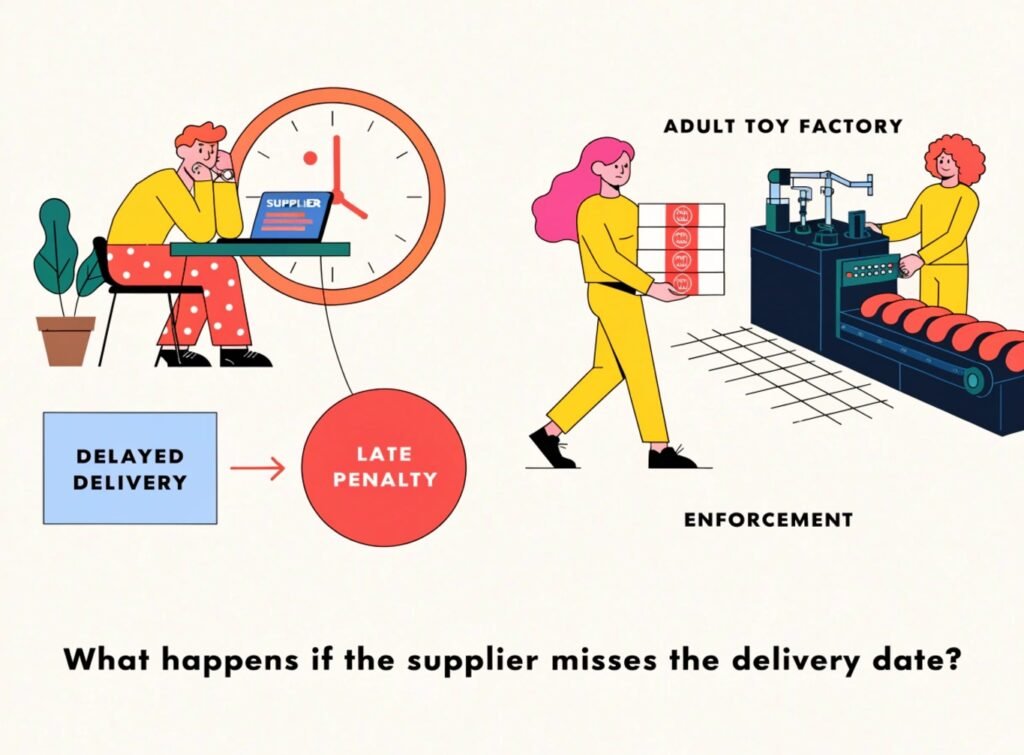
You built your campaign around your launch date. Your retail buyer confirmed shelf space. Your ad budget is locked. Then the factory misses the delivery window by two weeks — and sends a vague message about "production complications" four days after the original delivery date had already passed. By then, your options are limited and every one of them is expensive.
When a sex toy supplier misses a delivery date and your contract has no penalty clause, you have no commercial remedy — only the option to accept the delay, cancel the order and lose your deposit, or renegotiate on the factory's terms. A well-drafted penalty clause converts a delivery date from a factory preference into a financially enforceable commitment, with liquidated damages that compensate your actual business loss when a supplier's delay creates it.1
I'm Sally. I run VF Pleasure — a direct adult toys factory in Dongguan, China, with 15+ years of manufacturing experience. Our standard mass order lead time is 25–35 days depending on complexity and quantity, with expedited options available for urgent orders. Our monthly production capacity is 50,000 units with scalability for seasonal surges — and I have managed enough production timelines to know exactly where delays come from and what structures prevent them.
This guide explains the real mechanics of delivery delays in adult toy manufacturing, how to write penalty clauses that Chinese factories will accept, and what separates a factory culture that protects your delivery date from one that treats it as a suggestion.
- 1 Why Is a Delivery Date Without a Penalty Clause Almost Worthless?
- 2 What Are the Root Causes of Supplier Delivery Delays in Adult Toy Manufacturing?
- 3 How Do You Write a Penalty Clause That Chinese Factories Will Actually Accept?
- 4 What Should Your Milestone Schedule Look Like for an Adult Toy Production Run?
- 5 How Do You Handle a Delay in Real Time Without Destroying the Relationship?
- 6 What Separates a Factory That Protects Your Delivery Date from One That Doesn't?
- 7 Conclusion
- 8 References & Source Notes
Why Is a Delivery Date Without a Penalty Clause Almost Worthless?
Most adult toy OEM purchase orders contain a delivery date. Almost none of them contain consequences for missing it. This asymmetry is entirely predictable: factories draft purchase orders, and factories have no incentive to include language that penalises themselves. Buyers accept these documents because they assume good faith will hold. It often does — until a larger client's urgent reorder competes for the same production line as your order.
A delivery date without a penalty clause is almost worthless because it creates no commercial asymmetry between delivering on time and delivering late. The factory faces no financial consequence for a two-week delay — while your business absorbs the full cost: missed retail windows, cancelled ad campaigns, delayed customer orders, and lost revenue. A penalty clause changes this by creating a cost for the factory that makes on-time delivery financially preferable to late delivery.1
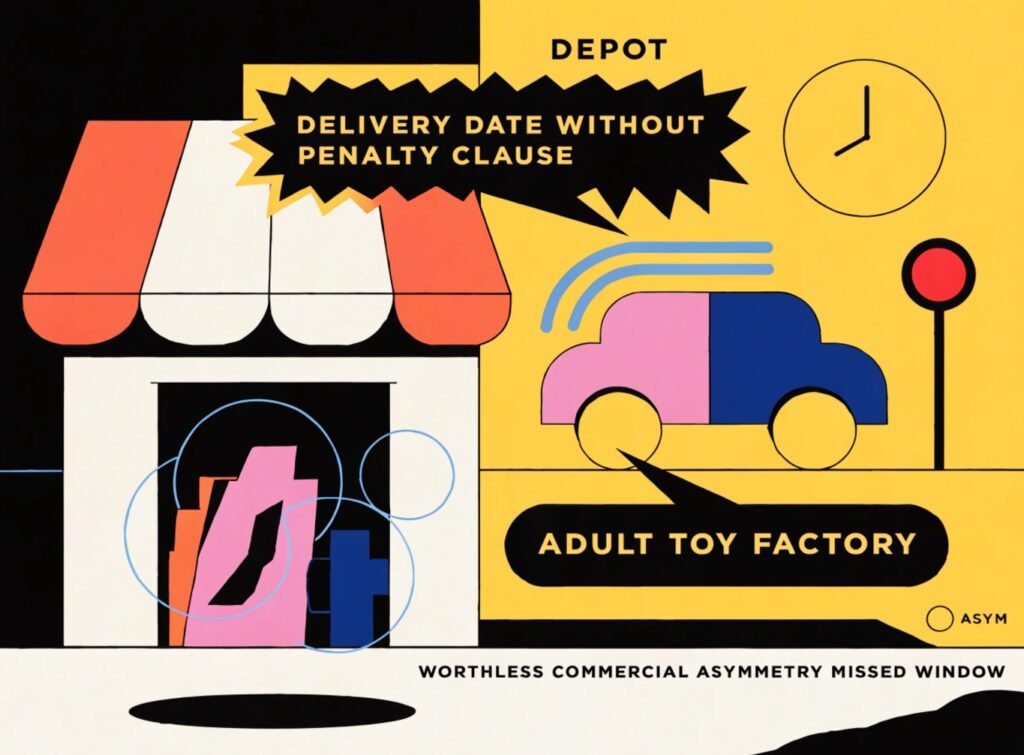
Here is the cost asymmetry that makes a penalty clause not just useful but necessary.
📊 The Cost Asymmetry Between Factory and Buyer on Late Delivery
| Stakeholder | Cost of On-Time Delivery | Cost of Two-Week Late Delivery |
|---|---|---|
| Factory | Production effort required regardless | No financial consequence without penalty clause |
| Buyer (e-commerce brand) | Zero additional cost | Lost campaign spend, delayed revenue, possible stock-out |
| Buyer (retail distributor) | Zero additional cost | Retailer penalties, lost shelf placement, relationship damage |
| Buyer (subscription box) | Zero additional cost | Subscriber cancellations, brand trust damage, box delay fees |
Without a penalty clause, every row in the right-hand column represents buyer cost with zero factory accountability. With a well-drafted penalty clause, the factory's cost of late delivery becomes proportional to the buyer's business loss — which changes the factory's production scheduling decision.
Production delays are one of the most common challenges in adult toy manufacturing — along with communication barriers, hidden costs, and quality control issues. The prescribed solution is direct: set clear deadlines and include penalty clauses. This guide shows you exactly how to do both. Our adult toy manufacturing challenges and solutions guide and how to negotiate with Chinese adult toy factories guide cover the broader contract negotiation context.
What Are the Root Causes of Supplier Delivery Delays in Adult Toy Manufacturing?
Delivery delays feel random from the buyer's side. From the factory side, they almost always have a predictable cause — and each cause has a structural prevention mechanism. Understanding the root cause tells you which contractual and operational protection to put in place before a delay occurs, rather than scrambling to manage it after.
The root causes of delivery delays in adult toy manufacturing fall into five categories: production scheduling conflicts caused by larger client priority overrides, component supply chain disruptions affecting critical electronic parts, quality control failures that require rework time not built into the production schedule, documentation misalignments that delay customs clearance, and communication failures where the factory knows about a delay but does not inform the buyer until the deadline has already passed.2
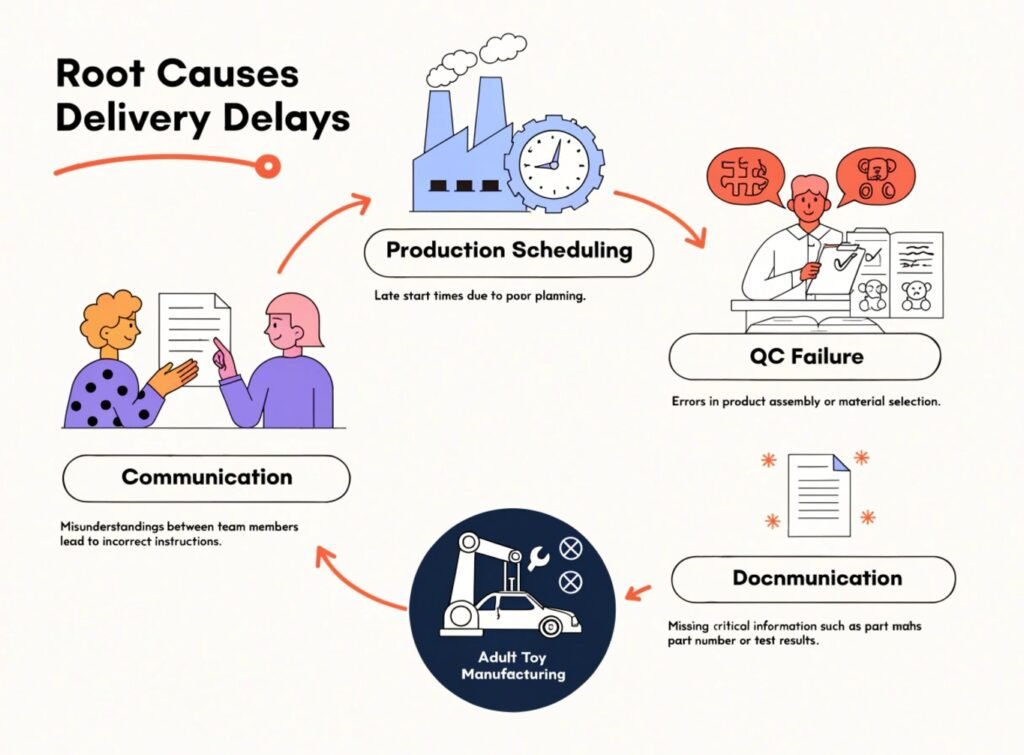
Here is each root cause with the prevention mechanism that specifically addresses it.
⚙️ Root Cause 1 — Production Scheduling Conflict
When a factory's largest client places an urgent reorder, the factory makes a scheduling choice: deprioritise the smaller client's order and absorb the relationship cost, or miss the larger client's timeline and absorb the commercial cost. In the absence of a penalty clause, small buyers almost always lose this decision.
Prevention: A dedicated production slot clause names your order's production window specifically and requires written notification if that window is moved for any reason. A penalty clause makes the financial cost of a scheduling overrule concrete. Together, these two contract elements change the factory's scheduling decision calculus.
🔩 Root Cause 2 — Component Supply Chain Disruption
Electronic components — motors, charging modules, PCBs — can face supply disruption from sub-suppliers, creating material shortages that delay production start. A factory that relies on a single sub-supplier for any critical component has a structural delay risk with no internal buffer.
Prevention: Ask any factory candidate: "How many qualified sub-suppliers do you have for your critical motors and electronics? Have you tested alternatives?" A factory with single-source component dependency should be required by contract to notify you within three business days of any anticipated supply issue — not after production has already started without the critical component.
🧪 Root Cause 3 — QC Failure and Rework
QC failures cause a significant share of shipment delays. A waterproofing failure at finished product inspection, a charging connection issue discovered in batch testing, or a colour fastness problem that surfaces at pre-shipment — all require rework time that was not built into the original lead time estimate.
The key distinction is whether the factory catches these failures internally or you discover them when the goods arrive. When one of our partners updated their IPX7 waterproof testing protocol to include pre-use simulation, the existing product failed the updated standard. Rather than shipping non-compliant product and hoping for the best, we redesigned the internal waterproof architecture, ran repeated internal validation, and resubmitted. The delivery date was maintained. The rework time came from our production buffer — not from a delay to the buyer's schedule.
Prevention: A milestone schedule with an explicit finished product QC checkpoint date — before the final delivery date — gives you visibility into whether a QC rework scenario is developing in time to adjust your logistics rather than your launch.
📄 Root Cause 4 — Documentation Misalignment at Customs
This is the root cause most buyers never anticipate — because it happens after production is complete, not during it. A batch code that does not align with the inspection date on customs documentation can trigger a hold at the port of export or at your destination customs. Your goods are complete, quality-approved, and sitting in a container — but the paperwork is wrong and clearance is delayed.
When an adjusted delivery schedule created a mismatch between batch codes and inspection dates for one of our clients, we clearly documented the full production and inspection timeline, communicated proactively with the client before the inspection date, and provided written QA explanation for the inspector. The issue was accepted. Delivery was maintained. Transparent communication is the key to solving these operational challenges — but it has to happen before the inspection, not after it fails.
Prevention: Require pre-shipment documentation review as a named milestone — confirmed complete and accurate before the shipment leaves the factory. A two-day documentation check window before dispatch catches paperwork errors that would otherwise become port delays.
📡 Root Cause 5 — Communication Failure
The most damaging root cause is not the delay itself. It is discovering the delay on or after the delivery date rather than ten days before it. A factory that knows three weeks before the delivery date that production will be two weeks late — and says nothing — gives its buyer no time to adjust logistics, warn a retail partner, or extend an ad campaign. A factory that communicates the same information proactively gives the buyer two weeks to manage the situation.
Prevention: A proactive communication obligation clause — requiring the factory to notify the buyer not less than ten business days before any milestone is anticipated to be missed — is the single most effective delivery protection in any adult toy manufacturing contract.
How Do You Write a Penalty Clause That Chinese Factories Will Actually Accept?
A penalty clause that no factory will sign provides exactly as much protection as no penalty clause. The challenge is writing one that is commercially reasonable enough that a legitimate, transparent factory accepts it, while specific enough that it actually compensates your real business loss when a delay occurs.
A penalty clause that Chinese factories will accept uses three drafting principles: liquidated damages framed as a genuine pre-estimate of loss rather than a punitive penalty, a tiered rate structure that escalates with delay duration rather than applying a flat rate from day one, and a force majeure carve-out that is specific and limited rather than broad and open-ended. Legitimate factories accept this structure because it is proportionate. Only factories planning to miss your deadline resist it.3
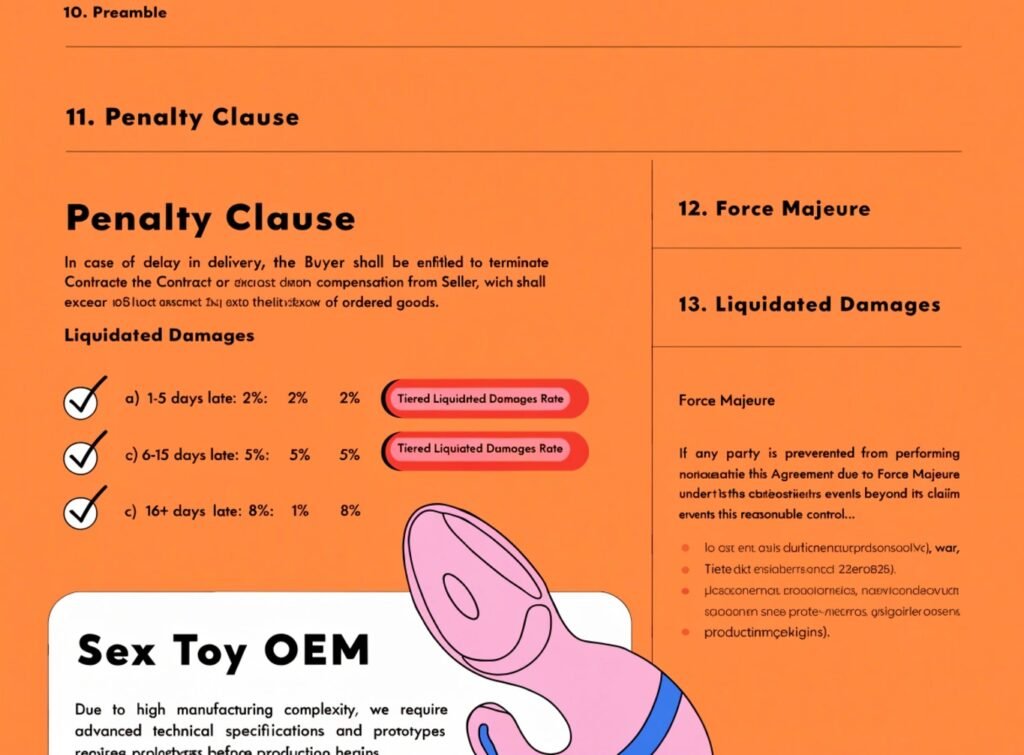
Here is the full penalty clause framework — with specific language for each element.
✍️ Element 1 — Liquidated Damages as Pre-Estimate of Loss
The clause must characterise the damages as compensatory rather than punitive. This matters for enforceability in both Chinese contract law and most common law jurisdictions:
"In the event of late delivery not excused under the Force Majeure provisions, Supplier shall pay Buyer liquidated damages representing a genuine pre-estimate of Buyer's loss, calculated as follows: [see tiered rate structure below]. Both parties acknowledge that these amounts represent a genuine pre-estimate of Buyer's loss and not a penalty."
The "genuine pre-estimate" language is what makes this clause enforceable. A court assessing a penalty clause will ask: does this represent a reasonable estimate of the actual loss? If yes, it is enforceable. If it looks punitive, it may be set aside.
✍️ Element 2 — Tiered Rate Structure
A flat penalty from day one feels punitive to a factory dealing with a one-day delay. A tiered structure that starts small and escalates feels proportionate — which is why legitimate factories accept it while still creating meaningful consequences for sustained delays:
"Liquidated damages shall be calculated as: (a) Days 1–7 of delay: 0.3% of the delayed order value per day; (b) Days 8–14 of delay: 0.5% of the delayed order value per day; (c) Days 15 and beyond: 1.0% of the delayed order value per day; subject to a maximum aggregate liquidated damages amount of 15% of the total order value."
The maximum cap (typically 10–15%) is important for factory acceptance. An uncapped penalty is treated as potentially unlimited exposure — which most factories refuse to sign. A capped structure signals commercial reasonableness.
✍️ Element 3 — Specific and Limited Force Majeure
"Force Majeure events under this Agreement are limited to: (a) natural disasters directly preventing production at Supplier's named facility with documented evidence; (b) government-mandated factory closures with documented government order; (c) civil unrest directly affecting transportation to Supplier's facility. The following are expressly excluded from Force Majeure: supply chain cost increases, component shortages, production scheduling conflicts, Supplier's own quality failures, and delays caused by Supplier's sub-contractors."
The explicit exclusion list is where the real protection lives. Component shortages and scheduling conflicts are the two most common excuses for delays — and both are within the factory's control if it has proper supply chain management and production scheduling practices.
✍️ Element 4 — Buyer Termination Right
"If Supplier's delay exceeds [21 calendar days] from the stated delivery date and is not excused under the Force Majeure provisions, Buyer may terminate this Agreement by written notice, in which case Supplier shall refund Buyer's deposit in full within [15 business days] of receipt of the termination notice, plus any liquidated damages accrued to the termination date."
This termination right is the backstop that gives the penalty clause real commercial weight. Without it, a factory can simply run up liquidated damages while refusing to ship — knowing the buyer still needs the goods eventually. The termination and refund right changes this dynamic entirely.
📋 Penalty Clause Rate Reference Table
| Delay Duration | Liquidated Damages Rate | Example: $10,000 Order |
|---|---|---|
| Days 1–7 | 0.3% per day | $30/day ($210 total max) |
| Days 8–14 | 0.5% per day | $50/day ($350 total max) |
| Days 15+ | 1.0% per day | $100/day |
| Maximum total | 15% of order value | $1,500 cap |
💡 Sally's factory-side note: At VF Pleasure, we have signed penalty clauses in this general structure. We do it because we have no intention of missing delivery dates — and a well-drafted penalty clause is evidence that the buyer takes their supply chain seriously. The factories that refuse to sign reasonable penalty clauses are, in my experience, the factories that have either missed deadlines before or are planning to.
What Should Your Milestone Schedule Look Like for an Adult Toy Production Run?
A penalty clause that applies only at the final delivery date gives you one chance to catch a problem — on the date it has already become a crisis. A milestone schedule built into the contract gives you five or six earlier chances to catch and correct the same problem when it is still manageable.
An adult toy production milestone schedule should include six named dates: material confirmation, production start, mid-production inline QC report, finished product QC completion, pre-shipment documentation sign-off, and vessel loading or dispatch date. Each milestone creates a checkpoint where delay visibility surfaces early — when the correction is still cheap — rather than at final delivery, when it is already expensive.4
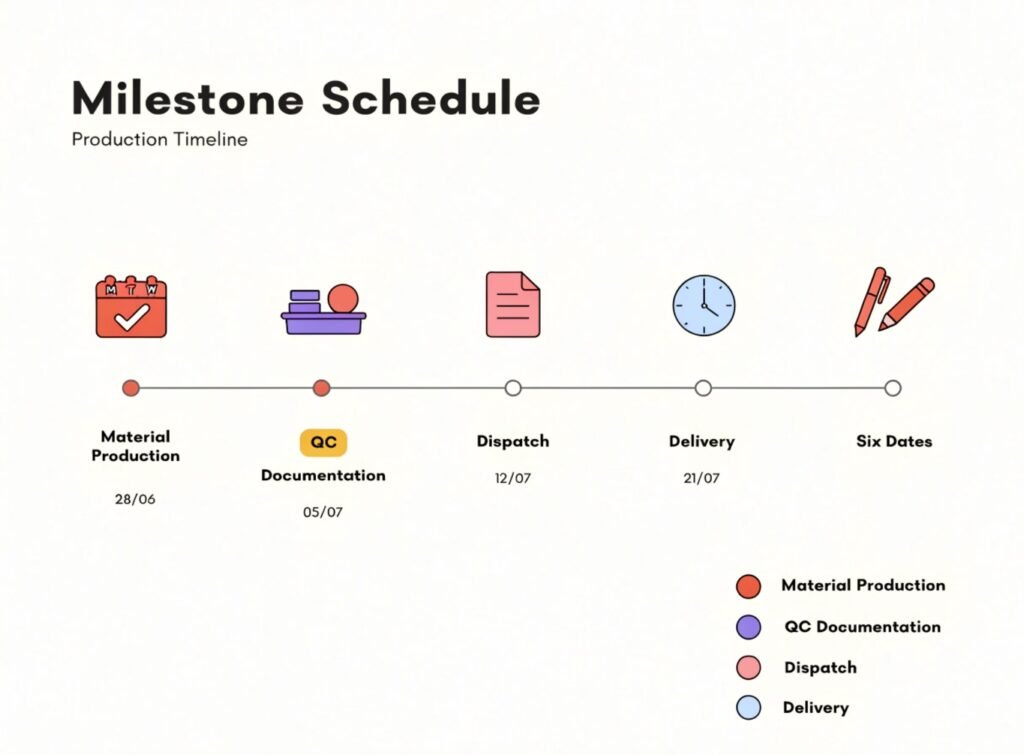
Here is the milestone schedule with the specific deliverable for each date.
📅 The Six-Milestone Production Schedule
| Milestone | Timing | Factory Deliverable | Buyer Action |
|---|---|---|---|
| 1. Material confirmation | Day 2 after deposit | Written confirmation that food-grade silicone batch is validated and in stock | Confirm in writing, request batch reference |
| 2. Production start | Per agreed schedule | Confirmation that production line is active for your order | Confirm in writing |
| 3. Mid-production QC | Day 5–8 of production | Inline QC report: units produced, pass/fail by category | Review report, flag any failure trends |
| 4. Finished product QC | Per schedule, 3+ days before packaging | QC results: waterproofing, vibration, charging — before packaging begins | Approve in writing before packaging proceeds |
| 5. Pre-shipment documentation | 3 business days before dispatch | Full QC batch report, compliance documentation set, packing list | Review and confirm complete before dispatch authorisation |
| 6. Dispatch confirmation | Day of vessel loading or courier handover | Tracking information, bill of lading or AWB | Confirm receipt, adjust logistics planning |
Each milestone should be written into the contract with the specific date and the specific deliverable — not just a list of stages. A milestone with no deliverable defined is a stage name, not an accountability mechanism.
The contract clause covering milestones should read:
"Supplier shall provide Buyer with written confirmation of each production milestone as listed in Schedule [X] on or before the date stated for each milestone. In the event that any milestone is anticipated to be delayed, Supplier shall notify Buyer not less than [5 business days] before the milestone date with: (a) the specific cause of anticipated delay; (b) a revised milestone schedule; and (c) Supplier's proposed remediation plan."
How Do You Handle a Delay in Real Time Without Destroying the Relationship?
A penalty clause exists to be used if needed — not to start every conversation with. When a supplier notifies you of a delay, the most productive response is not immediately invoking the liquidated damages rate. It is treating the notification as the relationship-appropriate behaviour it is — and using the conversation to assess whether the delay is recoverable and what it actually costs you.
When a sex toy supplier notifies you of a delay, the right response sequence is: assess the commercial impact of the delay on your specific business commitments, quantify the direct cost as a reference point for negotiation, propose a recovery plan collaboratively before invoking penalty terms, and reserve liquidated damages for delays that either significantly exceed the stated threshold or come without prior notification.5
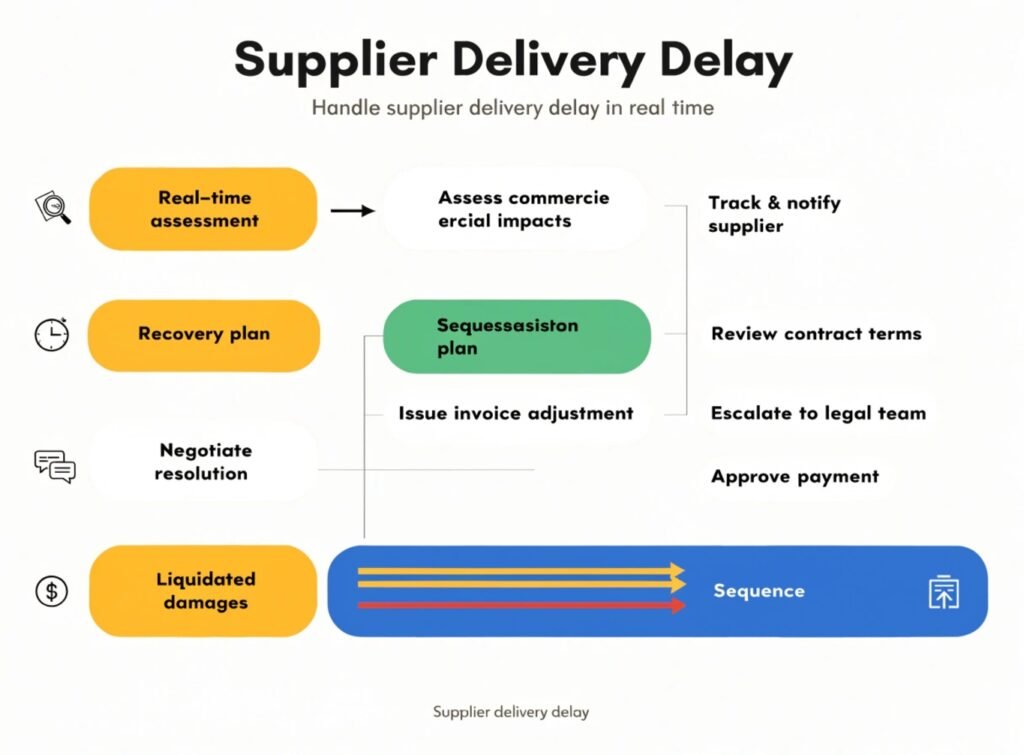
Here is the real-time delay management sequence — with the specific steps and the communication approach for each.
🗓️ Step 1 — Quantify Your Actual Business Impact
Before any penalty conversation, calculate what the delay actually costs your business:
- Campaign costs: Are paid media campaigns timed to the delivery? What is the cost of pausing or shifting them?
- Retail commitments: Does a retailer have confirmed shelf space or a listing going live? What are their late delivery consequences?
- Subscription timing: Are subscribers expecting a box that now cannot be fulfilled on schedule?
- Cash flow: Does the delay push revenue recognition into a different reporting period?
This quantification serves two purposes: it tells you what amount to reference in any penalty conversation, and it gives you the business case for expedited options that the factory may offer.
🤝 Step 2 — Propose a Recovery Plan Before Invoking Penalties
A collaborative recovery conversation often produces a better outcome than an immediate penalty invocation:
"I've received your notice of anticipated delay. Our launch is tied to [specific commitment]. The direct cost of a two-week delay to us is [specific amount]. I would like to discuss whether expedited production, air freight upgrade at your cost, or partial shipment of completed units can recover part of the schedule before we discuss the liquidated damages provision."
This approach achieves two things: it quantifies your loss clearly, and it offers the factory a commercially rational alternative to paying the liquidated damages — one that both parties may prefer.
At VF Pleasure, expedited options are available for urgent orders. Our manufacturing schedule has buffer capacity for situations where a production timeline needs to be accelerated — and we absorb the cost of that acceleration when the delay is on our side. This is the factory culture that a penalty clause should enforce but should not need to invoke routinely.
⚖️ Step 3 — Reserve Formal Penalty Invocation for Two Scenarios
Use the liquidated damages clause formally in two situations only:
Scenario A — Delay that exceeds the notification threshold. If the factory notifies you of a delay less than the contractual minimum notice period, the failure to provide adequate notice is itself a breach — and the full liquidated damages should apply from the original delivery date, not from when you were told.
Scenario B — Delay that cannot be recovered within your tolerance window. If expedited options, partial shipment, and recovery conversations cannot recover the schedule within your stated tolerance, the liquidated damages provision is the commercial remedy that compensates your actual loss.
💡 Sally's note: I've watched business relationships end not because a delivery was late, but because the factory communicated nothing until the deadline had already passed. The same two-week delay, communicated ten days before the deadline, becomes a manageable operational challenge. Communicated on the deadline date, it becomes a relationship crisis. Your proactive communication obligation clause is what makes the difference — not by compelling a factory to communicate well, but by making non-communication financially consequential.
What Separates a Factory That Protects Your Delivery Date from One That Doesn't?
Penalty clauses enforce delivery accountability on a factory that might otherwise deprioritise your order. But the best outcome — for both parties — is a factory that protects your delivery date because its production system is built to do so, not because you have a legal mechanism forcing it. These two factory types are identifiable before you sign any contract.
A factory that genuinely protects delivery dates has four structural characteristics: a documented production milestone system that creates internal accountability, sufficient production capacity headroom to absorb scheduling pressure without pushing smaller orders aside, a communication culture that surfaces problems early enough to allow correction, and a quality system that catches failures within production rather than at final inspection.6
Here is how to assess each characteristic before you sign — and the specific questions that reveal the answer.
🔍 Characteristic 1 — Documented Production Milestone System
Ask the factory to show you a production Gantt chart or milestone schedule from a recent completed order. A factory that runs documented milestone tracking has the internal infrastructure to catch delays before they become delivery failures. A factory that manages production from memory or a simple spreadsheet without named milestone dates has no early warning system for your order.
At VF Pleasure, our 12-point inspection system creates four documented production checkpoints per order — raw material intake, pre-assembly, finished product testing, and batch testing — with QC reports generated at each stage. This documentation structure is the same one that lets us catch a waterproofing architecture issue, a motor performance drift, or a charging contact geometry problem before it affects a delivery date rather than after.
🔍 Characteristic 2 — Production Capacity Headroom
Ask any factory: "What is your current production utilisation rate, and what is your monthly capacity at full production?" A factory running at 100% utilisation has no buffer for your order when anything goes wrong. A factory with meaningful capacity headroom — like our 50,000-unit monthly capacity across 5–10 production lines — can absorb a scheduling adjustment without cascading it into your delivery window.
"We were impressed by their fast production and delivery times. VF Pleasure has been instrumental in our growth" — James Carter, CEO. That feedback reflects the capacity headroom behind the delivery timeline — not luck.
🔍 Characteristic 3 — Proactive Communication Culture
Ask a factory to give you a specific example of a delivery risk they communicated to a client proactively — before it became a delivery failure. A factory that can answer this question with a specific case has the communication culture you need. A factory that deflects, changes the subject, or can only describe problems they fixed after delivery is a factory whose communication culture is reactive.
Transparent communication is key to solving operational challenges. When an adjusted delivery schedule created a documentation mismatch for one of our clients, we communicated proactively before the inspection date and provided a written QA explanation for the inspector. The issue was resolved. Delivery was maintained. The client was informed before the problem became a surprise.
🔍 Characteristic 4 — Quality System That Catches Within Production
QC failures cause a significant share of shipment delays. The difference between a QC failure that is caught at the finished product inspection stage and one that surfaces at the pre-shipment stage is approximately two weeks of production schedule. A factory with inline QC checkpoints catches the same failure at day 8 of a 25-day lead time rather than at day 23 — and has 15 days of schedule to recover it rather than two.
Ask for the factory's QC checkpoint structure and the test tools used at each stage. A factory with no inline QC checkpoints has no early warning on quality issues that will affect delivery.
📊 Factory Delivery Reliability Evaluation Checklist
| Characteristic | Questions to Ask | Pass Signal | Fail Signal |
|---|---|---|---|
| Milestone system | "Show me a milestone schedule from a recent order" | Named dates, documented deliverables, QC reports at each stage | "We track production internally" (no external documentation) |
| Capacity headroom | "What is your monthly capacity vs current utilisation?" | Named unit figure with headroom visible | Vague claims, no utilisation data |
| Communication culture | "Give me an example of proactively communicating a risk" | Specific case with timing and outcome | Deflection or "we always deliver on time" |
| QC architecture | "Where in production does your QC catch issues?" | Inline checkpoints with named test tools | "Final inspection before shipping" only |
Our verify adult toy quality from Chinese suppliers guide, evaluate Chinese adult toy factory delivery capability guide, and red flags OEM adult toy manufacturer guide give you the full evaluation framework for assessing both delivery reliability and quality architecture before you sign any agreement.
Conclusion
A delivery date without a penalty clause is a hope. A tiered liquidated damages clause with a milestone schedule, a proactive communication obligation, and a specific force majeure definition is an enforceable commitment — and the kind of commitment a transparent factory accepts without hesitation.
🚀 Want to Work with a Factory That Takes Delivery Dates as Seriously as You Do?
At VF Pleasure, our standard mass order lead time is 25–35 days with expedited options for urgent orders. Our 50,000-unit monthly capacity across 5–10 production lines means your order is never competing against a larger client for production time. And our proactive communication culture — documented in five real case studies — means you hear about a potential delay before it becomes one.
We offer every client:
- ✅ Documented production milestones — material confirmation through dispatch, with written reports at each stage
- ✅ 12-point QC inspection — four inline checkpoints that catch quality issues within production, not at final inspection
- ✅ Proactive delay communication — named obligation in our manufacturing process, not just a goodwill practice
- ✅ Expedited options available — when timing is critical, we have the capacity to accelerate
- ✅ Food-grade platinum silicone across all vibrators, female sex toys, couples toys, thrusting toys, and private label programs
- ✅ CE, RoHS, REACH, CA65 documentation per batch — pre-shipment documentation review included
📬 Start Your Delivery-Protected Sourcing Conversation:
1. What is your launch date — and how much buffer do you have for delivery variance?
(This determines whether standard lead time works or we need to discuss expedited production options)2. What product category and order volume are you planning?
(e.g., 500 private label sex toys for a Q4 retail launch / 200 male adult toys for a DTC e-commerce campaign)3. Have you experienced a delivery delay from a previous supplier — and what specifically went wrong?
(This helps me explain exactly which of our production structures addresses that specific failure type)👉 Request a Production Timeline Confirmation + Free Samples from VF Pleasure →
References & Source Notes
-
VF Pleasure — Adult Toy Manufacturing Challenges and Solutions
| Field | Detail |
|---|---|
| 📌 Supports | A delivery date without a penalty clause creates no financial consequence for the factory on late delivery, leaving buyers to absorb the full business impact. Production delays are a documented challenge in adult toy manufacturing — the prescribed solution is setting clear deadlines and including penalty clauses. VF Pleasure's standard lead times are 25–35 days for mass orders with expedited options available. |
| 🔍 Evidence Role | Definition + General Support |
| 📁 Source Type | Industry Guide |
⚠️ Scope Note: Penalty clause frameworks described are general best-practice guidance. Enforceability depends on the specific jurisdiction, governing law, and whether damages constitute a genuine pre-estimate of loss under applicable contract law. All contract language should be reviewed by qualified legal counsel before use in any binding agreement. This article does not constitute legal advice.
-
VF Pleasure — How to Evaluate a Chinese Adult Toy Factory's Delivery Capability
| Field | Detail |
|---|---|
| 📌 Supports | The five root causes of delivery delays in adult toy manufacturing are: production scheduling conflicts, component supply chain disruption, QC failure requiring rework, documentation misalignment at customs, and communication failure where delays are not disclosed until after the delivery date. VF Pleasure's documented case studies include examples of waterproofing failure resolution, motor supply chain management, and batch code documentation alignment — all delivered without disruption to client schedules through proactive communication. |
| 🔍 Evidence Role | Definition + Case Reference |
| 📁 Source Type | Industry Guide |
⚠️ Scope Note: Root cause descriptions and case study references reflect VF Pleasure's manufacturing experience across anonymised client projects. Individual factory delay patterns vary by production system, capacity management, and communication culture. These patterns are illustrative reference points — not predictions for any specific factory's behaviour.
-
VF Pleasure — How to Negotiate with Chinese Adult Toy Factories Guide
| Field | Detail |
|---|---|
| 📌 Supports | Penalty clauses that Chinese factories accept use three drafting principles: liquidated damages characterised as a genuine pre-estimate of loss, a tiered rate structure that escalates with delay duration, and a specific and limited force majeure carve-out. A solid contract and close collaboration reduce the likelihood of major issues including production delays. |
| 🔍 Evidence Role | Mechanism |
| 📁 Source Type | Industry Guide |
⚠️ Scope Note: Liquidated damages rates (0.3–1.0% per day, 15% cap) and force majeure clause language are illustrative frameworks. Actual enforceability depends on jurisdictional contract law, the specific facts of any delay, and whether damage amounts represent a genuine pre-estimate of loss. Legal review is recommended before finalising penalty clause language for any significant manufacturing agreement.
-
VF Pleasure — Sex Toy Manufacturing Process Guide
| Field | Detail |
|---|---|
| 📌 Supports | A production milestone schedule with six named dates — material confirmation, production start, mid-production QC, finished product QC, pre-shipment documentation sign-off, and dispatch — creates six visibility points where delay is detected early. VF Pleasure's 12-point inspection system creates four internal checkpoints per order, generating QC reports at each stage. |
| 🔍 Evidence Role | Mechanism |
| 📁 Source Type | Industry Guide |
⚠️ Scope Note: Milestone schedule structure described reflects VF Pleasure's standard production process. Individual factory milestone systems vary. All milestone dates and deliverables should be explicitly confirmed with the specific factory and written into the purchase order or manufacturing agreement before production begins.
-
VF Pleasure — Adult Toy Manufacturer Partnership Strategies
| Field | Detail |
|---|---|
| 📌 Supports | The real-time delay management sequence — assess commercial impact, propose collaborative recovery before invoking penalties, reserve formal liquidated damages for notification failures or irrecoverable delays — converts a potential dispute into a managed operational challenge. VF Pleasure offers expedited options for urgent orders and absorbs acceleration costs when delay originates on the factory side. |
| 🔍 Evidence Role | General Support |
| 📁 Source Type | Industry Guide |
⚠️ Scope Note: Delay management recommendations reflect VF Pleasure's manufacturing advisory experience. Individual delay situations, commercial relationships, and dispute resolution outcomes vary significantly. Formal legal remedies should be pursued with qualified legal counsel in cases involving material breach or significant financial loss.
-
VF Pleasure — Verify Adult Toy Quality Chinese Suppliers
| Field | Detail |
|---|---|
| 📌 Supports | Factories that genuinely protect delivery dates have four structural characteristics: documented production milestone systems, capacity headroom (VF Pleasure: 50,000 units/month across 5–10 production lines), proactive communication culture, and inline quality checkpoints that catch failures within production. Client testimony: "We were impressed by their fast production and delivery times. VF Pleasure has been instrumental in our growth." — James Carter, CEO. |
| 🔍 Evidence Role | General Support + Case Reference |
| 📁 Source Type | Industry Guide |
⚠️ Scope Note: Factory evaluation characteristics described are based on VF Pleasure's manufacturing experience and general adult toy industry observations. Individual factory systems, capacity figures, and communication cultures vary. All evaluations should be conducted through direct factory verification — including milestone documentation requests, capacity confirmation, and reference checks from existing clients.