Skip to content
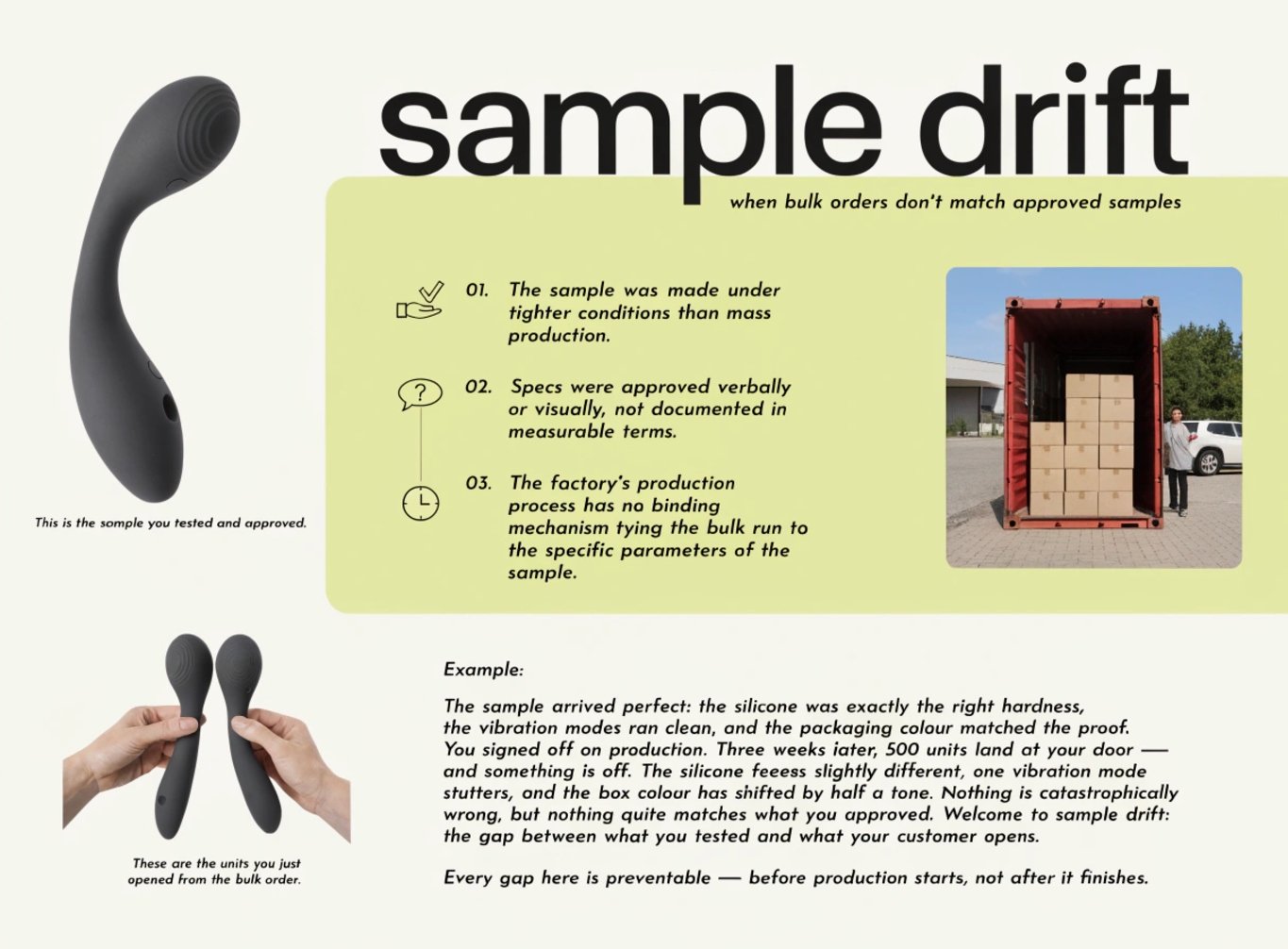
You placed a 500-unit order. The factory ships on time, your box arrives, and when you start counting through the batch — charging failures, surface blemishes, one vibration mode that does not respond — the numbers do not add up. Your return rate starts climbing before your first review cycle is finished. Nobody told you what to expect, what to demand, or how to verify anything before you signed off on shipment.
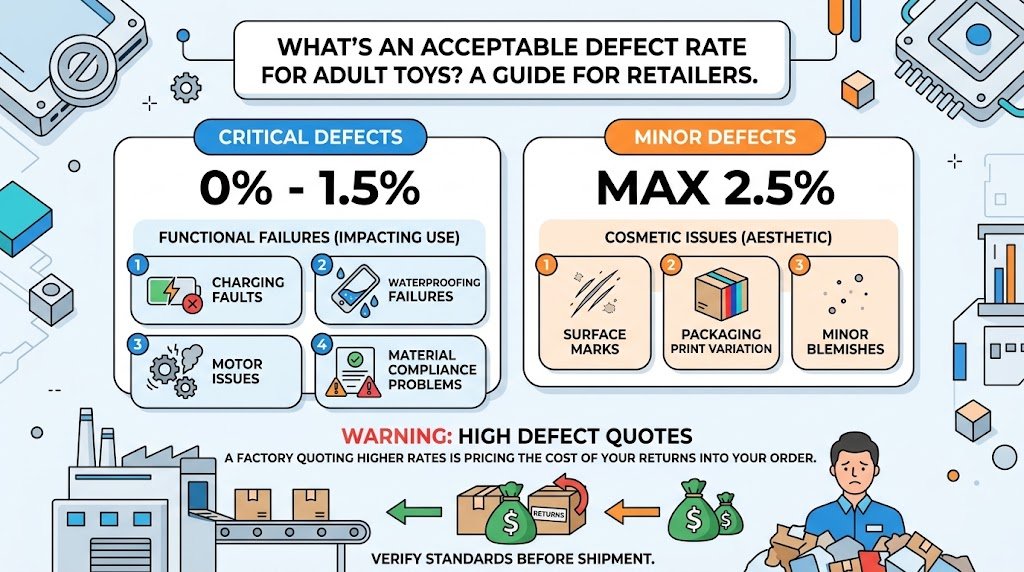
An acceptable defect rate in adult toy manufacturing is 0–1.5% for critical defects — functional failures including charging faults, waterproofing failures, motor issues, and material compliance problems — and 2.5% maximum for minor defects such as cosmetic surface marks or packaging print variation. Any factory quoting you higher than these thresholds as their standard is pricing the cost of your returns into your order.1
I'm Sally. I run VF Pleasure — a direct adult toys factory in Dongguan, China, with 15+ years of manufacturing experience and a monthly production capacity of 50,000 units. Our products are CE, RoHS, and food-grade silicone certified — and we maintain strict quality control procedures at every stage of production.
I know exactly what QC failures cost — not just in replacement units, but in customer relationships, review profiles, and platform account health. QC failures cause roughly 22% of shipment delays across the industry. When defects ship, your brand absorbs the hit. This guide explains the defect rate numbers that matter, the inspection system that generates them, and exactly how to verify any factory's claims before your goods leave their loading dock.
- 1 What Does "Defect Rate" Actually Mean in Adult Toy Production?
- 2 What Defect Rate Should You Demand From a Premium Adult Toy Factory?
- 3 How Does a Multi-Stage QC System Actually Reduce Your Defect Risk?
- 4 What Are the Most Common Defect Types in Adult Toy Manufacturing?
- 5 How Do You Verify a Factory's Defect Rate Claims Before You Order?
- 6 What Happens When a Batch Fails QC — and How Should a Factory Respond?
- 7 Conclusion
- 8 References & Source Notes
What Does "Defect Rate" Actually Mean in Adult Toy Production?
Most buyers use "defect rate" as a single number — as if a 2% defect rate on a waterproofing failure and a 2% rate on a packaging crease are the same problem. They are not. The category of defect determines whether you have a returns issue, a compliance issue, or a cosmetic issue — and each carries a completely different cost.
Defect rate in adult toy manufacturing is measured across two classifications: critical defects (functional or safety failures that prevent normal use or create user safety risk) and minor defects (cosmetic or packaging issues that do not affect function). A production batch with a 1% critical defect rate and a 3% minor defect rate carries very different commercial risk from a batch with the reverse — because critical defects generate returns, reviews, and platform flags while minor cosmetic issues mostly generate nothing.1
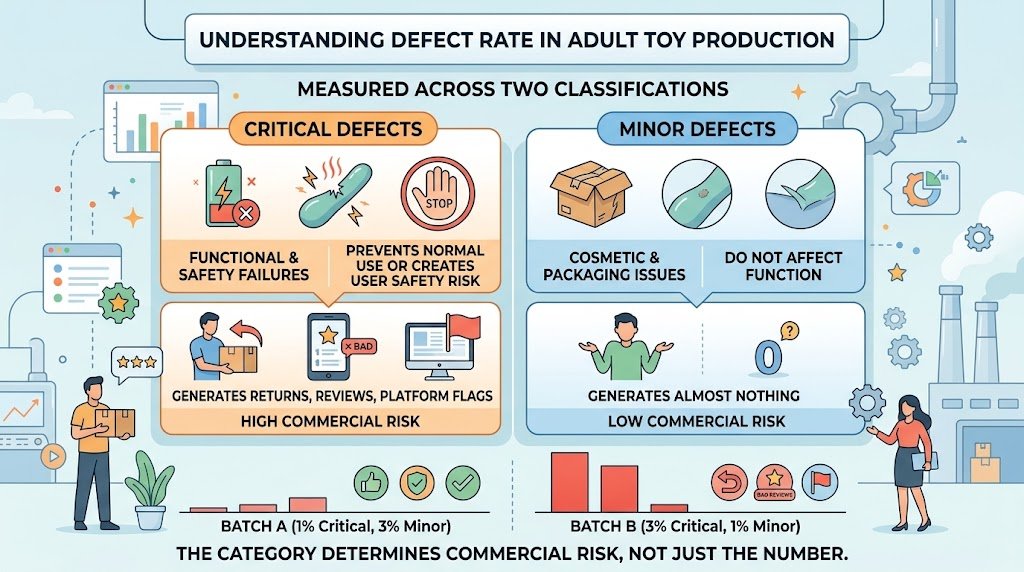
Understanding the classification framework is the first step to using defect rates as an actual quality management tool — not just a number in a factory's marketing materials.
📊 The Two-Tier Defect Classification for Adult Toys
| Defect Class | Definition | Examples | Acceptable Rate | Brand Impact |
|---|---|---|---|---|
| Critical | Functional failure, safety issue, compliance gap | Charging failure, waterproof failure, motor not working, silicone material non-compliant | 0–1.5% | Returns, reviews, platform flags, compliance risk |
| Minor | Cosmetic or presentation issue, does not affect function | Surface mark, packaging print variation, colour slight deviation | 0–2.5% | Minimal — customer may not even notice |
The third tier that most QC frameworks include — major defects — sits between these two and covers issues like a vibration mode that works intermittently, a charging port that connects correctly but requires precise alignment, or a silicone seam that is visible but structurally sound. Major defects typically use a 1.5–2.5% threshold, depending on product complexity.
🎯 Why the Category Matters More Than the Number
A factory that quotes you a 2% overall defect rate tells you almost nothing. Ask instead: "What is your critical defect rate for this product type — and what were the top three critical failure modes in your last audit cycle?" The answer to that question tells you far more about a factory's actual quality engineering than any single percentage figure.
Our crafting high-quality adult toys guide and adult toy quality compliance guide both explain this classification system in more depth — including how to use it to structure your purchase order QC requirements before you commit to production.
Setting a defect rate expectation in writing before production begins is the single most important QC action a buyer can take. Without a written standard, "acceptable quality" defaults to whatever the factory considers acceptable — which may bear no relation to what your customer, your platform, or your returns budget can tolerate.
A premium adult toy factory should deliver a critical defect rate of 1% or lower across the full production batch, verified through a documented AQL (Acceptable Quality Level) sampling plan before shipment. For food-grade silicone products — where material compliance is as important as functional quality — the material inspection standard should be confirmed alongside the functional defect rate, not treated as a separate question.2

Here is the full defect standard framework I recommend for any buyer sourcing food-grade silicone adult products at premium positioning.
📋 The Premium Adult Toy Defect Standard Framework
AQL 1.0 — The Target for Premium Private Label
AQL 1.0 means that for a shipment to be accepted, the sampled units must show 1% or fewer critical defects from the batch. This is the standard applicable to any product positioned as a premium food-grade silicone item — because your customer's expectations have been set by your brand story, your packaging, and your price. When a premium product fails at 3%, you do not lose 3% of your customers. You lose the 3% who return, plus an amplified number who see the review.
AQL 2.5 — The Standard for Minor Defects
AQL 2.5 is the widely accepted threshold for minor cosmetic defects in consumer goods manufacturing. For adult toy packaging, surface finish, and print accuracy, this is a reasonable operational standard that most factories with genuine QC infrastructure can consistently meet.
Food-Grade Silicone Material Standard
For food-grade silicone products, the defect standard must include a material compliance check alongside the functional defect check. A batch where 100% of units charge correctly but 3% of units have a surface silicone compound outside the food-grade specification is not a 0% critical defect batch — it is a material compliance failure. At VF Pleasure, food-grade platinum silicone is our material baseline for every body-contact surface — not a premium option — and our QC system validates it per batch.
💡 Sally's note: The most expensive QC mistake I see buyers make is accepting a factory's stated "AQL 2.5" standard without asking what defect classification it applies to. AQL 2.5 is appropriate for minor defects. Applied to critical defects like charging failure or waterproofing failure, it means 2.5 products per 100 reaching your customer with a functional problem — enough to generate a visible negative review pattern within your first three shipments.
How Does a Multi-Stage QC System Actually Reduce Your Defect Risk?
The difference between a 0.5% defect rate and a 4% defect rate from the same product design is almost always the QC architecture — specifically, whether the factory catches failures at the stage where they cost a few minutes of rework or the stage where they cost a full shipment replacement.
A multi-stage QC system in adult toy manufacturing reduces defect risk by catching material, assembly, and functional failures at the earliest possible production stage — before defects compound through the production process. A factory that inspects only at the final shipment stage catches defects after they have already been assembled, finished, and packaged, making rework exponentially more expensive and timeline disruption inevitable.3
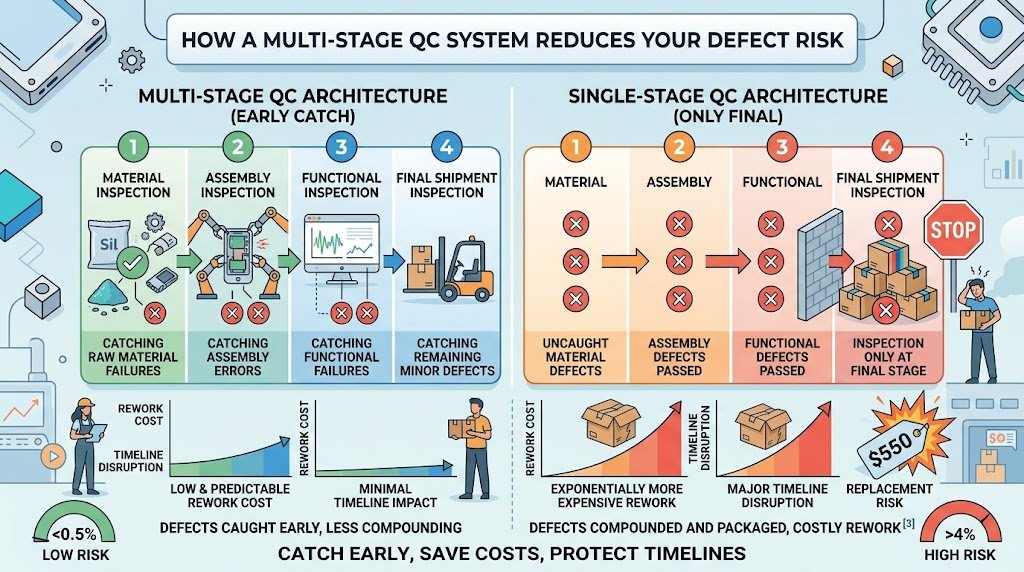
Here is what a real multi-stage QC system looks like — using VF Pleasure's own 12-point inspection system as the benchmark.
🏭 VF Pleasure's 4-Checkpoint QC System
Our 12-point inspection system runs across four defined production checkpoints — each designed to catch a specific category of failure at the lowest rework cost point:
| Checkpoint | Stage | Tests Performed | Tools Used | Defect Category Targeted |
|---|---|---|---|---|
| 1 — Material Intake | Before production begins | Phthalate screening, food-grade silicone compound verification | Gas chromatograph | Material compliance failures |
| 2 — Pre-Assembly | During component production | Dimensional accuracy, surface finish, motor function | Visual inspection, functional test | Structural and mechanical defects |
| 3 — Finished Product | Post-assembly | Waterproof testing, vibration mode testing, charging cycle testing | IPX7 chambers, functional test rigs | Functional and waterproofing failures |
| 4 — Batch Testing | Pre-shipment | Full AQL sampling, stress testing, drop testing on packaging | 50kg pressure rigs, 3-metre height simulator | Assembly durability, packaging integrity |
This four-checkpoint structure means a food-grade silicone material failure is caught at checkpoint 1, before a single unit enters production. A charging fault is caught at checkpoint 3, before it reaches your customer. A packaging structural failure is caught at checkpoint 4, before shipment dispatch. Each checkpoint catches a category of failure that the previous checkpoint cannot — which is why a single final inspection cannot replicate this outcome.
🧪 Why Material Inspection Is Checkpoint 1 — Not an Afterthought
Food-grade silicone is not a label. It is a measurable material specification — and the measurement has to happen before the silicone compound is injected into the mold, not after 500 finished units are sitting in a box waiting for shipment. At VF Pleasure, we prioritize food-grade silicone for its non-porous nature and hypoallergenic properties, and we validate it at the material intake stage using gas chromatography for phthalate screening. For private label orders, third-party lab verification through SGS or Bureau Veritas is available.
This is the material standard that lets you print "food-grade silicone" on your packaging with confidence — not because you trust the factory's word, but because the documentation from an independent laboratory backs the claim.
Our body-safe adult toys manufacturing standards guide and verify adult toy quality Chinese suppliers guide explain how to read a factory's QC checkpoint documentation and verify that the inspection system described actually matches the physical production reality.
What Are the Most Common Defect Types in Adult Toy Manufacturing?
Knowing your defect rate target is step one. Knowing which specific defects are most likely to generate returns, reviews, and platform flags is what lets you write meaningful quality specifications into your purchase order — not just a generic "must pass QC" clause that means nothing to the factory's floor team.
The most common critical defects in adult toy manufacturing are: waterproof seal failures, charging connection failures, vibration motor failures, food-grade silicone material non-compliance, and colour fastness degradation on silicone surfaces. Each follows a predictable failure pattern — and each can be caught at a specific QC checkpoint if the inspection system is designed to test for it.4

Here is what each defect type means in practice — and the real production case behind each one.
🧪 Defect Type 1 — Waterproof Seal Failure
Waterproof seal failure is the defect most likely to generate a simultaneous wave of customer complaints — because every subscriber in a subscription box or every customer in a single batch runs the product in the bath or shower around the same time, creating a cluster of returns in a single week.
The critical factor most buyers miss: waterproof testing that uses only static submersion does not replicate real use conditions. A product that passes 30 minutes of static IPX7 submersion may fail when the seal is stressed by insertion cycles before submersion — which is exactly how your customer uses the product.
At VF Pleasure, we encountered this directly when one of our partners updated their IPX7 validation protocol to include pre-use simulation. The existing product failed the updated standard. Rather than downgrading the product's waterproof rating, we analyzed the sealing architecture, identified specific assembly sequence weaknesses, redesigned the internal waterproof structure, and revalidated. The product passed the updated standard without external redesign changes and without delivery delay.
💡 Ask any factory: "Is your IPX7 waterproof test conducted with pre-use simulation — insertion cycles before submersion — or static submersion only?" The answer tells you whether their waterproof certification reflects how your customer actually uses the product.
⚙️ Defect Type 2 — Motor Performance Failure and Silent Substitution
Motor failure takes two forms: outright non-function (caught at checkpoint 3 before shipment) and performance degradation (not caught unless you test at the component specification level). The second form is more dangerous commercially — because a vibrator that vibrates but noticeably less strongly than your previous batch generates the specific review pattern "quality has gone downhill" that erodes premium brand positioning over time.
When a supply chain disruption caused a key motor component cost to increase significantly for one of our partners, we did not silently substitute the nearest available alternative. We benchmarked multiple replacement options against the original's vibration strength, noise level under load, and operational stability profile, and selected the replacement that maintained performance consistency. The next production batch had no detectable performance change. The brand's pricing power was protected.
🔌 Defect Type 3 — Charging Connection Failure
Charging failures generate one of the highest chargeback-risk review patterns in adult toy retail — because customers who receive a product that does not charge assume the product is dead and are quick to dispute the transaction. Post-production customer feedback on one of our batches identified intermittent charging failures across a product run. We traced the root cause to DC pin contact geometry — specifically how pin length interacted with the silicone body's natural flex under repeated use. We redesigned the pin structure and validated long-term durability under simulated use. A structural engineering fix eliminated the failure mode before it spread across the production line.
🎨 Defect Type 4 — Colour Fastness Degradation
Updated QA standards required higher colour fastness performance on silicone and ABS surfaces than our previous surface treatment provided. Rather than shipping to the lower standard, we reviewed the full material and coating process, replaced specific surface treatments with compliant alternatives, conducted internal validation, and resubmitted. Every SKU passed. No large-scale production rejection. No customs hold. No retail delisting.
For premium food-grade silicone brands, colour fastness is a material integrity signal — a product whose colour degrades visibly on first or second use contradicts the durability claim that food-grade silicone inherently carries.
📦 Defect Type 5 — Packaging Structural Failure
Packaging defects sound minor until you consider how subscription box operators and e-commerce brands use their packaging as content — the unboxing is the brand's first physical impression. A magnetic closure box that no longer closes cleanly, a satin insert that is misaligned, or a printed box with colour deviation from the approved proof is a brand integrity failure, not just a cosmetic one.
Packaging drop testing using a 3-metre height simulator at checkpoint 4 catches the structural failures that occur in transit before your customer opens the box — not after.
Our adult toy manufacturing challenges and solutions guide documents all five of these defect types in more detail, with the specific engineering approaches used to resolve each one before it reached any client's customer.
How Do You Verify a Factory's Defect Rate Claims Before You Order?
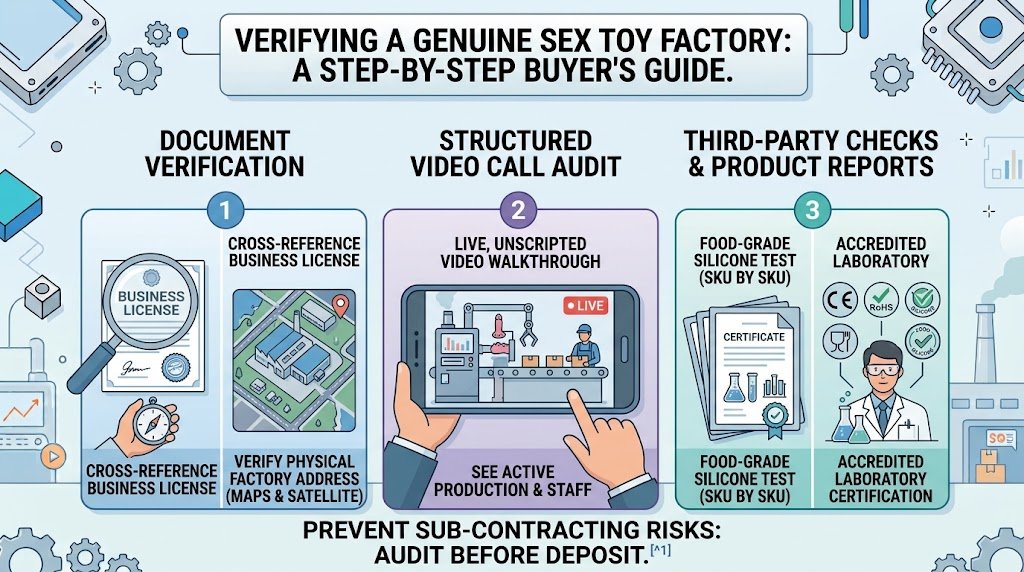
"We have a very low defect rate" is the quality equivalent of "our products use quality materials." It is a marketing statement, not evidence. Verifying a factory's actual defect rate requires specific documentation requests — not a tour of the facility and a handshake.
You verify an adult toy factory's defect rate by requesting three specific document sets: a recent QC batch report showing pass/fail rates across the four checkpoint stages for a comparable product, a third-party inspection report from a named auditing firm for at least one recent shipment, and a written defect classification standard showing what the factory counts as critical versus minor defects in its own QC process.5
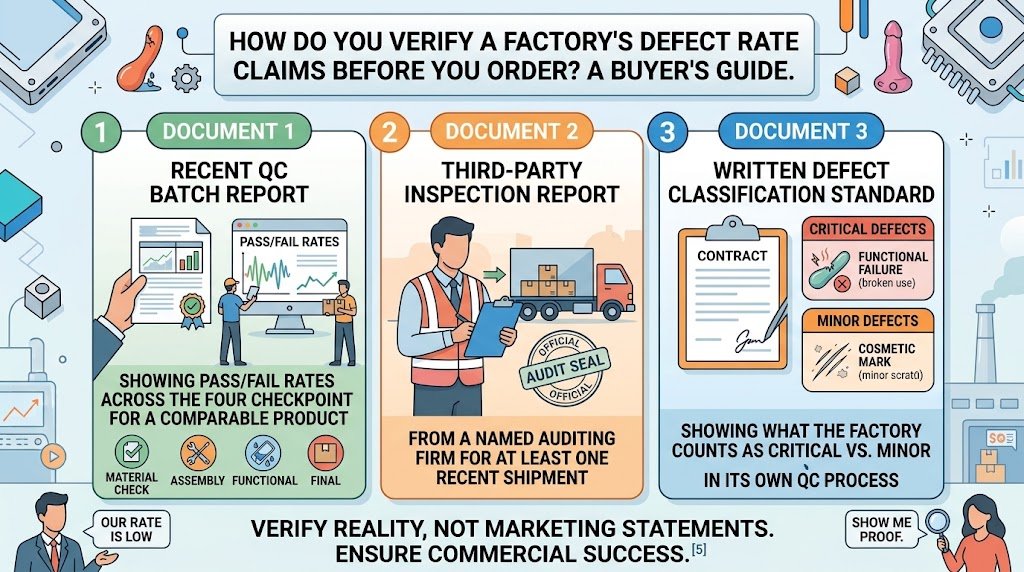
Here is what each document looks like when it is real — and what to look for when it is a marketing asset masquerading as quality evidence.
📄 Document 1 — The QC Batch Report
A real QC batch report for an adult toy production run includes:
- ✅ The product SKU or reference number
- ✅ The total production quantity and the sample size inspected
- ✅ The number of units failing at each checkpoint — raw material, pre-assembly, finished product, batch testing
- ✅ The defect category (critical / major / minor) for each failure type
- ✅ The pass/fail determination against the buyer's stated AQL
- ✅ The inspector's name and the inspection date
A one-page document that says "QC PASSED — 500 units" with a stamp is not a QC batch report. It is a shipping authorization. Ask specifically: "Can you provide a QC report showing the number of units inspected, the number of failures at each checkpoint, and the defect category breakdown?"
📄 Document 2 — The Third-Party Inspection Report
For private label orders, third-party inspection through firms like SGS or Bureau Veritas provides independent verification that the factory's own QC results are accurate — because a factory that inspects only its own output has an inherent conflict of interest. VF Pleasure offers third-party lab verification through SGS or Bureau Veritas for private label orders as a standard option, precisely because independent verification is the documentation that carries weight with retail buyers and platform compliance teams.
Ask: "Do you offer third-party pre-shipment inspection through an independent auditing firm? Which firms, and what does that process cover?"
📄 Document 3 — The Factory's Own Defect Classification Standard
This is the document most buyers never think to request — and it is often the most revealing. A factory that can hand you its own written defect classification standard (showing what it categorizes as critical, major, and minor for your specific product type) is a factory whose QC team has standardized their inspection criteria. A factory that cannot produce this document is one whose floor inspectors make judgment calls — which means your defect rate depends on whoever happens to be on the inspection line that day.
🔍 The Pre-Order Verification Checklist
| Verification Item | What to Request | Pass Signal | Fail Signal |
|---|---|---|---|
| QC batch report | Last 2–3 batch reports for comparable SKU | Specific unit counts, checkpoint breakdown, defect categories | Single-page stamp, no failure data |
| Third-party inspection | Recent pre-shipment report from SGS, BV, or equivalent | Named auditor, specific defect list, AQL stated | No third-party option available |
| Defect classification | Written standard showing critical/major/minor definitions | Typed document with product-specific criteria | "We know defects when we see them" |
| Food-grade silicone | Gas chromatography report per batch, per SKU | Named accredited laboratory, measured phthalate values | Generic certificate template |
| Retest policy | Written policy on what happens when a batch fails | Clear rework, retest, or rejection protocol | "We fix it and reship" |
Our choose reliable OEM adult toy factory China checklist and red flags OEM adult toy manufacturer guide give you the full factory evaluation process — with specific questions designed to surface a factory's real QC capability before you commit to production.
What Happens When a Batch Fails QC — and How Should a Factory Respond?
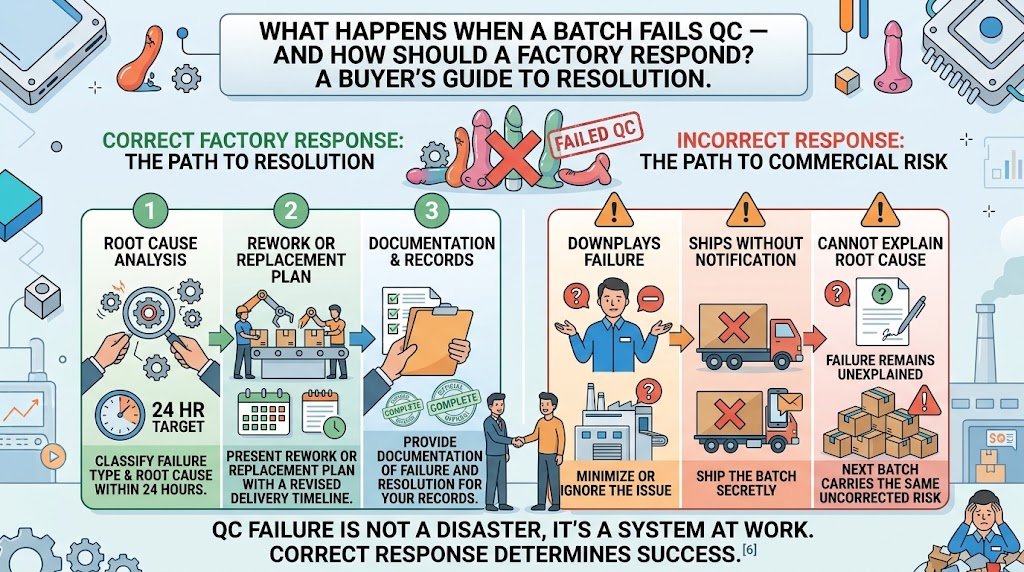
A batch that fails QC is not a disaster. It is the QC system working exactly as intended — catching failures before they reach your customer. What happens next is what actually determines whether your factory relationship is an asset or a liability.
When a production batch fails QC in adult toy manufacturing, the correct factory response is: classify the specific failure type and root cause within 24 hours, present a rework or replacement plan with a revised delivery timeline, and provide documentation of the failure and resolution for your records. A factory that downplays a QC failure, ships without notification, or cannot explain the root cause is a factory whose next batch carries the same uncorrected risk.6
![]()
Here is what a well-structured QC failure response looks like — and the signals that tell you a factory's response culture is protecting your brand rather than its own schedule.
✅ The Five-Step Factory QC Failure Response Standard
Step 1 — Immediate Classification
Within 24 hours of QC failure identification, the factory should tell you: which checkpoint the failure occurred at, what defect category it is (critical/major/minor), how many units are affected, and whether the failure is isolated or systemic. A systemic failure — one affecting the entire batch — has a different resolution path from an isolated one.
Step 2 — Root Cause Analysis
Before any rework begins, the root cause should be identified. "The waterproof seal failed" is not a root cause — it is a symptom. "The assembly sequence was adjusted by one operator on a specific production shift, creating inconsistent sealing pressure" is a root cause. Only root cause identification prevents the same failure in the next batch. VF Pleasure's documentation shows this in action: when charging failures surfaced post-production, the root cause investigation traced it to DC pin contact geometry under silicone flex — not just "a charging problem" — which led to a structural fix rather than a surface patch.
Step 3 — Written Remediation Plan
The factory should provide a written remediation plan covering: the number of units to be reworked or replaced, the revised production timeline, and the additional QC steps that will prevent recurrence. This document protects you if the same failure type surfaces in a future batch — you have written evidence that the factory knew about the issue and proposed a specific fix.
Step 4 — Proactive Communication
The most revealing signal of a factory's QC culture is whether they tell you about a failure before the delivery date — or after you ask why your goods have not arrived. A factory with genuine quality engineering discipline communicates failures at the stage they emerge, not at the deadline that forces disclosure. When a batch code and inspection timeline misalignment created a documentation gap for one of our clients, we documented the full timeline, communicated proactively before the inspection date, and provided written QA explanation for the inspector. The documentation was accepted without rework. Delivery was maintained. The client was informed before the problem became a surprise.
Step 5 — Documentation for Your Records
Every QC failure and resolution should generate a document in your factory relationship file — the failure report, the root cause analysis, the remediation plan, and the re-inspection result. This documentation is your quality history with the factory. It tells you whether quality is improving or cycling through the same failure modes. And it is your evidence if you ever need to dispute a shipment, make a warranty claim, or transition to a new supplier while protecting your brand's compliance story.
💡 Sally's 15-year observation: The factories I've watched lose client relationships are almost never the ones that had quality failures. They are the ones that handled quality failures badly — shipped without telling the client, deflected root cause questions, or provided vague timelines and no written remediation. A factory that handles a QC failure correctly, with clear documentation and proactive communication, builds more trust than one that never had a failure. Because every factory will eventually have a failure. What matters is how they respond when it happens.
Conclusion
An acceptable defect rate in adult toy manufacturing is 1% critical and 2.5% minor — verified through a documented multi-stage QC system, not a single final inspection stamp, and backed by food-grade silicone material testing per batch that confirms what is inside the product matches what is printed on the box.
🚀 Want to See VF Pleasure's QC System in Action Before You Order?
At VF Pleasure, quality control is built into every production stage — not bolted on at the end. Our 12-point inspection system runs four checkpoints from raw material intake through pre-shipment batch testing. All products are CE, RoHS, and food-grade silicone certified. Third-party verification through SGS or Bureau Veritas is available for private label orders.
What we provide with every order:
- ✅ Food-grade platinum silicone standard — phthalate screening per batch via gas chromatograph, no medical-grade claims
- ✅ 4-checkpoint QC system — material, pre-assembly, finished product, and batch testing stages
- ✅ IPX7 waterproof validation — including pre-use simulation, not static submersion only
- ✅ QC batch reports — specific unit counts, checkpoint breakdown, defect categories per production run
- ✅ Third-party lab verification — SGS or Bureau Veritas for private label sex toys orders
- ✅ Proactive failure communication — root cause reporting and written remediation plans, not post-deadline disclosure
👉 Request a Free Sample + QC Documentation Package from VF Pleasure →
References & Source Notes
-
VF Pleasure — Adult Toy Quality Compliance Guide
| Field | Detail |
|---|---|
| 📌 Supports | An acceptable critical defect rate in adult toy manufacturing is 0–1.5%, with minor cosmetic defects at 0–2.5%. Defect classification — critical versus minor — determines the commercial risk, not the overall defect rate as a single figure. |
| 🔍 Evidence Role | Definition |
| 📁 Source Type | Industry Guide |
⚠️ Scope Note: Defect rate thresholds described represent industry best practice standards applicable to premium food-grade silicone adult toy manufacturing. Acceptable rates may vary by product complexity, market channel, and buyer specification. These figures should be used as planning benchmarks and confirmed as written quality standards in any purchase order or supplier agreement.
-
VF Pleasure — Crafting High-Quality Adult Toys
| Field | Detail |
|---|---|
| 📌 Supports | Premium adult toy factories should deliver critical defect rates of 1% or lower verified through documented AQL sampling. Food-grade silicone material compliance must be verified alongside functional defect rates as part of any complete quality standard. VF Pleasure maintains CE, RoHS, and food-grade silicone certification on all products. |
| 🔍 Evidence Role | Definition + General Support |
| 📁 Source Type | Industry Guide |
⚠️ Scope Note: The premium defect standard of AQL 1.0 for critical defects reflects VF Pleasure's quality engineering approach and industry benchmarks for premium consumer goods. Individual buyer requirements and product categories may justify tighter or more relaxed standards. All quality thresholds should be written into purchase order specifications before production begins.
-
VF Pleasure — Manufacturing Process Guide
| Field | Detail |
|---|---|
| 📌 Supports | Multi-stage QC systems reduce defect risk by catching failures at the lowest rework cost stage. VF Pleasure's 12-point inspection system includes four checkpoints: raw material intake (gas chromatograph phthalate screening), pre-assembly, finished product (IPX7 waterproof testing, functional testing), and batch testing (50kg stress testing, 3m drop simulation). Third-party SGS or Bureau Veritas verification available for private label orders. QC failures cause 22% of industry shipment delays. |
| 🔍 Evidence Role | Mechanism |
| 📁 Source Type | Industry Guide |
⚠️ Scope Note: The 22% shipment delay statistic is sourced from VF Pleasure's published content. The QC checkpoint structure and testing methodology described reflect VF Pleasure's own documented process. Individual factory systems vary significantly. Buyers should request equivalent checkpoint documentation from any factory they evaluate.
-
VF Pleasure — Adult Toy Manufacturing Challenges and Solutions
| Field | Detail |
|---|---|
| 📌 Supports | The five most common critical defect types in adult toy manufacturing — waterproof seal failure, motor performance substitution, charging connection failure, colour fastness degradation, and documentation misalignment — each follow predictable failure patterns and can be caught at specific QC checkpoints. All five are documented through VF Pleasure's real production case studies. |
| 🔍 Evidence Role | Case Reference |
| 📁 Source Type | Industry Guide |
⚠️ Scope Note: Defect type examples and production case studies are drawn from real anonymised VF Pleasure production projects. They illustrate the factory's engineering problem-solving approach — not a guarantee that identical outcomes will result in all equivalent production situations. Each defect type's frequency and resolution complexity varies by product design, production volume, and QC system architecture.
-
VF Pleasure — Verify Adult Toy Quality Chinese Suppliers
| Field | Detail |
|---|---|
| 📌 Supports | Verifying a factory's defect rate requires three specific documents: a QC batch report with checkpoint-level pass/fail data, a third-party inspection report from SGS, Bureau Veritas, or equivalent, and a written defect classification standard. VF Pleasure provides third-party verification for private label orders through SGS or Bureau Veritas. |
| 🔍 Evidence Role | Mechanism |
| 📁 Source Type | Industry Guide |
⚠️ Scope Note: The verification checklist represents best-practice due diligence for adult toy sourcing. Not all factories will have all documents available in the format described. The absence of any item from the checklist is a signal to investigate further — not automatically a disqualifying factor. Buyers should supplement document verification with reference checks from existing clients where possible.
-
VF Pleasure — Adult Toy Manufacturing Challenges and Solutions
| Field | Detail |
|---|---|
| 📌 Supports | When a production batch fails QC, the correct factory response involves immediate defect classification, root cause analysis, a written remediation plan with revised timeline, proactive communication before the delivery deadline, and documentation of the failure and resolution. VF Pleasure's case studies demonstrate this response culture in documented production scenarios. |
| 🔍 Evidence Role | Case Reference + General Support |
| 📁 Source Type | Industry Guide |
⚠️ Scope Note: The five-step QC failure response framework reflects VF Pleasure's quality management philosophy as evidenced in its published case studies. Individual factory response processes vary. Buyers should discuss QC failure response protocols explicitly during factory qualification — not after the first failure occurs.