Skip to content
You found the right product. It sells. Your market responds to it and your competitors do not yet carry it. The moment you scale your campaign behind it, you discover the factory has been selling the same design to two of your direct competitors at lower prices. Your product advantage evaporates overnight — and everything you invested in building category awareness benefits someone else's margin. This is the scenario exclusive distribution rights exist to prevent.
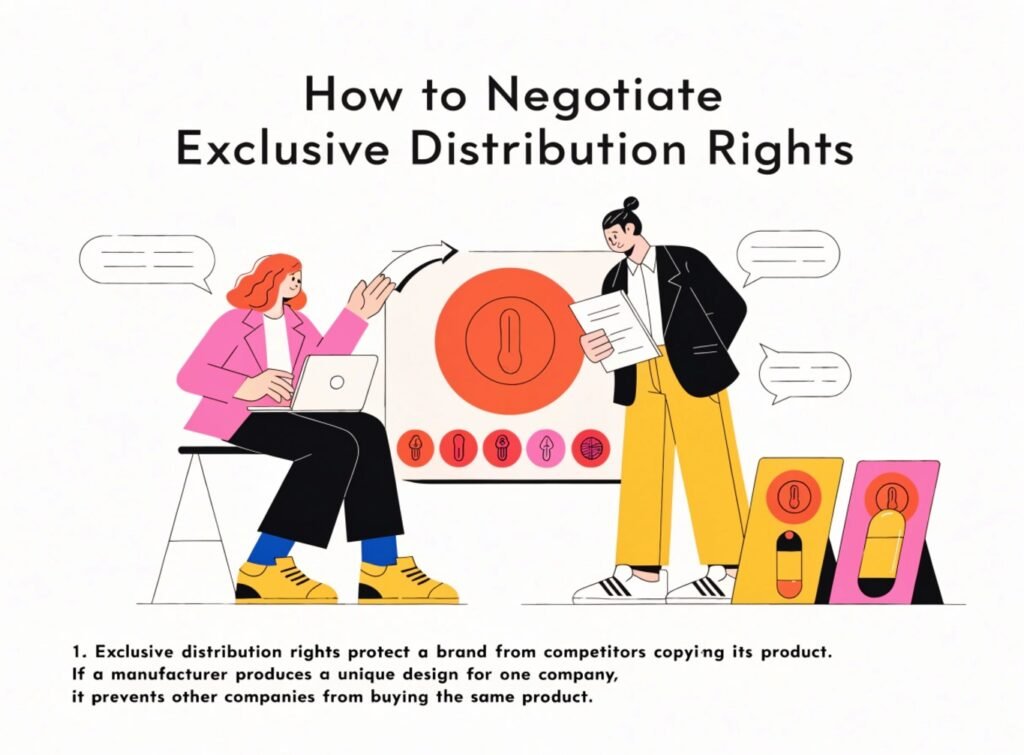
You negotiate exclusive distribution rights with a Chinese sex toy manufacturer by demonstrating strategic value first — volume commitment, geographic market coverage, and long-term partnership intent — before asking for exclusivity. The conversation succeeds when the manufacturer sees the exclusivity clause as a fair trade for guaranteed revenue, not as an obligation that limits their upside. The right timing, the right structure, and the right written terms determine whether you actually get protected — or just get a verbal assurance that is worth nothing.1
I'm Sally. I run VF Pleasure — a direct adult toys factory in Dongguan, China, with 15+ years of B2B manufacturing experience, trusted by over 1,000 businesses globally. Our mission is building partnerships through excellence — supporting distributors and retailers with high-quality, customisable adult products including food-grade silicone vibrators, female sex toys, couples toys, and private label programs. Competitive pricing, flexible MOQs, and tailored solutions are how we drive mutual success and long-term growth.
I have been on both sides of the exclusivity conversation. I have granted it, refused it, and watched buyers request it in ways that guaranteed rejection. This guide gives you the full strategic picture — what exclusivity actually covers, how to earn the right to ask for it, what the contract must contain, and which factory responses tell you the agreement is not worth the paper it will be printed on.
- 1 What Does "Exclusive Distribution Rights" Actually Mean in Adult Toy Sourcing?
- 2 What Leverage Do You Actually Need Before Asking for Exclusivity?
- 3 How Do You Structure the Exclusivity Agreement Itself?
- 4 How Do You Negotiate Exclusivity as a Smaller Buyer?
- 5 What Must the Written Agreement Include That Protects You?
- 6 What Red Flags Tell You a Manufacturer Will Not Honour Exclusivity?
- 7 Conclusion
- 8 References & Source Notes
What Does "Exclusive Distribution Rights" Actually Mean in Adult Toy Sourcing?
Most buyers use "exclusive distribution rights" as if it is one thing. It is not. It is a spectrum of commitments — from "you are our primary buyer in this region" to "we will not sell this design to anyone, anywhere, at any price, except through you." The difference between these two endpoints is enormous, and most buyers who ask for exclusivity get the first when they thought they were getting the second.
Exclusive distribution rights in adult toy sourcing can cover five different scopes: product design exclusivity (only you can sell this specific design), territory exclusivity (only you can sell this product in your named market), channel exclusivity (only you can sell this product through named distribution channels), brand exclusivity (only you can brand this product under your brand name), and full exclusivity (all of the above). Most manufacturers will negotiate territory or brand exclusivity. Very few grant full exclusivity without a significant volume commitment behind it.1
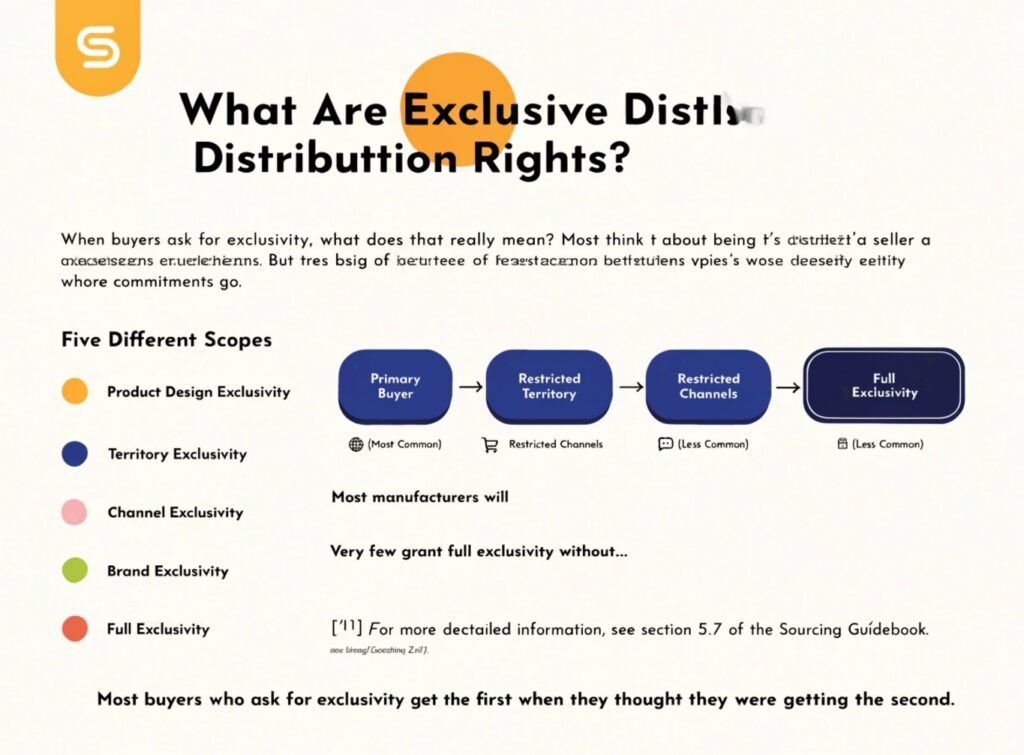
Here is each exclusivity type — what it covers, what it costs, and what is realistic to request.
📋 The Five Exclusivity Types: What Each Covers
Type 1 — Product Design Exclusivity
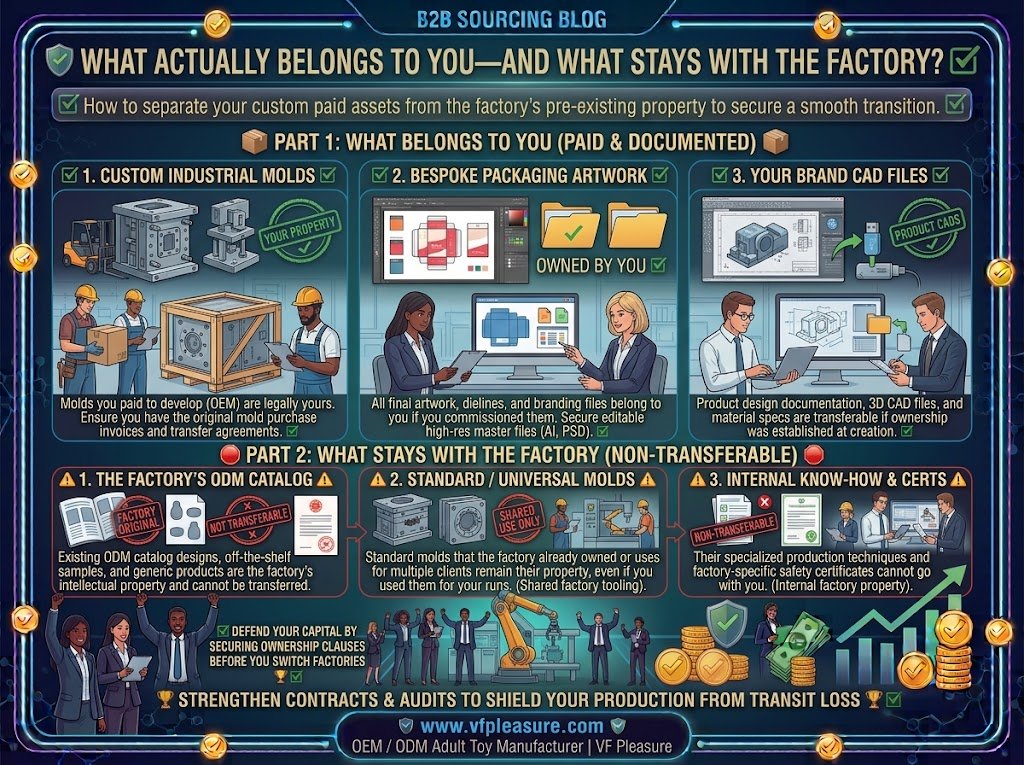
The manufacturer agrees not to sell your specific product design to any other buyer. This is the strongest form and requires either custom OEM tooling (a mold you own) or a contractual restriction on the factory using their ODM design for competing buyers.
Realistic for: OEM custom designs where you paid for the mold. Much harder to enforce for ODM designs where the factory's mold was pre-existing.
Type 2 — Territory Exclusivity
The manufacturer agrees not to sell this product design to any buyer targeting your named geographic market. A Chinese manufacturer may agree to "no other buyers importing and selling in the US adult toy market" while continuing to sell the same product in Europe and Asia.
Realistic for: Established distributors with verified market presence and volume commitments. Most commonly granted alongside a minimum annual purchase obligation.
Type 3 — Channel Exclusivity
The manufacturer agrees not to supply this design through competing distribution channels — for example, no direct online sales or marketplace listings, no sales to your direct retail competitors in the same channel.
Realistic for: Distributors who supply into specific retail chains or platforms where overlapping supply would create direct price competition.
Type 4 — Brand Exclusivity
The manufacturer agrees not to produce this product under any other brand's name. Your branding, your logo, your packaging — exclusively.
Realistic for: Private label buyers at any volume. Brand exclusivity is the easiest exclusivity type to negotiate because it costs the manufacturer nothing unless they were planning to sell the same factory product under another brand.
Type 5 — Full Exclusivity
No other buyer gets any version of this product design in your market, through any channel, under any brand. This is the hardest to negotiate and requires the strongest volume commitment.
Our sex toys distributors and manufacturing partners guide, future sex toy distribution trends guide, and distributor vs manufacturer wholesale sex toy partner guide all explain the distribution relationship framework in which exclusivity negotiations operate.
What Leverage Do You Actually Need Before Asking for Exclusivity?
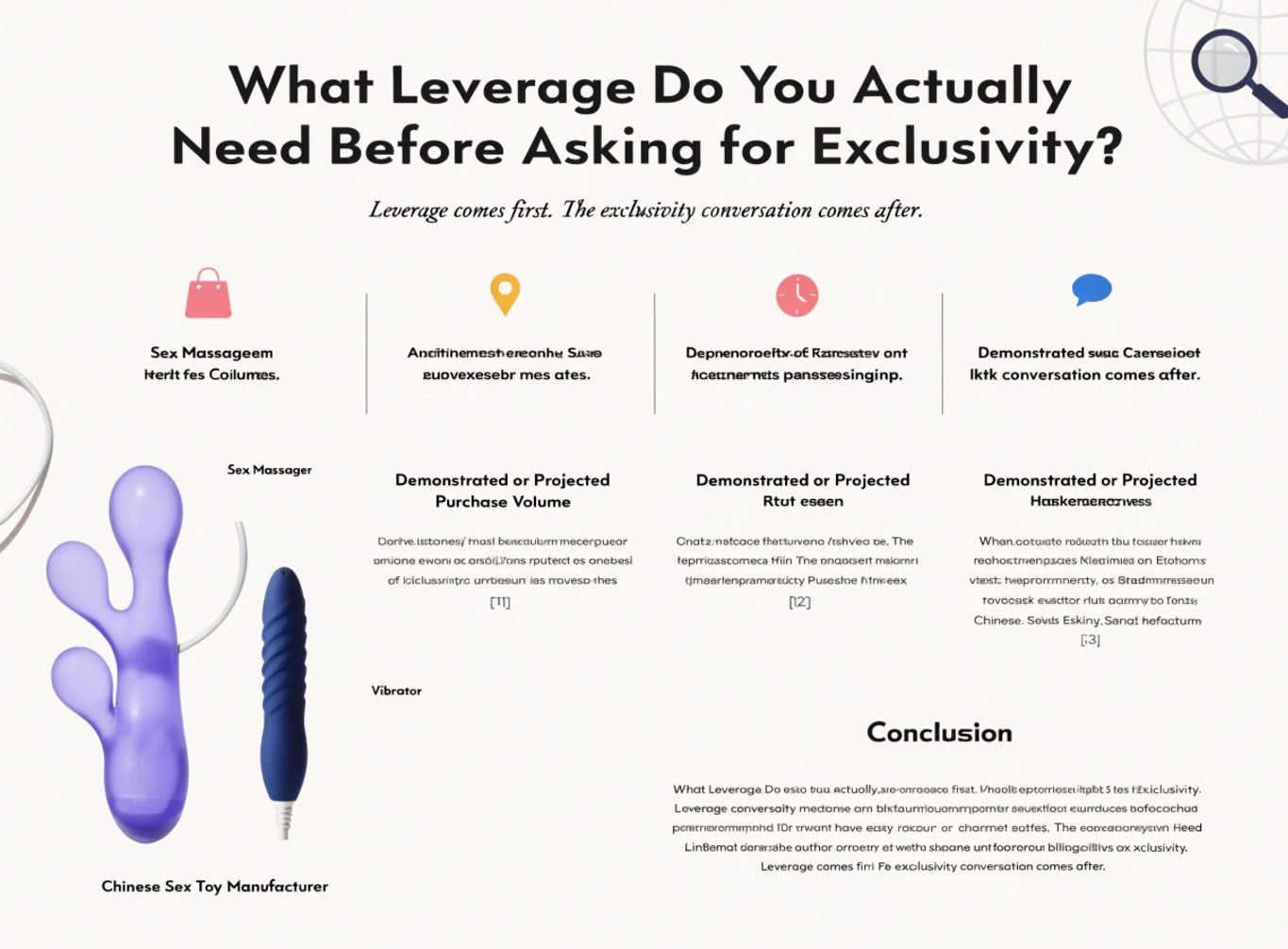
Asking for exclusivity without leverage is not a negotiation — it is a request. And requests from buyers who have not yet proven their volume, their market access, or their long-term intent get politely declined or receive verbal assurances that the factory has no real intention of honouring. Leverage comes first. The exclusivity conversation comes after.
The leverage you need before asking for exclusivity with a Chinese sex toy manufacturer comes from four sources: a demonstrated or projected purchase volume that makes exclusivity worth the factory's opportunity cost, a geographic or channel market the factory cannot easily access without you, a track record of on-time payment and professional communication across at least one completed order cycle, and a stated multi-year partnership intent that frames the exclusivity as a long-term business relationship rather than a one-order demand.2
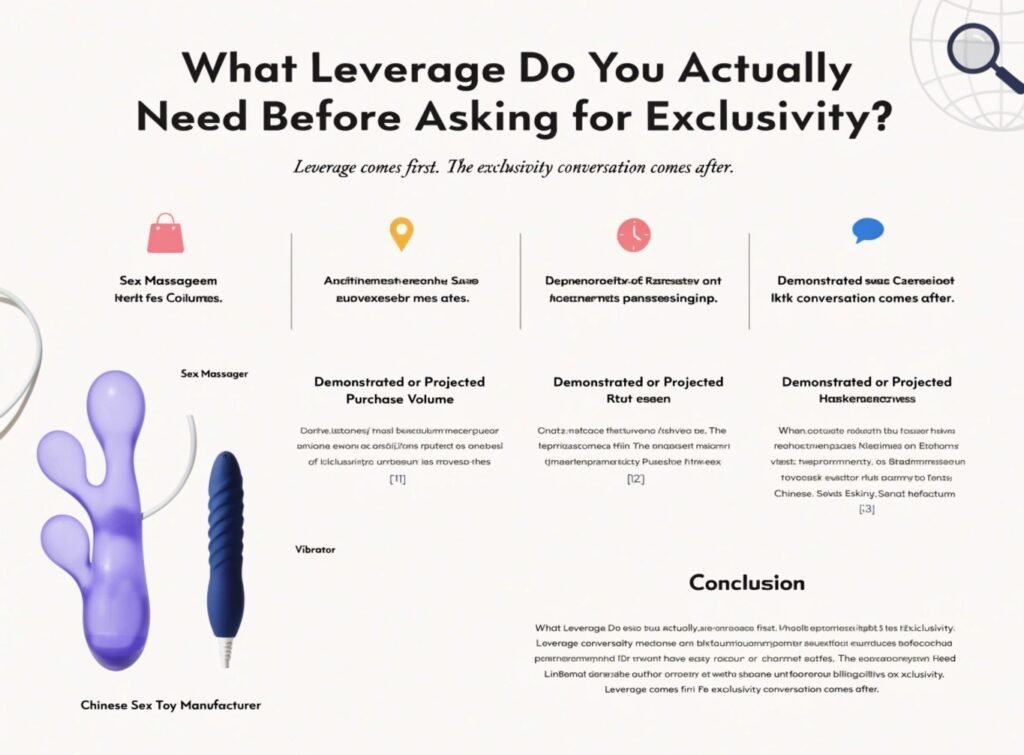
Here is how to build each leverage source — and when you have enough of each to make the exclusivity conversation productive.
🎯 Leverage Source 1 — Volume Commitment
The factory's primary question about any exclusivity request is: "What do I lose if I grant this?" Exclusivity means the factory cannot sell this design to other buyers in your market or channel. That is potential revenue they are forgoing. The question is whether your committed volume replaces it.
The right way to frame volume commitment:
"We are prepared to commit to a minimum annual purchase of [X units] across [Y SKUs] from your product range, with purchase orders placed quarterly. In exchange for this committed volume, we are requesting [territory / design / full] exclusivity in [market / channel]."
A volume commitment backed by a purchase order or a signed volume commitment letter converts the exclusivity request from a hope into a commercial exchange. The factory can calculate whether your committed revenue outweighs the opportunity cost of not selling to other buyers in your market.
What volume is enough? This depends on the factory's total production output for that product line. If the factory produces 2,000 units per month of a given vibrator design, a commitment of 500 units per month represents 25% of production for that SKU — enough to justify territory exclusivity in a single market. At VF Pleasure, our monthly production capacity of 50,000 units across multiple product lines means we can accommodate significant volume commitments without production constraints.
🎯 Leverage Source 2 — Market Access You Provide
If your distribution network gives a Chinese manufacturer access to a market or channel they cannot easily reach on their own, that market access has strategic value that converts directly into exclusivity leverage.
Examples of valuable market access:
- A regional adult novelty wholesale distribution network covering multiple retail accounts the factory cannot reach directly
- A relationship with a major online adult wellness platform where your brand is already listed
- A wellness retail buyer relationship that no other sex toy supplier currently holds
- A DTC subscriber community in a geography the factory has no established presence in
The conversation in this case shifts from "pay us for your opportunity cost" to "we are the only path to this market." Territory exclusivity becomes rational for the factory not because they are giving something up, but because they are gaining something.
🎯 Leverage Source 3 — Track Record of Professional Execution
Factories remember buyers. They remember who paid on time, who communicated clearly, who approved samples promptly, and who sent reasonable revision requests. A buyer who has completed one order cycle professionally — without payment disputes, without unreasonable last-minute changes, without aggressive demands — enters the exclusivity conversation with relationship capital that a new buyer does not have.
If this is your first order with a factory, the exclusivity conversation is premature. Complete one order. Pay on time. Communicate professionally. Then open the exclusivity discussion with the relationship context that makes it a natural next step.
🎯 Leverage Source 4 — Stated Multi-Year Partnership Intent
Exclusivity requests from buyers who frame the conversation as long-term partnership receive different responses than requests from buyers who frame it as a one-order protection. A factory will grant exclusivity to a buyer they believe will generate 50,000 units of annual revenue over three years. They are far less likely to grant it to a buyer who ordered 500 units and wants protection before they have proven anything.
State your intent explicitly: "We are looking for a long-term exclusive manufacturing partner for this product category. Our three-year plan in this market involves [specific channels, specific SKU expansion]. We want to build this with a single factory that we grow with."
This is the framing that separates buyers who get exclusivity from buyers who get polite deflection.
How Do You Structure the Exclusivity Agreement Itself?
An exclusivity commitment without a written structure is a factory's verbal assurance — and verbal assurances from manufacturers protect nothing if the relationship breaks down or the factory receives a more attractive offer. Structure converts intent into obligation.
An exclusive distribution agreement with a Chinese sex toy manufacturer must cover seven elements: precise definition of the exclusivity scope, the geographic or channel territory it applies to, the minimum purchase obligation that triggers and maintains exclusivity, the term length and renewal process, the enforcement mechanism for breach, the carve-out for non-competing markets, and the process for terminating exclusivity without terminating the supply relationship.3
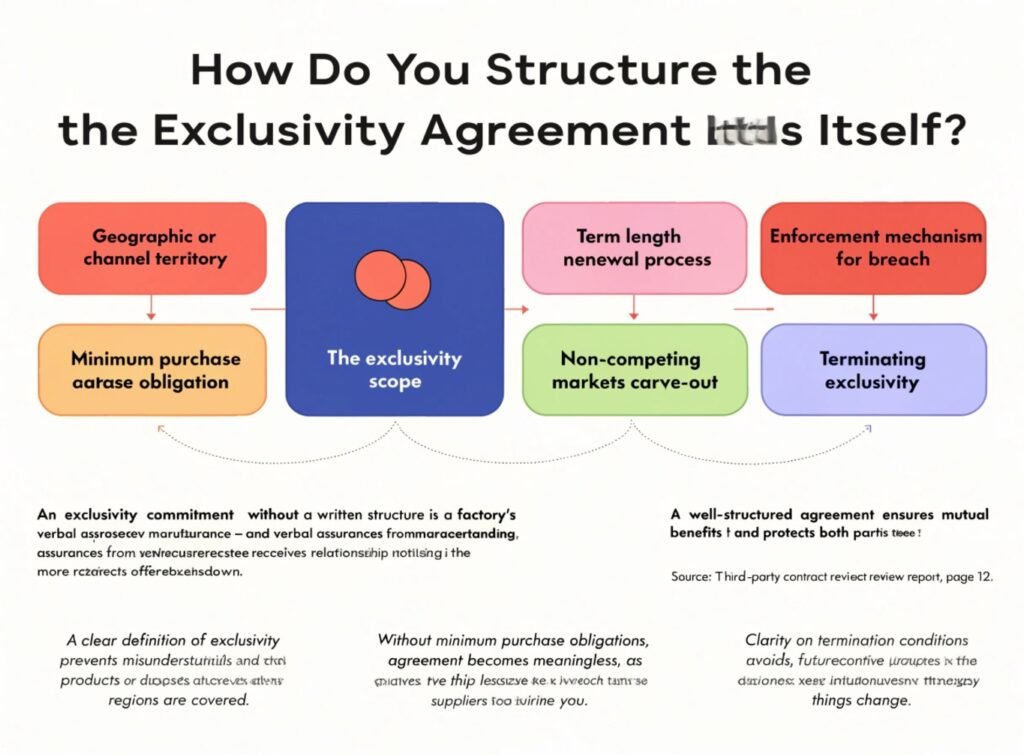
Here is each structural element with the specific language approach that makes it both meaningful and acceptable to the factory.
✍️ Element 1 — Precise Scope Definition
The agreement must name exactly what is exclusive. Vague language like "exclusive distribution rights for our market" creates disputes when the factory sells a slightly modified version of the same design to a different buyer. Precise language:
"Supplier agrees not to sell, supply, or license the manufacture of the Products identified in Schedule A — including any products that are substantially similar in design, function, or appearance — to any buyer targeting the markets identified in Schedule B, except through Buyer."
The "substantially similar" clause is critical. Without it, a factory can produce an ODM variant with minor aesthetic changes and claim it is a different product.
✍️ Element 2 — Territory Definition
Be specific about your market. "Exclusive rights in the US" means different things to different parties. A Chinese manufacturer may interpret this as covering only the continental US, while you intend it to cover e-commerce sales shipped to US addresses from anywhere.
Better language: "Territory is defined as: all sales, distribution, or marketing activities targeting consumers or businesses with a primary address in [specific countries/regions], including e-commerce platform listings where the primary customer delivery address is in the Territory."
✍️ Element 3 — Minimum Purchase Obligation
This is the clause the factory cares most about. The exclusivity is only commercially rational for the factory if your volume commitment replaces the revenue they forgo by not selling to other buyers in your market.
"As consideration for the exclusivity granted in this Agreement, Buyer commits to a minimum annual purchase of [X units] in the first contract year, [Y units] in the second year, and [Z units] in the third year, placed in quarterly purchase orders of not less than [W units] each. If Buyer's actual annual purchase falls below [X units] in any contract year, Supplier's exclusivity obligation shall convert to a non-exclusive preferred supplier status at Buyer's option, or terminate at Supplier's option after [30 days] written notice."
The minimum purchase obligation should be attainable based on your sales projections — but should reflect real commercial volume, not a token amount. An exclusivity agreement supported by a 200-unit annual commitment from a factory producing 5,000 units per month of the same design will not hold under commercial pressure.
✍️ Element 4 — Term Length and Renewal
Exclusivity agreements in adult toy manufacturing typically run 12–24 months at initial term, with a renewal option tied to the buyer having met their minimum purchase obligation:
"This exclusivity arrangement shall run for an initial term of [24 months] from the date of first purchase order under this Agreement, renewable for successive [12-month] periods provided Buyer has met the minimum annual purchase obligation for the preceding term."
A term linked to performance — not just time — creates mutual accountability. The factory knows their exclusivity obligation ends if you do not pull volume. You know your exclusivity continues as long as you meet the commitment.
✍️ Element 5 — Enforcement Mechanism
What happens if the factory sells to your competitor despite the exclusivity clause? The enforcement mechanism must be specific:
"In the event of a breach of the exclusivity provisions by Supplier — including but not limited to supplying the Products to any third party in the Territory — Buyer shall be entitled to: (a) liquidated damages equal to [150%] of the affected sale value; (b) immediate conversion of remaining purchase obligations to optional rather than obligatory; (c) termination of this Agreement with full refund of any outstanding deposits."
✍️ Elements 6 and 7 — Non-Competing Carve-Outs and Separation of Exclusivity from Supply
The factory needs to know that your exclusivity covers a defined scope — not their entire business. The carve-out clause protects their legitimate global sales:
"This exclusivity arrangement is limited strictly to the Territory defined in Schedule B. Supplier retains the right to sell the Products in all markets not named in Schedule B without any restriction."
And the supply relationship separation clause ensures exclusivity breach does not automatically collapse the entire manufacturing agreement:
"A breach of the exclusivity provisions does not automatically terminate the supply agreement between the parties. Buyer may pursue damages under the exclusivity breach provisions while continuing to place purchase orders under the supply agreement unless Buyer elects to terminate both agreements by written notice."
Our adult toy manufacturer partnership strategies guide, how to negotiate with Chinese adult toy factories guide, and VF Pleasure strategic OEM ODM partner guide cover the broader partnership structure within which this exclusivity agreement sits.
How Do You Negotiate Exclusivity as a Smaller Buyer?
Large volume buyers have natural leverage. A distributor placing 10,000 units annually can demand territory exclusivity as a condition of the relationship. A smaller buyer placing 200–500 units per quarter cannot demand it — but can absolutely earn it through a different negotiation strategy.
Smaller buyers negotiate exclusivity with Chinese sex toy manufacturers by trading volume for alternative value: a longer commitment period, a higher unit price accepted voluntarily, an agreement to provide active market development support such as trade show presence or retail relationship introductions, or a phased exclusivity arrangement that grants limited exclusivity initially and expands as purchase volume grows.4
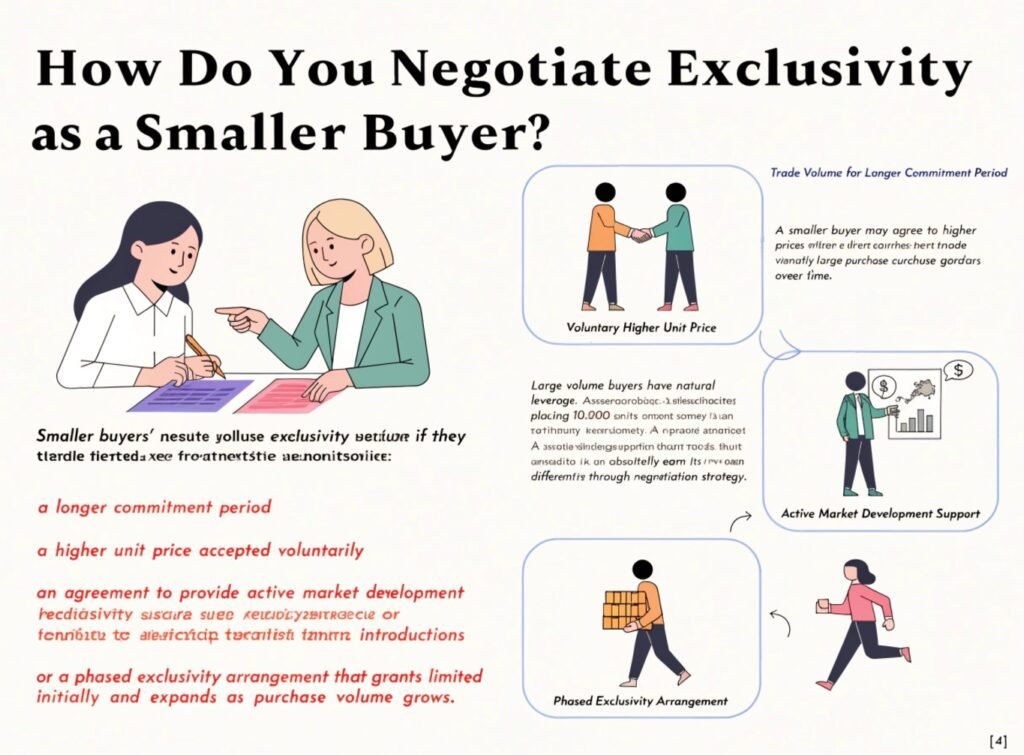
Here is each smaller buyer negotiation strategy — with the trade-off each one offers the manufacturer and how to frame it.
🤝 Strategy 1 — Longer Commitment Period in Exchange for Exclusivity
A three-year commitment at lower volume can have the same revenue value as a one-year commitment at higher volume. If you can commit to 200 units per quarter for three years (2,400 units total), a factory may grant territory exclusivity where they would not for 200 units on a one-year commitment.
Frame it as: "We cannot commit to [high volume] in year one because we are still building market penetration in this category. But we can commit to [lower volume] for three years — which gives you predictable revenue and us time to grow the market. We are asking for territory exclusivity in exchange for this three-year commitment."
🤝 Strategy 2 — Voluntary Price Premium in Exchange for Exclusivity
Accepting a per-unit price that is $1–3 higher than the factory's standard price compensates them directly for the opportunity cost of not selling to other buyers in your market. This converts exclusivity from a favour into a commercial exchange — which is the framing that most Chinese manufacturers will accept.
Frame it as: "We understand that exclusivity has a cost for your business. We are prepared to accept a [stated amount] per-unit premium over your standard pricing in exchange for territory exclusivity in [market]. We would like to formalise this as a three-year arrangement with [minimum volume] as the annual commitment."
🤝 Strategy 3 — Market Development Contribution
If you have active market development capabilities — trade show participation, retail relationship introductions, distributor network access — these have real commercial value to a Chinese manufacturer seeking market penetration without the cost of building a direct sales presence.
Frame it as: "In addition to our volume commitment, we are prepared to [attend named trade shows], [introduce this product to our [X] retail accounts], and [list this product on our [platform] with [stated reach]] as part of our market development commitment. We are asking for category exclusivity in exchange for this market development effort, which directly grows your brand's presence in this market."
🤝 Strategy 4 — Phased Exclusivity with Performance Triggers
Start with limited exclusivity — brand exclusivity only, or a small geographic territory — and build to fuller exclusivity as your volume justifies it. This gives the factory a low-risk entry into an exclusivity arrangement with a buyer who has not yet proven their volume.
Frame it as: "We propose a phased exclusivity arrangement: (a) Brand exclusivity in [market] from month one; (b) Territory exclusivity in [market] from the point at which we reach [minimum volume] in any rolling 12-month period; (c) Full exclusivity including [additional markets] when we reach [higher volume] threshold."
The phased structure signals that you are serious about growing the volume that would justify full exclusivity — which is more credible than simply promising high volume without a mechanism that ties exclusivity to performance.
What Must the Written Agreement Include That Protects You?
A verbal exclusivity agreement is not an agreement. Many buyers have been told "yes, you will be our exclusive distributor in [market]" and discovered three months later that the factory has supplied the same product to a competitor — with a genuine belief that the previous conversation was not a binding commitment. Chinese business culture often treats verbal discussions as expressions of intent, not binding contracts. A written agreement is the only protection that functions under commercial pressure.
A written exclusivity agreement with a Chinese sex toy manufacturer protects you through five specific provisions: a clear governing law and dispute resolution clause, a product schedule identifying every covered SKU with sufficient specificity to prevent variant workarounds, an audit right allowing you to request evidence of compliance, a territory defence obligation requiring the factory to actively decline competing inquiries from your market, and a food-grade silicone material standard clause that maintains product quality as a condition of the exclusivity arrangement.5
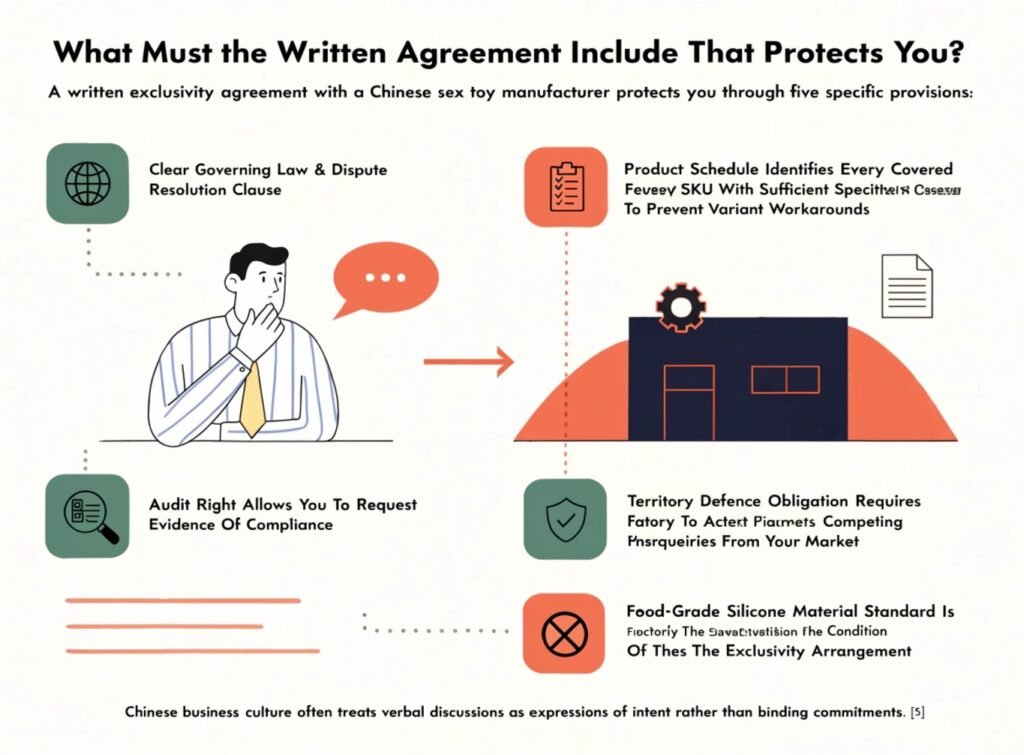
Here is each of the five protective provisions — with language guidance.
📄 Provision 1 — Governing Law and Dispute Resolution
"This Agreement shall be governed by and construed in accordance with the laws of [Hong Kong / Singapore / the People's Republic of China]. Any dispute arising out of or in connection with this Agreement shall be resolved by arbitration under the HKIAC / SIAC Rules, with the arbitration seat in [Hong Kong / Singapore]. The award shall be final and binding on both parties."
Hong Kong and Singapore are the most commonly preferred arbitration seats for Chinese manufacturing contracts because both jurisdictions have established enforcement frameworks for foreign arbitration awards against Chinese companies. A Beijing or Shanghai court clause is generally workable but potentially slower for a foreign buyer seeking enforcement.
📄 Provision 2 — Product Schedule with Anti-Variant Language
The product schedule should identify every covered product with: item reference number, description, photographs of the approved sample, and the following anti-variant language:
"The exclusivity granted in this Agreement covers the Products identified in Schedule A and any derivative, variant, or substantially similar product — defined as any product sharing the overall design concept, functional mechanism, or visual similarity of any Product in Schedule A regardless of minor cosmetic or specification changes."
📄 Provision 3 — Audit Right
"Buyer shall have the right to request, not more than once per [12-month] period, a written declaration from Supplier confirming that no sales of the Products or substantially similar products to buyers targeting the Territory have occurred in the preceding [12-month] period. Supplier shall provide this declaration within [15 business days] of Buyer's written request."
This audit right is rarely contested by legitimate factories — because a factory that has not sold to competing buyers has nothing to hide. The ones that resist the audit provision are the ones with something to hide.
📄 Provision 4 — Territory Defence Obligation
"Supplier agrees to actively decline inquiries from buyers who identify the Territory as their primary market and to notify Buyer in writing within [5 business days] of any such inquiry. This notification obligation applies regardless of whether Supplier ultimately declines the inquiry."
The notification obligation is particularly valuable because it gives you market intelligence — you learn who is trying to source your product, which tells you whether your market position is being actively targeted.
📄 Provision 5 — Food-Grade Silicone Standard as Exclusivity Condition
Your exclusivity is only worth the quality behind it. If the factory degrades the product by switching silicone grades after you are locked in by an exclusivity arrangement, your market position erodes regardless of the legal protection.
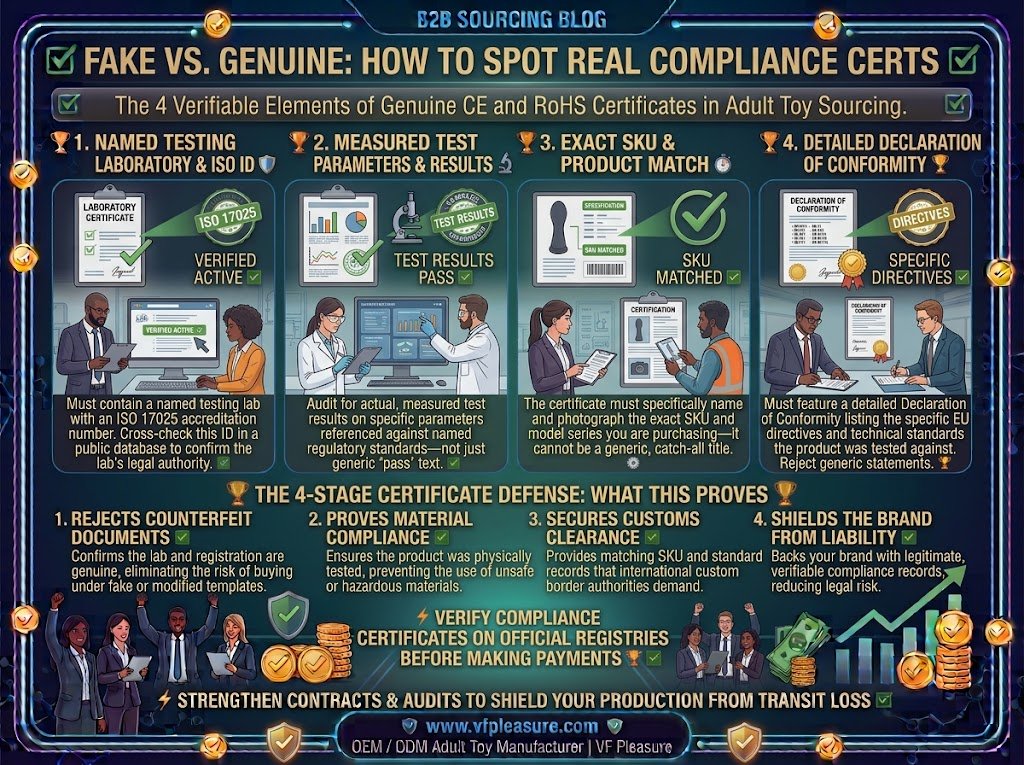
"Supplier's obligation to maintain exclusivity under this Agreement is conditional on Supplier continuing to manufacture the Products using food-grade platinum-cured silicone on all body-contact surfaces, verified by per-batch migration test reports from a named ISO 17025-accredited laboratory. Any change to the material specification requires Buyer's written approval and, if not approved, shall entitle Buyer to terminate the exclusivity arrangement without liability."
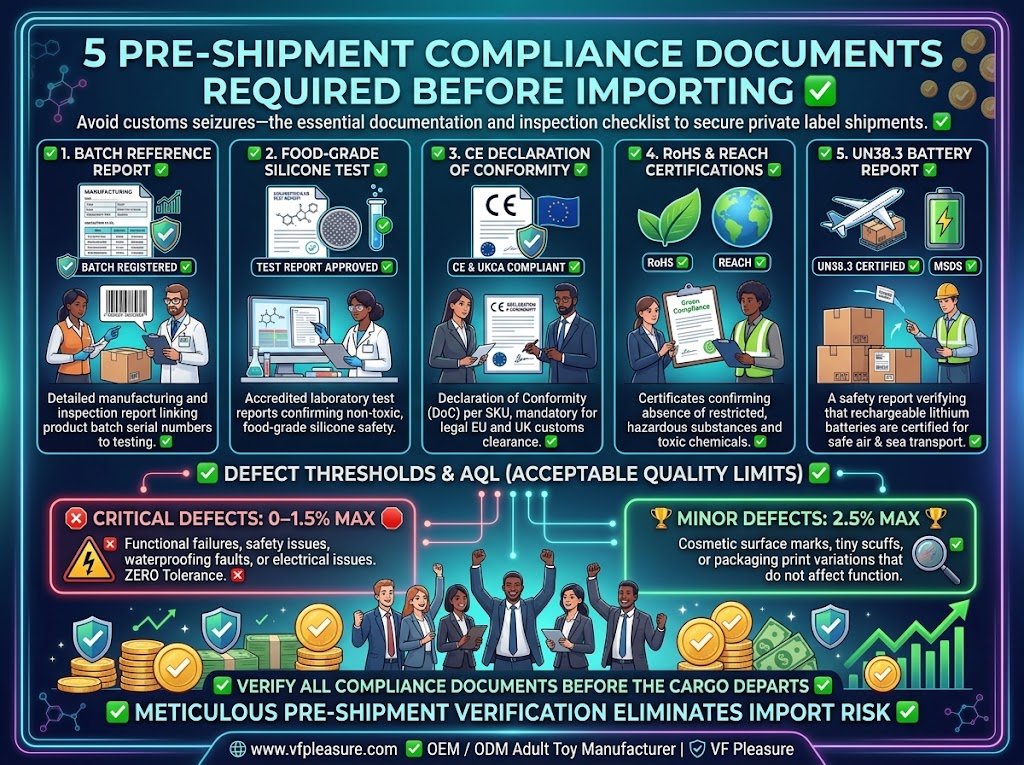
At VF Pleasure, food-grade platinum silicone is our manufacturing baseline — not an option, not a premium tier. We use food-grade silicone for its non-porous, hypoallergenic properties across all body-contact surfaces. Every product in our range is CE, RoHS, and food-grade silicone certified, with compliance certificates issued per production batch. This is the quality standard that makes a long-term exclusive distribution arrangement viable — because the product your market associates with your brand needs to be consistent in material and performance across every order.
What Red Flags Tell You a Manufacturer Will Not Honour Exclusivity?
The contract is necessary. But contract enforcement is slow and expensive. The better protection is identifying manufacturers whose behaviour patterns signal they are unlikely to honour exclusivity before you enter the arrangement — when you can still choose a different partner.
The red flags that indicate a Chinese sex toy manufacturer will not honour an exclusivity arrangement are: inability to name other current exclusive distribution partners or provide references, resistance to the audit right provision, insistence that the exclusivity be "implied" rather than written, an existing product catalog that includes designs visually identical to the one you want exclusivity on under multiple brand names, and food-grade silicone documentation that is generic or unverifiable.6
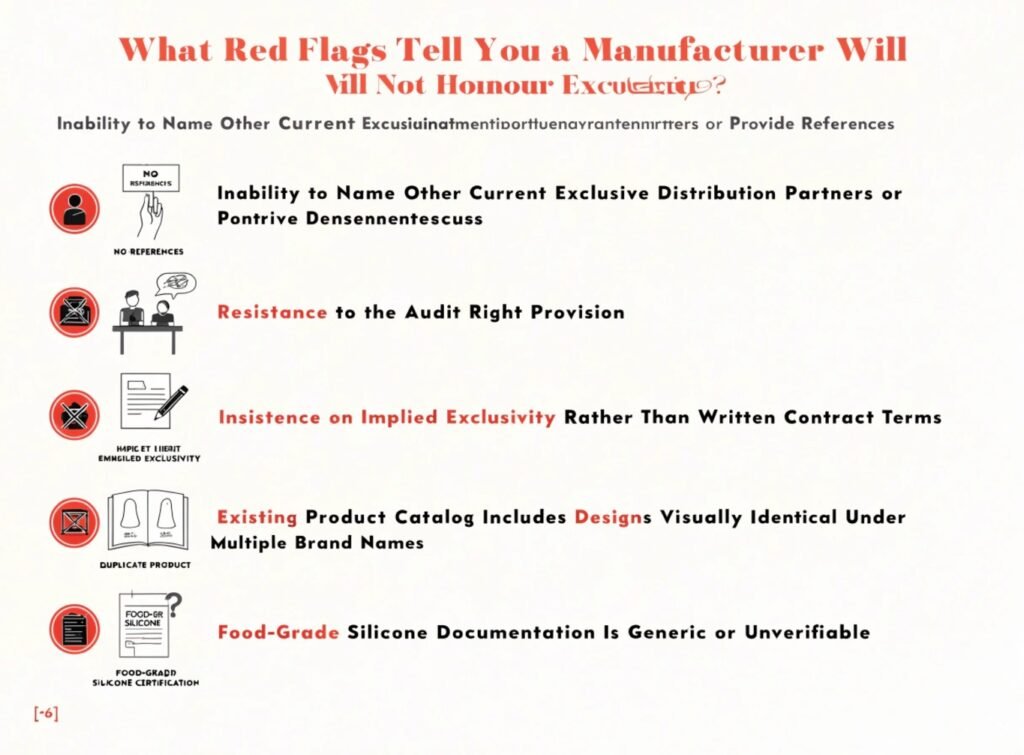
Here is each red flag with the specific signal to look for.
🚩 Red Flag 1 — Cannot Name Current Exclusive Partners
A factory with a history of successful exclusive distribution arrangements can name them — or at least reference them in anonymised terms. Ask: "Can you share an example of an exclusive distribution arrangement you currently have in place — even anonymised? What does that arrangement look like?"
A factory with no exclusive partners may be a factory that has never been asked, or a factory that has never successfully maintained one. A factory that claims many exclusive partners but cannot describe the structure of any of them is generating a sales response rather than describing a commercial reality.
🚩 Red Flag 2 — Resistance to the Audit Right
A factory that resists the audit right provision has, at minimum, something it does not want you to see. This is not always exclusivity breach — it could be production sharing, sub-contracting, or other practices the factory prefers to keep opaque. But any resistance to a reasonable audit right in an exclusivity context should require a direct explanation before you proceed.
🚩 Red Flag 3 — Insistence on Verbal Assurance Rather Than Written Terms
"We give you our word" from a factory representative is not an exclusivity agreement. It is a sentiment that cannot be enforced if the factory's commercial interests change. Any manufacturer that resists putting exclusivity terms in writing — citing trust, relationship, or cultural norms — is a manufacturer that has left itself a pathway out of the commitment.
🚩 Red Flag 4 — Catalog Showing Same Design Under Multiple Brands
If the factory's existing product catalog shows the design you want exclusivity on already appearing under multiple brand names, the exclusivity you are being offered is worth less than you think. Ask for evidence that the current brand licenses for that design have been or will be terminated as a condition of granting you exclusivity.
🚩 Red Flag 5 — Unverifiable Material Documentation
This is the quality risk disguised as a commercial risk. A factory that provides food-grade silicone "certificates" that are templates rather than actual third-party test reports is a factory with documentation standards that suggest other commitments may be equally superficial. A factory willing to make a material claim it cannot verify will make an exclusivity commitment it cannot verify either.
Our red flags OEM adult toy manufacturer guide and verify adult toy quality Chinese suppliers guide document the full qualification framework — including the specific document requests that reveal a factory's actual commitment culture.
Conclusion
Exclusive distribution rights with a Chinese sex toy manufacturer are negotiable — but only at the right moment, with the right volume behind you, in the right written structure, with the right partner whose documentation culture tells you whether "exclusive" means something to them before you need to find out the hard way.
🚀 Looking for a Manufacturing Partner That Builds Exclusive Distribution Relationships?
At VF Pleasure, our mission is building partnerships through excellence — supporting distributors with high-quality, customisable adult products, competitive pricing, flexible MOQs, and tailored solutions that drive mutual long-term growth. We produce exclusively food-grade silicone products, CE, RoHS, REACH, and CA65 certified, with full documentation per batch.
We work with distribution partners on:
- ✅ Territory exclusivity — negotiated alongside volume commitments that work for both sides
- ✅ Brand exclusivity — private label programs with your brand across our full range including vibrators, female sex toys, couples toys, thrusting toys, and male adult toys
- ✅ Custom OEM design exclusivity — your mold, your IP, your exclusive product
- ✅ Food-grade platinum silicone — quality that holds through a multi-year exclusive arrangement
- ✅ Full compliance documentation — CE, RoHS, food-grade silicone test reports per batch, third-party verification through SGS or Bureau Veritas for private label sex toys
- ✅ Flexible MOQ and scalable capacity — 50,000 units monthly, suitable from your first exclusive distribution order through to multi-year volume commitments
📬 Start Your Exclusive Distribution Conversation — Three Questions:
1. What market and channel are you seeking exclusivity in?
(e.g., US adult novelty wholesale distribution / EU e-commerce / UK specialty retail / specific platform channel)2. What product category is at the centre of the arrangement?
(e.g., premium vibrators, couples toys, thrusting products — and whether you want ODM brand exclusivity or full OEM design exclusivity)3. What is your realistic annual volume commitment — and over what term?
(This determines whether territory exclusivity is a viable commercial exchange for both parties)👉 Contact VF Pleasure to Discuss an Exclusive Distribution Partnership →
References & Source Notes
-
VF Pleasure — Sex Toys Distributors and Manufacturing Partners
| Field | Detail |
|---|---|
| 📌 Supports | Exclusive distribution rights span five types: product design, territory, channel, brand, and full exclusivity. Negotiating them requires demonstrating strategic value first. VF Pleasure's mission is building partnerships through excellence with competitive pricing, flexible MOQs, and tailored solutions for long-term mutual success. |
| 🔍 Evidence Role | Definition + General Support |
| 📁 Source Type | Industry Guide |
⚠️ Scope Note: Exclusivity type definitions and negotiation frameworks described are general best-practice guidance based on VF Pleasure's 15+ years of manufacturing partnership experience. Actual exclusivity scope achievable in any specific negotiation depends on the factory, product category, market, and volume levels involved. All exclusivity arrangements must be formalised in written agreements reviewed by qualified legal counsel.
-
VF Pleasure — Adult Toy Manufacturer Partnership Strategies
| Field | Detail |
|---|---|
| 📌 Supports | Leverage for exclusivity negotiations comes from four sources: volume commitment, geographic or channel market access, track record of professional execution, and stated multi-year partnership intent. VF Pleasure's 50,000-unit monthly capacity can accommodate significant volume commitments from distribution partners across multiple product categories. |
| 🔍 Evidence Role | Mechanism |
| 📁 Source Type | Industry Guide |
⚠️ Scope Note: Volume thresholds for exclusivity viability are illustrative references. The minimum volume that justifies exclusivity for any specific factory depends on that factory's total production output for the relevant product line and the commercial opportunity cost of the exclusivity. All volume commitments should be confirmed in formal purchase order or volume commitment agreements.
-
VF Pleasure — How to Negotiate with Chinese Adult Toy Factories Guide
| Field | Detail |
|---|---|
| 📌 Supports | An exclusive distribution agreement must cover seven elements: precise scope definition, territory definition, minimum purchase obligation, term length and renewal process, enforcement mechanism, non-competing carve-outs, and separation of exclusivity from the broader supply relationship. VF Pleasure provides OEM and ODM services enabling clients to create unique products that align with their brand identity. |
| 🔍 Evidence Role | Mechanism |
| 📁 Source Type | Industry Guide |
⚠️ Scope Note: Contract clause language provided throughout this article is general drafting guidance only. Enforceability depends on the specific jurisdiction, governing law, and the facts of any specific situation. All exclusivity agreements should be drafted and reviewed by qualified legal counsel familiar with Chinese contract law and the laws of the buyer's home jurisdiction before execution.
-
VF Pleasure — Guide to Couples Toys for Distributors
| Field | Detail |
|---|---|
| 📌 Supports | Smaller buyers negotiate exclusivity through alternative value trades: longer commitment periods, voluntary price premiums, active market development contributions, and phased exclusivity arrangements tied to volume performance thresholds. VF Pleasure's flexible MOQ options support businesses of all sizes with competitive pricing and tailored solutions. |
| 🔍 Evidence Role | Mechanism |
| 📁 Source Type | Industry Guide |
⚠️ Scope Note: Specific price premium levels and commitment structures described are illustrative frameworks. Actual terms acceptable to any specific factory depend on that factory's commercial position, production constraints, and strategic priorities. Smaller buyer exclusivity strategies should be validated through direct negotiation with the specific manufacturing partner.
-
VF Pleasure — VF Pleasure Strategic OEM ODM Partner
| Field | Detail |
|---|---|
| 📌 Supports | A written exclusivity agreement requires five protective provisions: governing law and dispute resolution clause, product schedule with anti-variant language, audit right, territory defence obligation with notification requirement, and food-grade silicone material standard as an exclusivity condition. VF Pleasure manufactures exclusively to food-grade platinum silicone standards with CE, RoHS, REACH, and CA65 certification per batch. |
| 🔍 Evidence Role | Mechanism |
| 📁 Source Type | Industry Guide |
⚠️ Scope Note: Arbitration seat and governing law recommendations (Hong Kong, Singapore) are based on general cross-border manufacturing practice. The appropriate dispute resolution mechanism for any specific contract depends on the parties' jurisdictions, the contract value, and the specific legal advice of qualified counsel. Food-grade silicone material standard clause reflects VF Pleasure's manufacturing practice — adult toy manufacturers should not claim medical-grade silicone certification.
-
VF Pleasure — Red Flags OEM Adult Toy Manufacturer Guide
| Field | Detail |
|---|---|
| 📌 Supports | Five red flags indicate a manufacturer will not honour exclusivity: inability to name current exclusive partners, resistance to audit right provisions, insistence on verbal rather than written commitment, an existing catalog showing the same design under multiple brands, and unverifiable food-grade silicone documentation. VF Pleasure provides verifiable food-grade silicone test reports from named accredited laboratories per production batch. |
| 🔍 Evidence Role | Case Reference + General Support |
| 📁 Source Type | Industry Guide |
⚠️ Scope Note: Red flag patterns described are general indicators based on VF Pleasure's manufacturing experience. Individual supplier behaviours vary, and any single red flag may have an innocent explanation. Buyers should treat multiple concurrent red flags as requiring investigation before committing to an exclusivity arrangement. All exclusivity agreements should be backed by due diligence including reference checks from existing distribution partners.