Skip to content
You have decided to move your adult toy production to a new factory. The reasons are your own — better quality, better pricing, delivery reliability, or a factory that actually returns messages before noon. The question that stops most buyers mid-decision is this: what happens to everything you built at the old factory? The molds you paid to develop. The packaging artwork your designer spent three weeks on. The compliance documentation with your brand name. Can you take any of it with you — or does switching suppliers mean starting from zero?
When you switch adult toy suppliers, what you can take depends entirely on what you paid for and what your contract says. Molds you paid for under OEM development are legally yours and transferable with the right documentation. Packaging artwork files belong to you if you commissioned them. CAD files and design documentation are transferable if ownership was established at creation. Compliance documentation — CE, RoHS, food-grade silicone test reports — must be re-issued for the new factory's production, because they reference the original factory's manufacturing process.1
![Switching adult toy suppliers molds packaging templates IP ownership transfer compliance documentation]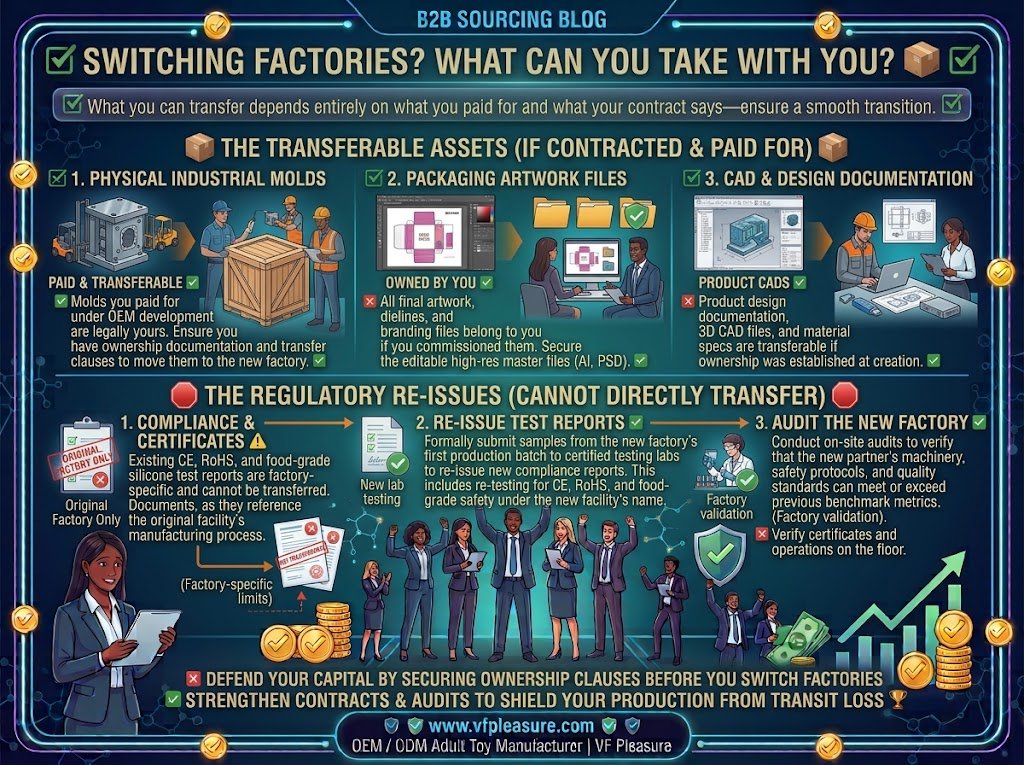 "Switching Suppliers — Can You Take Your Molds and Packaging Templates With You?")
I'm Sally. I run VF Pleasure — a direct adult toys factory in Dongguan, China, with 15+ years of B2B manufacturing experience. We receive incoming clients who are switching from other factories frequently — and the transition complexity they face almost always comes down to the same question: what did they actually own at their previous factory, and how much of it can they bring with them?
This guide covers every asset you build during a factory relationship — molds, CAD files, packaging artwork, compliance certificates — and tells you exactly what is transferable, what is not, and how to structure things from day one so that a future supplier switch costs you days, not months.
- 1 What Actually Belongs to You — and What Stays with the Factory?
- 2 Who Owns Your Adult Toy Mold — and How Do You Find Out?
- 3 Can You Transfer an ODM Product Design to a New Factory?
- 4 What Digital Assets Can You Always Take When You Switch Suppliers?
- 5 How Do You Transition Compliance Documentation to a New Factory?
- 6 How Do You Plan a Supplier Switch Without Disrupting Your Business?
- 7 Conclusion
- 8 References & Source Notes
What Actually Belongs to You — and What Stays with the Factory?
The clearest way to think about asset ownership in a factory relationship is to separate things you paid to create from things the factory already had when you arrived. This distinction is almost always the correct frame — but it only holds if the ownership was documented in writing at the time of creation. Without documentation, the factory's possession of the asset defaults to the factory's claim over it in any dispute.
In an adult toy factory relationship, you own what you paid to create with a documented ownership claim — custom molds, bespoke packaging artwork, your brand's CAD files, and your compliance documentation. The factory owns what existed before you arrived — their ODM product catalog, their standard molds, their internal manufacturing know-how, and their own compliance certificates. The line between these two categories is not always where buyers assume it is.1
![Adult toy factory ownership line buyer created assets factory owned ODM catalog molds compliance documents]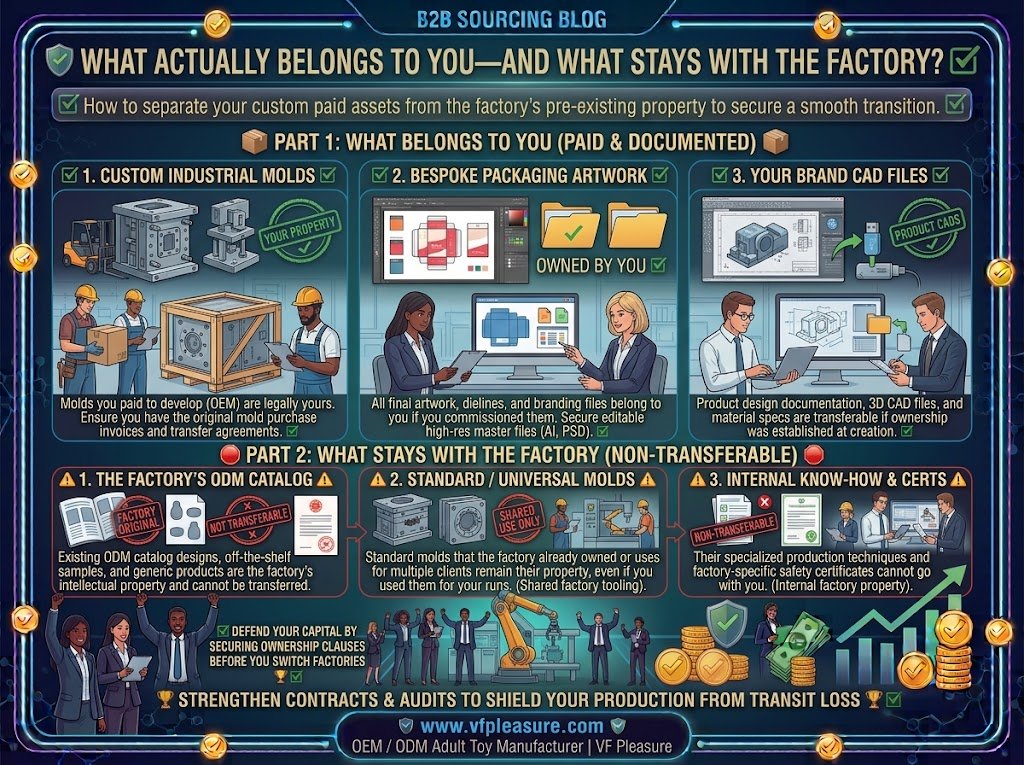 "What Belongs to You vs What Stays with the Factory When Switching Adult Toy Suppliers")
Here is the complete asset inventory — with the default ownership position for each.
📋 Asset Ownership Default Map
| Asset | Default Owner | Transferable? | What Determines It |
|---|---|---|---|
| Custom OEM mold (buyer paid for development) | Buyer — if contract states this | ✅ Yes | Written ownership clause in manufacturing agreement |
| ODM mold (factory's existing mold) | Factory | ❌ No | Factory owns pre-existing tooling |
| CAD files (buyer commissioned) | Buyer — if contract states this | ✅ Yes | IP assignment clause at commission stage |
| CAD files (factory created, no assignment) | Factory | ❌ Contested | No explicit assignment = factory default |
| Packaging artwork (buyer's designer) | Buyer | ✅ Yes | Created by buyer's designer, buyer's IP |
| Packaging artwork (factory's designer) | Factory — if no assignment | ⚠️ Contested | Needs IP assignment in manufacturing agreement |
| Food-grade silicone test reports | Factory | ⚠️ Re-issue needed | Tied to factory's production process and batch |
| CE Declaration of Conformity (your brand name) | Buyer's brand | ✅ Template usable | But new technical file needed from new factory |
| Brand logo and packaging copy | Buyer's brand | ✅ Yes | Your trademark, your copy |
| Product specification documentation | Buyer — if provided by buyer | ✅ Yes | Buyer's design brief and spec sheet |
The most common dispute zone is the bottom half of this table — assets that fall into the middle ground between "clearly yours" and "clearly theirs." The resolution is almost always the same: if ownership was not explicitly documented at creation, the factory has the stronger practical claim in China's legal environment, because possession is the starting point for any property dispute.
Our custom adult toy manufacturing guide, OEM vs ODM adult toys manufacturing model guide, and 5 contract clauses OEM sex toy supplier guide all explain how to structure ownership from the first order — not retrospectively when a switch becomes necessary.
Who Owns Your Adult Toy Mold — and How Do You Find Out?
The mold question is where most supplier switch disputes concentrate. Molds are expensive ($500–$8,000+ depending on complexity), they hold the physical form of your proprietary product, and they are physically large objects sitting in a factory thousands of kilometres away. Whether you own the mold that produces your exclusive vibrator design depends entirely on what happened when the tooling fee was paid — and what was written down about it.
You own your adult toy mold if and only if: you paid a named tooling fee that was itemised separately from the per-unit production price, your manufacturing agreement contains an explicit ownership clause stating "tooling and molds developed under this Agreement and paid for by Buyer are the exclusive property of Buyer," and the mold was developed specifically for your product rather than being an adaptation of the factory's pre-existing standard mold.2
![Own adult toy mold tooling fee ownership clause custom OEM design factory pre-existing standard mold]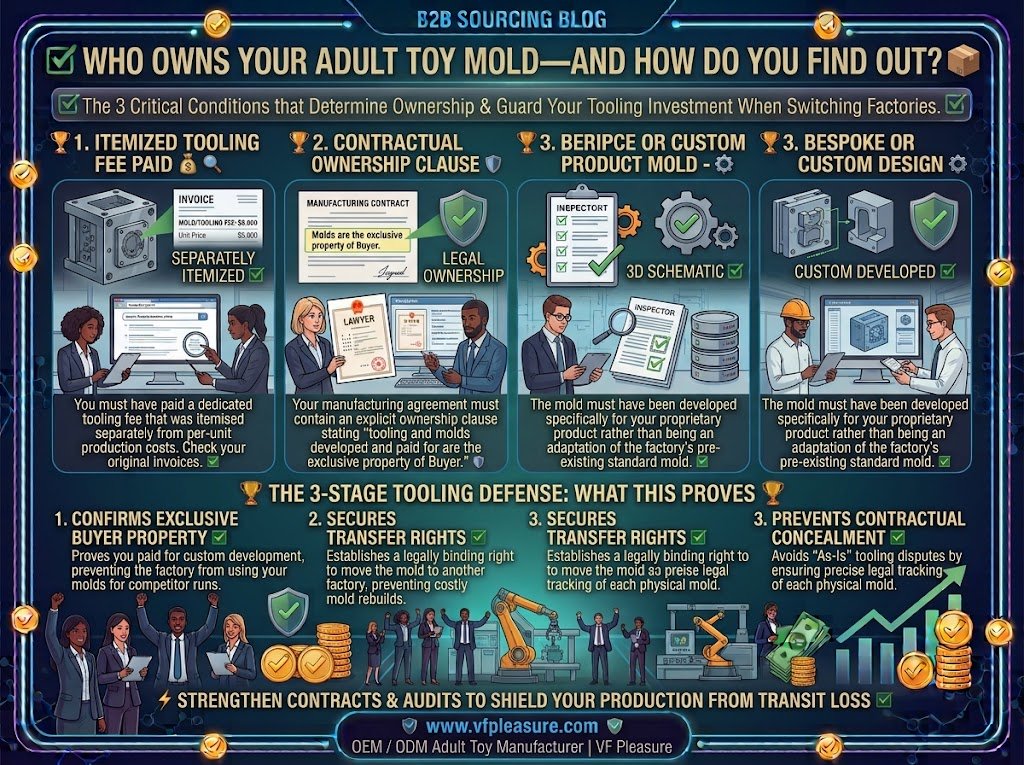 "Who Owns Your Adult Toy Mold — How to Determine Ownership When Switching Suppliers")
Here is how to determine which category your mold falls into — and what your options are in each case.
🔧 Scenario 1 — You Paid a Named Tooling Fee with Ownership Documentation
If your purchase order or manufacturing agreement has a line item for "mold development fee" paid by you, and a clause stating you own the resulting mold, you own the mold. Full stop.
Your next step when switching suppliers:
- Send a formal written notice to your existing factory stating that you are exercising your right to transfer the mold as documented in [agreement reference]
- Request a mold condition report and photographs confirming the mold's current state
- Arrange mold transport — typically packed in a custom wooden crate, transported by sea freight or road freight to the new factory
- Confirm receipt and condition at the new factory before any production begins on the transferred mold
The factory is legally obligated to release a mold you own. If they resist, your written ownership documentation is the basis for legal enforcement. Most factories comply without dispute when ownership documentation is clear.
🔧 Scenario 2 — You Paid a Tooling Fee with No Written Ownership Clause
This is the most common situation among buyers who did not get contract structure advice before their first OEM order. You paid $2,000 for mold development. You have the receipt. But neither the purchase order nor any written agreement says "this mold is the buyer's property."
In this scenario, ownership is contested. Chinese manufacturing practice generally defaults to factory ownership for tooling unless explicitly assigned otherwise. Your leverage is the payment record — which establishes that you funded the development — but it does not automatically create ownership without a written assignment.
Options in this scenario:
- Negotiate a mold transfer agreement retrospectively — most factories will agree to formalise your ownership for a mold you demonstrably paid for, in exchange for an agreement to complete any outstanding orders before the transfer occurs
- Negotiate to purchase the mold if the factory claims ownership — if the factory insists the mold is theirs, you can offer a nominal purchase price to formalise transfer rather than pursuing a legal dispute
- Accept and rebuild at a new factory — if the tooling fee was modest and the relationship with the existing factory is hostile, sometimes rebuilding the mold at the new factory at lower cost is the most practical path
💡 Sally's note from 15 years on the factory floor: At VF Pleasure, when a client pays a tooling fee for a custom mold, we include a mold ownership clause in the purchase order as standard practice. We do this because we want long-term partnerships — not clients who feel trapped. A factory that resists putting mold ownership in writing when the buyer has paid for the tooling is a factory protecting its own leverage at the expense of the relationship.
🔧 Scenario 3 — You Used an ODM Design (No Custom Mold)
If your product is based on the factory's existing ODM design — you chose a product from their catalog and added your branding — there is no custom mold to take. The factory's ODM mold belongs to the factory. This is not a dispute scenario; it is simply the structure of the ODM model.
The practical implication when switching: you need to find an equivalent ODM design at your new factory or commission a new OEM mold. For ODM-based private label brands, the most portable asset is your brand identity — your packaging artwork, your compliance brand name, and your market positioning — not the product design itself.
Our OEM vs ODM adult toys manufacturing model guide explains the IP ownership differences between these two models in full — including when starting with ODM and graduating to OEM is the right sequencing for a brand that wants to build transferable product IP.
Can You Transfer an ODM Product Design to a New Factory?
Here is the question that creates the most misunderstanding: if you cannot take the factory's physical mold, can you at least take the design — the CAD files, the technical drawings, the material specification — and have a new factory recreate it?
Whether you can transfer an ODM product design to a new factory depends on who created the CAD files and design documentation. If your factory created the files using their own R&D team with no IP assignment, the files belong to the factory. If you provided the design brief and commissioned the files as a work product under your brief, you may have stronger grounds — but without an explicit written IP assignment in your manufacturing agreement, Chinese contract law will not automatically assign IP to the commissioner.3
![ODM product design transfer new factory CAD files technical drawings IP assignment written documentation Chinese contract law]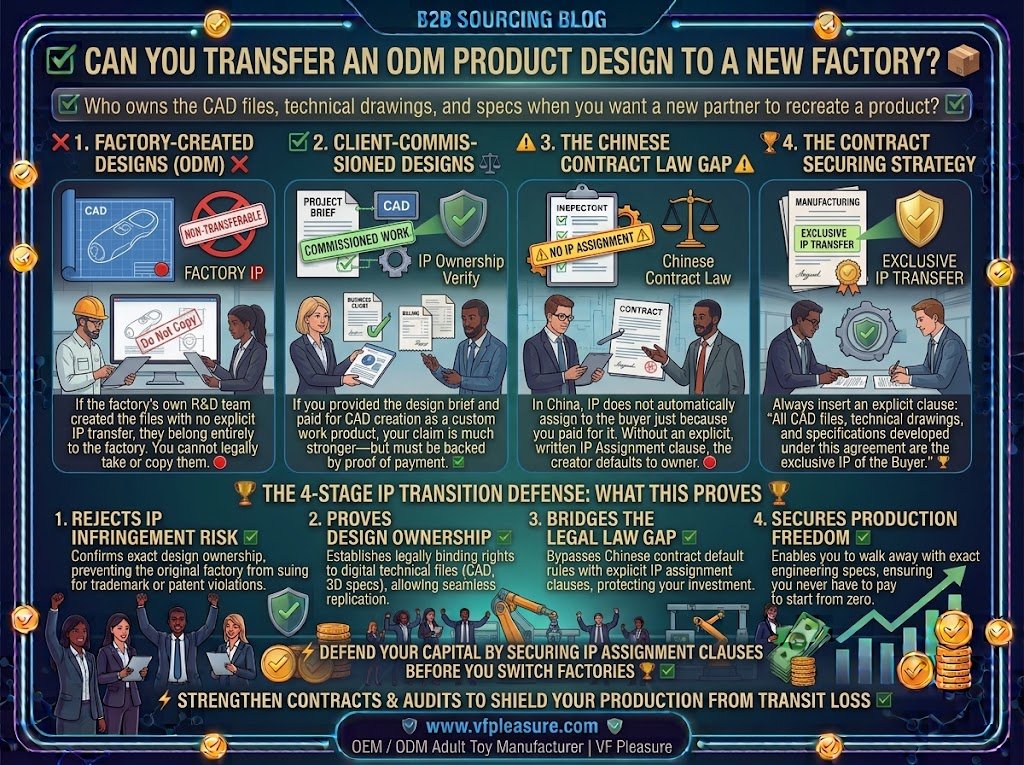 "Can You Transfer an ODM Adult Toy Product Design to a New Factory?")
Here is what is and is not portable in each CAD/design documentation scenario.
📐 What You Can Always Transfer — Your Design Brief
The design brief you wrote — your specification document describing the product function, material requirements, dimension parameters, and performance expectations — is 100% your IP. You created it. You own it.
A well-written product specification document can enable a new factory to recreate your product from scratch without needing the original factory's CAD files. This works better for some product types than others: a food-grade silicone vibrator with standard electronics can be recreated from a specification brief relatively easily. A highly complex custom mechanism is harder to recreate without the original technical drawings.
The lesson for buyers who have not yet switched: document your product specification as a buyer-created document, not as a factory deliverable. Your brief goes into your files. Their CAD output goes into theirs. This separation protects your ability to brief a new factory without needing anything from the old one.
📐 What Requires IP Assignment — Factory-Created CAD Files
If a factory created CAD files for your custom product, those files are the factory's work product under Chinese law unless an IP assignment clause explicitly transfers ownership to the buyer. A clause that says:
"All CAD files, design drawings, and technical documentation created by Supplier under this Agreement shall be the exclusive IP of Buyer upon full payment of the design fee."
— converts factory work product into buyer-owned IP. Without this clause, the factory's files are the factory's property, and you cannot legally use them at a new factory.
If you do not have this clause and you need the files, your options are:
- Negotiate with the existing factory to purchase the CAD files as part of the supplier transition
- Commission reverse-engineering from your physical product samples at the new factory — a new factory with a capable R&D team can recreate a product from physical samples in most cases
📐 What a New Factory Can Do From Samples Alone
A factory with an experienced R&D team can reverse-engineer a product from physical samples more quickly than most buyers expect. At VF Pleasure, our R&D process starts with concept finalization — and we have taken physical products from other manufacturers and recreated them as new tooling at the client's request in many cases, with a fully new food-grade silicone specification and new compliance documentation chain. The typical timeline is two to four weeks for concept finalization and 3D modeling, seven to ten days for functional sample production, and a further three to five days for feedback and adjustment.
This means that even when buyers cannot transfer CAD files from their old factory, a capable new factory can close the gap quickly from samples alone.
What Digital Assets Can You Always Take When You Switch Suppliers?
Not everything requires a contract clause to protect. Some digital assets are always yours — because you created them, commissioned them, or because they are registered intellectual property tied to your brand. Knowing which assets are always portable means you can plan a supplier switch around the ones that require negotiation rather than treating everything as at risk.
The digital assets you can always take when switching adult toy suppliers are: your brand logo and trademark registrations, your packaging artwork files created by your own designer or commissioned from an independent designer with proper IP assignment, your product photography and marketing imagery, your product specification briefs and quality requirements documents, your brand copy and positioning language, and your customer-facing compliance claims and body-safe material positioning.4
![Digital assets always portable switching adult toy suppliers logo artwork photography specification brief compliance claims]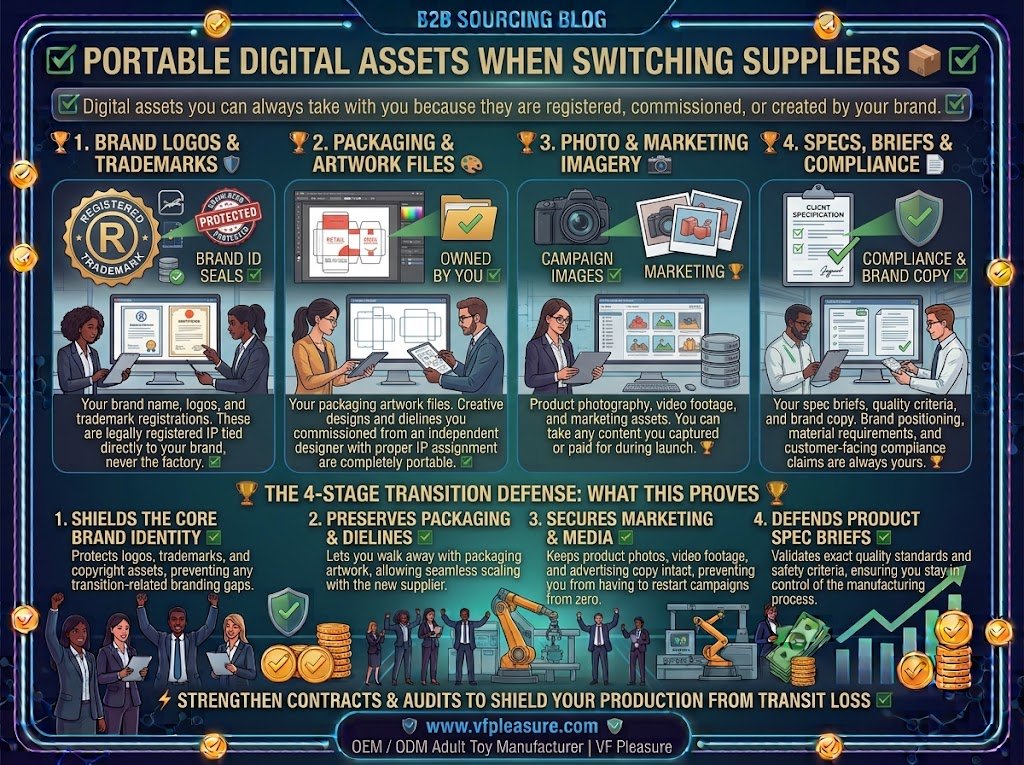 "Digital Assets You Can Always Take When Switching Adult Toy Suppliers")
Here is each portable asset category — and how to ensure it actually is in your possession and accessible when you need it.
🎨 Always Portable: Brand Logo and Trademark
Your registered trademark and brand logo are registered with the relevant national IP office — they are legally yours and have nothing to do with your manufacturing factory. The only IP risk at a factory relationship level is if you allowed the factory to register your brand name in China without you doing so first — a known scam pattern where trading companies or small manufacturers register foreign brand names in China before the brand owner does, then hold the registration as leverage.
If you have registered your trademark in China through a qualified IP attorney, this risk is eliminated. If you have not, a supplier switch is the right moment to do so.
🖼️ Always Portable: Packaging Artwork (If Commissioned Correctly)
Packaging artwork created by a designer you hired directly — whether a freelancer, a design agency, or your own in-house team — belongs to you under work-for-hire principles. You have the Adobe Illustrator or Figma files. You have the Pantone references. You have the print-ready specifications.
If your packaging was designed by the factory's design team without a formal IP assignment, the situation is more complex — but in practice, most factories will provide packaging artwork files to a departing client without dispute, because they have no commercial interest in holding packaging artwork that only works for your brand. It is worth requesting the source files when you initiate the switch conversation.
📋 Always Portable: Product Specification Briefs and Quality Requirements
Any document you created describing your product requirements — material specifications, dimensional tolerances, performance requirements, food-grade silicone grade specifications, test methodologies — is your IP because you created it. Keep your specification documents in your own files, updated with each production change.
This is the document asset that most directly enables a smooth factory switch — a new factory that receives a comprehensive specification brief can quote and sample accurately without needing anything from the old factory except the physical reference sample.
💡 Sally's practical note: I tell every new private label client at VF Pleasure to maintain their own file of: the approved sample photographs, the product specification brief, the packaging artwork files, and the approved food-grade silicone colour swatch. These four items, held by the buyer, make any supplier switch a 30-day project rather than a 90-day one.
How Do You Transition Compliance Documentation to a New Factory?
This is the aspect of supplier switching that most buyers underestimate. Your CE Declaration of Conformity names your brand as the EU responsible person — but it is supported by the previous factory's technical file, including their test reports, their production process documentation, and their quality management records. When you move to a new factory, that technical file no longer reflects your actual manufacturing process. You need a new one.
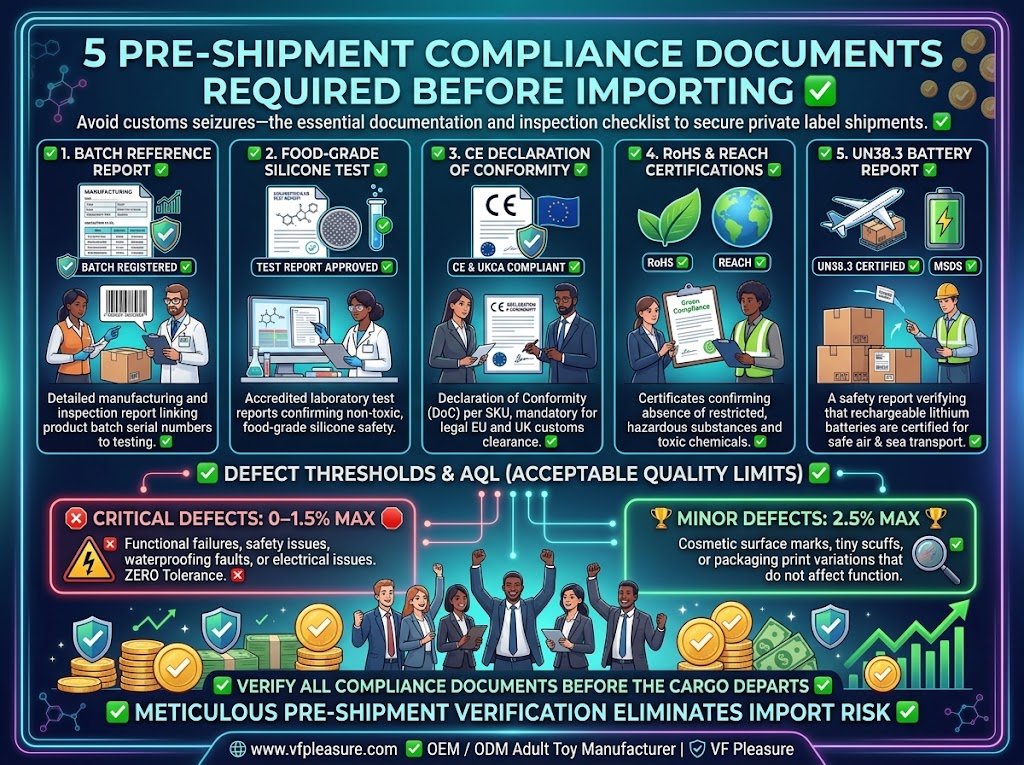
When you switch adult toy suppliers, all compliance documentation that references the manufacturing factory must be re-issued for the new factory's production process. This means: a new CE Declaration of Conformity supported by new test reports from the new factory, new food-grade silicone migration test reports from a named accredited laboratory per SKU per new production batch, new RoHS certificates referencing the new factory's component specifications, and new UN38.3 battery certification if any battery specification changes.5
![Compliance documentation re-issued switching adult toy suppliers CE Declaration food-grade silicone RoHS UN38.3 new factory]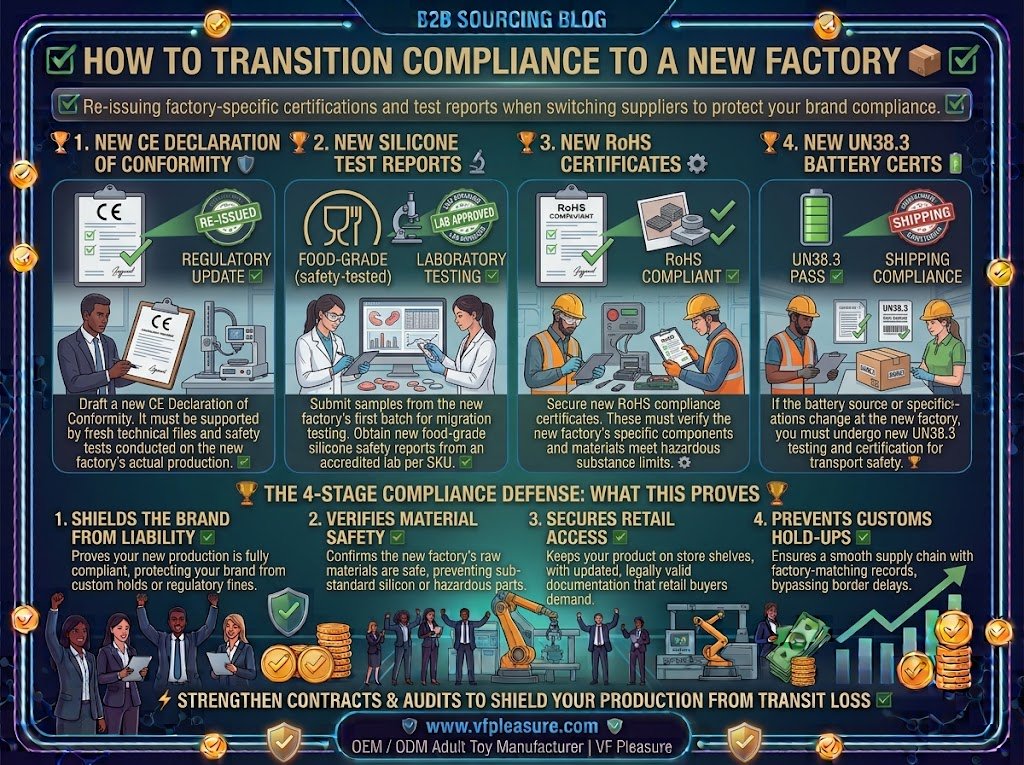 "Compliance Documentation Transition When Switching Adult Toy Suppliers")
Here is how each compliance document transitions — and the timeline and cost to expect.
🏅 Compliance Transition 1 — CE Declaration of Conformity
Your CE Declaration names your brand as the EU responsible person. It references a technical file at the supporting manufacturer. When you switch factories, the technical file at your old factory no longer matches your current production. The CE Declaration should be updated.
What stays the same: your brand name, the product description, and the directives listed.
What changes: the manufacturer reference in the technical file, the test report IDs supporting the declaration, and the production address.
A new factory that produces your product needs to provide: their production process documentation for the technical file, new electrical safety test results, and new product-specific CE test reports. The Declaration itself is then re-issued under your brand name. At VF Pleasure, we support this re-declaration process for all incoming private label clients.
Timeline: Two to four weeks for a standard electronic adult toy, assuming testing can be expedited through the factory's existing lab relationships.
🧬 Compliance Transition 2 — Food-Grade Silicone Test Reports
Food-grade platinum silicone test reports are batch-specific and factory-specific. A test report issued for a batch produced at your old factory does not cover production at your new factory — even if both factories claim to use the same food-grade silicone grade.
Each new production batch at the new factory requires its own migration test report from a named ISO 17025-accredited laboratory. This is not a bureaucratic inconvenience. It is the material verification that your "food-grade silicone" packaging claim is honest and defensible for the goods your customers are actually receiving.
At VF Pleasure, we manufacture exclusively with food-grade platinum silicone — the non-porous, hypoallergenic gold standard for body-contact products. We provide compliance certificates for every production batch, and for private label orders, third-party lab verification through SGS or Bureau Veritas is available. Any incoming client switching from another factory can start their compliance chain cleanly from their first production batch with us.
⚠️ Important: Never claim "food-grade silicone" on packaging for goods produced at a new factory based on test reports from your previous factory. The test report must reference the actual production batch being sold. Using old compliance documentation for new production is a material misrepresentation that creates both regulatory and reputational risk for your brand.
📋 Compliance Transition Timeline
| Document | Re-issuance Required? | Typical Timeline | Who Manages It |
|---|---|---|---|
| CE Declaration | ✅ Yes — new technical file needed | 2–4 weeks | New factory + compliance consultant |
| Food-grade silicone test report | ✅ Yes — per new batch | 2–3 weeks | New factory + accredited lab |
| RoHS certificate | ✅ Yes — new component verification | 1–2 weeks | New factory |
| CA65 / Prop 65 | ✅ Yes — new batch reference | 1–2 weeks | New factory |
| UN38.3 battery certification | ⚠️ Only if battery spec changes | 4–8 weeks if needed | New factory + test lab |
| Brand trademark | ❌ No — registered with IP office | — | Your IP attorney |
| Packaging artwork | ❌ No — update factory address if applicable | Days | Your designer |
How Do You Plan a Supplier Switch Without Disrupting Your Business?
A supplier switch is not a crisis. It is a business decision that can be executed cleanly if the timeline is planned correctly and the overlapping liabilities between the old factory and the new one are managed sequentially rather than simultaneously.
A supplier switch in adult toy manufacturing follows a four-stage transition plan: asset inventory and ownership confirmation at the old factory, new factory qualification with sample orders and compliance documentation chain established, parallel production planning where your final order at the old factory overlaps with your first samples at the new factory, and a defined handover point where the new factory takes over primary production with a full compliance and IP package.6
![Supplier switch adult toy four-stage transition plan asset inventory new factory qualification parallel production handover]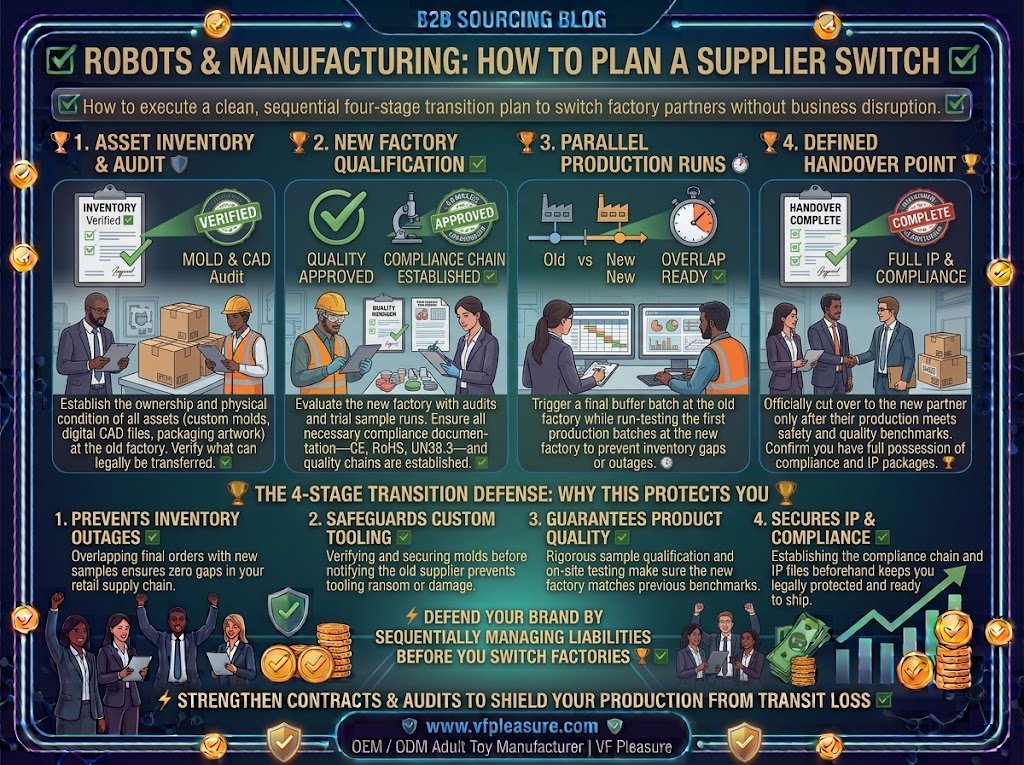 "How to Plan an Adult Toy Supplier Switch Without Business Disruption — Four-Stage Transition Plan")
Here is each stage — with the specific actions required and the timeline to expect.
📋 Stage 1 — Asset Inventory and Ownership Confirmation (Weeks 1–2)
Before you say anything to either factory, document what you own:
- ✅ Identify which molds (if any) you paid for under an ownership clause — locate the payment records and purchase order language
- ✅ Locate your packaging artwork source files — confirm they are in your possession and in a format transferable to a new factory
- ✅ Locate your product specification documents — update them with any changes from your most recent production
- ✅ Collect your current compliance documentation set — CE, RoHS, food-grade silicone reports — as the baseline for what needs to be re-issued
📋 Stage 2 — New Factory Qualification (Weeks 3–8)
Before you place any production order at the new factory, complete qualification:
- Submit your product specification brief and request a quote with full itemised cost breakdown
- Request the food-grade silicone documentation for the specific product you intend to source
- Place a sample order — not a production order — and evaluate quality against your specification and your current reference sample
- Confirm the compliance documentation chain: CE re-declaration support, food-grade silicone test report capability, third-party verification option
At VF Pleasure, sample lead time is 7–10 days and we provide free samples (3 units, ~$39 shipping) for qualification purposes. Our 15+ years of B2B expertise combined with a monthly capacity of 50,000 units means we can absorb incoming clients at any scale — from a 100-unit first order through to established large-volume relationships.
"VF Pleasure's private-label solutions were a game-changer for us. They helped us stand out in a crowded market." — Rachel Lee, Velvet Secrets.
📋 Stage 3 — Parallel Production Planning (Weeks 6–12)
Place your final order at the old factory while samples from the new factory are being evaluated. This ensures:
- No stock gap in your market during the transition
- Time to resolve any sample revision cycles at the new factory before you are dependent on them for primary supply
- A final opportunity to retrieve any physical assets (approved reference samples, mold condition reports) from the old factory while the relationship is still active
If you own molds at the old factory, this is the stage to initiate the mold transfer process — formally notifying the old factory of your ownership claim and arranging transport to the new factory for commissioning.
📋 Stage 4 — Handover and Compliance Rebuild (Weeks 10–16)
At the handover point:
- Your new factory has passed sample qualification and produced at least one production test batch
- New compliance documentation is in place — CE re-declared, food-grade silicone migration report for the new batch, RoHS updated
- Your old factory has fulfilled all outstanding orders and any mold transfer has been completed
- Your safety stock covers the compliance documentation gap period
💡 Sally's 15-year observation on supplier switches: The brands that execute a supplier switch cleanly are the ones that planned it before they needed it — not in response to a crisis. If you are reading this because you are already in a crisis with your current factory, the transition will take longer and cost more. If you are reading this while your current relationship is still functional, you can execute this transition on your terms, your timeline, and with your assets properly protected. Choose the second scenario every time you can.
Conclusion
When you switch adult toy suppliers, you take everything you created and paid for under written ownership documentation — custom molds, CAD files where IP was assigned, packaging artwork, and your brand itself. You leave behind factory-owned ODM molds and factory-created files without IP assignment. And you rebuild your compliance documentation chain completely — because food-grade silicone test reports and CE technical files reference the factory that made the product, not just the brand that sold it.
🚀 Ready to Switch to VF Pleasure — With a Clean IP and Compliance Start?
At VF Pleasure, we support incoming clients from other factories with clear mold ownership documentation, food-grade platinum silicone certification from day one, and a full compliance re-documentation process for CE, RoHS, REACH, and CA65 per new production batch.
We offer every incoming supplier-switch client:
- ✅ Written mold ownership clause — for any OEM tooling you develop with us, as standard in every purchase order
- ✅ IP assignment for design work — any CAD or packaging design work we do for you is assigned to your brand
- ✅ Food-grade platinum silicone — per-batch migration test reports from named accredited laboratories, starting from your first order
- ✅ CE re-declaration support — your brand as EU responsible person, with full technical file from our factory
- ✅ Third-party verification — SGS or Bureau Veritas for private label sex toys to establish your new compliance chain independently
- ✅ Free qualification samples — 3 units, ~$39 shipping, to evaluate our quality before any production commitment
- ✅ Full product range — vibrators, female sex toys, couples toys, thrusting toys, and male adult toys
📬 Start Your Supplier Transition Conversation — Three Questions:
1. What are you switching from — quality issues, delivery reliability, pricing, or something else?
(Understanding what went wrong helps me show you specifically how our production system addresses that issue)2. Do you have custom OEM molds at your current factory — and do you have written ownership documentation?
(This determines whether we need to plan for a mold transfer, a mold rebuild, or a fresh ODM start)3. What product category and volume are you switching over?
(This tells me the compliance documentation timeline and whether we need to plan a parallel production window)👉 Request a Supplier Transition Quote + Free Samples from VF Pleasure →
References & Source Notes
-
VF Pleasure — Custom Adult Toy Manufacturing Guide
| Field | Detail |
|---|---|
| 📌 Supports | Asset ownership when switching adult toy suppliers depends on written documentation at creation: custom OEM molds belong to the buyer if paid for under a written ownership clause; ODM molds belong to the factory; packaging artwork belongs to the commissioner; food-grade silicone test reports must be re-issued because they reference the specific factory's production batch. VF Pleasure includes mold ownership clauses as standard in OEM purchase orders. |
| 🔍 Evidence Role | Definition + General Support |
| 📁 Source Type | Industry Guide |
⚠️ Scope Note: Asset ownership default positions described reflect general Chinese contract law principles and standard adult toy manufacturing industry practice. Actual ownership rights depend on the specific contract language, jurisdiction, and individual circumstances. All IP ownership questions should be reviewed by qualified legal counsel familiar with Chinese contract and IP law before any supplier transition action is taken.
-
VF Pleasure — OEM vs ODM Adult Toys Manufacturing Model Guide
| Field | Detail |
|---|---|
| 📌 Supports | Mold ownership in adult toy manufacturing depends on whether a named tooling fee was paid, whether an explicit ownership clause exists in the manufacturing agreement, and whether the mold was custom-developed or an adaptation of the factory's pre-existing standard. OEM designs with paid tooling and written ownership clauses are transferable; ODM factory molds are not. VF Pleasure provides OEM/ODM services with exclusive designs tailored to the buyer's brand identity. |
| 🔍 Evidence Role | Definition |
| 📁 Source Type | Industry Guide |
⚠️ Scope Note: Mold transfer scenarios described are general frameworks. Actual enforceability of mold ownership claims depends on specific contract language, the applicable governing law, and the facts of the individual situation. Legal advice from a qualified Chinese IP or contract attorney is recommended before initiating any mold transfer request.
-
VF Pleasure — Custom Adult Toy Factory Process Guide
| Field | Detail |
|---|---|
| 📌 Supports | Whether ODM product designs can be transferred to a new factory depends on CAD file ownership — which requires explicit IP assignment clauses in the manufacturing agreement. Without written IP assignment, factory-created CAD files default to factory ownership under Chinese law. New factories can recreate products from physical samples and buyer specification briefs — VF Pleasure's R&D process includes concept finalization (5–7 days), 3D modeling (3–5 days), and prototype production (7–10 days). |
| 🔍 Evidence Role | Mechanism |
| 📁 Source Type | Industry Guide |
⚠️ Scope Note: CAD file ownership default positions reflect general Chinese contract law principles. The ease and timeline of product recreation from physical samples varies by product complexity and new factory R&D capability. Timeline estimates for VF Pleasure's R&D process reflect standard project parameters — individual projects may vary by complexity, revision requirements, and current production schedule.
-
VF Pleasure — Private Label Adult Products Development Process
| Field | Detail |
|---|---|
| 📌 Supports | Digital assets always portable when switching adult toy suppliers include: brand logo and trademark registrations, packaging artwork commissioned from buyer's designer, product photography, product specification briefs, brand copy, and body-safe food-grade silicone material positioning. VF Pleasure provides custom packaging, logos, and colors for private label clients — all with buyer-owned artwork as the baseline. |
| 🔍 Evidence Role | General Support |
| 📁 Source Type | Industry Guide |
⚠️ Scope Note: Portable asset descriptions assume buyers have commissioned packaging artwork from their own designers or have explicit IP assignment clauses covering factory-designed packaging. Buyers who relied entirely on factory design teams without written IP assignment should request source files from their factory and confirm file ownership before assuming complete portability.
-
VF Pleasure — Body-Safe Adult Toys Manufacturing Standards Guide
| Field | Detail |
|---|---|
| 📌 Supports | All compliance documentation referencing the manufacturing factory must be re-issued when switching suppliers: CE Declaration with new technical file, food-grade silicone migration test reports per new production batch from a named accredited laboratory, RoHS certificates with new component verification, and UN38.3 if battery specification changes. VF Pleasure provides compliance certificates for every batch and supports CE re-declaration under the buyer's brand name for all incoming private label clients. |
| 🔍 Evidence Role | Mechanism |
| 📁 Source Type | Industry Guide |
⚠️ Scope Note: Compliance documentation re-issuance timelines are general estimates based on VF Pleasure's experience with standard adult toy products. Actual timelines depend on product complexity, test laboratory availability, and whether expedited testing options are required. All compliance documentation must accurately reference the actual production batch — using previous factory compliance documentation for new factory production is not acceptable and creates regulatory risk.
-
VF Pleasure — Adult Toy Manufacturer Partnership Strategies
| Field | Detail |
|---|---|
| 📌 Supports | A clean supplier switch follows four stages: asset inventory and ownership confirmation, new factory qualification with sample orders and compliance chain established, parallel production planning with final order overlap, and a defined handover point with complete compliance and IP package. VF Pleasure's sample lead time (7–10 days) and 50,000-unit monthly capacity support incoming clients at every transition scale. |
| 🔍 Evidence Role | Mechanism |
| 📁 Source Type | Industry Guide |
⚠️ Scope Note: Supplier switch timeline (10–16 weeks for a full transition) reflects a general planning framework. Actual timelines depend on the complexity of mold transfers, compliance documentation rebuilding requirements, new factory sample revision cycles, and safety stock levels. Buyers should build additional buffer into their planning timelines for first-time supplier switches.