Skip to content
You have a brand vision but zero product design experience — and the adult toy market seems locked behind engineering degrees and factory connections you don't have. That gap is smaller than you think.
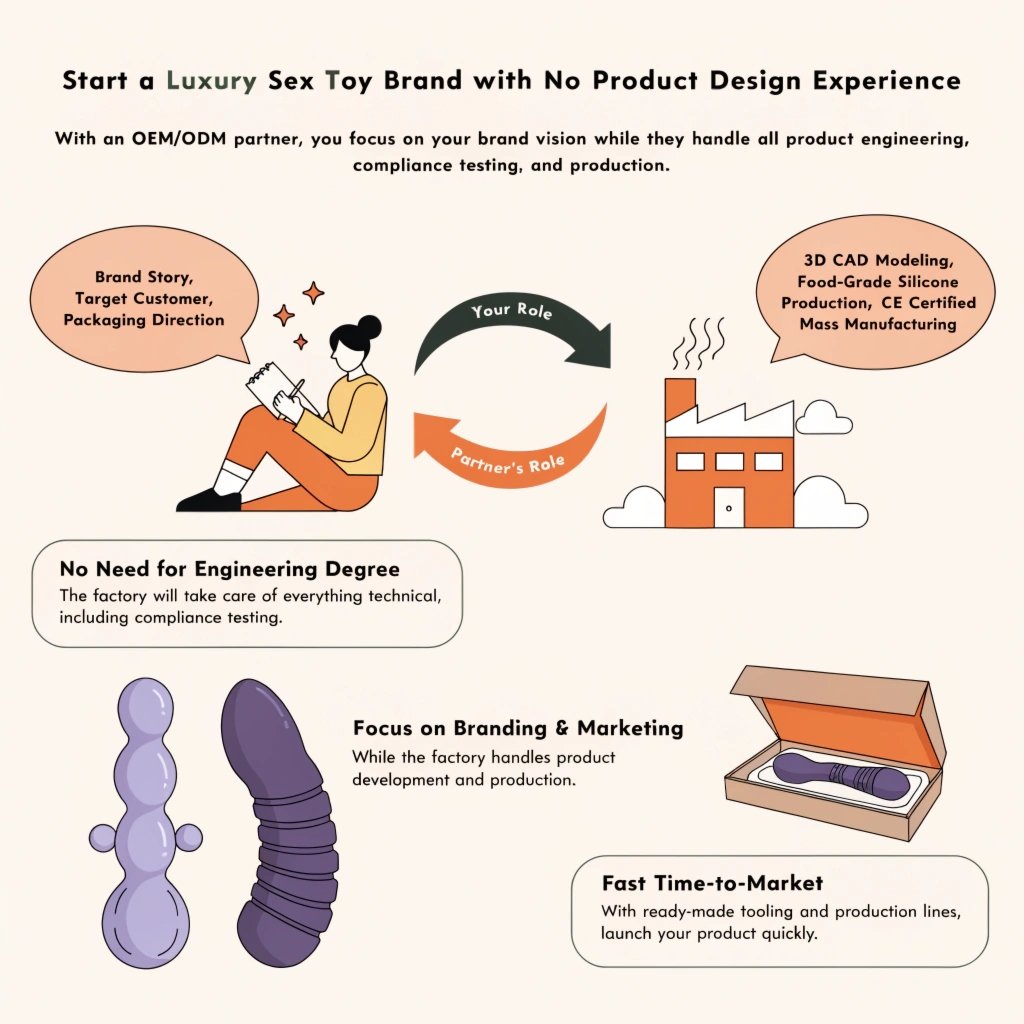
You can build a luxury sex toy brand without design experience by using an OEM or ODM manufacturing partner who handles all product engineering, compliance testing, and production. Your role is to define the brand story, target customer, and packaging direction. The factory does the rest — from 3D CAD modeling to food-grade silicone production to CE-certified mass manufacturing.1
I'm Sally. I've been running VF Pleasure — a direct adult toy factory in Dongguan, China — for over 15 years. In that time, I've helped brand builders with backgrounds in marketing, retail, wellness, and e-commerce build sexual wellness lines that compete in the premium market. Most of them came to me with a brand idea and no product development experience at all.
What they all had in common was this: they thought the gap between "brand concept" and "physical luxury product" was something only designers and engineers could cross. It is not. The right OEM adult toys manufacturer is the bridge. And this guide explains exactly how to cross it.
From choosing the right manufacturing model to understanding which materials signal luxury to building packaging that earns a premium price — I'll walk you through every decision, in order.
- 1 Why Can You Launch a Luxury Sex Toy Brand Without Design Experience?
- 2 What Does OEM vs ODM Mean for a First-Time Luxury Brand Builder?
- 3 How Does a Factory Transform Your Concept Into a Finished Luxury Product?
- 4 What Materials and Certifications Define a Luxury Sex Toy Brand?
- 5 How Does Private Label Packaging Build a Luxury Brand Perception?
- 6 What Real Production Problems Could Damage Your Luxury Brand — and How Does a Factory Prevent Them?
- 7 Conclusion
- 8 References & Source Notes
Why Can You Launch a Luxury Sex Toy Brand Without Design Experience?
Most people assume that making a product requires knowing how to design one. That assumption stops hundreds of potential brand builders from ever starting. The adult wellness market is growing fast — and the brands winning in it are not always the ones with the deepest engineering teams.
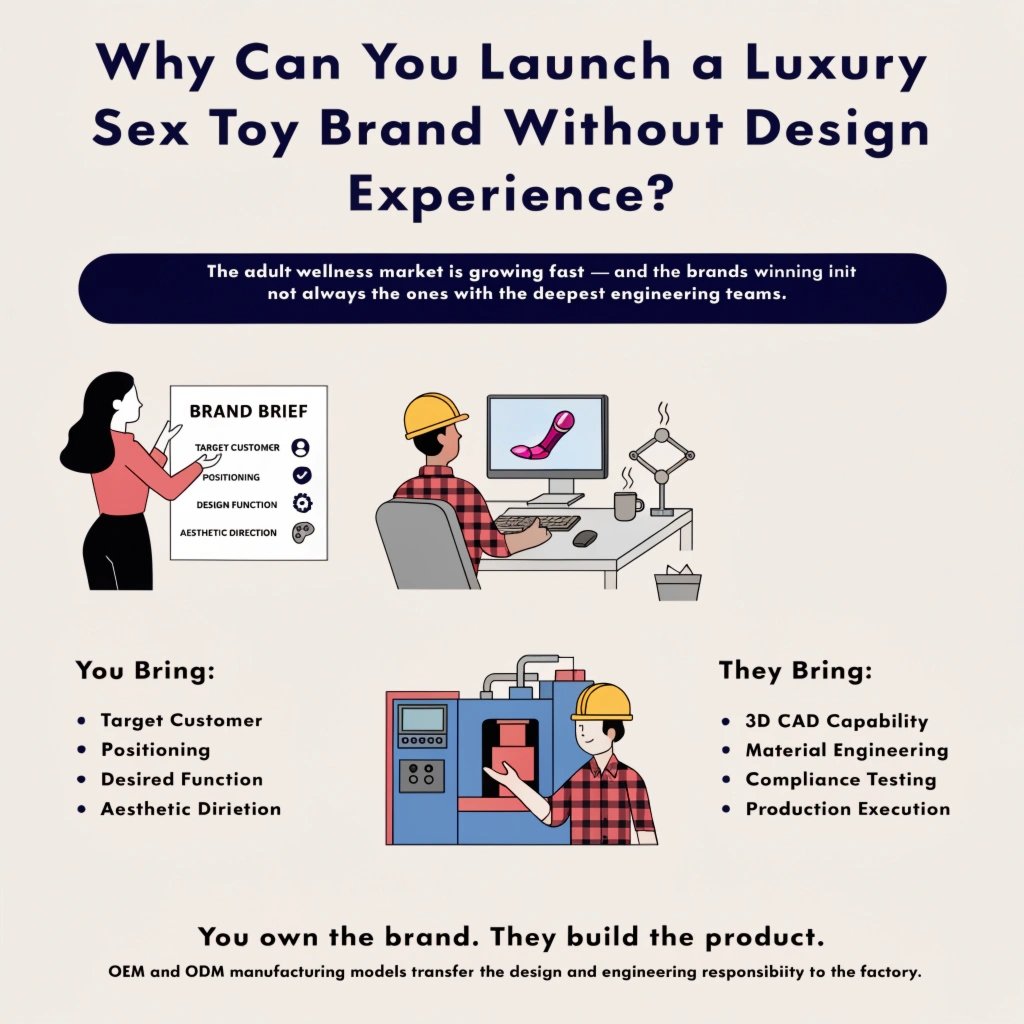
You can launch a luxury sex toy brand without design experience because OEM and ODM manufacturing models transfer the design and engineering responsibility to the factory. You bring the brand brief — target customer, positioning, desired function, and aesthetic direction. The factory brings 3D CAD capability, material engineering, compliance testing, and production execution. You own the brand. They build the product.1
This is not a shortcut. It is how most premium adult novelty brands in the US, EU, and Australian markets actually operate — and it is the same model used across consumer electronics, skincare, and personal care.
🏭 The Factory Is Your Design Team
When you brief a capable custom sex toys factory, you are not outsourcing the boring parts and keeping the creative parts. You are working with a team of engineers, product designers, and material specialists who have built hundreds of products before yours. They know what vibration frequency feels right at different silicone densities. They know which motor profiles create quiet operation under 45dB. They know which sealing architectures hold up to real IPX7 submersion testing.
You do not need to know any of those things. You need to know your customer.
🎯 What You Bring vs. What the Factory Brings
| Your Contribution | Factory Contribution |
|---|---|
| Brand name and positioning | 3D CAD product design |
| Target customer profile | Motor and mechanism engineering |
| Desired function and sensation | Food-grade silicone material sourcing |
| Aesthetic direction (color, finish, shape preference) | Compliance testing (CE, RoHS, REACH) |
| Packaging vision | Cleanroom production and QC |
| Market and price tier | Tooling, mold, and assembly |
The sexual wellness and intimate wellness markets have grown because consumers now treat self-care products with the same purchase standards they apply to skincare — materials matter, brand story matters, packaging matters. None of those things require you to know how to build a motor. Our start adult toy business guide and wellness and sex toy convergence guide explain the market context behind this shift in detail.
💡 Why Design Experience Is Not the Barrier
The real barriers to launching a luxury adult novelty brand are: finding a factory with genuine OEM engineering capability, choosing materials that support your premium brand claims, and building packaging that converts at a premium price. All three are learnable decisions — not design skills. The rest of this guide covers each one in detail.
What Does OEM vs ODM Mean for a First-Time Luxury Brand Builder?
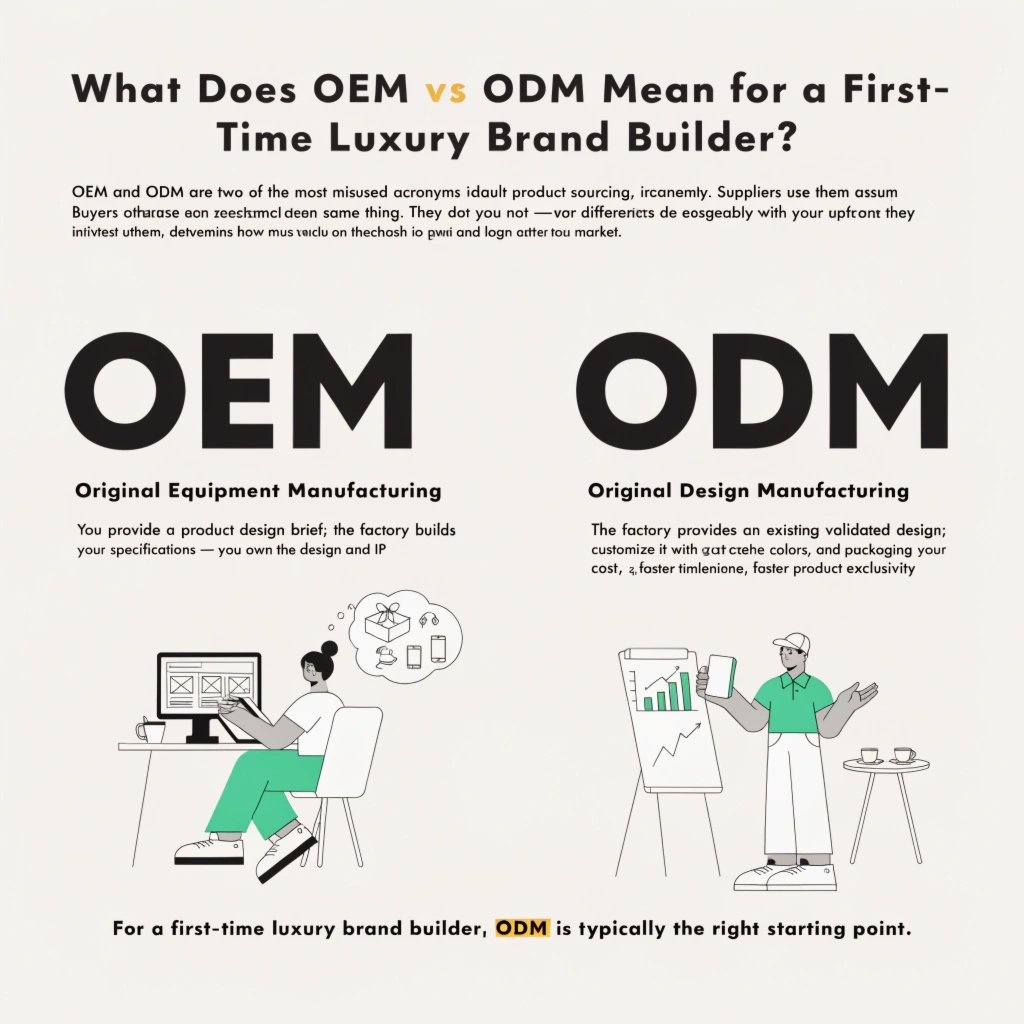
OEM and ODM are two of the most misused acronyms in adult product sourcing. Suppliers use them interchangeably. Buyers often assume they mean the same thing. They do not — and the difference between them determines how much you invest upfront, how exclusive your product is, and how fast you can get to market.
OEM (Original Equipment Manufacturing) means you provide the product design brief and the factory builds to your specification — you own the design and the IP. ODM (Original Design Manufacturing) means the factory provides an existing validated design that you customize with your brand's colors, logo, and packaging — lower upfront cost, faster timeline, less product exclusivity. For a first-time luxury brand builder, ODM is typically the right starting point.2
Here is how to think about which model fits where you are right now.
🟡 Start with ODM — Then Graduate to OEM
If you are launching your first luxury adult novelty line, ODM is almost always the smarter entry point. Here is why:
An ODM product comes with an existing design that the factory has already validated — vibration performance tested, waterproof rating confirmed, material compliance documented. You are not engineering a product from zero. You are selecting a proven product and dressing it in your brand's identity. Turnaround from brief to sample is typically one to three weeks rather than four to eight weeks for a new OEM tooling build.
The tradeoff is exclusivity. An ODM base design may be available to other buyers. But here is the reality for a first-time brand: the base product is rarely what differentiates you in the market anyway. The brand story, the packaging, the positioning, and the customer experience are what differentiates a luxury brand. And all of those belong to you completely — regardless of the manufacturing model.
🟢 Move to OEM When Your Market Validates You
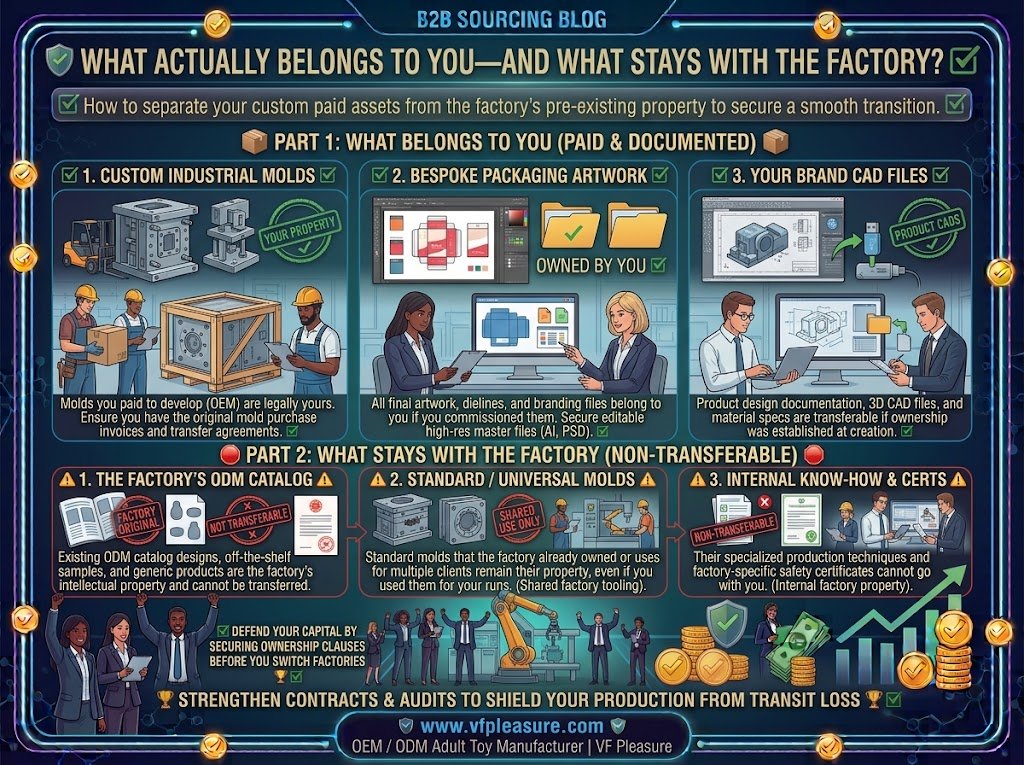
Once your ODM launch has validated that your target customer responds to your brand and your positioning, OEM gives you the next level of differentiation. You invest in custom tooling — a product shape, texture, or feature set that exists nowhere else. Your custom vibrators design becomes your brand's IP. Competitors cannot replicate it.
This graduated approach — ODM to launch, OEM to differentiate — is how most successful private label sex toys brands are actually built. It protects your capital during market validation and deploys it at the stage where differentiation matters most.
📊 OEM vs ODM: Decision Framework for Luxury Brand Builders
| Factor | ODM | OEM |
|---|---|---|
| Upfront investment | Low — no tooling cost | Higher — mold investment required |
| Time to first sample | 1–3 weeks | 4–8 weeks |
| Product exclusivity | Partial | Full — your mold, your IP |
| Design experience needed | None — existing design | Low — brief-based, factory executes |
| Compliance documentation | Often pre-existing | Built for your specific product |
| Best for | First launch, market validation | Established brand, differentiation stage |
Our OEM vs ODM adult toys manufacturing model guide, custom adult toy manufacturing OEM vs ODM guide, and how OEM and ODM services work in the adult toy industry guide go deeper on structuring both types of agreements — including IP protection clauses, exclusivity terms, and how to manage the OEM to ODM transition as your brand scales.
How Does a Factory Transform Your Concept Into a Finished Luxury Product?
One of the most common fears I hear from first-time luxury brand builders is this: "I can describe what I want, but I can't draw it or spec it — will a factory be able to work with that?" The answer, with the right factory, is yes. But you need to understand the process well enough to participate in it effectively at each stage.
A factory transforms a brand concept into a finished luxury product through five stages: creative brief and 3D CAD design development, physical prototype production and review, compliance sample testing and approval, pre-production run validation, and mass production with per-batch QC inspection. At every stage, your role is to review and approve — not to design or engineer. The factory does the technical work.3
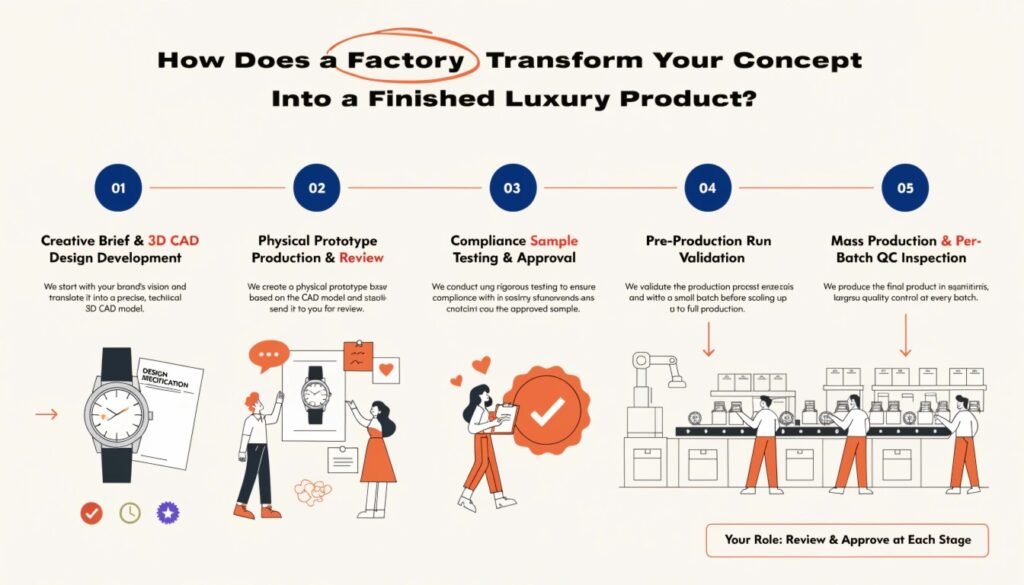
Here is what each stage looks like from your side of the relationship — and what to pay attention to at each one.
📐 Stage 1 — The Creative Brief: Your Most Important Contribution
This is the stage where your input matters most. A creative brief for a luxury adult novelty product does not need technical drawings. It needs clarity on five things:
- Who is your customer? (e.g., women 30–50 in the sexual wellness self-care space)
- What function does the product serve? (e.g., clitoral stimulation with multiple intensity modes)
- What does the product feel like in the hand? (e.g., smooth, weighted, premium — not toy-like)
- What is the brand aesthetic? (e.g., clean, minimal, inspired by skincare and body massager design)
- What is the price tier? (e.g., $85–120 retail in the EU and US market)
From this brief, a real adult toys custom factory with in-house design capability will build a 3D CAD model that captures your brief in a reviewable digital form. You approve or request revisions. No design software required on your end. Our how to create custom sex toys guide walks through exactly how to write a brief that gets you the right first-pass design.
🧪 Stage 2 — Prototype Review: Your First Physical Contact
Once your CAD model is approved, the factory produces a physical prototype. This is your first chance to hold the product. You review it for feel, dimensions, ergonomics, and surface finish. This is the right stage to identify anything that does not match your luxury positioning — surface texture that feels too plastic, proportions that feel wrong for the target customer's hand, or a weight profile that does not feel premium.
Request revisions. This is normal. Most luxury products go through two to three prototype iterations before sample approval. Budget for this cycle — it is not a problem, it is the process.
🔌 Stage 3 — Sample Approval with Compliance Testing
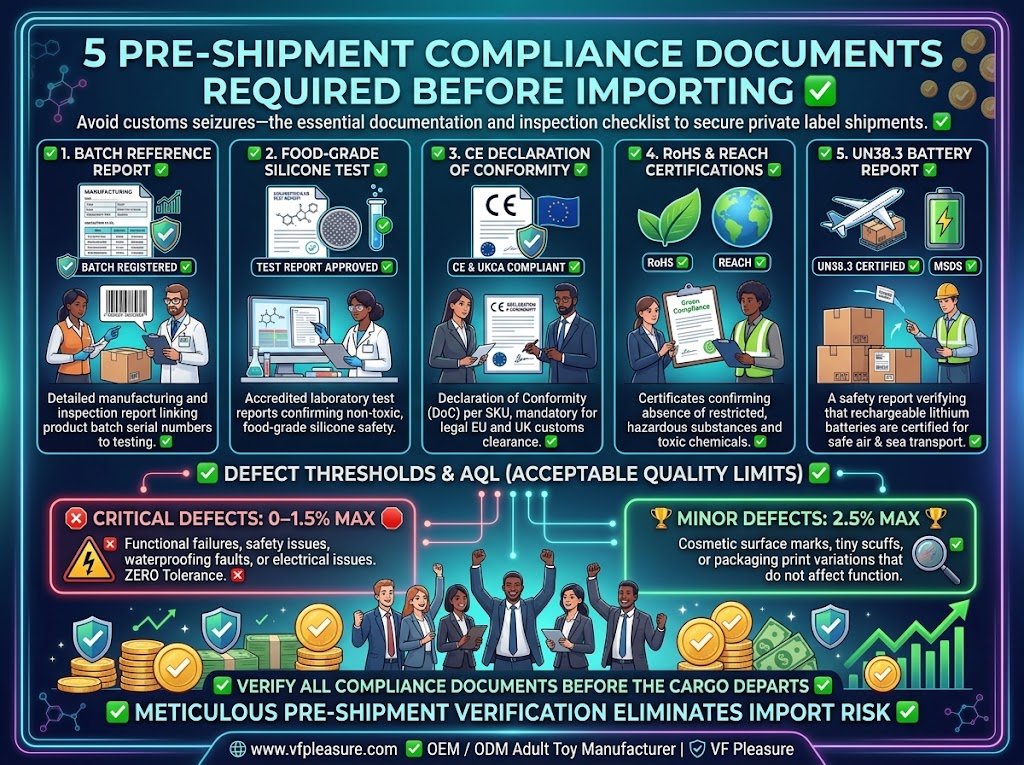
Formal samples — typically three to five units — go through compliance testing at this stage. For a luxury sexual wellness brand, the minimum compliance set includes: IPX7 waterproof rating validation, vibration performance testing, electrical safety testing (CE, RoHS), and food-grade silicone migration testing (REACH). You receive the test reports before you approve production.
Never skip this step. Our sex toy manufacturing process guide explains what a complete compliance package looks like for EU and US market entry.
🚚 Stages 4 and 5 — Pre-Production and Mass Production
A small pre-production run validates that the manufacturing process is consistent with your approved sample. Then mass production begins — with per-batch QC inspection. You receive a QC report with every delivery. Our crafting high-quality adult toys guide documents what a real production QC process looks like behind the cleanroom walls.
What Materials and Certifications Define a Luxury Sex Toy Brand?
Luxury in the adult novelty space is not just about packaging or price. It is increasingly about what the product is made of — and whether the brand can prove it. The sexual wellness and self-care consumer researches materials the same way they research skincare ingredients. If your product cannot answer "what is this made of, and can you prove it?" — it is not a luxury product. It is a premium-priced commodity.
Luxury sex toy brands are defined by three material and certification standards: food-grade platinum silicone (verified by third-party migration test reports, not just certificate images), CE and RoHS compliance with verifiable lab-issued documentation, and IPX7 waterproof rating validated under real-use simulation. These three standards are the minimum verifiable luxury material claim set for EU and US market positioning.4
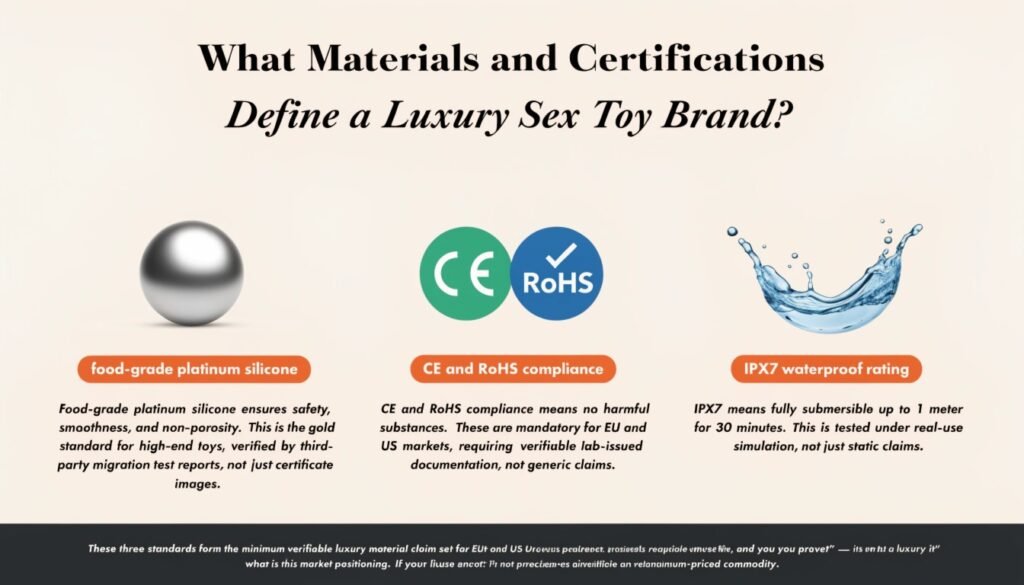
Here is what each standard means in practice — and how to confirm that your manufacturing partner actually meets it.
🧬 Food-Grade Platinum Silicone: The Non-Negotiable Foundation
Food-grade platinum silicone is the material standard that separates a luxury intimate wellness product from a commodity adult toy. It is:
- Non-porous — does not harbor bacteria, unlike PVC or rubber alternatives
- Phthalate-free — no endocrine-disrupting plasticizers
- Hypoallergenic — suitable for sensitive skin and body-contact applications
- Thermally stable — does not degrade or off-gas under normal use conditions
The key word here is platinum. There are two types of food-grade silicone used in adult product manufacturing: platinum-cured and peroxide-cured. Platinum-cured silicone is purer, more stable, and the material of choice for any brand making a genuine body-safe claim. If a factory says "food-grade silicone" without specifying platinum, ask.
Proof matters more than the claim. Request a third-party migration test report — not a certificate image that could be a template. A real migration test report names the testing laboratory, references a specific batch or sample ID, and shows the measured migration levels of key compounds against the applicable regulatory threshold. Our body-safe materials guide, body-safe adult toys manufacturing standards guide, and choose silicone sex toy manufacturer guide all explain how to read and verify these documents.
At VF Pleasure, food-grade platinum silicone is our standard for all body-contact surfaces — not an upgrade option. Every product leaves our 100,000-grade cleanroom with compliance documentation ready for EU and US retail entry.
🏅 CE and RoHS: Your Market Access Passport
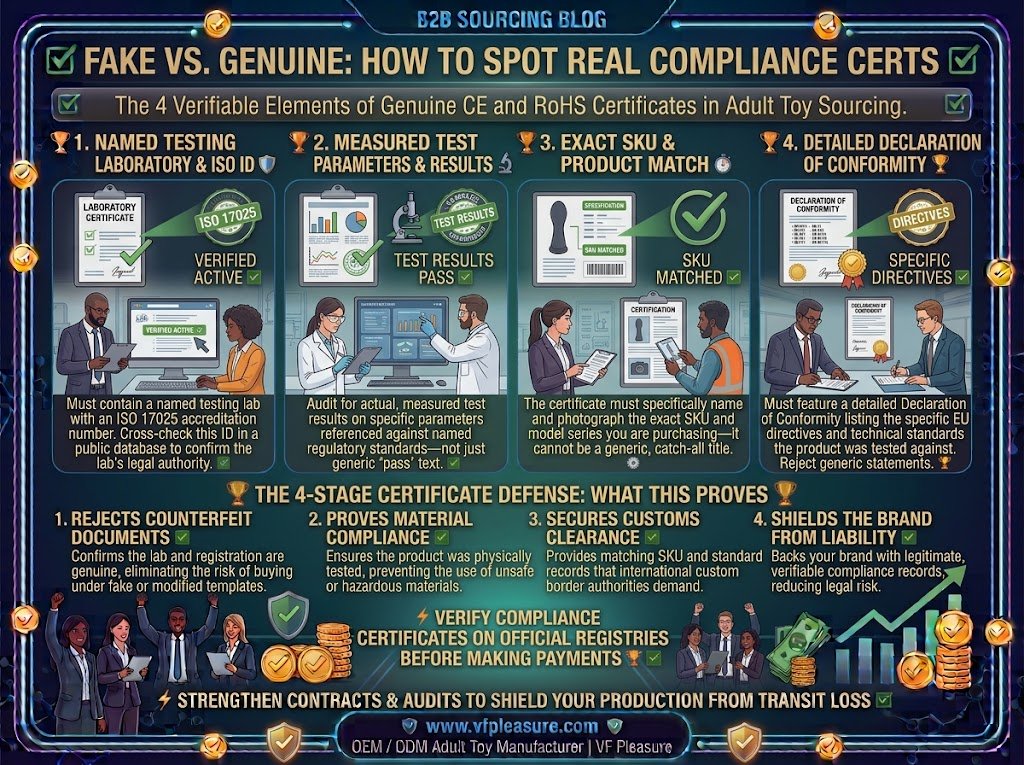
For EU market entry, CE certification is not optional — it is the legal requirement for any electronic product placed on the EU market. RoHS compliance confirms that the electronics inside your product meet hazardous substance restrictions. Both certifications need to be supported by full technical documentation — not just a CE mark on the product.
Ask any factory candidate for the Declaration of Conformity, the technical file reference, and the name of the testing laboratory. Then verify the lab. EU-recognized notified bodies appear in the NANDO database. If the lab name on your certificate does not appear there, the certificate needs deeper scrutiny.
💧 IPX7 Waterproof Rating: Luxury That Performs Under Pressure
A waterproof claim is a promise to your customer. When that promise breaks — when someone's luxury vibrator fails in the shower and leaves a one-star review about it — it takes your brand's premium positioning with it. IPX7 means the product is rated for submersion in one meter of water for 30 minutes.
What makes IPX7 credible is how the test was conducted. At VF Pleasure, we validate waterproof claims under real-use simulation conditions — the product goes through insertion cycles before the submersion test, because that is the condition it will face in actual use. A product that passes only a static submersion test may not survive the dynamic stresses of real use. Our adult toy quality compliance guide explains the difference between validated and unvalidated waterproof claims.
How Does Private Label Packaging Build a Luxury Brand Perception?
You can put a luxury-grade product in the wrong packaging and no one will know it is luxury. The reverse is also true — and it is how most premium brands build their first pricing power. Your packaging is the brand. It is what your customer sees, holds, and photographs before they have ever used the product.
Private label packaging builds luxury brand perception through five design elements: a matte or soft-touch outer box finish (signals quality without stating it), an embossed or foil-stamped brand logo (signals permanence and investment), a satin or foam product cradle inside the box (signals that the product is precious and worth protecting), a brand story insert card (signals intimacy and intentionality), and outer packaging with no visible product description (signals discretion and respect for the customer).5
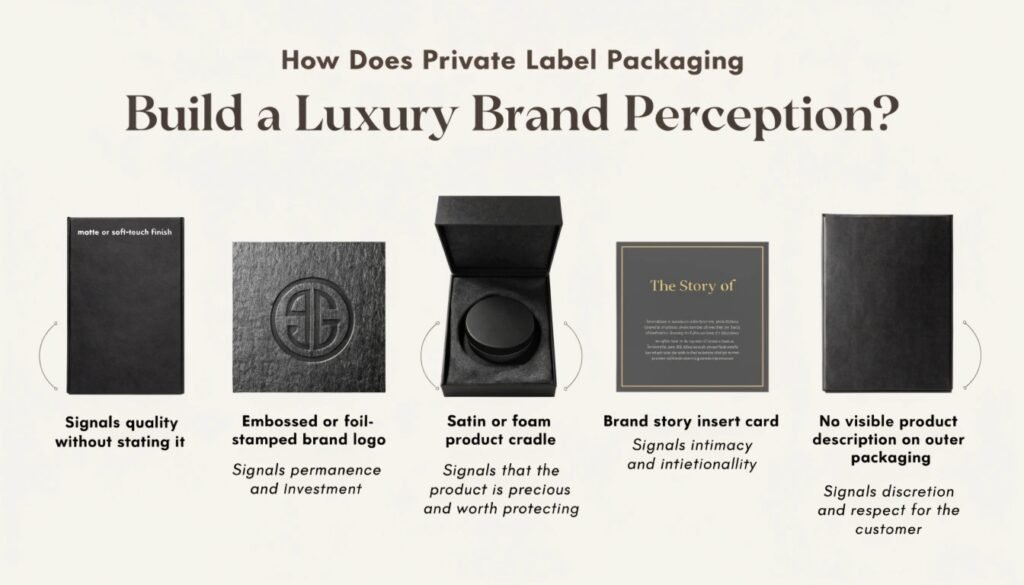
This is the piece of the brand-building puzzle that most first-time luxury brand builders underestimate — and the one that delivers the highest ROI per dollar invested.
📦 The ROI Calculation on Premium Packaging
Let me give you the actual numbers. A standard blister-pack presentation for an adult novelty product adds roughly $0.50–1.00 per unit in packaging cost. That product may retail at $35–45 in a mass market channel.
A premium matte magnetic closure box with satin insert, embossed logo, and a printed brand story card adds $3–6 per unit in packaging cost. That same product — identical manufacturing specification — may retail at $75–120 in a sexual wellness positioning channel.
The packaging investment is $2–5 additional per unit. The retail price support is $30–75 additional per unit. That is a 600–1,500% return on the packaging investment — before you account for the reduced price-sensitivity and higher conversion rate that premium packaging generates.
🏷️ The Three Private Label Positioning Models for Luxury
Model 1 — Clean Sexual Wellness
Design language: clinical-adjacent minimalism, monochrome palette, clean sans-serif typography. Copy: body-safe materials, self-care ritual, intimate wellness benefits. Retail tier: $75–120. Customer: women 30–55 who also buy premium skincare and pelvic health devices.
Model 2 — Bold Pleasure-First Luxury
Design language: confident colors, tactile packaging, unapologetic product photography. Copy: sensation engineering, technology features, user experience. Retail tier: $65–95. Customer: younger adults who engage openly with sexual wellness as lifestyle.
Model 3 — Couples Intimacy Premium
Design language: warm tones, dual-sided packaging that suggests partnership, gifting-ready presentation. Copy: connection, shared experience, relationship investment. Retail tier: $85–130. Customer: couples in long-term relationships investing in intimate wellness together.
Our private label sex toys business guide, white label sex toys business guide, private label adult products development process guide, and 5 tips for affordable private label guide cover the full packaging development process — including how to brief a packaging designer, what materials to specify, and how to review packaging proofs before bulk production.
💡 Sally's packaging rule: Spend at least 25% of your per-unit packaging budget on the outer box. That is what the customer sees first, photographs for social media, and judges your brand by. Everything else — inserts, cards, tissue — supports the box's first impression.
What Real Production Problems Could Damage Your Luxury Brand — and How Does a Factory Prevent Them?
Luxury brands live and die on consistency. One bad batch — a product that fails its waterproof claim, a motor that degrades faster than expected, a charging connection that drops after three weeks of use — generates reviews that no amount of brand story can overcome. The question is not whether production problems can happen. They can. The question is whether your manufacturing partner has the engineering discipline to catch them before your customer does.
The production problems most likely to damage a luxury adult novelty brand are: waterproof seal failures under real-use conditions, motor performance degradation from poorly validated component substitutions, charging reliability failures from structural design flaws, surface compliance failures from material change without re-testing, and documentation misalignments that create QA inspection delays. All five are solvable at the factory level — if the factory has the engineering capability to identify and fix them before shipment.6
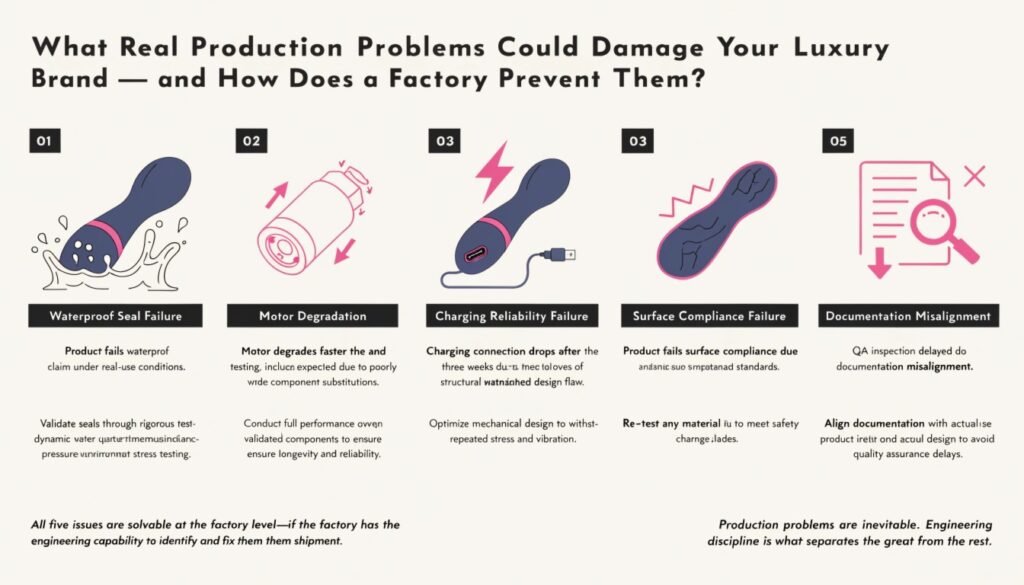
At VF Pleasure, we document the engineering challenges we solve for our partners. Here are five real cases — the kind of evidence you should ask any luxury manufacturing candidate to match before you sign anything.
🧪 Case 01 — Waterproof Failure Under Updated Real-Use Testing
One of our partners updated their IPX7 validation protocol to include pre-use simulation — the product went through insertion cycles before submersion testing. The existing product, designed for the original standard, failed.
Instead of suggesting a waterproof rating downgrade — which would have required a complete product relisting and damaged the brand's core body-safe claim — we analyzed the sealing structure, redesigned the internal waterproof architecture, optimized the assembly sequence for sealing consistency, and ran repeated internal tests before resubmitting for validation.
The product passed the updated standard. No external redesign. No shipment delay. No brand damage.6
💡 Why this matters for luxury brands: A waterproof failure in your customer's shower is not a product support issue. It is a brand reputation event. Solving it at the factory level — before it reaches your customer — is worth every hour of engineering time it takes.
⚙️ Case 02 — Motor Substitution Under Supply Chain Cost Pressure
A key motor component increased significantly in cost due to supply chain disruption. The product could no longer be built at the agreed price with the original motor.
Rather than swapping to the nearest available component without validation, we benchmarked multiple motor alternatives against the original's vibration strength, noise level, and operational stability profile. We selected the replacement that maintained performance consistency within the partner's premium brand positioning. The product arrived at retail with no detectable performance change. The brand's luxury positioning was protected.6
💡 Why this matters for luxury brands: "The new one isn't as strong as my last one" is one of the most brand-damaging review patterns in the premium adult novelty space. Solving this at the component selection stage prevents the review before it is written.
🔌 Case 03 — Charging Reliability from a DC Pin Contact Design Flaw
Post-production customer feedback flagged intermittent charging failures across a product batch. We traced the issue to DC pin contact geometry — specifically how pin length interacted with the silicone body's natural flexibility under repeated use.
We redesigned the pin structure, validated the new design under simulated use conditions, and confirmed long-term durability. The fix was a structural engineering solution — not a replacement warranty program that would have cost far more in returns and customer service than the engineering fix itself.6
🎨 Case 04 — Color Fastness Compliance Update Without Production Disruption
New QA standards required higher color fastness performance on silicone and ABS surfaces. Some existing SKUs in the partner's range failed the updated criteria under the new testing protocol. We replaced specific surface treatments with compliant alternatives, validated internally, and resubmitted — protecting the full product range without large-scale production rejection, schedule delay, or retail delisting.6
🔄 Case 05 — Batch Code and Inspection Timeline Misalignment
An adjusted delivery schedule created a mismatch between batch codes and inspection dates, with packaging already printed and completed. Instead of passing the documentation problem to the client as an unresolvable delay, we documented the full production and inspection timeline, communicated proactively, and provided written QA documentation for the inspector.
Accepted without rework. Delivery maintained on schedule. Brand relationship intact.6
🧠 What These Five Cases Mean for Your Luxury Brand
| Engineering Problem | Luxury Brand Risk if Unsolved | VF Pleasure's Solution |
|---|---|---|
| Waterproof seal failure | One-star reviews, returns, delisting | Internal structural redesign |
| Motor performance downgrade | "Not as powerful" review damage | Component benchmarking before substitution |
| Charging failures | After-sales cost, brand distrust | DC pin structural engineering fix |
| Color fastness non-compliance | Platform rejection, compliance penalty | Proactive treatment replacement |
| Batch code misalignment | Shipment delay, QA failure | Transparent documentation |
Ask every factory you consider this question: "Can you show me a production problem you solved for a client — in writing, with the outcome documented?" A real engineering partner has answers. A production house that only cares about its own schedule changes the subject. Our adult toy manufacturing challenges and solutions guide and ready to manufacture luxury vibrators massagers guide are good reference points for what this kind of documented partnership looks like in practice.
Conclusion
You do not need design experience to build a luxury sex toy brand — you need the right OEM factory, the right materials, and packaging that earns your premium price before your customer opens the box.
🚀 Ready to Build Your Luxury Adult Novelty Brand with VF Pleasure?
At VF Pleasure, we have spent 15 years building the OEM and ODM infrastructure that makes luxury adult novelty brands possible — for brand builders who come from marketing, retail, wellness, and e-commerce backgrounds, not just engineering ones.
Our Dongguan facility supports luxury brand development with:
- ✅ In-house 3D CAD design team — brief us in plain language, we build the technical files
- ✅ Food-grade platinum silicone across all female sex toys, vibrators, and body massager lines
- ✅ CE, RoHS, REACH compliance with real third-party test reports — not certificate templates
- ✅ 100,000-grade cleanroom production — inspectable by live video call or in-person visit
- ✅ Full private label sex toys program — custom packaging, embossed logos, satin inserts, brand story cards
- ✅ Low MOQ test orders from 50–200 units — test the market before you scale
- ✅ ODM to OEM pathway — start fast with existing validated designs, graduate to exclusive tooling when your market is ready
📬 Tell Us Three Things to Get Your Luxury Brand Started:
1. What is your luxury brand concept?
(e.g., clean sexual wellness for women 35+ / premium couples intimacy / self-care body massager line)2. Do you want to start with ODM (factory existing design, your brand) or OEM (custom design brief, your IP)?
(e.g., I want to launch fast with an existing product / I want a custom design from my brief)3. What is your target retail price and market?
(e.g., $85–120 in the US sexual wellness market / $65–95 in EU e-commerce)
References & Source Notes
-
OEM ODM Luxury Vibrators Massagers — VF Pleasure
| Field | Detail |
|---|---|
| 📌 Supports | You can build a luxury sex toy brand without design experience by using OEM or ODM manufacturing partners who handle all product engineering, compliance testing, and production execution from a brand brief. |
| 🔍 Evidence Role | Definition |
| 📁 Source Type | Industry Guide |
⚠️ Scope Note: The OEM/ODM framework described reflects VF Pleasure's 15+ years of manufacturing experience with B2B brand clients across multiple markets. The division of responsibilities between brand and factory varies between manufacturers and by project complexity. Buyers should confirm specific capabilities and deliverables directly with any factory they consider before signing a manufacturing agreement.
-
OEM vs ODM Adult Toys Manufacturing Model — VF Pleasure
| Field | Detail |
|---|---|
| 📌 Supports | OEM gives full design ownership and product exclusivity; ODM provides faster market entry with lower upfront cost. ODM is typically the right starting point for first-time luxury brand builders, with a transition to OEM once market validation is achieved. |
| 🔍 Evidence Role | Definition |
| 📁 Source Type | Industry Guide |
⚠️ Scope Note: The ODM-first recommendation reflects VF Pleasure's practical experience advising first-time adult novelty brand builders. Individual circumstances — available capital, differentiation requirements, market timeline — may make OEM a better fit for some first-time brands. IP protection clauses and exclusivity arrangements vary between factories and contracts. Legal review is advisable for any OEM agreement involving custom tooling investment.
-
Custom Adult Toy Factory Process — VF Pleasure
| Field | Detail |
|---|---|
| 📌 Supports | A factory transforms a brand concept into a finished luxury product through five stages: creative brief and 3D CAD design, prototype production and review, compliance sample testing, pre-production run validation, and mass production with per-batch QC inspection. |
| 🔍 Evidence Role | Mechanism |
| 📁 Source Type | Industry Guide |
⚠️ Scope Note: The five-stage process reflects VF Pleasure's standard custom manufacturing workflow. Timelines, stage sequencing, and approval gate structure may vary between factories and by product complexity. Buyers should request a written project timeline with defined approval gates from any factory before committing to a custom manufacturing program.
-
Body-Safe Adult Toys Manufacturing Standards Guide — VF Pleasure
| Field | Detail |
|---|---|
| 📌 Supports | Luxury sex toy brands are defined by food-grade platinum silicone with third-party migration test reports, CE and RoHS compliance with verifiable lab documentation, and IPX7 waterproof rating validated under real-use simulation. |
| 🔍 Evidence Role | Definition |
| 📁 Source Type | Industry Guide |
⚠️ Scope Note: The material and certification standards described represent the minimum verifiable luxury claim set for EU and US market positioning based on VF Pleasure's experience. Specific regulatory requirements vary by destination market, product category, and channel. Buyers should confirm current compliance requirements for their specific target market before finalizing product specifications.
-
Private Label Adult Products Development Process — VF Pleasure
| Field | Detail |
|---|---|
| 📌 Supports | Private label packaging builds luxury brand perception through five design elements: matte or soft-touch outer finish, embossed or foil-stamped brand logo, satin or foam product cradle, brand story insert card, and outer packaging with no visible product description. |
| 🔍 Evidence Role | General Support |
| 📁 Source Type | Industry Guide |
⚠️ Scope Note: ROI estimates on premium packaging are based on VF Pleasure's observations across private label projects and general adult novelty wholesale market pricing patterns. Actual ROI depends on the quality of packaging execution, brand story strength, retail channel, and competitive pricing context. These estimates are directional guidance — not guaranteed outcomes for any specific brand.
-
Adult Toy Manufacturing Challenges and Solutions — VF Pleasure
| Field | Detail |
|---|---|
| 📌 Supports | The five production problems most likely to damage a luxury adult novelty brand — waterproof seal failure, motor substitution without validation, charging design flaws, color fastness non-compliance, and documentation misalignment — are all solvable at factory engineering level before they reach the customer. |
| 🔍 Evidence Role | Case Reference |
| 📁 Source Type | Industry Guide |
⚠️ Scope Note: All five case studies are drawn from real anonymized production projects at VF Pleasure. They illustrate the factory's engineering approach and problem-solving discipline. Engineering outcomes depend on the specific failure mode, product construction, and QA standard involved. These cases represent VF Pleasure's capabilities — not a guarantee that all equivalent problems will be resolved identically in every production context.